
Emergency Communication Planning NZ: A Strategic Guide for Business Resilience
What would happen to your operations if the cellular network your team relies on suddenly vanished during a severe weather event? For many New Zealand businesses, this isn't a hypothetical scenario but a documented risk,…
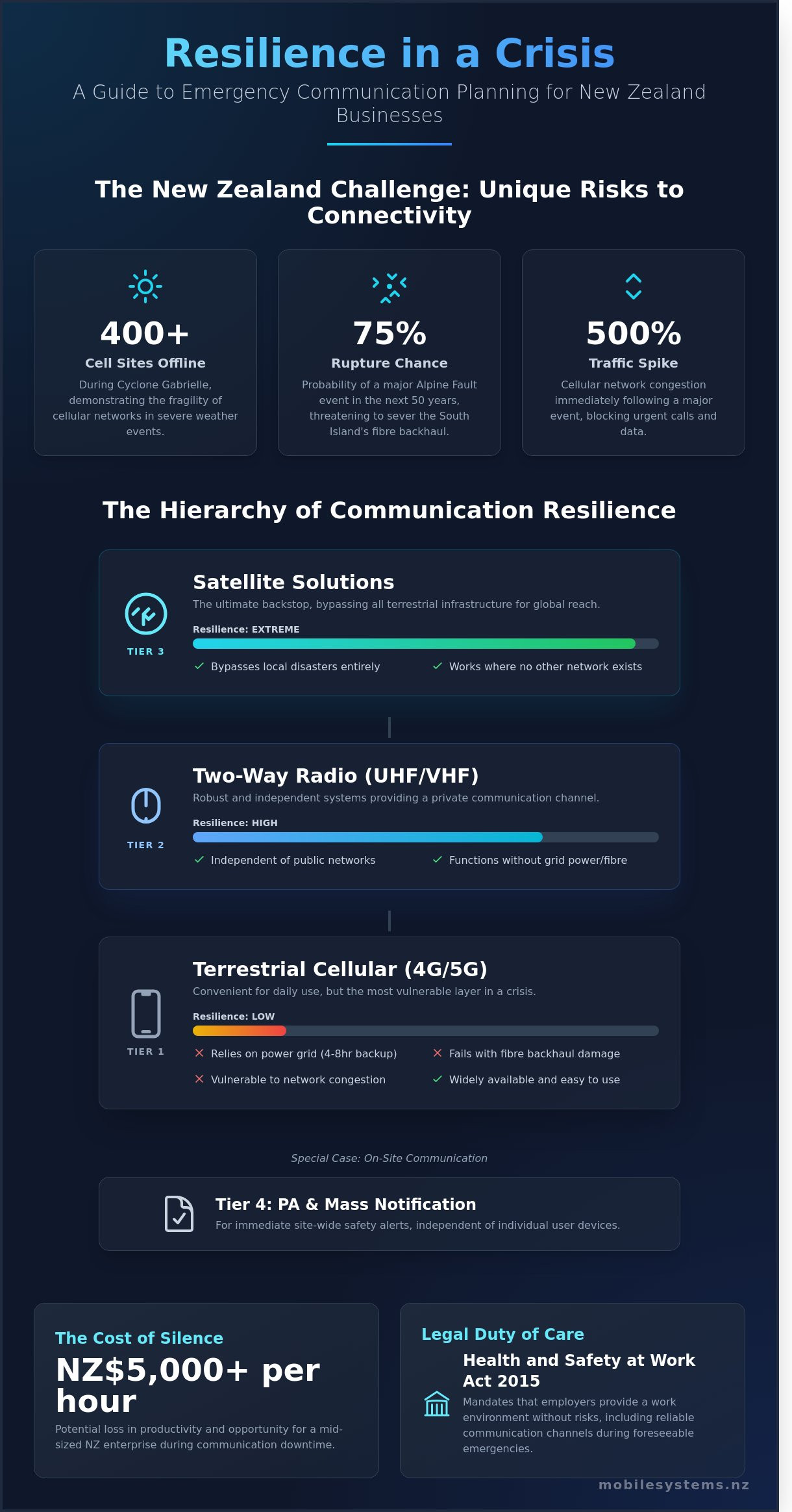
What would happen to your operations if the cellular network your team relies on suddenly vanished during a severe weather event? For many New Zealand businesses, this isn't a hypothetical scenario but a documented risk, as seen during Cyclone Gabrielle when over 400 cell sites went offline simultaneously. Effective emergency communication planning NZ is the difference between total isolation and maintaining a critical link to your remote workers.
You likely already understand that relying solely on a mobile phone in rural or mountainous terrain is a gamble with staff safety. We'll show you how to build a fail-safe communication strategy tailored for New Zealand conditions, ensuring your team stays connected when traditional infrastructure fails. You'll learn to navigate technical radio frequencies and select the right hardware to protect your people.
This guide provides a clear hierarchy of communication tools, from digital mobile radio to satellite messaging, to ensure full compliance with the Health and Safety at Work Act 2015. We'll explain exactly how to bridge the gap between geographic isolation and operational resilience through practical, field-tested solutions.
Key Takeaways
- Understand why New Zealand’s unique geography and weather patterns make robust emergency communication planning NZ essential for operational continuity during infrastructure failure.
- Discover the hierarchy of communication technologies and why independent two-way radio systems provide a more resilient fallback than standard cellular networks.
- Learn how to implement the PACE framework to ensure your team remains connected through every stage of a crisis using primary and alternate channels.
- Identify the specific hardware requirements, such as high-gain antennas, needed to maintain reliable signal strength across New Zealand's challenging and hilly terrain.
- Avoid common DIY pitfalls by learning the importance of professional frequency licensing and rigorous system testing for high-stakes business environments.
The Critical Need for Emergency Communication Planning in NZ
Emergency communication planning NZ is a strategic framework designed to maintain voice and data transmission when standard infrastructure collapses. It's not just a backup plan; it's the architecture that keeps a business operational when the grid fails. This planning ensures that decision-makers can reach their teams even when the primary networks are offline.
Under the Health and Safety at Work Act 2015, New Zealand directors and managers have a primary duty of care. This includes providing a work environment that's without risks to health and safety. This legal obligation extends to maintaining reliable communication channels during foreseeable emergencies to ensure staff welfare and operational safety.
Many businesses rely solely on 4G and 5G networks, but these are often the first systems to fail. Most cellular towers have only 4 to 8 hours of battery backup. Once the power grid stays down or the fibre-optic backhaul is severed by a landslide, cellular devices become useless. Network congestion also plays a role; in the minutes following a major event, traffic often spikes by 500%, blocking even the most urgent calls.
New Zealand's Geographic and Environmental Risks
Our unique geology creates specific vulnerabilities for fibre-optic networks. The Alpine Fault has a 75% chance of a major rupture within the next 50 years. Such an event would likely sever the main fibre backhaul connecting the South Island to the rest of the country, isolating entire cities instantly.
Extreme weather events also prove how fragile our links are. During Cyclone Gabrielle in February 2023, large parts of Tairāwhiti and Hawke's Bay lost all digital contact for days. The "last mile" problem is particularly acute in rural areas, where remote sites often rely on a single, vulnerable power line or one fibre strand that's easily damaged by falling debris.
Defining Business Continuity vs. Personal Readiness
Professional resilience goes beyond the household "grab bag" approach. While a battery-powered radio is sufficient for a home, business continuity requires identifying "critical path" communications. You must know exactly how you'll coordinate logistics and manage staff safety when the internet is dark.
- Operational Coordination: Maintaining contact with mobile fleets and remote workers.
- Data Integrity: Ensuring critical telemetry and security systems remain active.
- Stakeholder Confidence: Providing updates to clients and authorities during a crisis.
The cost of silence is high. For a mid-sized New Zealand enterprise, communication downtime can exceed NZ$5,000 per hour in lost productivity and missed opportunities. A proactive assessment from Mobile Systems Limited helps identify these gaps before they become liabilities.
The Hierarchy of Emergency Communication Technologies
Effective emergency communication planning NZ requires a structured, tiered approach to redundancy. Relying on a single medium creates a single point of failure that can isolate a business during a crisis. A resilient strategy categorises technology based on its independence from public infrastructure and its reliability during environmental stress.
- Tier 1: Terrestrial Cellular. This is the most convenient but also the most vulnerable layer. During the 2023 North Island weather events, cellular networks failed across entire regions as power outages and damaged fibre backhaul took towers offline.
- Tier 2: Two-Way Radio (UHF/VHF). These systems are localized and robust. They operate independently of external networks, providing a private communication channel that works even when the national grid is compromised.
- Tier 3: Satellite Solutions. By bypassing terrestrial infrastructure entirely, satellite devices offer global reach. They are the ultimate backstop for remote operations where cellular coverage is non-existent or destroyed.
- Tier 4: Public Address (PA) and Mass Notification. These systems provide immediate site safety by broadcasting alerts to everyone on a physical premises simultaneously, requiring no individual user devices.
Why Professional Two-Way Radios Excel in Emergencies
Professional two-way radios offer total independence from the public switched telephone network (PSTN). When cellular towers are congested or offline, radio systems continue to function. They facilitate one-to-many communication; a single button press alerts your entire team instantly. This speed is critical during fire evacuations or chemical spills where every second matters.
Durability is another vital factor for New Zealand businesses. Most consumer devices fail in harsh outdoor conditions. Professional radios carry high Ingress Protection (IP) ratings to prevent failure. An IP67 rating ensures the device is dust-tight and can survive immersion in water for 30 minutes. This level of resilience ensures your hardware remains functional when conditions are at their worst.
Satellite Technology: The Ultimate NZ Backstop
Satellite technology is no longer a luxury. It's a necessity for business continuity in remote sectors. Choosing the right platform depends on your specific data needs. Iridium is the standard for voice-centric satellite phones, offering reliable coverage for forestry, marine, and tourism sectors in remote parts of the country. Starlink provides high-speed data, making it better suited for maintaining office internet and cloud access during a prolonged terrestrial outage.
In many rural locations, cellular boosters act as a vital bridge. They amplify weak signals in fringe areas, ensuring that mobile devices remain functional even when the nearest tower is several kilometres away. A tailored assessment of your site's topography often prevents costly mistakes in hardware selection. If you're unsure which tier fits your specific risk profile, reaching out for a professional site audit is a prudent first step.
Building Your PACE Communication Plan
A PACE plan is a military-derived framework that ensures your business stays connected when standard systems fail. In the context of emergency communication planning NZ, this strategy eliminates single points of failure by layering four distinct communication methods. It's the difference between total silence and maintaining operational control during a crisis.
- Primary: Your everyday method, typically cellular networks or VoIP platforms like Microsoft Teams. These are efficient but vulnerable to network congestion or tower damage.
- Alternate: Your first backup, such as two-way radio systems. These provide instant, site-wide communication without relying on public infrastructure.
- Contingency: A second backup, usually satellite phones. These are critical when terrestrial networks are completely severed, as occurred during the 2023 North Island weather events.
- Emergency: The final resort for life-safety. This includes Personal Locator Beacons (PLBs) for isolated workers or high-output PA systems for immediate site evacuation.
Step 1: Conduct a Communication Audit
You can't fix what you haven't measured. Start by identifying "dead zones" across your operational area. In New Zealand's varied topography, it's common for 20% to 30% of a rural or industrial site to have unreliable cellular reception. Use signal testing tools to map these gaps accurately.
Map out where your critical personnel are located during a typical shift. If your floor manager is in a basement or a reinforced concrete warehouse, their primary device might fail first. Assess the power redundancy of your hardware. A high-end radio system is only as good as the backup batteries powering the repeaters.
Step 2: Assigning Roles and Protocols
Clear leadership prevents chaos. You must designate a specific individual, and a deputy, who has the authority to initiate the emergency protocol. This person decides when the team shifts from "Primary" to "Alternate" communication methods to ensure no one is left talking into a dead phone.
Establish standardized radio etiquette. Use "clear speech" rather than complex codes that employees might forget under pressure. During an event, implement scheduled check-in times. For example, a "status green" check every 30 minutes ensures all staff are accounted for without clogging the airwaves with constant chatter.
A tailored assessment often prevents costly mistakes during a rollout. Ensuring your PACE plan aligns with local terrain and staff capabilities is the most effective way to build genuine business resilience.
Essential Hardware for NZ Business Resilience
Hardware is the physical foundation of your emergency communication planning NZ. Relying on consumer-grade mobile phones during a significant seismic event or severe cyclone often leads to total isolation. Professional radio hardware provides a dedicated network that remains operational when cellular towers fail or become congested.
Selecting the Right Handheld Devices
Digital Mobile Radio (DMR) is the current standard for modern NZ businesses. Digital units provide roughly 30% more range than analogue counterparts before audio quality degrades. This clarity is vital when relaying safety instructions in high-stress environments.
- Digital vs. Analogue: DMR offers superior noise cancellation and 25% better battery efficiency.
- Battery Life: Look for lithium-ion batteries rated for 18 to 24 hours of heavy use.
- Durability: Select units with an IP67 rating to ensure they survive the heavy rain common during NZ storm events.
When selecting handheld radios and walkie-talkies, prioritize models that support multi-channel configurations. This allows your first aid, security, and management teams to have dedicated talk groups without interference.
Fixed-Mount Systems for Base Stations and Vehicles
Vehicle-mounted systems are essential for fleets operating in remote regions or across large construction sites. A standard handheld radio typically emits 5 watts of power. In contrast, a fixed-mount unit delivers 25 watts or more. This power difference, combined with a roof-mounted antenna, can triple your effective communication radius.
Integrating GPS tracking into these units allows dispatchers to monitor staff locations in real-time, fulfilling critical requirements under the Health and Safety at Work Act 2015. For large industrial sites or timber yards, portable PA systems provide the necessary volume to reach everyone at muster points during high-noise emergencies.
Antennas and Power Solutions
The hilly terrain across New Zealand requires specific antenna configurations to maintain signal integrity. A 6dB high-gain antenna is excellent for flat coastal areas, but a 3dB antenna often performs better in steep, mountainous regions because it has a wider vertical radiation pattern. This prevents the signal from "shooting" into the side of a hill.
Your emergency communication planning NZ must also account for total grid failure. A resilient base station requires a 100Ah deep-cycle battery backup and a 150W solar array. This setup ensures your comms remain active for several days without external power. Simple battery backups often fail after 4 hours; a professional solar-integrated solution provides indefinite uptime during extended disasters.
A tailored hardware assessment often prevents costly mistakes when matching equipment to your specific topography.
Professional Implementation and Testing in New Zealand
DIY communication plans often fail during real-world stress because they lack technical redundancy. When a crisis occurs, 100% of your staff must know exactly how to operate the hardware without hesitation. Professional emergency communication planning NZ bridges the gap between having equipment and having a functional response.
Partnering with experts ensures your system is resilient, legal, and ready for immediate deployment. Mobile Systems Limited provides the technical oversight required to move beyond basic checklists into a truly robust business resilience strategy. We focus on clear protocols that don't collapse when cellular networks go dark.
Frequency Management and NZ Regulations
The Radio Spectrum Management (RSM) branch of MBIE regulates all radio frequencies in New Zealand. Using unapproved, low-cost imports can lead to significant interference with licensed users, including emergency services. Professional installers ensure your business stays compliant with the Radiocommunications Act 1989.
- Legal Compliance: We manage your licensing to prevent costly fines and equipment seizures from regulatory authorities.
- Interference Protection: Approved hardware is strictly filtered to operate only on your assigned frequency, preventing overlap with neighbours.
- Signal Integrity: Experts conduct terrain mapping to ensure coverage across your specific operational area, whether it's a multi-storey Auckland CBD office or a remote Waikato site.
Ongoing Support and Mobile Servicing
Technical failure often stems from neglected hardware. It's a fact that radio batteries lose roughly 20% of their capacity annually, and antenna connections can corrode quickly in New Zealand's salt-heavy coastal environments. Regular "Comms Drills" and annual health checks prevent these silent failures from surfacing during a disaster.
Mobile Systems Limited provides on-site technical assistance via specialized mobile support vehicles. This service ensures your fleet stays operational without the downtime or risk of shipping critical gear to a service centre. We bring the workshop to your location to test signal strength and hardware integrity in your real-world environment.
Scheduling quarterly drills reveals if staff can operate radios under pressure and identifies any "dead zones" caused by new construction. A tailored communication assessment often prevents costly mistakes and ensures your business remains resilient when it matters most.
Securing Your Business Future Through Resilient Communication
Building a robust strategy for emergency communication planning NZ ensures your team stays connected when cellular networks fail. Relying on a single channel is a significant risk for New Zealand enterprises. By implementing a PACE plan and utilizing high-tier hardware like Tait or Hytera digital radios, you mitigate the danger of total isolation during a seismic or weather event.
Mobile Systems Limited provides over 25 years of technical expertise to guide your implementation. We're specialist installers of Tait and Hytera systems with deep knowledge of NZ-specific radio spectrum management. Our nationwide mobile support ensures your equipment remains compliant and functional across every site in the country. It's not just about buying hardware; it's about professional integration that meets local safety standards.
A tailored assessment often prevents costly mistakes and ensures your investment is fit for purpose. Contact Mobile Systems today for an expert assessment of your emergency communication needs.
Taking these practical steps now gives your organization the confidence to face any challenge with a clear line of communication.
Frequently Asked Questions
What is the best communication device for remote areas in NZ?
Satellite phones using the Iridium network are the most reliable option for remote New Zealand terrain. While cellular networks cover only 20% of the country's landmass, Iridium provides 100% global coverage. For businesses, a dedicated satellite handset ensures your team stays connected in the Southern Alps or deep bush where terrestrial signals fail.
Do I need a license to use a two-way radio for my business in New Zealand?
Most commercial two-way radios require a specific frequency license issued by Radio Spectrum Management (RSM). While low-power PRS radios operate under a General User Radio Licence at no cost, business-grade systems need protected frequencies to avoid interference. Professional emergency communication planning NZ ensures your system remains compliant and clear of cross-talk during a crisis.
How long do satellite phone batteries last in an emergency?
A standard Iridium 9575 Extreme battery provides roughly 4 hours of talk time and 30 hours of standby. In cold conditions typical of NZ winters, battery performance can drop by 20% or more. It's vital to include solar chargers or spare batteries in your emergency kit to maintain communication beyond the first 24 hours of a power outage.
Can I rely on my mobile phone for emergency communication if I have a booster?
You can't rely on a mobile phone and booster if the local cell tower loses power or backhaul connectivity. Boosters only amplify an existing signal; they don't create one. During the 2023 North Island weather events, dozens of cell sites went offline, rendering boosters useless. Satellite or radio backups are essential for true business resilience.
What is the difference between UHF and VHF for emergency use in NZ?
VHF is superior for rural NZ because its longer waves bend over hills and travel further in open spaces. UHF is better for urban environments or inside large complexes as it penetrates concrete and steel more effectively. Most NZ businesses operating in mixed terrain find that a high-power VHF system provides the most consistent emergency coverage across long distances.
How often should we test our emergency communication equipment?
You should perform a basic radio check every 30 days and a full communication drill every 90 days. Testing ensures batteries are healthy and staff remember how to operate the equipment under pressure. Data shows that many emergency systems fail during a crisis simply because of flat batteries or neglected firmware updates that weren't caught during routine checks.
What happens to the 111 system during a major network outage?
The 111 system depends on the availability of at least one functioning mobile network provider. If a major disaster knocks out local towers or the core fibre backhaul, your mobile phone won't connect to emergency services. This is why the National Emergency Management Agency recommends businesses maintain alternative communication methods, such as satellite messengers or radio networks, to bridge the gap.
Is Starlink a reliable primary emergency communication tool for businesses?
Starlink is an excellent secondary data tool but shouldn't be your only emergency solution. It requires a constant 50 to 75 watt power supply and a clear view of the sky, making it vulnerable during power cuts or heavy storm debris. A handheld radio or satellite phone is more portable and reliable for the critical first 72 hours of an emergency response.
Related posts

- May 23, 2026
Need to go beyond 100m? Our guide to the ethernet cable extender explains types, distance limits, and NZ use cases...

- May 22, 2026
Can't fix a phone on site? Learn essential troubleshooting for NZ field teams, when to seek professional repair, and how...

- May 21, 2026
Master the Fire and Emergency NZ portal. Access login steps, essential features, and build your communication backup plan for 2026.