
Practical Uses of Professional Communication Systems in New Zealand (2026)
In the rugged terrain of the Southern Alps or the remote reaches of the North Island, a mobile phone is often little more than a paperweight. For many businesses, reliable connectivity is the difference between a productive shift and a costly safety incident. Understanding the diverse two way radio uses in nz industries is essential for any operator navigating New Zealand's unique geographic and regulatory landscape.
In the rugged terrain of the Southern Alps or the remote reaches of the North Island, a mobile phone is often little more than a paperweight. For many businesses, reliable connectivity is the difference between a productive shift and a costly safety incident. Understanding the diverse two way radio uses in nz industries is essential for any operator navigating New Zealand's unique geographic and regulatory landscape.
You likely recognize that cellular blackspots and poor coordination lead to unnecessary operational downtime. It's frustrating when teams can't communicate, especially when trying to meet the strict requirements of the Health and Safety at Work Act 2015. This guide provides a comprehensive overview of how professional communication systems solve these specific challenges.
We'll examine how localized radio networks, satellite technology, and fleet tracking deliver total site coverage and measurable efficiency gains. This analysis explains how these tools function as critical infrastructure to protect your staff and streamline your New Zealand operations.
Key Takeaways
- Commercial-grade hardware provides the reliability and site coverage required for operational continuity that consumer-grade devices cannot match.
- Explore the diverse two way radio uses in nz industries, from coordinating civil engineering teams to managing safety on remote high-country stations.
- Satellite phones and cellular boosters provide essential lifelines for maritime operators and outdoor tourism businesses working outside standard network coverage.
- Integrated fleet tracking and public address systems offer measurable gains in asset management and crowd safety coordination.
- A structured assessment of regional geography helps determine whether VHF, UHF, or satellite technology is the most effective solution for your site.
Defining Professional Communication Uses for New Zealand Industries
Professional communication involves the deployment of high-tier hardware to maintain operational continuity across challenging environments. In New Zealand, the diverse geography often renders standard cellular options ineffective. Specialized systems ensure that teams remain connected regardless of their proximity to urban infrastructure or the density of the surrounding terrain.
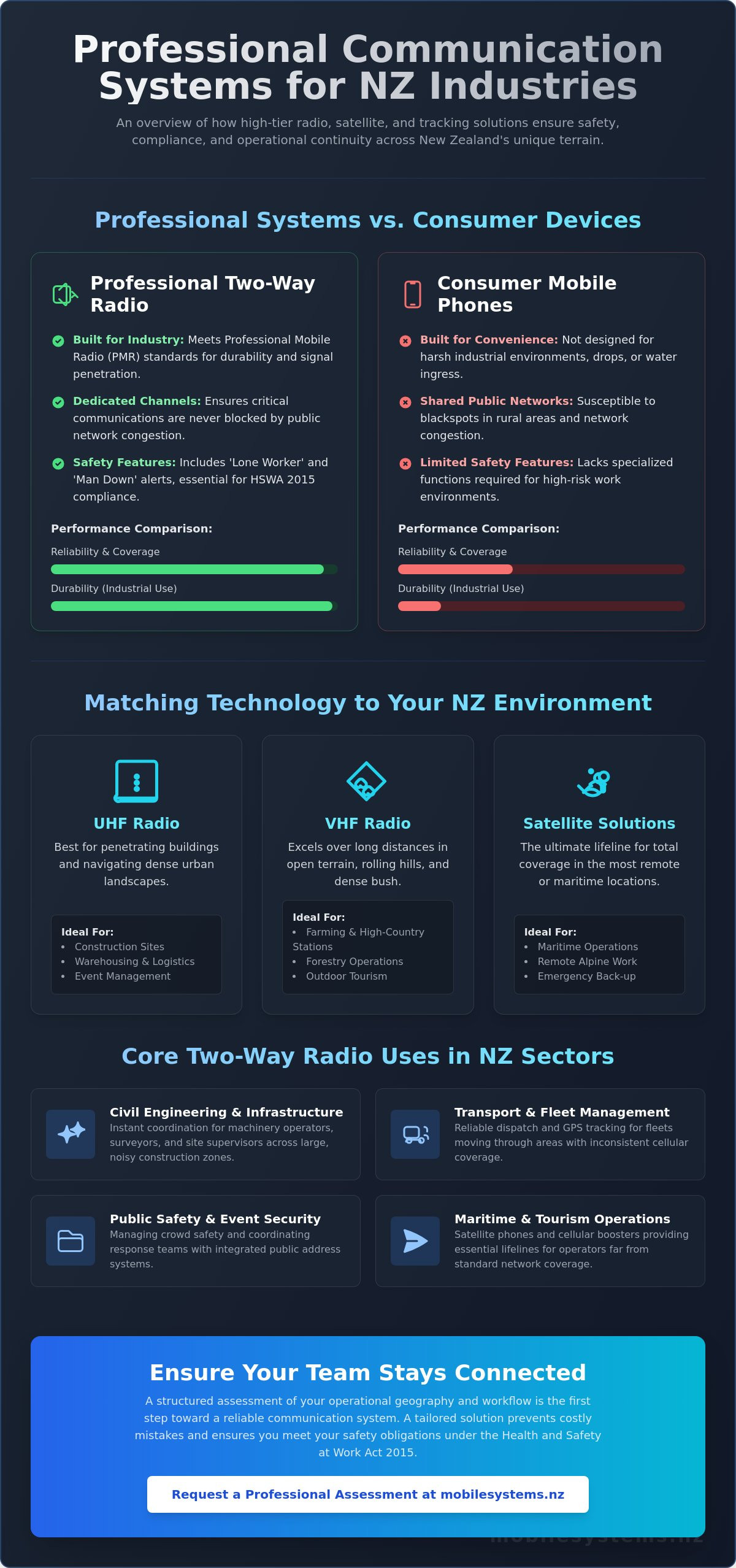
There's a clear distinction between consumer-grade walkie-talkies and commercial two-way radio systems. Commercial units are built to Professional Mobile Radio (PMR) standards. These standards guarantee the durability and signal penetration required for industrial applications where consumer electronics would fail.
To better understand the practical application of these devices, watch this helpful video:
The primary categories of professional systems used in New Zealand include UHF and VHF radio, satellite phones, and fleet tracking. UHF is typically selected for urban environments with building obstructions. VHF is preferred for the open terrain and dense bush found in rural areas. Satellite solutions provide a final layer of redundancy for the most isolated high-country regions.
Industrial Utility vs. Personal Convenience
Within the framework of the Health and Safety at Work Act 2015, communication tools are classified as critical safety equipment. Professional systems provide the reliability needed in high-stakes environments like forestry or civil engineering. In these sectors, a dropped signal isn't just an inconvenience; it's a potential compliance breach that risks worker safety.
Industrial uses prioritize "always-on" connectivity. Unlike personal devices that rely on shared public networks, professional radio networks offer dedicated channels. This ensures that emergency calls or operational instructions are never blocked by network congestion. Features like "lone worker" monitoring and "man down" alerts further distinguish these tools from personal mobile phones.
The Evolution of Communication Uses in NZ
The transition from basic analog voice to modern Digital Mobile Radio (DMR) has changed how businesses operate. Digital systems have expanded the possible two way radio uses in nz industries by introducing data capabilities. Modern handheld devices now support text messaging, emergency alerts, and remote system monitoring, providing a more comprehensive toolset for field staff.
This shift has led to integrated voice and data uses in modern NZ fleet management. GPS tracking and status updates are now transmitted over the same frequencies used for voice. This consolidation reduces the need for multiple devices and simplifies the workflow for drivers. Digital processing also filters out background noise, which is essential for clarity on loud construction sites or near heavy machinery
.
Practical Applications of Two-Way Radio in Core NZ Sectors
Exploring two way radio uses in nz industries reveals a heavy reliance on these systems for managing high-risk environments. In civil engineering and large-scale infrastructure projects, coordination isn't just about efficiency; it's a fundamental safety requirement. Teams spread across kilometers of roading or complex construction sites need instant, reliable access to supervisors and machinery operators.
For transport fleets operating across the North and South Island highways, dispatch management relies on consistent connectivity. Systems like Tait radios are frequently deployed for their wide-area coverage and advanced encryption. This ensures that sensitive operational data and dispatch instructions remain secure while vehicles move through areas with varying signal strength.
The Radio Frequency Users Association of New Zealand represents a broad spectrum of these sectors, emphasizing how standardized communication supports national productivity. Whether it's emergency response in the Southern Alps or day-to-day logistics, the right hardware bridges the gap where public networks fail. A tailored assessment of your site's topography can identify potential dead zones before they impact operations.
Construction and Infrastructure Management
On busy New Zealand construction sites, instant group communication is vital for site safety and heavy machinery coordination. Ruggedized handhelds are designed to withstand abrasive conditions, including dust, moisture, and high-impact drops. These devices allow site managers to allocate resources via voice commands, significantly reducing the downtime associated with manual coordination.
Using dedicated channels prevents the interference common on public frequencies. This clarity is essential when directing crane movements or managing traffic flow around active work zones. It's about keeping the workflow moving without compromising the safety of the crew on the ground.
Agriculture and Forestry Operations
Agriculture and forestry represent critical two way radio uses in nz industries due to the isolation of the work sites. In deep valleys and dense bush, cellular signals often disappear entirely. Professional radio systems overcome these coverage gaps, providing a lifeline for staff working in remote blocks.
- Lone Worker Features: Automated check-ins ensure that workers are safe even when out of visual range.
- Man Down Alarms: Integrated sensors trigger an emergency alert if a handheld unit detects a fall or lack of movement.
- Vehicle Integration: Seamless transitions between vehicle-mounted units and portable handhelds keep teams connected as they move between the cab and the field.
These features are essential for compliance with modern safety standards. They provide peace of mind for operators managing large-scale high-country stations where help may be hours away. Reliability in these conditions is not optional; it's a core operational requirement.
Satellite and Cellular Solutions for Remote and Maritime Operations
While terrestrial radio networks cover vast areas, New Zealand's extreme topography creates significant cellular blackspots. In the Southern Alps or deep within Fiordland, terrestrial signals are often blocked by mountain ranges. In these scenarios, two way radio uses in nz industries often transition to satellite-based technologies to maintain critical safety links.
For operations on the fringe of network coverage, cellular devices and boosters play a vital role. These systems capture weak external signals and amplify them within a vehicle or remote building. This technology is particularly effective for disaster recovery, providing backup communication for regional services when primary infrastructure is compromised.
Essential regional services, such as rural fire and emergency management, use these hybrid systems to ensure redundancy. When terrestrial towers are damaged during extreme weather events, satellite-linked cellular boosters allow local command centers to maintain a data connection. This multi-layered approach prevents a total communication blackout during high-stakes recovery operations.
Remote Operations and Adventure Tourism
Adventure tourism operators require reliable communication for guided treks and mountain expeditions. Traditional handheld satellite phones provide a dedicated voice link where cellular networks fail. It's essential for coordinating emergency evacuations or providing weather updates to teams in the field.
Portable satellite hotspots have expanded two way radio uses in nz industries by allowing data transfer in remote research stations. Operators must evaluate the uses of Starlink compared to traditional handheld satellite phones. While Starlink offers high-speed data, traditional satellite phones remain the preferred choice for mobile voice communication due to their portability and lower power requirements.
Marine Safety and Long-Range Communication
Maritime operators face unique challenges once they move beyond the standard VHF coastal range. Within 20 nautical miles of the coast, VHF radio is the primary tool for ship-to-shore coordination. For blue-water fishing and long-range ocean transport, satellite solutions become the only viable method for maintaining contact with land-based dispatch.
Compliance with New Zealand maritime regulations requires specific hardware standards. Understanding the nuances of maritime communication is essential for regulatory compliance and crew safety. These systems ensure that vessels can transmit distress signals and receive navigational warnings regardless of their distance from the shore.
Advanced Uses for Fleet Management and Public Safety
Integrating GPS trackers with digital radio networks creates a unified operating picture for dispatchers. This technical synergy represents one of the most effective two way radio uses in nz industries today. It allows for real-time asset protection while ensuring that voice communication is always contextually relevant to a worker's exact location.
Surveillance and monitoring become more manageable when high-value cargo is tracked alongside the personnel protecting it. Sensitive industrial sites benefit from this integration by allowing security teams to receive automated alerts on their handheld units if a digital perimeter is breached. This seamless flow of data ensures that responses are immediate and coordinated without relying on external phone networks.
Modern digital radio standards like DMR facilitate the transmission of short data packets. This means location updates don't interrupt voice traffic, providing a continuous stream of information to the base station. In high-pressure environments, having this data visible on a single dispatch screen reduces the mental load on coordinators and prevents communication errors.
Fleet Optimisation and Asset Tracking
Monitoring driver behaviour is a primary method for improving safety and reducing fuel consumption across New Zealand fleets. Fleet tracking systems provide the data needed for automated Road User Charges (RUC) reporting and maintenance scheduling. These tools remove the administrative burden from drivers, allowing them to focus on safe vehicle operation.
By analysing route data, businesses can identify inefficiencies in their daily runs. Route optimisation doesn't just save time; it reduces the wear and tear on vehicles navigating difficult North Island terrain. Automated maintenance alerts ensure that fleet vehicles remain compliant and safe, preventing costly breakdowns in remote areas where recovery is difficult.
Public Address and Crowd Management
In large-scale event safety, the meaning of PA systems extends beyond simple amplification. They're critical for crowd control and emergency announcements at scale. Professional portable PA uses include temporary work sites and community gatherings where safety alerts must remain clear despite high ambient noise levels.
For event organizers, providing clear information is as much about visibility as it is about sound; using professional display kits from Mobile Light Box can ensure that important signage and branding are seen clearly even in crowded venues.
Ensuring clarity of message in noisy industrial environments is essential for effective safety alerts. Modern PA systems can be integrated with radio networks, allowing a supervisor to make a site-wide announcement directly from their handheld radio. This capability is vital for rapid evacuations or when immediate hazards are identified on a busy site.
For businesses looking to consolidate their technology, an integrated system design ensures all components work together without frequency interference.
Strategic Implementation: Matching Communication Uses to Your Business
Implementing a communication strategy requires a precise match between technology and the operational environment. Understanding the specific two way radio uses in nz industries is the first step toward building a resilient network. A tailored assessment often prevents costly mistakes in hardware selection, ensuring that the chosen system meets both current needs and future expansion.
Geography dictates the hardware. VHF systems are generally superior for the undulating terrain and dense bush found in rural New Zealand. Conversely, UHF systems provide better signal penetration in urban settings or large industrial complexes with significant concrete and steel obstructions. For the most isolated high-country stations, satellite integration provides the necessary redundancy.
Professional installation is a critical factor in system performance. Poorly mounted antennas or incorrectly configured repeaters can lead to significant coverage gaps, even with high-end equipment. Ensuring that your hardware is optimized for your specific site coordinates is essential for maintaining the "always-on" connectivity required for industrial safety.
While communication hardware secures the operational side of a business, environmental safety is another pillar of risk management. For those overseeing industrial or residential properties, Methamphetamine Testing Services NZ Limited provides expert contamination testing to ensure that the physical workspace is as safe as the communication network protecting it.
Conducting a Communication Audit
A communication audit identifies coverage gaps in your North or South Island operations. This process involves mapping "dead zones" where terrain or structures block signals. You must also evaluate the number of concurrent users to ensure the network has sufficient capacity to handle peak traffic without congestion.
Determining if data capabilities are required alongside traditional voice communication is another vital step. Modern workflows often benefit from integrated GPS tracking or automated status messaging. If your staff work in isolation, your audit should prioritize features like man-down alerts and automated check-in sequences to maintain compliance with safety standards.
Selecting and Servicing Your Equipment
Selecting reputable brands like Tait or Iridium ensures your equipment is designed for harsh NZ conditions. These manufacturers produce hardware that withstands extreme moisture, dust, and temperature fluctuations. Choosing the right brand is only half the battle; the role of Mobile Systems in providing professional installation and nationwide on-site support is equally important.
- Regular Maintenance: Scheduled servicing prevents hardware failure in safety-critical environments.
- Antenna Optimization: Periodic checks ensure that signal gain remains at peak levels for wide-area coverage.
- Battery Management: Proactive replacement of handheld batteries prevents communication loss during long shifts.
- Firmware Updates: Keeping digital systems updated ensures access to the latest security and data features.
Regular maintenance is essential for all professional systems. Dust and vibration can degrade internal components over time, leading to reduced range or audio clarity. By establishing a consistent servicing schedule, you protect your investment and ensure your team has a reliable lifeline when they're operating in remote or high-risk areas.
Optimising Your Operational Connectivity
Building a resilient communication framework is a strategic decision that directly impacts worker safety and business efficiency. Professional systems provide the specialized reliability required to overcome New Zealand's unique geographic barriers, ensuring teams remain connected where public networks are absent. This infrastructure is essential for maintaining operational continuity in high-stakes environments.
Integrating modern technologies like fleet tracking and satellite redundancy creates a high-trust environment for any site. Understanding the diverse two way radio uses in nz industries helps businesses move beyond simple voice communication toward a data-driven, unified operating picture. These advancements ensure that your organization remains compliant with the Health and Safety at Work Act 2015 while maximizing productivity.
As official suppliers for industry leaders like Tait, Iridium, and GME, Mobile Systems delivers expert NZ-wide installation and ongoing support. Our specialized mobile support vehicles are equipped for on-site servicing to minimize your operational downtime and maintain equipment longevity. Contact Mobile Systems for a professional assessment of your communication needs to ensure your team has the most reliable tools for the job. Investing in the right technology today secures your operations for the future.
Frequently Asked Questions
What are the most common uses for two-way radios in New Zealand businesses?
The primary two way radio uses in nz industries include managing site safety and coordinating large-scale civil engineering projects. Businesses use these tools to maintain compliance with the Health and Safety at Work Act 2015 by providing instant communication in high-risk environments. These systems are essential for logistics, forestry, and agriculture where teams must stay connected across vast or rugged terrain.
Can I use a satellite phone as my primary communication tool for a remote farm?
Satellite phones are highly effective as a primary communication tool in areas where cellular and radio signals are non-existent. While traditional radio is better for frequent team talk, satellite phones provide a vital lifeline for lone workers in deep valleys or high-country stations. They ensure you can contact emergency services or off-site management from any location with a clear view of the sky.
What are the benefits of using a professional PA system for event management?
Professional PA systems provide the high-volume clarity needed for crowd control and emergency announcements at large-scale events. Unlike consumer equipment, commercial systems can be integrated with your radio network; this allows supervisors to broadcast urgent messages directly from their handheld units. This integration is critical for rapid response during safety incidents or site-wide evacuations.
How do fleet tracking uses differ from standard GPS navigation?
Standard GPS navigation provides directions to the driver, while fleet tracking provides real-time location data to the business manager. These systems monitor driver behaviour, fuel consumption, and automated Road User Charges (RUC) reporting. Professional tracking integrates with your communication network to provide a unified view of all assets, improving overall operational efficiency and asset security.
Is a license required for the various uses of UHF and VHF radios in NZ?
Most professional two way radio uses in nz industries require an Individual Radio License issued by Radio Spectrum Management (RSM). This license allows your business to operate on private, interference-free frequencies. While the General User Radio Licence (GURL) allows for CB and PRS radio use without an individual fee, these channels are shared and have strict power limitations that may not suit industrial needs.
What are the safety-critical uses for "man down" features on handheld radios?
The "man down" feature is a safety-critical tool that automatically triggers an emergency alert if the radio stays at a specific angle for too long. It's designed for lone workers who may become incapacitated due to a fall or medical event. This automated response ensures that help is dispatched to the worker's exact location even if they're unable to press the emergency button themselves.
How do I determine which communication uses are best for my specific terrain?
The choice between VHF and UHF depends entirely on your local topography and infrastructure. VHF is generally more effective for open rural areas and dense bush; UHF is better suited for urban environments or sites with many buildings. A professional site audit is the most reliable way to identify dead zones and select a frequency that provides total coverage for your specific location.
Can cellular boosters be used to improve communication in rural NZ areas?
Cellular boosters are designed to capture weak external signals and amplify them for use inside vehicles or remote buildings. They're an excellent solution for fringe coverage areas where a signal exists but is too weak for reliable mobile phone use. These devices help bridge the gap between traditional cellular networks and the need for consistent connectivity in rural New Zealand.
Related posts

- May 23, 2026
Need to go beyond 100m? Our guide to the ethernet cable extender explains types, distance limits, and NZ use cases...

- May 22, 2026
Can't fix a phone on site? Learn essential troubleshooting for NZ field teams, when to seek professional repair, and how...

- May 21, 2026
Master the Fire and Emergency NZ portal. Access login steps, essential features, and build your communication backup plan for 2026.