
Maximising Your Two-Way Radio Range: A NZ Business Guide
Unlock the true potential of GME's UHF CB Handheld Two-Way Radio Range in NZ. Expert NZ guide covers terrain, antennas, and repeaters to boost team safety.
When team safety and operational efficiency depend on clear communication, understanding the real-world range of your handheld radios is non-negotiable. A radio that gives you 15 km of clear chat from one hilltop to another might struggle to reach 1-2 km in downtown Auckland or through dense West Coast bush. Why is that? And how can you guarantee your team stays connected when it matters most?
For Kiwi businesses in agriculture, construction, forestry, or logistics, these aren't just technical questions. The answers determine if a critical instruction is heard, a safety warning is received, or a lone worker in the backblocks can check in. That "up to 20 km" range printed on the box is a perfect-world scenario, measured between two high points with zero obstructions, a situation you will almost never find on a real New Zealand worksite.
The Communication Breakdown: Why NZ Workplaces Can't Afford Black Spots
Across New Zealand, from the Bay of Plenty to the Canterbury Plains, businesses face a common set of challenges that put their teams at risk and drag down productivity.
In agriculture and horticulture, coordinating teams across sprawling properties with rolling hills means constant communication black spots. A machinery breakdown in a back paddock can leave a worker isolated for hours. For forestry crews, the dense canopy and steep terrain of a commercial block can swallow radio signals, making it impossible to coordinate felling operations safely or respond to an injury.
Construction and traffic management teams in urban centres battle with steel framing, concrete walls, and vehicle noise that garble instructions and create hazards. Transport and logistics companies need to track fleets and ensure drivers can communicate from remote delivery points. Lone workers in any sector, from energy exploration to security patrols, depend on a reliable connection to call for help.
When a message doesn't get through, the consequences can be severe:
- Lost time and costly project delays.
- Serious health and safety incidents.
- Failed compliance with lone worker safety regulations.
- Inefficient deployment of staff and machinery.
These pain points all stem from one root cause: a communication system that isn't fit for the unique demands of New Zealand’s rugged and varied environments. Hoping for the best isn't a strategy. Mission-critical operations demand mission-critical communications.
Understanding How UHF Radio Waves Actually Work in NZ
Ever wondered why your 5-watt GME handheld can talk clearly over 20 kilometres in the high country, but struggles to reach 2 kilometres across town? It’s not magic, it's physics. Getting your head around the basics of how Ultra High Frequency (UHF) radio waves behave is the key to setting realistic expectations for your team.
Think of your GME radio's signal like the beam from a powerful torch. In a clear, open field at night, that beam travels a long, long way in a straight line. But shine that same torch into a dense pine forest, at a concrete wall, or down into a foggy valley, and the light gets blocked, absorbed, or scattered. Its effective range is cut down dramatically. UHF radio waves act in almost the exact same way.
The Line-of-Sight Principle
The single most important concept in the UHF world is line-of-sight. UHF signals travel in relatively straight lines. They don’t bend well around the curve of the Earth or punch through big obstacles like hills and buildings. For two handhelds to chat, there needs to be a reasonably clear, unobstructed path between their antennas.
This explains the massive difference in performance you see across different Kiwi landscapes:
- Hilltop to Hilltop: With a clear line-of-sight, even a low-power handheld can communicate over incredible distances.
- Urban Environments: Every single building, truck, and piece of machinery acts as an obstacle, blocking and reflecting the signal. This is what eats up your range in the city.
- Dense Bush: Trees, especially our wet native bush, are brilliant at absorbing UHF energy, which kills the signal strength.
This is exactly why your physical position is so critical. Sometimes, just walking a few metres to higher ground is all it takes to get that connection back. For a deeper dive into the science, you can learn more about radio wave propagation in our detailed guide.
Wattage Isn’t the Whole Story
There's a common belief that more power (wattage) automatically means more range. It's not that simple. While a 5-watt radio is certainly more powerful than a 1-watt radio, doubling the power doesn't come close to doubling the range. Power helps the signal "punch through" minor obstructions and atmospheric fuzz, but it can't force a signal through a solid mountain.
A 5-watt signal that is completely blocked by a hill is just as useless as a 1-watt signal. The real-world performance of GME's UHF CB handheld two-way radio range depends far more on line-of-sight than it does on raw power.
The Shift to UHF in New Zealand
Today's UHF CB radios are a world away from the old systems. Before 1996, many Kiwi businesses were stuck with the crackly, interference-prone 26 MHz Citizens Band (CB). These old radios were easily affected by atmospheric noise and just weren't very reliable.
The game changed when the New Zealand Government launched the 477 MHz Personal Radio Service (PRS). This move opened up licence-free UHF channels, including dedicated channels for repeaters, and completely transformed short-range comms for industries like construction, farming, and maritime safety. The switch to UHF brought far better clarity and reliability, with typical handheld range jumping to 5-10 km in open country, a perfect fit for New Zealand's rugged terrain.
How NZ Terrain and Conditions Impact Radio Performance
New Zealand's geography is spectacular, but it's also the single biggest challenge for your handheld radio. A signal that travels for kilometres across the Canterbury Plains can be stopped dead by the hills of the Coromandel Peninsula. To get reliable comms for your team, you absolutely have to understand how different environments mess with UHF radio waves.
At their core, UHF signals are line-of-sight. They don't bend around hills or punch through solid earth. This means your effective range is constantly changing based on whatever landscape is between you and the person you're trying to reach.
The Elevation Advantage
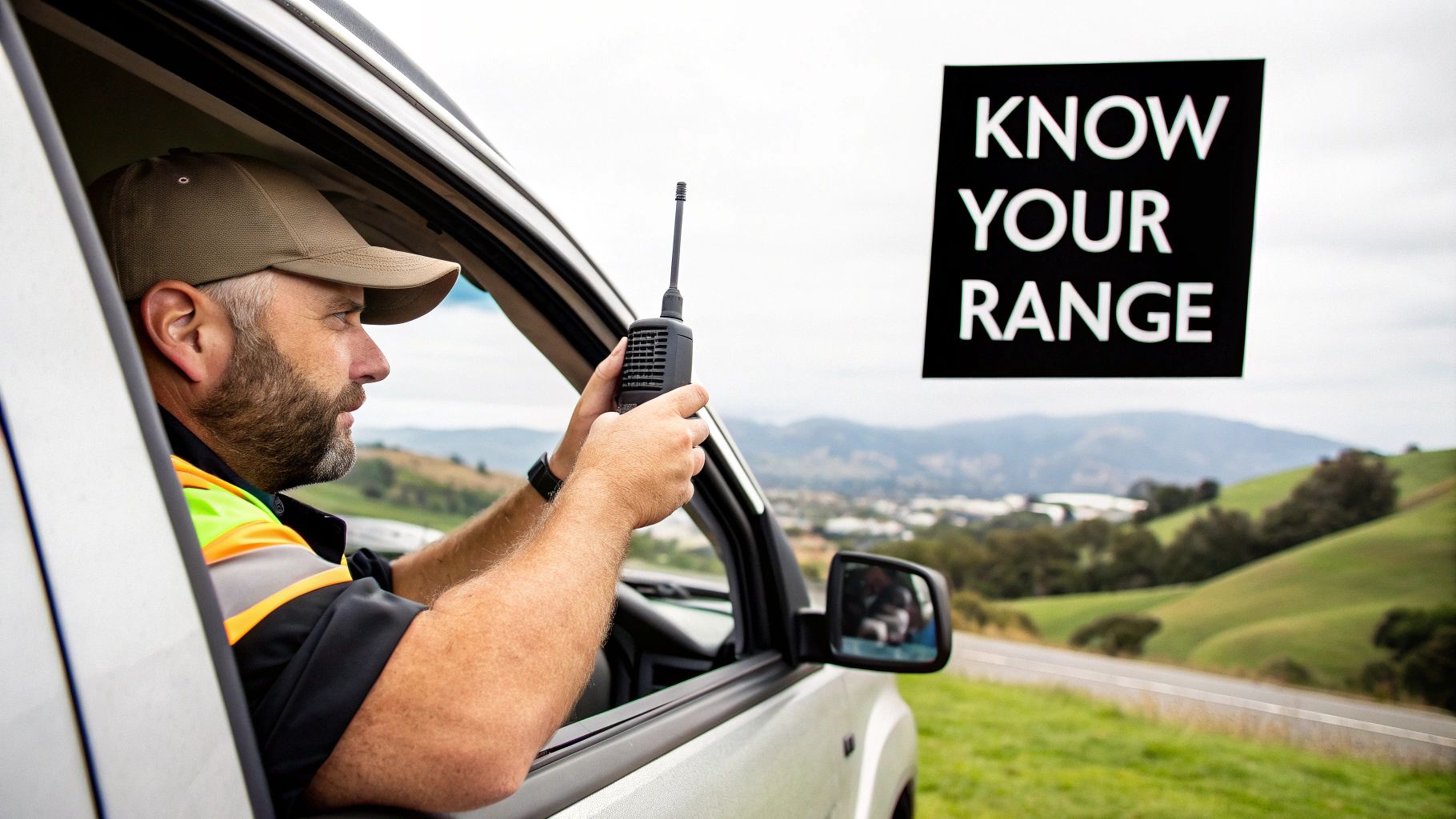
Want to reliably boost your GME's UHF CB handheld two-way radio range? Gain some height. Elevation is your best friend in the radio game. Just getting to the top of a small rise, a hill, or even standing on the tray of a ute can dramatically improve your line-of-sight and turn a patchy signal into a crystal-clear one.
For teams in agriculture, construction, or forestry working across hilly country, this is a critical operational tactic. Briefing your staff to move to higher ground before they transmit can be the difference between a successful call and complete radio silence.
In our experience, a team member in a valley might get less than 1 km of range. Meanwhile, another person standing on a nearby ridge can communicate clearly over 10-15 km using the exact same GME handheld. It’s a perfect example of why planning your coverage is so vital for safety.
For a deeper dive into this, check out our detailed article on radio communications in the mountains.
Realistic Range Expectations for NZ Environments
To give you a practical, field-tested benchmark, this table shows typical simplex (radio-to-radio) performance without using a repeater to boost the signal.
| NZ Environment Type | Typical Obstructions | Expected GME UHF Range |
|---|---|---|
| Urban Centres (Auckland, Tauranga) | Concrete buildings, vehicles, electronic interference | 1–3 km |
| Rolling Farmland (Waikato, Manawatū) | Gentle hills, sheds, tree lines, livestock | 3–8 km |
| Dense Native Bush (Coromandel, Ureweras) | Thick foliage, steep gullies, high moisture content | 1–4 km |
| Commercial Forestry Plantation | Dense trees, hilly terrain, logging machinery | 2–5 km |
| Open High Country (Canterbury) | Clear line-of-sight, minimal obstructions | 10–20+ km |
| Coastal & Marine (Bay of Plenty) | Open water, other vessels, coastal cliffs | 5–12 km (over water) |
As you can see, the environment is everything. Choosing the right gear starts with understanding the specific challenges of where you'll be using it.
Choosing the Right Handheld and Antenna to Maximise Range
When you're equipping a team for serious commercial work, simply buying a radio is not enough. The single most important decision you'll make is matching the right handheld with the right antenna for the job. This isn't just about convenience; it's about safety, productivity, and whether your communication system actually works when you need it most.
Your focus should boil down to three key things: how tough the radio is, whether the battery will last a full shift, and if the antenna is suited to the terrain you're in. Get that combination right, and you'll unlock the full potential of your communication gear.
Selecting the Right Handheld Model
For demanding Kiwi worksites, you need hardware that can handle dust, rain, and the inevitable drop. When looking at professional radio models, the first thing to check is the IP rating. This number tells you exactly how well the radio is sealed against the elements.
- IP54/55: This gives you decent protection from dust and water splashes. It's a solid choice for general farm use or on a light construction site.
- IP67: This is the gold standard for tough environments. An IP67-rated radio is completely dust-tight and can survive being submerged in 1 metre of water for up to 30 minutes. For forestry, marine, or heavy civil construction work, this level of durability is non-negotiable.
Next up is battery life. A dead radio is a useless radio, especially halfway through a long day. Look for models with high-capacity lithium-ion batteries rated for at least 12-14 hours of real-world use. That way, your team stays connected from the start of their shift to the very end.
The Antenna Is Your Most Important Upgrade
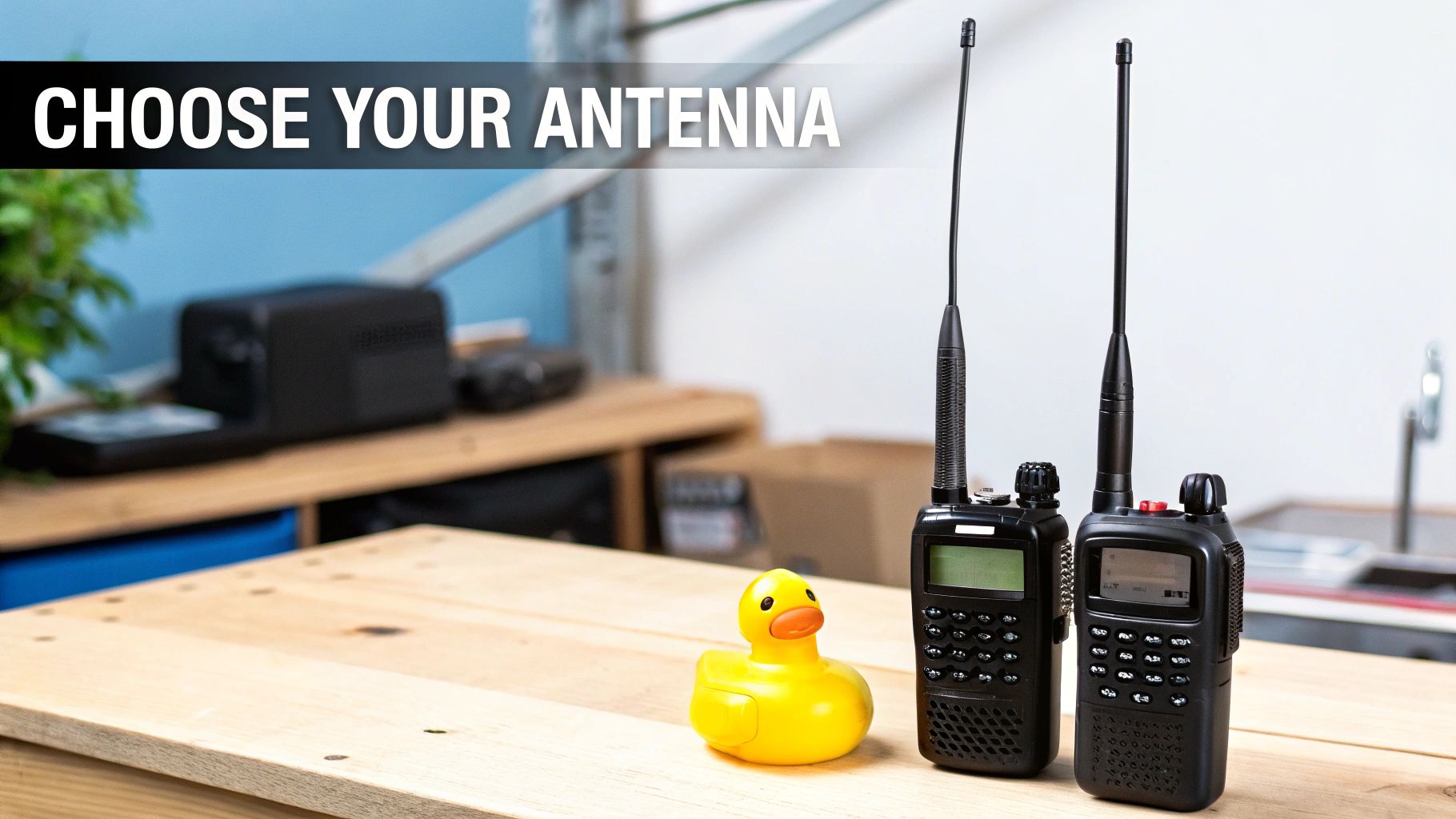
That short, black "rubber ducky" antenna that comes with your handheld is a compromise. It’s designed for portability, not performance. The single best (and most affordable) thing you can do to boost your handheld two-way radio range is to upgrade the antenna.
The secret is matching the antenna's gain to your surroundings:
- Low Gain (e.g., 2.1dBi): These are shorter antennas, often called quarter-wave whips. They push the signal out in a wide, donut-shaped pattern. This makes them perfect for hilly, obstructed country like a forestry block or a busy urban site, because the signal radiates up and over obstacles.
- High Gain (e.g., 6.6dBi): These longer antennas focus the radio's power into a flat, narrow beam, like a lighthouse. They're what you want for wide-open spaces like Canterbury farmland or communicating over open water, where you need to push that signal as far as possible towards the horizon.
Upgrading from a standard antenna to a properly matched whip can often double your usable range. For any business relying on clear comms for safety and efficiency, it's an essential step.
For more detailed advice, check out our in-depth guide on UHF antennas in NZ. Better yet, talking to an expert here at Mobile Systems means you’re not just buying a radio. You’re investing in a complete communication solution designed specifically for what you do.
Pushing Your Range Further with Repeaters and Smart Habits
Sooner or later, your team is going to hit the physical limits of direct radio-to-radio communication. Hills, dense bush, large buildings, or just sheer distance will create frustrating communication black spots, putting both safety and productivity on the line. This is exactly where UHF repeaters come in. They are one of the most powerful tools you can add to your comms toolkit.
Think of a repeater as a high-powered radio relay station. We usually install them on a mountain, a tall building, or a grain silo, anywhere with a commanding view. It listens for weak signals from your handheld radios, gives them a massive power boost, and then re-broadcasts them over a much, much wider area. It’s a simple concept that can instantly turn a 5 km direct connection into a rock-solid 50+ km link.
Tapping into New Zealand’s UHF Repeater Network
New Zealand is fortunate to have a great network of public UHF repeaters that anyone can use on PRS channels 1–8 and 41–48. To get onto one, all you need to do is switch on the 'duplex' or 'repeater' function on your GME radio and pick the right channel for your location. Your radio then cleverly transmits on one frequency and listens on another, letting the repeater work its magic in between.
For many commercial outfits, these public channels are a fantastic starting point. The only catch is that they can get busy, and if your work is mission-critical, you can’t afford to have your instructions get lost in the chatter. That’s when it’s time to consider a private repeater.
Here at Mobile Systems, setting up private repeater systems for businesses is our bread and butter. We can come out to your site, do a full coverage audit to find those persistent black spots, and install a dedicated repeater that guarantees 100% comms coverage exactly where you need it.
Simple Habits for a Big Performance Boost
It's not all about the technology. How your team actually uses their radios can make a huge difference to clarity and range, and it costs nothing to improve. Instilling a few professional habits is key.
- Good Radio Etiquette: Get your team into the habit of thinking before they press the button. Keep messages short and to the point. Most importantly, always pause for a second after pressing transmit before you start talking. This stops the first word from getting cut off.
- Hold it Right: The antenna should always be vertical and held away from your head. Holding a radio flat like a phone or tucked under your arm can kill its broadcast power.
- Do Your Radio Checks: A quick "radio check, one-two-three" at the start of a shift is a simple way to make sure everyone's gear is working and they’re in clear range.
- Battery Power is Broadcast Power: A radio with a dying battery will have a seriously reduced range. Make sure every unit is fully charged before a shift and think about keeping spare batteries on hand for those long days.
New Zealand's 477 MHz UHF PRS network has been a game-changer for workplace safety, especially in high-risk industries. This licence-free service, established back in 1996, is leagues ahead of the old 26 MHz CB band, which is notoriously plagued by interference. You can read more on the official spectrum rules from Radio Spectrum Management's official publication.
NZ Compliance, Safety, and Operational Considerations
For a professional operation, a two-way radio is a critical piece of Health and Safety equipment. Getting your communication strategy right involves more than just range. It means thinking about compliance, durability, and how the system supports your team in the toughest conditions.
- Lone Worker Safety: Under NZ law, businesses have a duty of care for remote and lone workers. A reliable communication system with features like GPS tracking and 'Man Down' alerts is essential for meeting these obligations and ensuring help can be dispatched quickly.
- Durability (IP Ratings): As mentioned, the IP rating tells you how well a device is sealed against dust and water. For wet, dirty, or high-vibration environments like a quarry or a fishing vessel, choosing a radio with a high IP rating (like IP67) is crucial for reliability.
- Acoustic Safety: In loud environments like manufacturing plants or sawmills, standard radios can be useless. Solutions with high-noise headsets and acoustic protection are vital to ensure messages are heard clearly without damaging workers' hearing.
- Device Shift-Life: Commercial-grade radios are built for long shifts. Their battery capacity, charging systems, and robust construction are designed to last a full 12-hour day, unlike consumer models.
- RSM Licensing: While UHF CB is licence-free, using private channels for security, or setting up your own repeater for guaranteed coverage, requires a formal licence from Radio Spectrum Management (RSM). This ensures your communications are private and interference-free. We manage this entire process for our clients.
Recommended Solutions for NZ Businesses
Choosing the right technology depends entirely on your operational needs, coverage area, and budget. Here are some of the professional-grade solutions we deploy for our clients across New Zealand.
- UHF/VHF Radios: The dependable workhorse for most on-site communications. Brands like Hytera, Tait, Motorola, Entel, Icom, GME, and Uniden offer robust, professional-grade handheld and in-vehicle radios built for NZ conditions.
- Marine Radios: Essential for maritime safety, with specific channels and durability requirements. We trust leading brands like GME, Uniden, and Icom for their proven reliability at sea.
- Push-to-Talk over Cellular (PoC): For teams spread across a wide geographical area, PoC radios like the Hytera P50 or Motorola TLK110 use cellular and Wi-Fi networks to provide nationwide coverage.
- Satellite Devices: When you're completely off the grid, nothing beats satellite. We deploy solutions from Starlink, Iridium, Inmarsat, and Garmin inReach to provide voice and data connectivity anywhere in New Zealand.
- Repeaters & Coverage Systems: For sites with challenging terrain or buildings, a dedicated repeater system is the only way to guarantee 100% coverage. We design and install custom systems to eliminate black spots.
- GPS Tracking & Lone Worker Solutions: We integrate GPS and man-down technology into radio systems to provide real-time location data and emergency alerts, ensuring compliance with WorkSafe NZ guidelines.
Why Choose Mobile Systems Limited?
Picking the right handheld radio is a solid first step. But the radio itself is just one piece of the puzzle when you’re building a communication system that needs to be safe, compliant, and genuinely reliable.
To get the absolute best out of your gear and make sure it holds up day in, day out, you need a partner who understands the lay of the land here in New Zealand. That’s where we come in. We are not a general retailer; we are a dedicated communications partner for NZ businesses.
A Kiwi Company Built on Real-World Experience
We’re a 100% New Zealand owned and operated business, based right here in Mount Maunganui. For nearly two decades, we’ve been out on the ground with Kiwi businesses across the Bay of Plenty, Coromandel, and Waikato, helping them sort out their real-world communication headaches.
Our experience isn’t from a textbook; it’s been earned on farms, construction sites, in forestry blocks, and out on the water. We know exactly how the local terrain affects radio range and what it really takes to build a system that won’t let you down when it counts.
More Than Just a Sale – A Full Solution
When you work with us, you’re not just buying a radio; you’re getting a complete support system designed to protect your investment and keep your team safe.
- Expert Advice: We start by listening. We want to understand your operation, the challenges on-site, and your safety rules before we recommend a piece of gear.
- Professional Programming: We’ll program your radios with private channels, repeater access, and specific features to keep your comms clear, secure, and free from public chatter.
- Mobile On-Site Support: Our dedicated support fleet comes straight to you. We can handle everything from fitting out your vehicles to setting up a full repeater system for guaranteed site coverage.
- Custom Coverage Planning: Got black spots on-site? We will carry out a full audit to find them and then design a system that delivers solid coverage exactly where your crew needs it.
- Licensing & Compliance: We handle the tricky RSM licensing paperwork for you, making sure your entire radio fleet is fully compliant with New Zealand regulations.
- Long-Term Reliability: We’re in this for the long haul. We provide ongoing servicing, repairs, and aftercare to keep your system performing at its best for years to come.
Choosing Mobile Systems means you're getting a long-term partnership with a team of dedicated NZ-based experts who are genuinely committed to the safety and productivity of your operation.
Let's Build a Solution That Works
Tired of communication black spots and unreliable gear? It's time to talk to a team that understands your challenges and has the hands-on experience to solve them.
Our communications specialists are here to help you design a system that is tough, reliable, and perfectly tailored to your New Zealand workplace. Reach out today for practical, no-obligation advice.
Request a Quote | Ask for a Demo | Speak to a Communications Specialist
Frequently Asked Questions
We get asked a lot of questions about two-way radios from Kiwi businesses just like yours. Here are some of the most common ones, with straight-up, practical answers.
What is the best UHF channel to use in NZ?
The "best" channel really comes down to what you're doing and where you are.
For on-site work, it's a good idea to find a quieter general channel. Channels 22 or 23 are often your best bet. While they're technically designated for telemetry and data, they're usually free from the general chatter.
To push your signal as far as possible, use a repeater channel: 1-8 and 41-48. You'll need to hit the 'duplex' or 'repeater' button on your radio to access them. Just remember, these are public repeaters, so keep your comms professional and to the point.
Do I need a licence for a UHF CB radio in NZ?
No, you don't. UHF CB radios operate on the public Personal Radio Service (PRS) band at 477 MHz. This part of the spectrum is designated by Radio Spectrum Management (RSM) as licence-free for everyone in New Zealand.
This makes them a brilliantly simple and cost-effective tool. That said, if your operations require a secure, private channel or your own dedicated repeater for guaranteed clear comms, you will need a private licence from RSM. We handle that whole process for our clients.
How can I legally boost my handheld radio’s range?
There are two main ways to legally get more distance out of your handheld, and neither involves illegal modifications.
First, and most effectively, is to upgrade your antenna. Swapping the standard aerial for a longer, higher-gain whip can make a world of difference in open country. Conversely, in hilly terrain, a lower-gain antenna can actually perform better. It’s all about matching the gear to the ground.
The second method is using a UHF repeater. These stations are typically set up on hilltops and can take your signal from just a few kilometres to well over 50 km by re-broadcasting it over a much wider area. Both methods are perfectly legal and standard professional practice.
Can I use my UHF radio to call for help in an emergency?
Yes, absolutely. This is one of their most critical functions. Channels 5 and 35 are the designated emergency repeater channels across New Zealand.
If you find yourself in a genuine emergency, you can broadcast a call for help on these channels. Your signal will be picked up and re-broadcast by the repeater network, meaning it will be heard by anyone monitoring them, including emergency services.
For anyone working or travelling in truly remote areas, we always recommend backing up your UHF radio with a dedicated lifesaving device. Something like an ACR rescue beacon provides a critical safety net when you're well outside of radio range.
What is the difference between UHF and VHF?
UHF (Ultra High Frequency) and VHF (Very High Frequency) are two different radio frequency bands. In simple terms:
- UHF has shorter wavelengths, which are better at penetrating through and around obstacles in built-up areas, forests, and complex industrial sites. This is why it's the standard for most on-site business communications in NZ.
- VHF has longer wavelengths that travel further in open, unobstructed terrain. It is the standard for marine communication ("VHF Marine") and is also used in agriculture and forestry in wide-open country.
Choosing the right one depends entirely on your specific operational environment.
Related posts

- June 07, 2026
A single wiring error in a modern vehicle's digital bus system can lead to repair costs of up to NZ$4,500....

- June 05, 2026
Could a single corroded antenna connection result in a NZ$3 million fine? For New Zealand fleet operators working in forestry,...

- May 28, 2026
NZ police scanner frequencies are changing. Learn why & discover reliable communication solutions for NZ businesses in 2026. Authoritative guide.