
Starlink Internet Plans in NZ: The Ultimate Commercial Guide
Explore Starlink internet plans in NZ. This expert guide covers costs, performance, and best plans for commercial, maritime, and rural business needs.
Is your business battling slow, unreliable internet in a remote corner of New Zealand? For commercial operations beyond the reach of traditional fibre or cellular networks, finding a dependable connection isn't just a convenience, it's a critical operational necessity. Starlink internet plans are a genuine game-changer, delivering high-speed, low-latency connectivity via satellite that finally bridges the digital divide for Kiwi businesses.
This guide provides a practical, no-nonsense breakdown of how to select the right Starlink plan for your commercial needs. Are internet black spots and unstable connections costing your business productivity, compromising safety, and limiting growth? How do you ensure your remote teams, vehicles, and vessels stay connected and efficient when standard options simply fail?
The Critical Need for Reliable Connectivity in NZ's Toughest Workplaces
For years, New Zealand businesses operating outside major urban centres have been hamstrung by inadequate internet. Legacy solutions like copper lines, patchy rural wireless, and older satellite services simply cannot cope with our country's rugged terrain, dense bush, and unpredictable weather. This creates significant operational roadblocks for our most vital industries.
An unreliable connection is more than just a frustration; it's a direct threat to safety, efficiency, and your bottom line. These challenges are felt daily across multiple sectors:
- Agriculture & Forestry: Inability to run cloud-based farm management software, access real-time weather data, or maintain a reliable communications link for lone workers in remote forest blocks.
- Construction & Transport: Difficulty coordinating logistics, submitting digital compliance forms, or tracking fleet assets in real time from worksites plagued by connectivity black spots.
- Maritime & Fishing: Loss of vital contact for safety alerts, catch reporting, and crew welfare the moment a vessel moves beyond coastal cell range.
- Emergency Response & Health and Safety: Compromised ability to coordinate teams during critical incidents or monitor the safety of lone workers in isolated areas when the connection constantly drops.
- Energy & Exploration: Hindered data transfer from remote monitoring sites, impacting operational decisions and response times.
These pain points all highlight the mission-critical need for a dependable, high-performance internet solution that works anywhere, every time.
Starlink solves this by bypassing ground-based infrastructure entirely. It delivers the high-speed, low-latency connection required to run a modern, data-intensive operation, whether you're on a high-country station, a remote construction site, or a vessel navigating the Tasman Sea. This guide will walk you through the different Starlink internet plans to help you make a confident, strategic decision for your business.
Understanding Starlink Performance in Real-World NZ Conditions
Let's cut through the marketing hype and focus on what you can actually expect from Starlink in the field here in New Zealand. For a business managing a remote operation, theoretical speeds are irrelevant. What truly matters is consistent, real-world performance that keeps your teams safe and your business productive.
The great news is that for most of Aotearoa, Starlink is a transformative technology. It provides a robust, reliable connection capable of handling modern business software, communications, and large data transfers, even in locations previously considered connectivity dead zones.
What Speeds and Latency Really Mean for Your Operations
The technical specifications are one thing, but what do those numbers actually deliver for your day-to-day work?
-
Download Speeds (Typically 100-200 Mbps): This is the speed at which data comes to you. It's the difference between streaming smooth, high-definition CCTV footage from a remote worksite versus watching a stuttering, pixelated feed. It means downloading large project files in minutes, not hours, and running cloud-based inventory or farm management software without lag.
-
Upload Speeds (Typically 10-20 Mbps): This is the speed at which you send data out. It's absolutely crucial for backing up critical business data to the cloud, sending high-resolution images from a site inspection, or holding a stable video conference where you are clearly seen and heard.
-
Latency (Typically 20-50ms): This is often described as the 'lag' in a connection. Starlink's exceptionally low latency makes real-time applications feel instantly responsive. It's the difference between a crystal-clear VoIP phone call and a frustrating, delayed conversation. It enables instant team communication and even facilitates the remote control of machinery.
Independent data confirms this. Across New Zealand's diverse landscapes, Starlink consistently delivers download speeds of 100-200 Mbps and latency around 40-50 ms. For a deeper dive into local performance, see our detailed Starlink Speed NZ Analysis.
Performance During Adverse NZ Weather
A valid concern for any satellite system is its resilience in poor weather. New Zealand's conditions can be severe, from torrential rain on the West Coast to gale-force winds battering coastal regions.
Starlink has been engineered to withstand these challenges. While extremely heavy rain or dense, wet snow can momentarily affect the signal (a phenomenon known as 'rain fade'), these interruptions are typically brief and infrequent. The system is designed to maintain a strong connection to satellites as they pass overhead, and the dish itself is built to handle significant wind and precipitation.
For mission-critical industries like forestry, emergency response, and maritime logistics, this level of dependability is non-negotiable. A communications link that remains stable during a storm is a vital operational and safety tool, ensuring you stay connected when it matters most.
The bottom line is that Starlink provides a robust and reliable connection that stands up remarkably well to New Zealand's challenging weather, giving businesses the consistent performance they can depend on.
A Detailed Breakdown of Starlink Internet Plans
Choosing the right Starlink internet plan is a critical business decision. Selecting the wrong one can mean paying for performance you don't need or, worse, facing frustrating slowdowns just when your operations depend on a stable connection. For any commercial operator in New Zealand, understanding the key differences is about ensuring reliability and capability.
The decision-making process below can help you determine the best path forward.
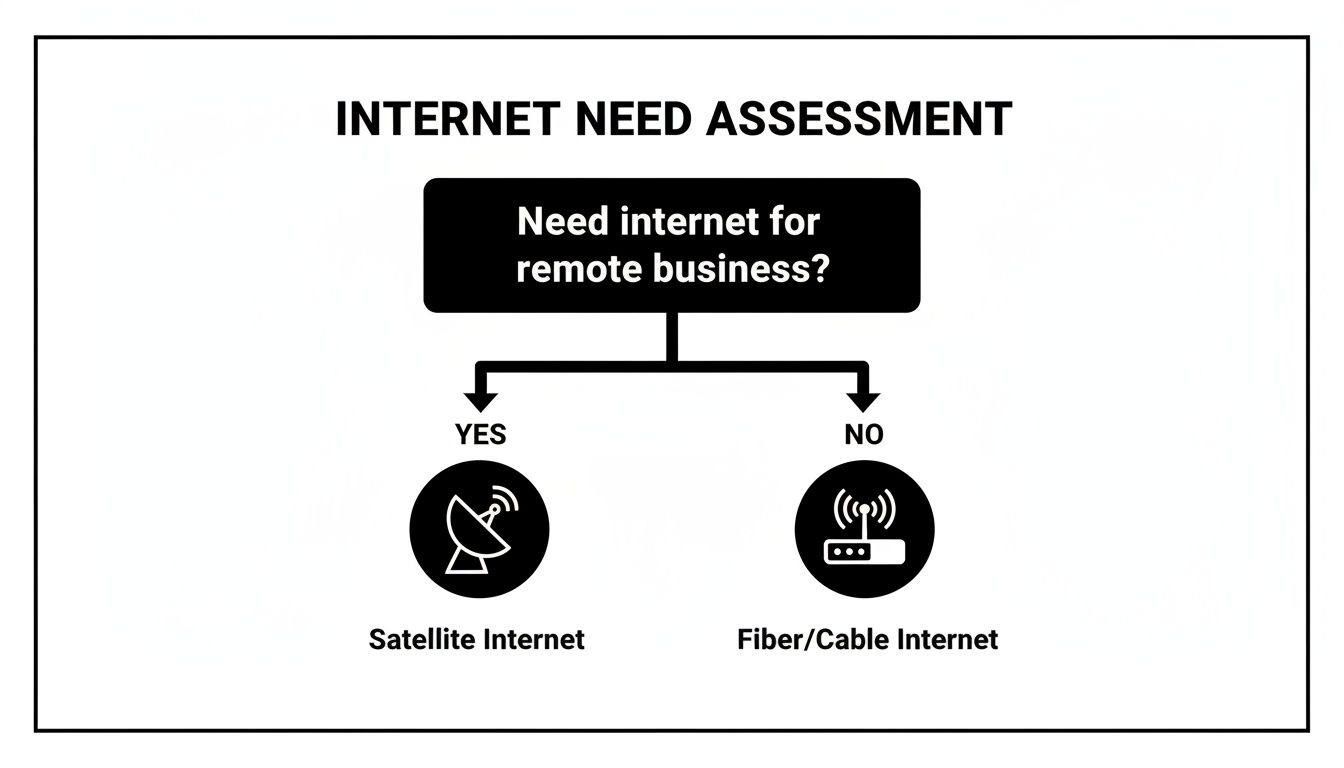
For businesses operating in remote or mobile environments where traditional internet is not a viable option, a satellite solution like Starlink becomes the essential tool for staying connected.
Understanding The Core Plan Types
Starlink structures its plans into key categories, each designed for a specific application. It's vital to match the plan to how and where your business will use the service.
-
Standard (Fixed Location): This is the foundational plan, designed for a single, fixed address like a farm office, a rural workshop, or a remote tourist lodge. It provides unlimited standard data and is the ideal choice for most businesses that operate from a permanent location.
-
Priority (Fixed Location): This plan is engineered for businesses that cannot afford connectivity disruptions. The Priority plan gives your data traffic preferential treatment on the network, ensuring you receive more consistent high speeds, especially during peak usage times. It is perfect for sites running VoIP phone systems, cloud-based ERP software, or streaming live CCTV feeds where a drop in speed could halt operations.
-
Mobile (Portable & In-Motion): As the name suggests, this plan is designed for use on the move. It is the essential choice for vehicles, vessels, and temporary worksites. It requires specialised hardware engineered to maintain a satellite lock while in motion, making it a perfect fit for transport fleets, maritime operators, and mobile construction offices.
The Importance of Priority Data
Priority Data is a game-changing feature for commercial users. Imagine the Starlink network as a multi-lane motorway. Standard data travels in the general traffic lanes; you'll reach your destination, but you might encounter congestion during peak hours.
Priority Data is your dedicated express lane.
For a business, this is non-negotiable for critical tasks. It guarantees that your most important data, like a payment transaction, a health and safety report upload, or a video conference with stakeholders, gets through at maximum speed, regardless of network congestion. Priority plans include a set monthly allocation of this high-speed data (e.g., 1TB or 2TB). If you exceed your allocation, you can purchase more or revert to the unlimited standard data plan.
You can explore the investment required in our guide to Starlink costs in NZ.
Starlink Plan Comparison For NZ Businesses
This table breaks down the main options to help you align a plan with your business needs, whether you require guaranteed data priority, on-the-go connectivity, or a simple fixed connection.
| Plan Feature | Standard (Fixed) | Priority (Fixed) | Mobile Priority (In-Motion) |
|---|---|---|---|
| Best For | Rural offices, workshops, lodges at one address. | Businesses needing top-tier performance for critical apps. | Vehicles, vessels, temporary sites, and mobile operations. |
| Data Type | Unlimited Standard Data. | A set amount of Priority Data, then Unlimited Standard. | A set amount of Mobile Priority Data, then Unlimited Standard. |
| Mobility | No, designed for a fixed location only. | No, designed for a fixed location only. | Yes, purpose-built for use while moving. |
| Hardware | Standard Dish | High Performance Dish | Flat High-Performance Dish |
| Use Case | General business internet, email, basic cloud apps. | VoIP, live video feeds, large file transfers, payment processing. | Fleet management, marine comms, remote field work. |
Your choice ultimately depends on two factors: are you stationary or mobile? And how critical is consistent, high-speed performance to your daily operations?
Hardware and Plan Alignment
Your hardware choice is directly tied to your selected plan; they cannot be mixed and matched.
-
The Standard Dish is supplied with Standard plans for fixed locations. It is a robust unit that delivers excellent performance but is not designed or warrantied for use while in motion.
-
The High Performance Dish is available for Priority plans, offering enhanced performance in adverse weather and challenging environments.
-
The Flat High-Performance Dish is the mandatory hardware for all in-motion Mobile Priority plans. It features a wider field of view to track satellites from a moving vehicle or vessel, superior weather resistance, and a rugged build designed to withstand the harsh conditions of road or sea travel.
Choosing the right combination of plan and hardware is the first and most crucial step to unlocking reliable, high-speed internet, no matter how remote your operation.
Which Starlink Plan Is Right for Your NZ Industry?
Selecting the correct Starlink plan is not a one-size-fits-all process. What works for a head office in Auckland is unsuitable for a fishing trawler off the coast of Fiordland. The optimal setup depends entirely on the unique demands of your industry, from the salt-sprayed deck of a commercial vessel to a remote, dusty construction site.
Let’s examine the most effective plans for New Zealand’s key commercial sectors.
Maritime, Marine, and Fishing
Once a vessel loses sight of the coast, cellular signals disappear, leaving crews isolated. For any maritime operation, reliable communication is a non-negotiable lifeline for safety, compliance, and operational efficiency. Starlink has revolutionised connectivity at sea.
The definitive choice for any marine application is a Mobile Priority plan paired with the Flat High-Performance Dish. This combination is purpose-built to handle the unforgiving conditions on the water.
- Why It Works: The Flat High-Performance hardware is engineered to maintain a stable satellite lock, even as the vessel rolls and pitches in heavy seas. Its high IP rating for weather resistance means it can withstand constant exposure to salt spray and harsh marine elements.
- The Onboard Advantage: Mobile Priority data provides your vessel with a high-speed, low-latency connection crucial for sending catch reports, accessing real-time weather data from sources like MetService, and supporting crew welfare. It can even be used for remote diagnostics on vital machinery, transforming your vessel into a fully connected operational hub, no matter how far from shore you are.
Construction and Civil Works
Construction sites, particularly during the initial earthworks and foundation stages, are notorious connectivity black spots. They are often located in new subdivisions or remote areas with no existing internet infrastructure, and establishing a temporary fixed-line connection can be slow and costly.
Starlink offers unparalleled flexibility for these environments.
- For the Site Office: A Standard (Fixed) or Priority (Fixed) plan is perfect for the temporary cabin or Portacom. It provides more than enough bandwidth to run project management software, submit digital compliance forms like those required by WorkSafe NZ, hold video calls with architects, and support the entire site’s administrative functions.
- For Mobile Teams and Vehicles: A Mobile plan is essential for maintaining connectivity across a large site or in work vehicles moving between locations. This is ideal for supervisors, surveyors, and machinery operators who require constant access to digital plans and data while on the move.
Agriculture and Horticulture
Modern farming and horticulture are increasingly data-driven. From smart irrigation systems and soil sensors to drone mapping and cloud-based livestock management, data is fundamental to productivity. For farms and orchards located in the high country or remote valleys, Starlink provides the digital backbone to make these technologies viable.
A Priority (Fixed) plan is typically the wisest investment for the main farm office or packhouse.
While a Standard plan is suitable for basic connectivity, the Priority plan offers the resilience required for business-critical applications. When processing payments during the peak harvest season or relying on a VoIP phone system as your primary line of contact, the consistent high performance of Priority Data is essential.
This ensures your most important operational data is always prioritised, preventing costly delays and supporting a more efficient, data-driven enterprise. For large properties, multiple Starlink terminals can create a seamless network covering different sheds, workshops, and operational zones, all without relying on patchy cellular coverage. This is the robust connectivity that empowers farmers to fully embrace smart agriculture and boost productivity.
Commercial Installation and Network Integration
Deploying a Starlink dish on a commercial site is fundamentally different from a simple residential setup. While the hardware is impressive, its full potential is only realised through a professional installation that integrates it into your existing operational systems. This is where expert planning and execution are paramount.
A professional commercial Starlink installation is not just about mounting a dish. It’s about weaving that powerful internet connection into your existing, often complex, robust network infrastructure to ensure flawless interoperability. This transforms a standalone internet source into the reliable backbone of your entire communications ecosystem.

Optimising Hardware Placement and Durability
The first step is identifying the optimal location for the dish, ensuring a clear, wide view of the sky, free from obstructions like trees, buildings, or other equipment.
- On a Vessel: Mounting must account for constant motion and avoid signal blockage from masts or radar equipment. We exclusively use marine-grade mounts to guarantee stability and durability against corrosion.
- On a Worksite: A temporary site office requires a secure mounting point that is safely away from heavy machinery while still achieving the best possible line of sight.
- On a Rural Property: The roof of a packhouse or workshop is often ideal, but we always conduct a thorough site survey to find the perfect location that balances signal strength with an efficient and protected cable run.
A professional installation ensures the hardware is secured against New Zealand's weather and positioned for peak, long-term performance. Learn more about our specialised approach in our guide to Starlink installation services.
Powering Your Connection Off-Grid
Many remote commercial sites lack reliable mains power. We specialise in designing and implementing off-grid and mobile power solutions, including solar and battery-backup systems. This keeps your Starlink and other connected systems online 24/7, which is critical for safety and operational continuity.
Integrating Starlink Into Your Business Network
This is where commercial operators realise the true return on their investment. Starlink's powerful internet backhaul can be bridged with your other mission-critical communication tools.
At Mobile Systems, we don’t just install a satellite dish; we integrate it to create a unified communications network. We can bridge your Starlink connection with on-site Wi-Fi, CCTV security systems, and even your UHF/VHF radio network using Radio over IP (RoIP) technology. This complies with all licensing rules managed by Radio Spectrum Management (RSM).
This integration means a team member in a remote forest with a two-way radio can communicate seamlessly with head office in Tauranga. It means you can monitor live security footage from a construction site hundreds of kilometres away.
By partnering with an expert integrator like Mobile Systems, you ensure your investment in a Starlink internet plan becomes a powerful, strategic asset that drives efficiency, safety, and productivity across your entire operation.
Why Partner with Mobile Systems for Your Starlink Solution?
Any business can order a Starlink kit online. But deploying it to perform reliably and safely on a demanding New Zealand worksite, vessel, or vehicle is another matter entirely.
Choosing the right Starlink internet plan is just the beginning. The real challenge, and where the true value lies, is transforming that satellite connection into a resilient, fully integrated business asset. That is precisely what we do at Mobile Systems.
As a 100% NZ-owned and operated company based in Mount Maunganui, we have spent nearly two decades solving complex communication challenges for New Zealand businesses. We understand the unique pressures and harsh conditions you face because we work in them every day. We don't just sell you a product; we deliver a complete, field-tested solution that works.
Local Expertise and Hands-On Support
When you contact us, you’re not dealing with an overseas call centre. You’re speaking directly with our team of experienced technicians.
Our mobile fleet is equipped to handle everything on-site. We conduct initial site surveys and coverage planning, manage professional installations, and provide ongoing aftercare. We come to you, wherever your business operates, to ensure your system is optimised from day one.
Partnering with a local expert means you have a dedicated team who knows your setup inside and out. We provide direct, no-fuss support to resolve issues quickly, minimising your downtime and keeping your operation running smoothly.
More Than a Dish: A Fully Integrated Solution
A standalone Starlink connection is powerful, but its true potential is unlocked only when it is seamlessly integrated with your other critical systems. This is where our deep expertise in radio, cellular, and satellite technologies comes into play.
We specialise in building unified communications networks.
- Professional Installation: We ensure your hardware is mounted securely and positioned perfectly to withstand NZ weather, whether on a vessel, vehicle, or rural depot.
- System Integration: We can bridge your Starlink internet with on-site Wi-Fi, CCTV cameras, and your existing UHF/VHF radio network to create a seamless flow of communication.
- Ongoing Maintenance and Support: We are your long-term partner, providing expert servicing and support to ensure your investment continues to perform year after year.
Choosing Mobile Systems means gaining a dedicated communications partner genuinely invested in making your operation safer and more efficient. It’s the difference between merely having internet and having a resilient, professionally supported communications backbone for your entire business.
If you’re ready for a Starlink solution built for the realities of your industry, our team is here to provide the expert guidance you need.
Talk to a communications specialist today and let’s build a solution that works for you.
Your Top Questions About Starlink for Business Answered
Upgrading your business's connectivity is a significant decision. To help you make a clear and confident choice about the right Starlink internet plan, we've compiled straightforward answers to the most common questions we receive from commercial operators across New Zealand.
Can Starlink truly replace my existing rural broadband or 4G connection?
For the vast majority of remote commercial operations in New Zealand, the answer is an emphatic yes. In terms of speed, latency, and reliability, Starlink operates in a different league compared to older satellite services, inconsistent rural broadband, or patchy 4G. It is more than capable of serving as the primary, high-performance internet connection for your entire operation.
For businesses where even a moment of downtime is unacceptable, such as critical infrastructure monitoring or emergency response coordination, we can engineer an additional layer of resilience. A common solution is to configure Starlink as the primary connection with an automatic 4G failover. This creates full redundancy, providing peace of mind that your operation will remain online, no matter what.
How does the hardware hold up in harsh NZ environments?
Starlink hardware is built to be tough, but its longevity in New Zealand's most challenging environments depends on a professional installation. This is particularly true for our maritime and alpine clients, where equipment is constantly exposed to salt spray, high winds, and extreme temperatures.
The Flat High-Performance dish, essential for any mobile or maritime plan, has a high IP rating, making it highly resilient to rain, wind, and corrosive salt air. However, the key to maximising this durability lies in the installation itself.
At Mobile Systems, we use only marine-grade mounts and proven installation techniques to secure the hardware. We focus on optimal placement to protect it from the worst of the elements while ensuring a perfectly clear view of the sky. This is how we ensure your investment is built to last.
What happens if my business needs technical support?
This is one of the most significant differences between a DIY setup and partnering with a dedicated communications specialist. If you encounter a problem with a self-installed kit, your only recourse is a standard consumer support system, which can be a slow and frustrating process when your business is offline.
When you work with Mobile Systems, you have a direct line to our New Zealand-based team of experts. We know your specific setup because we designed and installed it. We provide dedicated troubleshooting, run remote diagnostics, and, if necessary, dispatch our mobile support fleet for prompt on-site service. This hands-on approach dramatically reduces downtime and gets you back to business quickly.
Can I use a standard Starlink plan on my vehicle or vessel?
No. Attempting to do so is a common mistake that results in poor performance and violates Starlink's terms of service. The terms are clear: using the service while in motion requires a designated Mobile plan and the appropriate hardware, specifically the Flat High-Performance dish.
There are sound technical reasons for this. The mobile-rated hardware is engineered differently to maintain a stable connection while being rocked by waves or bounced along a worksite track. More importantly, the Mobile Priority and Mobile plans ensure your data is correctly prioritised on the network as you move between satellite coverage cells. Using the right plan and hardware is not a suggestion; it is essential for performance, reliability, and compliance.
Related posts

- May 24, 2026
Our expert Starlink review NZ looks at speed, pricing, and reliability for business, farm, and maritime use. See if it's...

- May 23, 2026
Approximately 40% of New Zealand's landmass remains outside the reach of traditional mobile networks. For professional teams operating in remote...

- May 14, 2026
A complete guide to Starlink setting up for NZ businesses. Learn pro tips on site survey, mounting, network integration, and...