
Buying Two-Way Radios in NZ: The 2026 Professional Guide
Is your communication system a genuine safety asset or a hidden liability? While consumer-grade sets like the $89.99 Uniden UH45-2 serve recreational users well, they lack the power and durability required for profession…
Is your communication system a genuine safety asset or a hidden liability? While consumer-grade sets like the $89.99 Uniden UH45-2 serve recreational users well, they lack the power and durability required for professional operations. When you are buying two way radios nz business owners must look beyond basic walkie-talkies to find systems that withstand remote terrain and long shifts.
It's frustrating when communication blackspots or battery failures disrupt your workflow; especially when you're trying to meet strict health and safety standards. This guide clarifies exactly how to select commercial-grade systems that provide reliable coverage across New Zealand's challenging landscapes. You'll learn how to navigate technical specifications to ensure your investment delivers clear audio from the first hour to the last.
We'll detail how to integrate radios into vehicle fleets and explain why 98.6% of commercial users must prepare for the July 1, 2026, license fee increase to $190.00. Understanding these technical requirements helps you choose hardware that ensures your team stays connected. At Mobile Systems, we've found that a tailored assessment prevents costly mistakes and ensures your system remains compliant with the Radiocommunications Act 1989.
Meta Description: Master the 2026 NZ radio landscape. Learn about RSM licensing changes, commercial-grade hardware, and how to eliminate communication blackspots for your fleet.
URL Handle: buying-two-way-radios-nz
Key Takeaways
- Identify the critical differences between consumer CB units and commercial systems to ensure your communication gear survives harsh industrial environments.
- Match your radio technology to specific New Zealand terrain, ensuring clear signals whether you operate in dense bush or urban construction sites.
- Discover the strategic advantages of combining handheld portables with high-power vehicle mounts when buying two way radios nz for your business fleet.
- Gain clarity on current Radio Spectrum Management (RSM) requirements to ensure your operation remains fully compliant with national licensing regulations.
- Understand why professional installation and precise antenna placement are the most important factors in achieving maximum communication range and reliability.
Understanding the NZ Radio Landscape: CB vs. Commercial
When buying two way radios nz businesses often struggle to distinguish between consumer-grade walkie-talkies and commercial systems. In New Zealand, the radio spectrum is managed by Radio Spectrum Management (RSM), a division of the Ministry of Business, Innovation and Employment. RSM operates under the Radiocommunications Act 1989 to ensure frequencies remain organized and interference is minimized. Understanding Two-way radio technology is the first step in choosing a system that meets your operational needs.
Commercial radio systems provide the reliable, instant communication required to meet Health and Safety at Work Act 2015 obligations in high-risk environments. Unlike consumer sets, these professional tools are designed as safety-critical infrastructure rather than recreational accessories.
To better understand how different radio types compare in real-world scenarios, watch this helpful analysis:
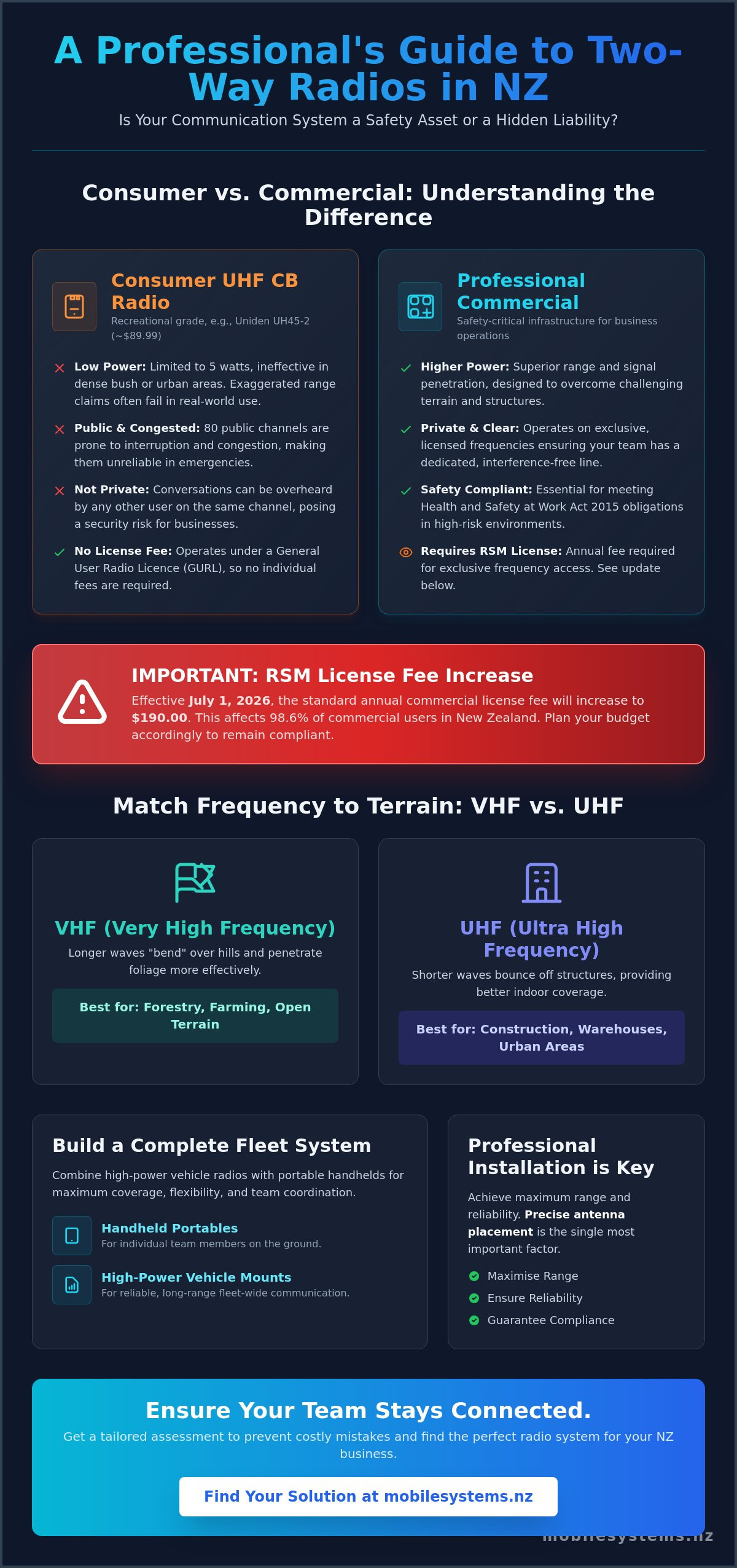
A common mistake is purchasing consumer units based on exaggerated range claims. Some retailers suggest ranges up to 17km, but these figures usually apply only to perfect line-of-sight conditions, such as from one mountain peak to another. In the dense bush of the Central North Island or the "urban canyons" of Auckland, these units frequently fail due to low power output and inferior antenna quality.
UHF CB: When is it enough?
UHF Citizen Band (CB) radios operate under a General User Radio Licence (GURL), specifically license number 228151. This means you don't need an individual license or have to pay annual fees to use the 80 designated channels. While these are excellent for short-range coordination or recreational convoys, they have significant drawbacks for professional use:
- Public access means your conversations aren't private and can be interrupted by other users.
- Congestion in busy areas can make it impossible to find a clear channel during an emergency.
- The power is limited to 5 watts, which often isn't enough to penetrate heavy foliage or steel structures.
Commercial VHF and UHF: The professional choice
Commercial systems operate on exclusive frequencies assigned specifically to your business. This prevents "crosstalk" from neighboring sites and ensures your team has a clear line of communication at all times. For those ready to view professional options, our commercial radio collection features hardware designed for New Zealand's unique conditions.
Choosing between VHF (Very High Frequency) and UHF (Ultra High Frequency) depends on your specific terrain. VHF is generally superior for outdoor environments like forestry or farming because the longer waves "bend" over hills and pass through trees more effectively. UHF is better suited for construction sites or warehouses where the shorter waves bounce off concrete and metal to provide better indoor coverage. Effective July 1, 2026, the standard annual fee for these commercial licenses will increase to $190.00, reflecting the value of this dedicated spectrum.
Key Factors to Evaluate Before Buying Two-Way Radios
Selecting the right hardware requires a systematic approach to your operational environment. When buying two way radios nz decision-makers should prioritize functional reliability over upfront cost savings. You must ensure all equipment complies with the Prohibited Equipment Notice issued by the New Zealand government. This prevents the use of non-compliant hardware that can cause harmful interference to emergency services or other licensed users.
- Step 1: Assess your terrain. Identify whether your team operates in dense bush, urban canyons, or open farmland to determine if VHF or UHF is appropriate.
- Step 2: Determine user count. Calculate your peak user count and needed channel capacity to avoid communication bottlenecks during busy shifts.
- Step 3: Evaluate durability. Check IP ratings for dust and water resistance to ensure your hardware survives wet New Zealand winters.
- Step 4: Check battery life. Ensure your selected units can sustain 12-hour shifts or remote work without requiring mid-day charging.
Terrain is the primary factor in signal propagation. Dense bush and hilly terrain in regions like the King Country require VHF frequencies for their superior diffraction capabilities. Conversely, urban environments with concrete structures benefit from UHF signals that reflect better within buildings. A tailored assessment often prevents costly mistakes by matching the hardware to these environmental variables.
Analogue vs. Digital (DMR) Systems
Digital Mobile Radio (DMR) has largely superseded analogue technology in commercial settings. Our DMR radio explainer details how digital systems maintain audio clarity right to the edge of the coverage area. Unlike analogue, which gets noisier as you move away, digital signals remain clear until they drop out. These systems also support integrated GPS tracking and text messaging for lone worker safety.
Durability and IP Ratings for NZ Conditions
Professional radios are often built to MIL-STD-810 standards. They pass rigorous drop, vibration, and temperature tests. If you operate in fuel depots or timber mills, you might require "intrinsically safe" (IS) hardware. These units prevent sparks that could ignite flammable gases or dust. It's a significant safety risk to choose the wrong hardware in these environments, and it can lead to regulatory fines.
Handheld vs. Fixed-Mount: Building Your Fleet System
When buying two way radios nz fleet managers must decide between the mobility of handheld units and the raw power of fixed vehicle mounts. The technical difference is substantial. A standard professional handheld radio typically outputs 5 watts of power, while a vehicle-mounted unit delivers 25 watts or more. This fivefold increase in power allows signals to push through heavy rain and challenging topography that would otherwise block a handheld signal.
A hybrid communication strategy often provides the best results for New Zealand businesses. This involves equipping ground crews with rugged handhelds while installing high-power mobile units in trucks, loaders, or utes. The vehicle-mounted radio acts as a communication hub, ensuring that even if a worker moves into a valley, the vehicle remains within reach of the main base or repeater station. For those who need to supplement their business fleet with reliable transport for staff or site inspections, you can visit Drive NZ Rental Cars to find suitable hatchbacks and SUVs for your New Zealand travels.
Range is not just about power; it's about antenna efficiency. Fixed-mount units utilize external antennas mounted on the vehicle roof, providing a superior ground plane and higher elevation than a handheld's flexible "rubber ducky" antenna. All equipment must be configured to meet the technical standards set by Radio Spectrum Management (RSM) to ensure your fleet doesn't interfere with other licensed users.
Handheld Radios (Walkie-Talkies) for Ground Teams
For staff on foot, ergonomics and durability are the primary concerns. Professional units from brands like Tait and Hytera are designed for use with heavy work gloves and feature high-visibility displays. These devices are built to survive drops on gravel and submersion in mud, which are common occurrences on NZ worksites. Our professional walkie talkie guide provides a deeper look at the specific models currently leading the market in reliability.
- Lightweight designs reduce user fatigue during 12-hour shifts.
- Large, textured Push-to-Talk (PTT) buttons ensure reliable operation in cold weather.
- Noise-cancelling microphones filter out background machinery hum for clearer audio.
Fixed-Mount Radios for Vehicle Fleets
Fixed-mount radios are essential for teams operating in remote areas like the Southern Alps or the King Country. By integrating directly with the vehicle's 12V or 24V power system, these units avoid the battery life limitations of handhelds. This permanent installation also allows for high-gain external antennas that are critical for signal penetration in deep valleys. You can view our full range of vehicle-ready hardware in our Two-Way Radio collection to find the right fit for your fleet.
Professional installation ensures these units don't cause interference with modern vehicle electronics. Poorly shielded cables or incorrect grounding can disrupt GPS systems or engine management units. A strategic installation places the antenna for maximum 360-degree coverage, significantly extending your operational footprint compared to a DIY setup.
Navigating NZ Licensing and Compliance Requirements
Radio Spectrum Management (RSM) controls the New Zealand airwaves to prevent communication chaos. When buying two way radios nz, choosing the right license type is just as important as the hardware itself. Most businesses move beyond the free General User Radio Licence (GURL) to secure an individual license for dedicated, interference-free communication.
Effective July 1, 2026, the standard annual fee for an individual radio license increases to $190.00. This fee covers the administrative costs of maintaining your exclusive frequency and protecting it from signal overlap. Investing in this license ensures your team has a clear, reliable channel for safety-critical instructions without competing with public users.
Using unapproved hardware imported from overseas is a significant legal risk. These radios often lack the necessary filters to stay within NZ-approved bands and may bleed into restricted frequencies. If your equipment disrupts emergency service or aviation channels, you face equipment seizure and prosecution under the Radiocommunications Act 1989.
Why Licensing Matters for Business Safety
Licensed frequencies provide a legal "right of way" that hobbyist channels cannot offer. In high-stakes environments like forestry or heavy construction, you can't afford to have your safety protocols interrupted by unauthorized users. Licensed digital systems also support critical features like "Man Down" sensors and "Lone Worker" timers.
These features automatically trigger an alarm if a staff member stops moving or fails to check in at a pre-set interval. On a busy public CB channel, these digital distress signals could be blocked or ignored. A dedicated frequency ensures these safety alerts reach your base station or fleet manager instantly, every time.
Working with a Qualified NZ Radio Dealer
A professional dealer acts as your liaison with RSM, handling the complex frequency coordination required for a new license application. When buying two way radios nz from a local expert, we ensure your handheld and vehicle-mounted units are programmed strictly to NZ/AS standards. This technical precision prevents your system from causing interference with neighboring businesses.
Professional dealers also manage the ongoing license renewals and technical updates required by the Radiocommunications Regulations 2001. This allows you to focus on your operations while we ensure your communication infrastructure remains fully compliant. To ensure your fleet meets all local regulatory standards, speak with our compliance experts today.
Why Professional Installation is a Strategic Investment
When buying two way radios nz, the hardware is only half of the equation. The actual performance of a professional 25W mobile unit relies heavily on the precision of its installation. Poor antenna placement or the use of low-grade coaxial cabling can reduce your effective communication range by 50% or more, turning a high-end system into a liability.
DIY kits often overlook the technical nuances of grounding and signal loss. A professional installer uses specialized equipment to measure the Voltage Standing Wave Ratio (VSWR), ensuring maximum power reaches the antenna rather than reflecting back into the radio. This technical calibration prevents hardware overheating and ensures your signal reaches across the valley as intended.
Modern vehicles are packed with sensitive electronics and complex CAN bus wiring. Incorrectly installed radio equipment can lead to phantom electrical faults or interfere with GPS tracking systems and engine management units. Professional installation mitigates these risks by using correct shielding and dedicated power runs that don't compromise the vehicle's integrity.
The Mobile Systems Difference
Based in Mount Maunganui, Mobile Systems provides nationwide service and on-site support across both the North and South Islands. We don't just sell boxes; we design custom communication ecosystems tailored for forestry, heavy transport, and emergency services. Our team understands how New Zealand's volcanic soil and dense bush impact signal propagation.
A tailored assessment often prevents costly mistakes in hardware selection by identifying specific terrain challenges before you commit to a system. This ensures your investment provides the coverage your team needs to stay safe and productive. To ensure your fleet meets all local regulatory standards, you should consult with a specialist regarding your specific site requirements.
After-Sales Support and Servicing
Maintaining a radio fleet requires more than just charging batteries. Regular "health checks" are essential to ensure your devices haven't drifted off-frequency, which can lead to poor audio quality or non-compliance with RSM standards. We provide essential firmware updates that keep your digital features, like GPS and text messaging, functioning correctly.
Our mobile support vehicles are equipped to provide on-site servicing and repairs, keeping your team operational in the field. This proactive maintenance schedule protects your long-term ROI and ensures your safety-critical communication tools work when they're needed most. We focus on building long-term partnerships, ensuring your system evolves alongside your operational requirements.
Securing Reliable Fleet Communication for the Future
Selecting the right communication infrastructure involves balancing technical requirements with long-term operational goals. You've seen how commercial frequencies and professional installation provide a level of reliability that consumer sets cannot replicate. When buying two way radios nz business owners must prioritize systems that offer both immediate clarity and the flexibility to grow with the fleet.
Mobile Systems supports your operation as an authorized Tait and Hytera dealer, providing access to hardware that is specifically engineered for New Zealand's environment. Our nationwide mobile service vehicles bring technical expertise directly to your site, ensuring your equipment remains operational regardless of the terrain. We focus on maintaining strict Radio Spectrum Management compliance, allowing you to focus on your core business without worrying about regulatory shifts.
Don't leave your team's safety to chance with unproven hardware or poorly configured frequencies. Choosing a professional partner ensures your communication remains a strategic asset rather than a technical burden. To start building a more reliable network for your team, contact the expert team for a custom communication assessment today.
Frequently Asked Questions
Do I need a licence to use a two-way radio in New Zealand?
It depends on the frequency band you intend to use for your operations. Personal Radio Service (PRS) on 477 MHz is covered by a General User Radio Licence (GURL) which is free; however, businesses buying two way radios nz for private operations require an individual commercial licence. Effective July 1, 2026, these standard commercial licences cost $190.00 annually.
What is the maximum range I can expect from a 5W handheld radio in NZ bush?
You can typically expect a range of 1km to 3km in dense New Zealand bush with a 5W handheld. While some manufacturers claim ranges up to 17km, these figures only apply to perfect line-of-sight conditions. Dense foliage and undulating terrain quickly absorb and block radio waves, which significantly reduces the effective distance.
Can I use Australian UHF radios in New Zealand?
Yes, Australian UHF CB radios are generally compatible because New Zealand and Australia share the same 477 MHz band technical standards. You must verify the device explicitly complies with the AS/NZS 4365 standard before use. Using non-compliant hardware can lead to interference and potential enforcement action from Radio Spectrum Management (RSM).
What is the difference between VHF and UHF for NZ forestry work?
VHF is the superior choice for forestry work because its longer wavelengths diffract more effectively over hills and through thick canopy. While UHF is excellent for bouncing signals around concrete structures in urban areas, it struggles with the high signal absorption rates found in wet, dense timber environments common in the Central North Island.
How long do professional radio batteries typically last on a single charge?
Modern professional lithium-ion batteries typically last between 12 and 18 hours on a single charge. This duration is based on a standard 5-5-90 duty cycle, where the user spends 5% of the time transmitting and 5% receiving. Digital radios often provide 20% better battery efficiency than analogue models because the transmitter is not constantly active during a call.
Is it better to buy or lease a radio system for a large fleet?
Buying is usually the better long-term financial decision for established businesses as it results in a lower total cost of ownership over a five-year period. Leasing is a practical alternative for large fleets when you prefer to preserve capital or wish to include maintenance and regular hardware upgrades in a single monthly operating expense.
Can digital (DMR) radios talk to older analogue radios?
Yes, most modern Digital Mobile Radio (DMR) units are dual-mode and can communicate with older analogue radios. This allows you to phase in new digital hardware while still utilizing your existing analogue fleet. You simply program the new radios with analogue channels to maintain team compatibility during your fleet transition.
What happens if my radio equipment is not NZ/AS compliant?
Using non-compliant hardware puts your business at risk of equipment seizure and significant fines under the Radiocommunications Act 1989. Non-compliant radios often transmit on restricted frequencies, which can disrupt emergency services or aviation channels. Ensuring your supplier provides NZ/AS certified hardware is a critical legal requirement for any New Zealand business.
Related posts

- June 11, 2026
PoC or UHF/VHF? An honest comparison of coverage, cost, licensing and reliability for New Zealand worksites.

- June 08, 2026
In New Zealand’s vertical terrain, the network constellation matters more than the device features. When you're deep in the Southern...

- June 05, 2026
Transport & Logistics Fleet-wide communication that actually works: digital radio for NZ transport and logistics Transport & Logistics 8 min...