
What to Do When Cell Service Fails: A Guide for NZ Business Resilience
Cellular connectivity is a convenience, yet it remains a single point of failure for many New Zealand businesses. With the complete shutdown of 3G networks in early 2026 and the impact of recent network outages
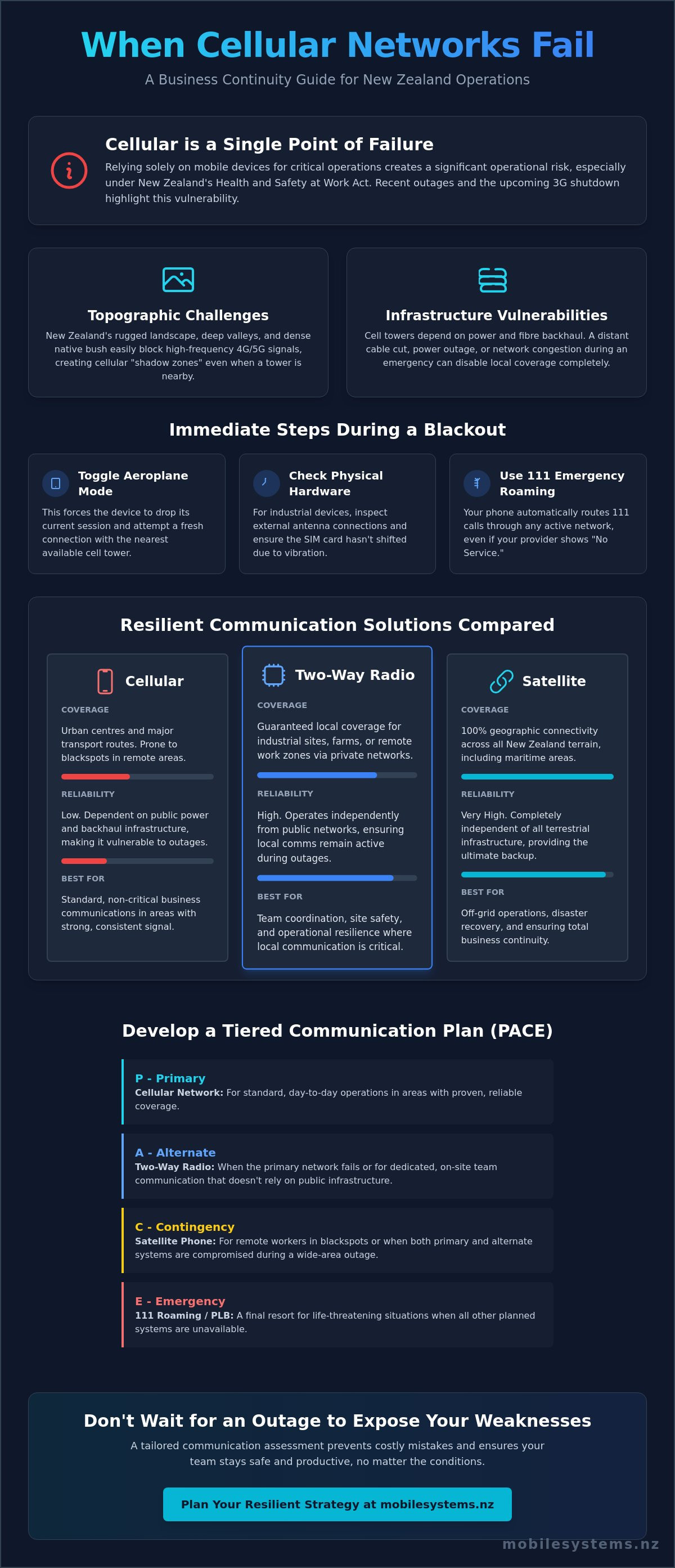
Cellular connectivity is a convenience, yet it remains a single point of failure for many New Zealand businesses. With the complete shutdown of 3G networks in early 2026 and the impact of recent network outages, relying on a mobile device for critical operations is an operational risk. You likely recognise that your team's safety and your business continuity shouldn't depend on the proximity of a functional cell tower. Understanding what to do when cell service fails is essential for meeting your obligations under the Health and Safety at Work Act.
This guide from Mobile Systems provides a technical overview of how to maintain communication and safety when cellular networks are unavailable or compromised. You will learn how to implement a robust backup strategy using professional radio and satellite systems to ensure 100% coverage across the New Zealand terrain. We will examine the functional differences between vehicle-mounted two-way radios and satellite phones, providing the clarity required to protect isolated workers and eliminate operational downtime during network failures.
Key Takeaways
- Identify the topographical and infrastructure limitations that lead to cellular "shadow zones" and network vulnerabilities across New Zealand.
- Establish a clear protocol for what to do when cell service fails, including the use of emergency roaming for 111 calls and device status verification.
- Discover how two-way radio systems and private repeater networks provide guaranteed local coverage for industrial and remote work sites.
- Understand the role of satellite phones in achieving total geographic connectivity for off-grid operations and business continuity.
- Learn to apply the PACE methodology to create a resilient, tiered communication plan that addresses primary, alternate, contingency, and emergency scenarios.
Understanding Why Cellular Networks Fail in New Zealand
Cellular networks provide an essential service, but they're inherently fragile in the face of New Zealand's unique geography. Relying solely on mobile phones for remote operations creates a significant safety gap. Understanding what to do when cell service fails is a critical component of any New Zealand business continuity plan, especially for those operating outside urban centres. While urban 5G coverage is expanding, the underlying infrastructure remains vulnerable to both environmental and technical pressures.
To better understand this concept, watch this helpful video:
Topographic Challenges: Valleys and Bush
New Zealand's rugged landscape is a major obstacle for cellular signals. High-frequency 4G and 5G bands require a clear line-of-sight between your device and the tower. In deep valleys or areas with dense native bush, these signals are easily blocked or absorbed. This is why blackspots are so prevalent in the forestry and high-country farming sectors. While a cell tower might be only a few kilometres away, the terrain makes it effectively invisible to your hardware. Lower frequency radio waves are often more effective in these environments as they can diffract over obstacles that stop cellular signals entirely.
Infrastructure Vulnerabilities
The national mobile network isn't just a series of towers; it's a complex web of fibre-optic cables and power supplies. Most cell sites in New Zealand rely on terrestrial fibre backhaul to transport data. If a single cable is severed by construction or a slip 100km away, the local tower loses its connection to the world. During the 2026 cyclone season, power outages at base stations were the primary cause of network failures. A reliable emergency communication system avoids these single points of failure by using independent technology.
Capacity also plays a role through a process known as cell breathing. Cell breathing is a dynamic network management function where a cell site's coverage area shrinks as the volume of active users increases to maintain signal quality for those closest to the tower. During an emergency or peak event, your team might lose connectivity simply because the network is overloaded. When evaluating what to do when cell service fails, you must distinguish between a local signal shadow and a wide-area outage. If a device shows "No Service" across a wide geographic area, it usually indicates a failure in the backhaul or power supply. For many businesses, moving toward professional two-way radio systems ensures that local communication remains functional even when the public network is down.
Immediate Steps to Take During a Communication Blackout
When a mobile device loses connectivity, the initial response determines how quickly a team can restore operational awareness. Knowing what to do when cell service fails starts with identifying the source of the disruption. Sudden silence on a device doesn't always indicate a national network failure; it can often be a localized hardware fault or a specific terrain-based shadow zone. Staff should be trained to perform a rapid diagnostic check before escalating to emergency protocols.
Device Troubleshooting
The most effective immediate action is toggling Aeroplane Mode. This forces the device to drop its current session and attempt a fresh handshake with the nearest available cell tower. If this fails, inspect the hardware for physical issues. For teams using industrial cellular devices, check the external antenna connections and ensure the SIM card hasn't shifted due to vibration or impact. In remote New Zealand environments, software-based resets rarely resolve connectivity issues caused by geographic barriers.
Emergency 111 Roaming
New Zealand's telecommunications infrastructure allows for emergency roaming. If your primary provider has no coverage, your phone will automatically attempt to route 111 calls through any active network in the area, regardless of your plan. This means a phone showing "No Service" might still successfully place an emergency call if a competitor's tower is within reach. To maximize this capability, move to the highest available point in the landscape. Maintaining a stationary position at a high elevation increases the likelihood of sustaining a weak signal long enough for emergency services to triangulate a location.
If the cellular network is entirely compromised but local internet remains active via satellite or fibre, Wi-Fi calling can serve as a temporary bridge. This feature allows the device to use a local wireless network to place standard voice calls. However, this is a fragile solution that depends on the local power supply and router stability. For long-term resilience, relying on consumer-grade workarounds is a common mistake that leads to safety risks. A tailored communication assessment often prevents costly mistakes by identifying these vulnerabilities before they lead to a critical failure in the field.
Field staff must follow established safety protocols when primary communication fails. This includes staying with their vehicle, which often contains superior communication tools and provides shelter. Moving aimlessly in search of a signal frequently results in workers becoming lost or entering more dangerous terrain without the ability to call for assistance. Clear procedural documentation ensures that every team member understands their role when the network goes dark.
Implementing Two-Way Radio Systems for Local Resilience
Two-way radio systems provide a closed-loop communication environment that operates independently of public cellular infrastructure. For New Zealand businesses, this independence is a primary solution for what to do when cell service fails during regional outages. These systems don't require external power grids or fibre backhaul to function over short to medium distances, making them a staple for industrial resilience.
UHF vs. VHF: Choosing the Right Frequency
Selecting the correct frequency band depends on your operational environment. VHF (Very High Frequency) is the standard for long-range, open-terrain applications like marine coordination and large-scale agriculture. UHF (Ultra High Frequency) utilizes shorter wavelengths that are better suited for built-up areas or dense bush where signal diffraction is necessary to navigate obstacles. Portable team coordination is best achieved through high-quality handheld radios that can be programmed for specific site requirements.
Radio communication relies on two primary modes: simplex and duplex. Simplex allows direct radio-to-radio transmission, which is effective for line-of-sight contact between workers. Duplex systems utilize private repeater networks to extend coverage across larger catchments or over topographic barriers that would otherwise block a standard signal. This ensures that your team stays connected even in the "shadow zones" where cellular towers cannot reach.
Commercial Radio Benefits
Commercial-grade radio systems offer significant operational advantages over consumer devices. They incur no monthly airtime fees and operate without any reliance on third-party infrastructure providers. This removes the risk of "cell breathing" or network congestion during emergencies. Digital Mobile Radio (DMR) technology improves voice clarity by using digital processing to filter out background noise and maintain signal quality at the edge of the coverage area.
- Instant "one-to-many" communication for improved fleet efficiency.
- High-power transmission through vehicle-mounted units for extended range.
- Rugged hardware built to withstand New Zealand's environmental conditions.
- Privacy and security through dedicated, licensed frequencies.
Integrating these units into vehicle-mounted systems allows for high-power transmission, often reaching up to 25 watts. This is significantly more powerful than the 5 watts typically found in handheld units. This increased power is vital for maintaining contact in the challenging terrain common across rural New Zealand. A tailored assessment often prevents costly mistakes when designing these coverage zones to ensure 100% reliability.
Satellite Solutions for Remote and Off-Grid Operations
Satellite hardware provides the only true global fail-safe for New Zealand businesses operating in extreme environments. While terrestrial networks rely on a chain of vulnerable fibre cables and power-dependent base stations, satellite systems communicate directly with orbiting constellations. This technology is the definitive answer for what to do when cell service fails in deep backcountry or during widespread infrastructure collapse. Modern advancements have transitioned satellite from an expensive emergency backup to a functional primary link for remote data and voice.
Satellite Phones for Critical Voice
Voice communication remains the most efficient way to manage complex field operations. For New Zealand's specific latitudes, the choice between network providers is a technical decision. Iridium utilizes a Low Earth Orbit (LEO) constellation that provides superior performance in deep valleys and steep terrain because the satellites move across the sky, reducing the time a signal is blocked by topography. In contrast, Inmarsat uses geostationary satellites that remain in a fixed position, which can be problematic if a mountain stands between the user and the satellite's orbital slot. For a detailed comparison of hardware and network reliability, refer to our satellite phones NZ guide.
Effective remote deployment requires strict battery management protocols. Satellite phones consume significant power during signal acquisition and active transmission. It's essential to keep devices powered off when not in use or to utilize external solar charging kits for extended field stays. Cold temperatures in the Southern Alps can also degrade lithium-ion performance, so keeping handsets insulated is a necessary procedural step for field teams.
Modern Satellite Data
The emergence of high-speed LEO satellite data has transformed connectivity for remote work sites and mobile camps. Services like Starlink now support business-grade internet in areas where cellular towers have never existed. This data link can be used to power cellular small cells, effectively creating a private mobile bubble in a remote valley. For workers who only require periodic check-ins, messaging-capable satellite handsets offer a cost-effective way to transmit GPS coordinates and status updates without the overhead of a full voice call.
- Achieve 100% geographic coverage across all New Zealand territories.
- Maintain high-speed data for cloud-based reporting and fleet tracking.
- Reduce reliance on vulnerable terrestrial fibre and power grids.
- Integrate satellite hotspots to enable smartphone messaging via satellite.
Satellite is no longer just a tool for the "worst-case scenario" but a standard component of a resilient communication stack. If your operations frequently take staff into areas with zero mobile reception, a professional consultation is the best way to determine the right hardware mix. Contact Mobile Systems today to discuss a satellite solution tailored to your team's specific geographic requirements.
Developing a Business Continuity Communication Plan
A resilient communication strategy requires more than just purchasing hardware. It involves a structured approach to what to do when cell service fails to ensure no team member is left isolated during a network disruption. Effective planning utilizes the PACE methodology to establish a clear hierarchy of communication channels. This framework ensures that if one system fails, a pre-verified alternative is immediately available to the field team.
The PACE methodology categorises communication into four tiers:
- Primary: The everyday method, typically cellular or standard data networks.
- Alternate: A secondary common method, such as vehicle-mounted two-way radios for fleet coordination.
- Contingency: A reliable system for when local infrastructure fails, such as satellite phones or messaging devices.
- Emergency: Dedicated life-safety tools used only in life-threatening situations, such as PLBs or satellite SOS features.
The Audit and Design Process
A professional signal audit is the first step in identifying operational vulnerabilities. This process involves mapping your fleet's movements against known topographical "shadow zones" and cellular blackspots. Relying on consumer coverage maps is a common mistake; these maps often fail to account for the impact of deep valleys or dense vegetation on signal penetration. A site-specific assessment identifies where cellular boosters can stabilize a weak signal and where only a dedicated radio or satellite link will suffice.
Duty of Care and Compliance
Under the New Zealand Health and Safety at Work Act 2015, businesses have a legal obligation to provide a reliable means of communication for workers, particularly those in remote or isolated roles. Failure to address known communication gaps can lead to significant liability if an incident occurs. Implementing professional communication systems provides more than just safety; it creates a verifiable log of transmissions that can assist in incident investigations and safety audits. Regular equipment testing and staff training are essential to ensure these tools are used correctly during high-pressure situations.
Establishing a robust communication stack prevents operational downtime and protects your most valuable assets. A tailored assessment often prevents costly mistakes by ensuring your hardware matches your specific geographic challenges. You can contact Mobile Systems for a comprehensive resilience assessment to secure your team's connectivity across all New Zealand terrains.
Strengthening Your Communication Resilience
Relying on a single communication channel is a vulnerability that New Zealand businesses can no longer ignore. By moving away from a public-only network model, you secure your team against the inherent risks of network outages and topographical limitations. Implementing a layered approach is the most effective way to ensure that critical safety information and operational data continue to flow regardless of the state of cellular towers.
Knowing what to do when cell service fails involves more than a reactive protocol; it requires a proactive investment in resilient hardware. Whether through high-power radio repeaters or global satellite constellations, establishing a private communication stack provides the certainty required for compliance with the Health and Safety at Work Act. This resilience prevents the isolation of lone workers and keeps your commercial fleet connected in the most demanding environments.
Mobile Systems provides the technical expertise needed to integrate these technologies into your daily operations. With NZ-wide mobile support vehicles and specialists in UHF, VHF, and satellite integration, we ensure your safety systems are installed and maintained to industrial standards. To identify and close the communication gaps in your current setup, request a professional communication audit for your NZ business. Secure your operational continuity and provide your team with the tools they need to stay safe across all New Zealand terrains.
Frequently Asked Questions
Will a cell phone booster work if I have no service at all?
A cellular booster will not function if there is zero signal to amplify. These devices are designed to capture a weak existing signal via an external antenna and enhance it for indoor or in-vehicle use. If you are in a complete shadow zone or the network is down, you must understand what to do when cell service fails by switching to a radio or satellite alternative.
Can I use a two-way radio to call a mobile phone?
Direct calls from a two-way radio to a mobile phone are possible through the use of a Radio-over-IP (RoIP) gateway or specific digital radio network integrations. This allows field staff using UHF or VHF handhelds to communicate with office-based staff on standard phone lines. This setup requires specific hardware configuration and is not a standard feature of entry-level consumer walkie-talkies.
What is the best communication device for remote forestry work in NZ?
Remote forestry operations in New Zealand typically require a combination of high-power VHF vehicle radios and satellite phones. VHF is preferred for its ability to penetrate dense canopy and provide long-range communication across rugged topography. Satellite phones serve as the critical safety link for emergency SOS calls when the team is working outside the range of a local radio repeater.
How long does a satellite phone battery last in an emergency?
Battery life for satellite phones depends on the specific model and usage patterns. For example, a standard Iridium handset typically provides approximately 4 hours of talk time and up to 30 hours of standby time on a single charge. In an emergency, it's vital to keep the device powered off when not active and use solar chargers or spare batteries for extended deployments.
Is Starlink a reliable backup for business cellular networks?
Starlink is a highly reliable backup for data-heavy business operations, but it doesn't replace the mobility of a cellular network. It provides a stable internet connection for Wi-Fi calling and cloud-based reporting in remote areas. Because it requires a clear view of the sky and a consistent power source, it's best used as a fixed-site solution rather than a tool for workers on the move.
Do I need a licence to operate a commercial two-way radio in NZ?
Yes, most commercial two-way radios in New Zealand require a licence issued by Radio Spectrum Management (RSM). Businesses can either apply for their own dedicated frequency or operate under a service provider's licence. Many providers manage the licensing requirements as part of their service package, ensuring your equipment stays compliant with national regulations and avoids interference with emergency frequencies.
What happens to 111 calls if the cell tower is damaged by fire or flood?
If a specific cell tower is destroyed, your phone will attempt to roam onto any other available network to complete a 111 call. This is a mandatory requirement for NZ carriers. If all local infrastructure is compromised or power is cut to the entire region, cellular emergency calls will fail. Knowing what to do when cell service fails includes having an independent satellite or radio backup for these scenarios.
Can I integrate my radio system with my existing fleet tracking?
Digital Mobile Radio (DMR) systems can be fully integrated with professional fleet tracking software. Many vehicle-mounted radios include built-in GPS modules that transmit location data over the radio frequency. This allows dispatchers to monitor the real-time position of the fleet even in areas where there is no cellular data coverage for standard GPS trackers, ensuring continuous operational oversight.
Related posts

- June 03, 2026
Mobile coverage on New Zealand farmland averages just 57% as of September 2025. This figure hasn't improved since 2022, leaving...

- June 02, 2026
Research indicates that 52% of all construction rework is caused by communication breakdowns, costing the industry billions annually. On a...