
Communication Solutions for Field Workers in NZ: A 2026 Safety & Efficiency Guide
Did you know that a single communication failure in a remote work zone could expose your business to fines of up to NZ$3 million under the Health and Safety at Work Act 2015? Relying on standard mobile phones in New Zealand's rugged backcountry is a significant risk, as cellular black spots often leave isolated teams vulnerable.
Did you know that a single communication failure in a remote work zone could expose your business to fines of up to NZ$3 million under the Health and Safety at Work Act 2015? Relying on standard mobile phones in New Zealand's rugged backcountry is a significant risk, as cellular black spots often leave isolated teams vulnerable. Implementing specialized communication solutions for field workers nz is no longer just a productivity choice; it's a legal necessity for modern regional operations.
You likely understand the frustration and danger when a crew loses contact in a dead zone. This guide explores how to maintain reliable connectivity for remote teams across New Zealand's challenging terrain while meeting strict health and safety obligations. We'll show you how to bridge the gap between efficiency and compliance using professional-grade technology and technical expertise from Mobile Systems.
We provide a technical overview of how vehicle-mounted radios, satellite phones, and fleet tracking systems create a redundant safety net. You will learn to identify the specific hardware required to meet WorkSafe standards and maintain operational coordination, regardless of your site's location or terrain.
Key Takeaways
- Understand how New Zealand topography impacts signal propagation and why cellular coverage is insufficient for 25 percent of the country's landmass.
- Identify the specific roles of UHF and VHF systems within comprehensive communication solutions for field workers nz to ensure reliable team coordination.
- Learn how integrating satellite phones and cellular hybrid technology creates a fail-safe lifeline for teams working in high-risk, remote environments.
- Explore automated safety features like Man-Down and Lone Worker timers that trigger immediate alerts during emergencies.
- Discover why professional site surveys and coverage mapping are essential for designing a system that meets legal safety standards.
The Challenges of Remote Field Communication in New Zealand
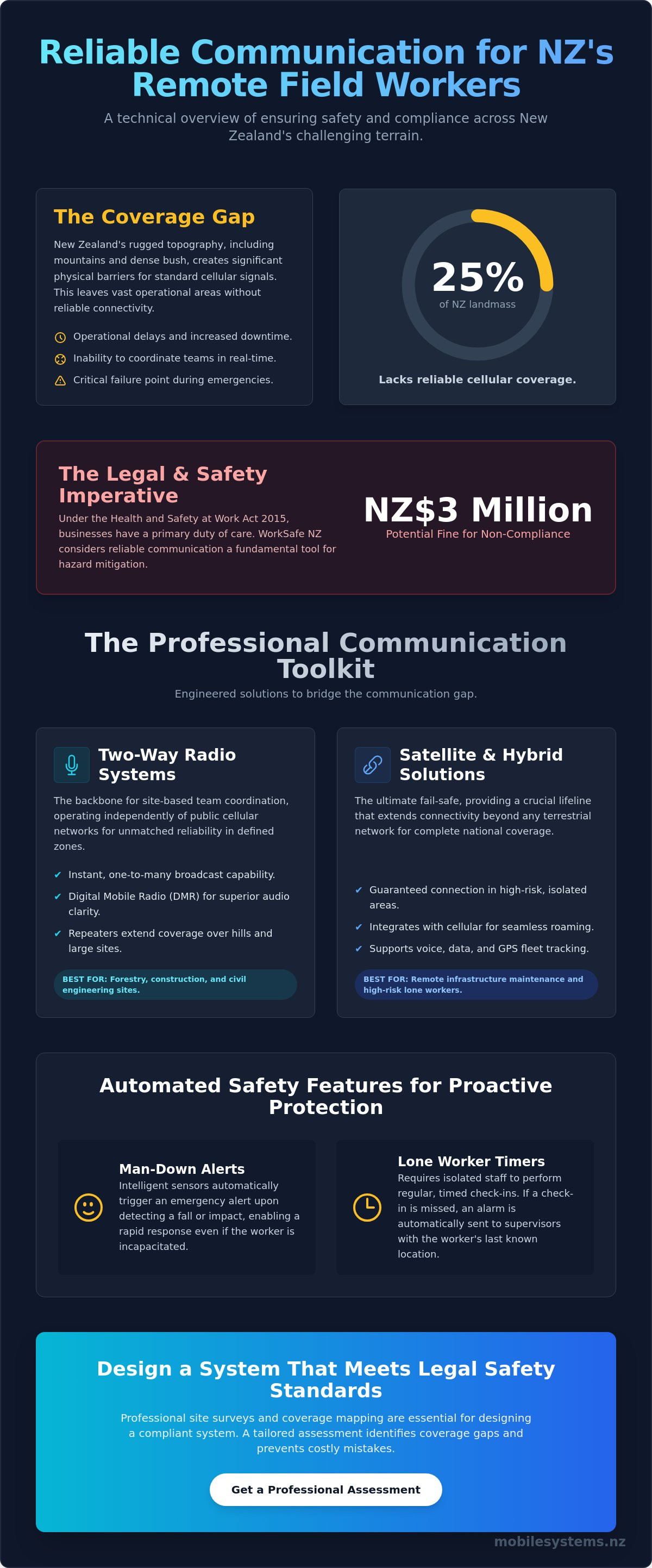
New Zealand's unique topography presents significant obstacles for maintaining reliable contact across diverse industry sectors. While urban centers enjoy robust infrastructure, approximately 25% of the country's landmass remains outside the reach of standard cellular networks. This gap is most pronounced in "back-country" regions where forestry, civil engineering, and infrastructure maintenance occur, leaving teams without a primary means of contact.
Operational efficiency suffers when communication channels fail. It's not just a rural issue; urban construction projects with high-density concrete and steel structures often create localized "dead zones" similar to deep mountain valleys. When teams cannot coordinate in real-time, project timelines slip and the cost of downtime increases. Implementing robust communication solutions for field workers nz is essential to maintain professional standards and project momentum.
To better understand the impact of these challenges, watch this helpful video:
For many industries, Two-way radio systems serve as the primary alternative to cellular devices. These systems operate independently of public networks, providing the immediate broadcast capability required for site safety and logistics. Unlike consumer electronics, professional-grade equipment is designed to withstand the rigors of the New Zealand field environment while delivering consistent signal clarity.
Geography and Signal Propagation in Aotearoa
Mountains and dense native bush create physical barriers for radio waves. In areas like the Southern Alps or deep North Island forests, signal propagation is limited by line-of-sight constraints. High-frequency signals struggle to penetrate heavy canopy or wrap around steep ridges. Consumer-grade walkie-talkies often lack the power or antenna quality to overcome these environmental factors, leading to total signal loss. Professional systems utilize higher sensitivity and output to maintain links where standard devices fail.
Regulatory Requirements for Remote Worker Safety
Under the Health and Safety at Work Act 2015, businesses have a primary duty of care to ensure staff safety, especially those in isolation. WorkSafe NZ views reliable communication as a fundamental hazard mitigation tool. If a worker is injured in a remote location and cannot call for help, the company may face severe penalties. Fines for non-compliance can reach NZ$3 million. Effective communication solutions for field workers nz must include features that allow for regular check-ins and emergency alerting. A tailored assessment often prevents costly mistakes and ensures your business meets these legal obligations.
Two-Way Radio Systems: The Backbone of Team Coordination
Two-way radios remain the standard for site-based operations because they offer instantaneous, one-to-many communication without relying on external cellular infrastructure. For teams in forestry, construction, or civil engineering, these devices are the core of communication solutions for field workers nz. Unlike mobile phones, professional radios provide high-duty cycle performance and durability in harsh weather conditions.
Systems typically operate in either simplex or duplex modes. Simplex communication occurs directly between two units, making it ideal for short-range tasks like crane spotting or local site coordination. Duplex systems utilize a repeater to receive and re-broadcast signals, which significantly extends the operational footprint across larger distances or over physical obstacles like ridges and valleys.
The transition from analogue to Digital Mobile Radio (DMR) has changed field operations. DMR technology provides superior audio clarity by filtering out background noise, which is critical when working near heavy machinery. It also offers enhanced battery efficiency and integrated data features, such as text messaging and GPS location tracking, allowing for better fleet management.
Security is another vital factor when Implementing a Professional Communication Strategy. Digital systems allow for encrypted transmissions, preventing unauthorized parties from intercepting sensitive operational data. Using professional-grade hardware from brands like Tait or Motorola ensures these security protocols are robust and compliant with modern standards.
VHF vs. UHF: Choosing the Right Frequency
VHF (Very High Frequency) signals have longer wavelengths that follow the Earth's curvature, making them suitable for open terrain, agriculture, and marine environments. Conversely, UHF (Ultra High Frequency) waves are shorter and better at penetrating obstacles. This makes UHF the preferred choice for dense forestry or urban environments where signals must pass through buildings and thick foliage. Commercial use of these frequencies in New Zealand requires specific licensing through Radio Spectrum Management (RSM).
Extending Range with Repeater Networks
Standard handheld radios have a limited range determined by terrain and power output. To cover regional sites or traverse steep hills, businesses deploy repeaters. These units are strategically placed on high ground to bridge communication gaps. Mobile Systems specializes in custom repeater installation and maintenance, ensuring your network remains operational in the most demanding environments. A tailored assessment often prevents costly mistakes when designing these networks.
Satellite and Cellular Hybrid Solutions for Total Coverage
Traditional radio systems provide exceptional site-specific reliability, but they often struggle with nationwide coordination. To achieve 100% coverage across New Zealand's varied landscapes, businesses are increasingly adopting hybrid communication solutions for field workers nz. These systems combine the immediate response of radio with the vast reach of satellite and cellular networks.
Satellite phones serve as the ultimate fail-safe for remote operations. When workers venture into the deepest parts of the Southern Alps or remote West Coast forests, cellular and radio signals may vanish entirely. Integrating satellite phones into standard operating procedures ensures that an emergency lifeline is always available, regardless of local infrastructure availability.
Satellite Solutions for High-Risk Isolation
The Iridium satellite network is the preferred choice for New Zealand operations because it utilizes a low-earth orbit constellation. This provides truly global coverage, including deep valleys where other geostationary satellites might be blocked by terrain. For teams constantly on the move, handheld devices offer portability, while vehicle-mounted fixed solutions provide more stable antennas and consistent power for long-duration deployments.
In scenarios requiring heavy data transmission, such as remote site mapping or high-resolution photo uploads, satellite hotspots are the most effective choice. These devices create a localized Wi-Fi zone, allowing standard laptops and tablets to connect to the internet in areas with zero cellular reception. This capability prevents the high cost of downtime when teams cannot coordinate with head offices.
PoC and Cellular Boosters: The Middle Ground
Push-to-Talk over Cellular (PoC) represents a significant shift in how regional teams stay connected. By utilizing existing 4G and 5G infrastructure, PoC devices offer the "one-touch" simplicity of a radio with the nationwide range of a mobile network. This is particularly effective for logistics and transport sectors where workers move between urban centers and rural fringes. You can explore a range of professional cellular devices designed for these specific environments.
A common question involves the trade-offs between PoC and traditional Digital Mobile Radio (DMR). While DMR requires private infrastructure like repeaters, it functions during total network outages. PoC relies on commercial cellular towers, making it vulnerable during widespread carrier failures. However, PoC avoids the high capital expenditure of private towers and offers unlimited range within carrier footprints. This makes it a versatile component of communication solutions for field workers nz.
Cellular boosters complement these systems by enhancing weak signals in semi-remote locations. A vehicle-mounted booster can turn a single, unusable bar of signal into a functional connection for voice and data. This allows site offices to maintain cloud-based reporting and safety logs even in areas where standard mobile phones would typically fail. A tailored assessment often prevents costly mistakes when selecting the right hybrid mix.
Essential Safety Features for NZ Field Workers
Safety in the field depends on more than just voice contact; it requires automated systems that act when a worker cannot. Modern communication solutions for field workers nz incorporate sensors and timers designed to trigger emergency protocols without human intervention. These features are critical for high-risk sectors like forestry or remote infrastructure maintenance where immediate assistance is vital.
A key component of these systems is fleet tracking. By monitoring the movement and status of vehicles and personnel, dispatchers can identify anomalies in real-time. This oversight ensures that if a vehicle stops unexpectedly or deviates from a planned route, the business can initiate a welfare check immediately.
Man-Down and Lone Worker Functionality
Man-Down technology utilizes internal accelerometers to monitor the orientation and movement of a radio or handheld device. If the unit detects a sudden impact followed by a lack of movement, it initiates a pre-alarm. If the user doesn't cancel this alarm, the system automatically sends an emergency alert to dispatch or nearby team members.
Lone Worker timers operate on a different principle. They require the field worker to check in at pre-set intervals, such as every 60 or 90 minutes. Failure to interact with the device triggers an alarm. These features significantly reduce response times during "Golden Hour" medical emergencies, where the speed of intervention often determines the medical outcome.
GPS Integration and Emergency SOS
Integrated GPS trackers provide precise coordinates that are essential for aerial or ground-based rescue teams. While standard GPS is useful for daily logistics, professional-grade communication solutions for field workers nz ensure that location data remains accurate even under heavy forest canopy or in steep valleys.
It's important to distinguish between integrated GPS in a radio and a dedicated Personal Locator Beacon (PLB). Radios provide real-time tracking for operational oversight, whereas PLBs are used as a final emergency resort to alert NZ Search and Rescue (SAR) via satellite. Combining these technologies ensures that rescue teams have the most current location data before they even leave the base.
Ensuring your team has the correct safety configuration is a complex task. Contact Mobile Systems to discuss a safety audit of your current hardware and protocols.
Implementing a Professional Communication Strategy
Off-the-shelf retail radios often fail to meet the rigorous safety standards required for industrial use. While consumer devices might work in ideal conditions, they lack the durability and signal penetration necessary for professional communication solutions for field workers nz. Professional systems are engineered to provide consistent performance in environments where failure isn't an option and legal compliance is mandatory.
A professional site survey is the first step in any successful deployment. This process involves coverage mapping to identify potential signal black spots caused by topography or infrastructure. Relying on theoretical range estimates is a common mistake that leads to communication gaps during critical operations. Mapping ensures that repeaters and antennas are placed with technical precision to provide 100% coverage across your specific work site.
Custom System Design and Installation
Every operation has specific requirements based on terrain and team size. Custom design involves assessing whether your site needs high-gain antennas for deep valleys or specific mounting solutions for heavy machinery. Professional installation of vehicle-mounted radios is essential to ensure that equipment remains functional despite the constant vibration and dust typical of NZ work sites. Poorly installed cabling is a frequent cause of system failure in the field.
Equipment must be ruggedized to survive local conditions. This includes high IP (Ingress Protection) ratings to guard against heavy rain and fine dust. Properly installed external antennas significantly increase the effective range of a vehicle-mounted radio compared to a handheld unit used inside a vehicle cab. A tailored assessment often prevents costly mistakes when selecting these hardware components.
Support, Training, and Fleet Servicing
The best technology is ineffective if staff don't know how to use it. Training covers radio etiquette, channel management, and the correct use of emergency features like the SOS button or Lone Worker timers. Clear protocols ensure that during a crisis, the response is calm and coordinated rather than panicked. This human element is just as important as the hardware itself for maintaining a safe workplace.
Regular maintenance is vital for system longevity and reliability. This includes battery health checks for handhelds and firmware updates for digital systems to ensure security patches are current. Mobile Systems provides on-site support vehicles to assist with nationwide fleet servicing, ensuring your equipment is serviced without requiring long periods of downtime. Regular servicing prevents the high cost of equipment failure during peak operational periods.
Designing a reliable network requires technical expertise and a deep understanding of local regulations. Consulting with a communications expert allows you to develop a tailored solution that protects your staff and your business. We invite you to contact our team to discuss your specific site requirements and safety goals.
Securing Your Remote Operations for the Future
Achieving reliable contact in the field requires moving beyond consumer electronics toward a unified ecosystem of radio and satellite hardware. This guide has detailed how hybrid networks and automated safety features provide the coverage and oversight necessary for modern industrial compliance. By prioritizing hardware durability and signal redundancy, your business can maintain operational continuity regardless of local terrain.
Implementing these communication solutions for field workers nz ensures your team remains connected even in the most isolated regions of the South Island or dense northern forests. Mobile Systems provides the technical design and ruggedized hardware required to maintain these critical links in harsh environments. We specialize in custom installations and ongoing mobile support to ensure your safety systems remain operational year-round.
Don't leave your operational safety to chance. You can request a tailored communication assessment for your field team to identify coverage gaps and implement a professional safety protocol. We look forward to helping you secure your remote operations.
Frequently Asked Questions
What is the best communication solution for workers with no cell coverage?
A hybrid system combining two-way radios for site-wide coordination and satellite phones for long-distance emergency lifelines is the most reliable approach. Two-way radios allow for immediate group communication without relying on external towers, while satellite devices ensure a connection remains possible in deep valleys or remote bush where all other signals fail.
Do I need a license to use professional two-way radios in New Zealand?
Yes, most commercial operations require a specific radio license issued by Radio Spectrum Management (RSM). While Citizen Band or PRS radios are license-free, they don't offer the power, clarity, or security required for professional use. Commercial licensing ensures your team can operate on dedicated frequencies without interference from other users or emergency services.
What is the difference between a satellite phone and a PLB?
A satellite phone provides two-way voice and text communication for daily logistics and welfare checks. A Personal Locator Beacon (PLB) is a one-way emergency device intended strictly for life-threatening situations. While a satellite phone helps manage operational tasks, a PLB's only function is to alert Search and Rescue (SAR) to your precise location during a crisis.
How does Man-Down technology work on a radio?
Man-Down technology utilizes an internal accelerometer to monitor the orientation and movement of the radio. If the device remains at a horizontal angle or stays motionless for a pre-set period, it triggers a local warning. If the worker doesn't cancel this warning, the radio automatically transmits an emergency alert to dispatchers or nearby team members.
Can I use my smartphone as a professional field communication tool?
Smartphones are generally unsuitable as primary safety tools in remote New Zealand environments. They are fragile, have limited battery life, and rely entirely on cellular infrastructure that covers only about 75% of the country's landmass. Professional communication solutions for field workers nz require ruggedized hardware that functions independently of public networks and withstands extreme weather.
How much does it cost to install a vehicle-mounted radio system?
The total investment for a vehicle-mounted system depends on the hardware selected, the type of antenna required for your terrain, and the complexity of the installation. Factors such as GPS integration and the need for external boosters also influence the final cost. A tailored assessment often prevents costly mistakes by ensuring the system is designed correctly for your specific operational area.
What are the legal requirements for lone worker safety in NZ?
Under the Health and Safety at Work (General Risk and Workplace Management) Regulations 2016, businesses must provide a system for effective communication with workers who are remote or isolated. This is a mandatory requirement to ensure help can be summoned in an emergency. Implementing reliable communication solutions for field workers nz is a key part of meeting this primary duty of care.
Related posts

- May 23, 2026
Need to go beyond 100m? Our guide to the ethernet cable extender explains types, distance limits, and NZ use cases...

- May 22, 2026
Can't fix a phone on site? Learn essential troubleshooting for NZ field teams, when to seek professional repair, and how...