
Fleet Tracking ROI Calculator: Measuring Real Value for NZ Businesses (2026)
How much is a ten minute error in a daily timesheet actually costing your business when diesel sits at $3.30 per litre? For many New Zealand operators, this hidden drain on annual profits often exceeds five figures. Using a fleet tracking roi calculator allows you to move past guesswork and measure the tangible impact of every kilometre your team drives.
How much is a ten minute error in a daily timesheet actually costing your business when diesel sits at $3.30 per litre? For many New Zealand operators, this hidden drain on annual profits often exceeds five figures. Using a fleet tracking roi calculator allows you to move past guesswork and measure the tangible impact of every kilometre your team drives.
You likely already feel the pressure of rising operational costs and the administrative burden of the 2026 RUC system updates. It's frustrating to manage manual logs while unleaded 91 prices hover around $3.26 per litre. We'll show you how to transform these overheads into measurable savings by automating your compliance and monitoring.
This article provides a clear roadmap to calculate your exact return on investment using current NZTA Waka Kotahi rates and local fuel data. You'll discover how to reduce unauthorized vehicle use, eliminate timesheet inflation, and prepare for the upcoming universal RUC transition with confidence.
Key Takeaways
- Move beyond simple vehicle tracking by defining ROI as the net profit generated relative to your total system investment.
- Use specific formulas to quantify savings from reduced fuel burn, lowered idle time, and decreased vehicle wear and tear.
- Learn how to reclaim billable hours and improve payroll accuracy by eliminating manual logbooks and timesheet guesswork.
- Identify New Zealand-specific savings through automated eRUC management and the recovery of RUC for off-road travel on private sites.
- Discover how a professional fleet tracking roi calculator helps you determine the exact timeframe for your system to pay for itself.
Why ROI is the Essential Metric for Fleet Management
ROI isn't just a buzzword; it's the financial backbone of your fleet operations. In the context of a fleet tracking roi calculator, ROI represents the net profit your business generates specifically from the implementation of the system, minus the total cost of ownership. It's the difference between seeing where a van is and knowing how that van is contributing to your bottom line.
Many operators focus on "dots on a map" as the primary benefit. However, a modern vehicle tracking system is a data engine, not just a locator. While visibility is a feature, the true outcome is the reduction in wasted fuel and recovered labour hours. To better understand this concept, watch this helpful video:
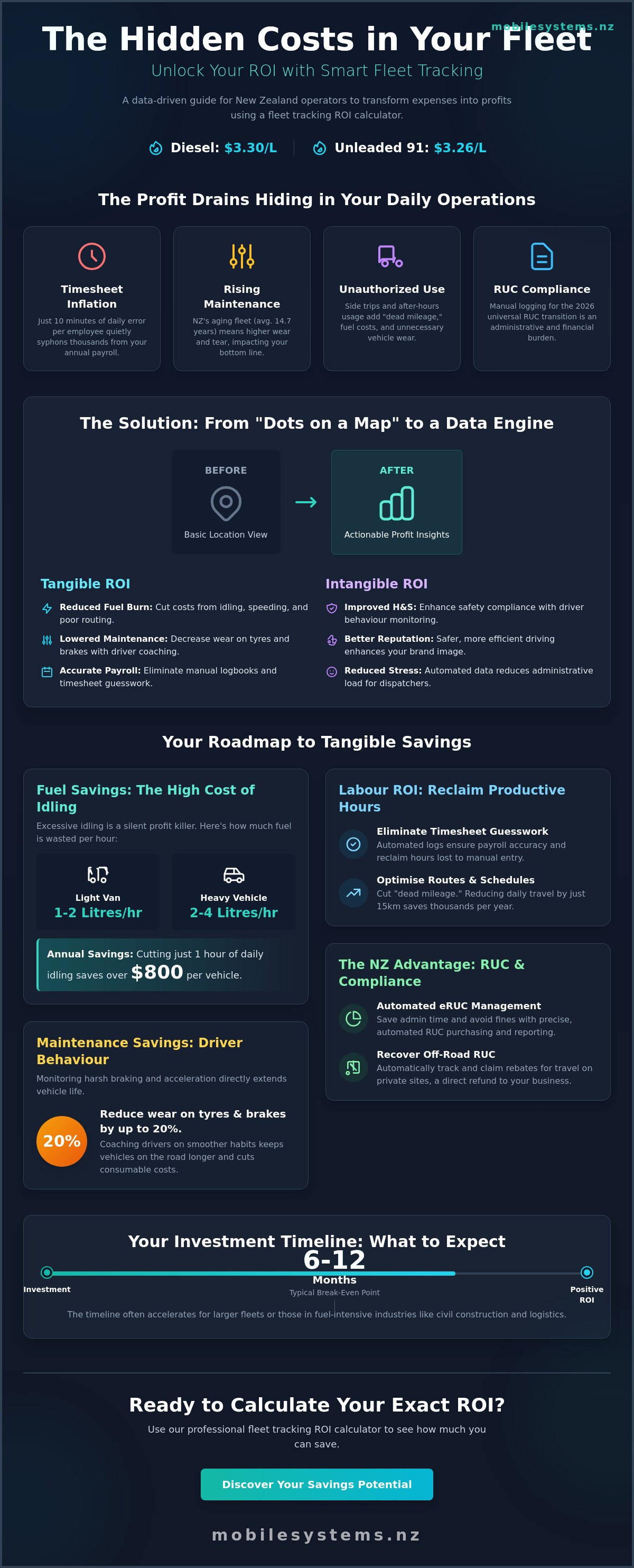
The "Cost of Doing Nothing" (CODN) is particularly high in the 2026 New Zealand market. With diesel prices at $3.30 per litre and unleaded 91 at $3.26, even a 5% inefficiency in routing or idling becomes a major liability. New Zealand's aging fleet, now averaging 14.7 years, also means maintenance costs are rising. Ignoring these variables doesn't just stall growth; it actively erodes your margins.
ROI is categorized into two main streams:
- Tangible ROI: Direct savings on fuel, RUC administration fees, and reduced wear on tyres and brakes.
- Intangible ROI: Improved Health and Safety compliance, better brand reputation through safer driving, and reduced stress for dispatchers.
Beyond GPS: The Evolution of Telematics
Modern telematics have moved far beyond basic location tracking. Systems now integrate engine diagnostics and real-time driver behaviour monitoring. This allows you to identify harsh braking or rapid acceleration before they lead to mechanical failure. For operations in remote areas like the King Country or West Coast, satellite-integrated solutions ensure you never lose contact, even when cellular coverage fails.
The ROI Timeline: What to Expect
Most New Zealand businesses see a complete break-even on their investment within 6 to 12 months. This timeline often accelerates for larger fleets or those in fuel-intensive industries like civil construction and logistics. High mileage significantly increases the impact of fuel savings and RUC recovery. Using a fleet tracking roi calculator helps you visualise this timeline based on your specific fleet size and usage.
A tailored assessment often prevents costly mistakes by ensuring you select a system that matches your specific operational profile. Choosing the right hardware from the start ensures the data you gather is accurate and provides the highest possible return on your investment.
Calculating Tangible Savings: Fuel and Maintenance
Quantifying the value of a telematics system requires looking at the raw data behind your daily operations. A standard fleet tracking roi calculator uses a core formula to determine savings: (Idle Time Reduction x Fuel Burn Rate) + (Km Reduction x Cost Per Km). By applying this to your specific fleet, you can see how minor adjustments lead to substantial annual gains.
Route optimisation plays a critical role in reducing "dead mileage." If a single technician reduces their daily travel by just 15 kilometres through better scheduling, the savings add up quickly. With diesel at $3.30 per litre and petrol at $3.26, cutting 75 kilometres per week across a fleet of ten vehicles saves thousands in fuel and RUC expenses each year.
Beyond fuel, driver behaviour directly impacts your maintenance budget. Aggressive driving, such as harsh braking and rapid acceleration, increases tyre wear and brake pad depletion by up to 20%. Monitoring these events allows you to coach drivers, extending the life of consumables and keeping your vehicles on the road for longer periods between services.
The High Cost of Excessive Idling
Fuel wastage during idling is a silent profit killer. A heavy vehicle typically burns between 2 and 4 litres of fuel per hour while stationary, while a light commercial van burns approximately 1 to 2 litres. At current 2026 prices, an hour of unnecessary idling every day costs your business over $800 per vehicle annually.
Implementing idle alerts helps shift driver culture without the need for constant micro-management. When drivers understand that reducing idle time supports the company's sustainability goals and carbon footprint targets, they're more likely to comply. This cultural change is a key driver in the fleet tracking roi calculator results.
Predictive Maintenance vs. Reactive Repairs
Relying solely on odometer readings for servicing can be misleading, especially for vehicles that spend significant time idling on worksites. Modern fleet tracking systems track engine hours, providing a more accurate trigger for maintenance. This ensures you aren't over-servicing or, conversely, risking engine damage by waiting too long.
The ROI of preventing a single roadside breakdown in a remote New Zealand location is immense. With basic services in 2026 costing between $150 and $250, and major repairs often exceeding $900, diagnostic alerts that catch issues early are invaluable. Avoiding towing fees and lost billable time often pays for the tracking hardware in a single event. If you're unsure where your fleet stands, requesting a custom data analysis can highlight your immediate saving opportunities.
The Labour ROI: Reclaiming Productive Hours
Labour is frequently the single largest expense for New Zealand service and logistics businesses. A fleet tracking roi calculator helps you quantify how much of that investment is lost to manual errors. By using the formula (Inaccurate Minutes Per Day x Hourly Rate) x Number of Drivers, you can see the immediate impact on your monthly profit and loss statement.
Manual logbooks and timesheets rely on memory, which often leads to "Friday afternoon guesswork." If a team of five drivers each rounds up their finish time by just 12 minutes daily, a business paying a $35 hourly rate loses over $8,500 every year. Automated tracking removes this ambiguity, ensuring that you pay for actual time on the job rather than estimated entries.
Real-time dispatching also enables the "one more job" effect. When dispatchers can see the exact location of every unit, they can assign the closest technician to an urgent call-out. This efficiency often allows a fleet to complete an extra service call per day without increasing staff numbers or extending work hours. It transforms your fleet from a cost centre into a more agile revenue generator.
Unauthorized personal use, often called the "pie run" effect, is another area where costs vanish. With 2026 diesel prices at $3.30 per litre, every unsanctioned kilometre erodes your margin. Monitoring asset use ensures company vehicles are used for company business, directly protecting your bottom line from unnecessary wear and fuel burn.
Automating Timesheets and Proof of Delivery
Geofencing technology creates a digital perimeter around worksites or customer locations. This provides automated "arrival" and "departure" timestamps that are impossible to dispute. It significantly reduces the time office administrators spend on billing verification and customer queries regarding service duration.
Office staff often spend between 5 to 10 hours a week reconciling manual logs against invoices. By automating this data flow, you reclaim that administrative time for higher-value tasks like customer acquisition. For a setup tailored to your specific workflow, the Mobile Systems contact page provides access to expert advice on customized reporting.
Improving Driver Accountability and Retention
Accountability shouldn't be about "catching" drivers; it's about rewarding your best performers. Accurate data allows you to recognize staff who consistently drive safely and efficiently. In a tight New Zealand labour market, using objective data to provide fair bonuses or recognition is a powerful tool for improving driver retention.
Tracking data also serves as a legal shield for your team. When a third party makes a false complaint about a driver's speed or location, GPS records provide an indisputable defence. Protecting your drivers from unfair accusations builds trust and reduces the high ROI-killing costs associated with staff turnover and recruitment.
The NZ Advantage: RUC and Compliance Savings
In New Zealand, the financial impact of Road User Charges (RUC) is a significant variable in any fleet tracking roi calculator. As of April 2026, the rate for a standard 2-axle diesel vehicle under 3500kg is $76 per 1000km. For businesses still managing these licences manually, the administrative overhead and the risk of "over-buying" or forgetting to renew leads to unnecessary costs and potential fines.
Electronic RUC (eRUC) systems automate the entire purchasing process. By buying licences in smaller, automated increments, you improve cash flow compared to bulk manual purchases. Additionally, purchasing online via an app costs $12.44 per licence, whereas counter sales at agents cost $13.71. For a fleet of 20 vehicles, these small savings in administration fees and time contribute to a faster ROI.
The most substantial "hidden" ROI often comes from off-road RUC recovery. If your vehicles spend time on private forestry roads, farms, or construction sites, you're entitled to a refund for the RUC paid on those kilometres. Without a digital record, claiming these refunds is nearly impossible. Tracking systems provide the precise GPS evidence required by NZTA Waka Kotahi to reclaim these funds, often worth thousands of dollars annually for civil and agricultural firms.
eRUC: Turning Compliance into Cash Flow
Transitioning to a universal RUC system is a major trend in 2026 as the government moves away from petrol excise taxes. Staying ahead of this shift by implementing fleet tracking systems ensures your business isn't caught off guard by changing regulations. Automating this compliance eliminates "paper-chasing" and ensures your fleet is always legal and on the road.
Mitigating Risk under the HSWA
The Health and Safety at Work Act (HSWA) places a strict "Duty of Care" on business owners. A fleet tracking roi calculator should also factor in the potential cost of non-compliance fines or WorkSafe investigations. Tracking provides a permanent digital audit trail that proves you're actively managing driver fatigue and speed, which are critical components of a safe workplace.
Safety features like impact sensors and rollover alerts provide immediate ROI by reducing emergency response times in remote areas. This proactive stance on safety often leads to lower insurance premiums and reduced ACC levies over time. If you want to see how these savings apply to your specific fleet, contact our team for a compliance audit today. Protecting your team is a moral obligation that fortunately also supports your financial bottom line.
Maximising ROI through Professional Implementation
The accuracy of any fleet tracking roi calculator depends entirely on the quality of the data it receives. The "Garbage In, Garbage Out" principle is particularly relevant when managing assets across New Zealand's varied topography. If your hardware fails to provide consistent updates due to poor installation, your ROI projections will be fundamentally flawed and unreliable.
While "plug-and-play" devices are often marketed as a simple solution, they frequently fail in rugged local conditions. These devices are prone to driver tampering and often lose GPS lock in heavy bush or mountainous terrain. Investing in professional installation ensures that your data remains high-integrity, providing a stable foundation for your long-term financial decision-making.
For a truly comprehensive operational view, many businesses find value in integrating their tracking with two-way radio systems. This creates a unified communication and data ecosystem, allowing for better coordination in areas where cellular coverage is intermittent. Mobile Systems acts as a specialist partner to ensure these systems work together seamlessly.
The Importance of Expert Installation
Professional mounting is about more than just aesthetics; it's about signal reliability. In remote regions like the Ureweras or Central Otago, an incorrectly positioned antenna can lead to significant data gaps. Expert technicians ensure that hardware is concealed to prevent tampering while maintaining a clear line of sight for GPS and cellular connectivity.
Durability is another critical factor for the New Zealand market. With the average age of the national vehicle fleet reaching 14.7 years in 2026, tracking hardware must withstand the vibrations and environmental stresses of older vehicles. Mobile Systems’ nationwide support ensures your equipment stays operational, protecting your investment from premature failure.
Selecting the Right System for Your Industry
Not all tracking hardware is created equal, and the wrong choice can quickly erode your expected returns. When selecting a system, consider these common trade-offs:
- Hardwired Units: Best for heavy transport and construction vehicles requiring constant engine diagnostics and real-time updates.
- Battery-Powered Trackers: Ideal for non-powered assets like trailers, skips, or site offices where a permanent power source isn't available.
- Satellite-Integrated Systems: Essential for high-risk industries like forestry where cellular blackspots are a daily reality.
A professional consultation ensures your system matches your specific ROI goals. Whether you're managing a forestry crew in the Bay of Plenty or a delivery fleet in Auckland, understanding these technical trade-offs is essential. A tailored assessment often prevents costly mistakes, ensuring you get the single best answer for your business needs. Using a fleet tracking roi calculator is the first step, but high-quality implementation is what makes those numbers a reality.
Turning Fleet Data into Financial Certainty
Managing a fleet in 2026 requires more than just knowing where your vehicles are located. It's about understanding how every litre of $3.30 diesel and every billable hour contributes to your success. By focusing on tangible metrics like reduced idle time and automated RUC recovery, you move from reactive spending to proactive profit management. Using a fleet tracking roi calculator is your first step toward total operational visibility and long-term financial stability.
The difference between a generic tracker and a high-integrity solution lies in the implementation. Accurate data depends on professional installation that survives New Zealand's rugged conditions and remote terrain. Mobile Systems provides the local expertise needed to ensure your system delivers the results you expect without the frustration of signal drops or hardware failure.
We provide NZ-based technical support and expert installation nationwide, specialising in ruggedized communication and tracking. To see how these savings apply to your specific business, request a tailored fleet ROI assessment from the Mobile Systems team today. Investing in the right data now ensures your business stays ahead of rising costs and regulatory shifts.
Frequently Asked Questions
How much can I realistically save with a fleet tracking ROI calculator?
Most New Zealand businesses save between 10% and 15% on their total operational costs after implementing a tracking system. These savings come from reduced fuel wastage, lower maintenance expenses, and the elimination of manual timesheet errors. A tailored assessment provides a more precise figure by analyzing your specific idle times and daily mileage against 2026 fuel prices.
How long does it take for a fleet tracking system to pay for itself?
The typical "break-even" point for a professional system is between 6 and 12 months. High-mileage fleets or those operating in fuel-intensive industries like civil construction often see a faster return. This timeframe is accelerated when you factor in immediate gains from recovered labour hours and automated RUC administration fees.
Can fleet tracking help with RUC claims for off-road driving in NZ?
Yes, tracking systems provide the high-integrity GPS evidence required by NZTA Waka Kotahi to reclaim RUC for travel on private roads, farms, or forestry sites. This automation is a critical component of any fleet tracking roi calculator, as it allows you to recover funds that are nearly impossible to claim accurately using manual logbooks.
Will fleet tracking reduce my insurance premiums in New Zealand?
Many New Zealand insurers offer premium discounts or reduced excesses for fleets that use GPS tracking and impact sensors. By demonstrating a proactive approach to theft prevention and driver safety, you lower your business's risk profile. This often results in direct annual savings that contribute to your overall system ROI.
Does fleet tracking count as "spying" on my employees under NZ law?
No, provided you comply with the Privacy Act 2020 by being transparent about what data is collected and why. It's essential to update your employment agreements and vehicle use policies to reflect the use of telematics. Clear communication helps employees understand that the system is a tool for their safety and fair recognition.
What is the most significant "hidden" cost of a poorly installed tracking system?
The most significant hidden cost is data inaccuracy, which makes your financial projections unreliable. Poorly installed hardware often suffers from signal drops in remote areas or is easily tampered with by staff. This leads to missed RUC claims and incomplete safety records, which eventually costs more than the initial professional installation fee.
How does fuel idle time specifically impact my monthly ROI?
Every hour of idling in a light commercial van burns approximately 1 to 2 litres of fuel, costing about $3.30 per hour at 2026 rates. If a fleet of ten vehicles idles for just one hour each day, your business loses over $650 every month. Reducing this wastage is one of the fastest ways to improve your fleet tracking roi calculator results.
Is fleet tracking worth it for a small business with only 3–5 vehicles?
Yes, small fleets often see the most immediate impact because every dollar saved goes directly back into the business's cash flow. For a small operator, preventing just one unauthorized personal trip or recovering off-road RUC can cover the entire monthly system cost. You also benefit from automated timesheets that save hours of administrative work each week.
Related posts

- June 11, 2026
PoC or UHF/VHF? An honest comparison of coverage, cost, licensing and reliability for New Zealand worksites.

- June 08, 2026
In New Zealand’s vertical terrain, the network constellation matters more than the device features. When you're deep in the Southern...

- June 05, 2026
Transport & Logistics Fleet-wide communication that actually works: digital radio for NZ transport and logistics Transport & Logistics 8 min...