
How to Improve Team Communication on Site: A Practical Guide for NZ Businesses
A standard mobile phone is often the most dangerous piece of equipment on a New Zealand job site. When your team relies on consumer-grade devices in deep basements or remote bush areas, communication doesn't just fail.
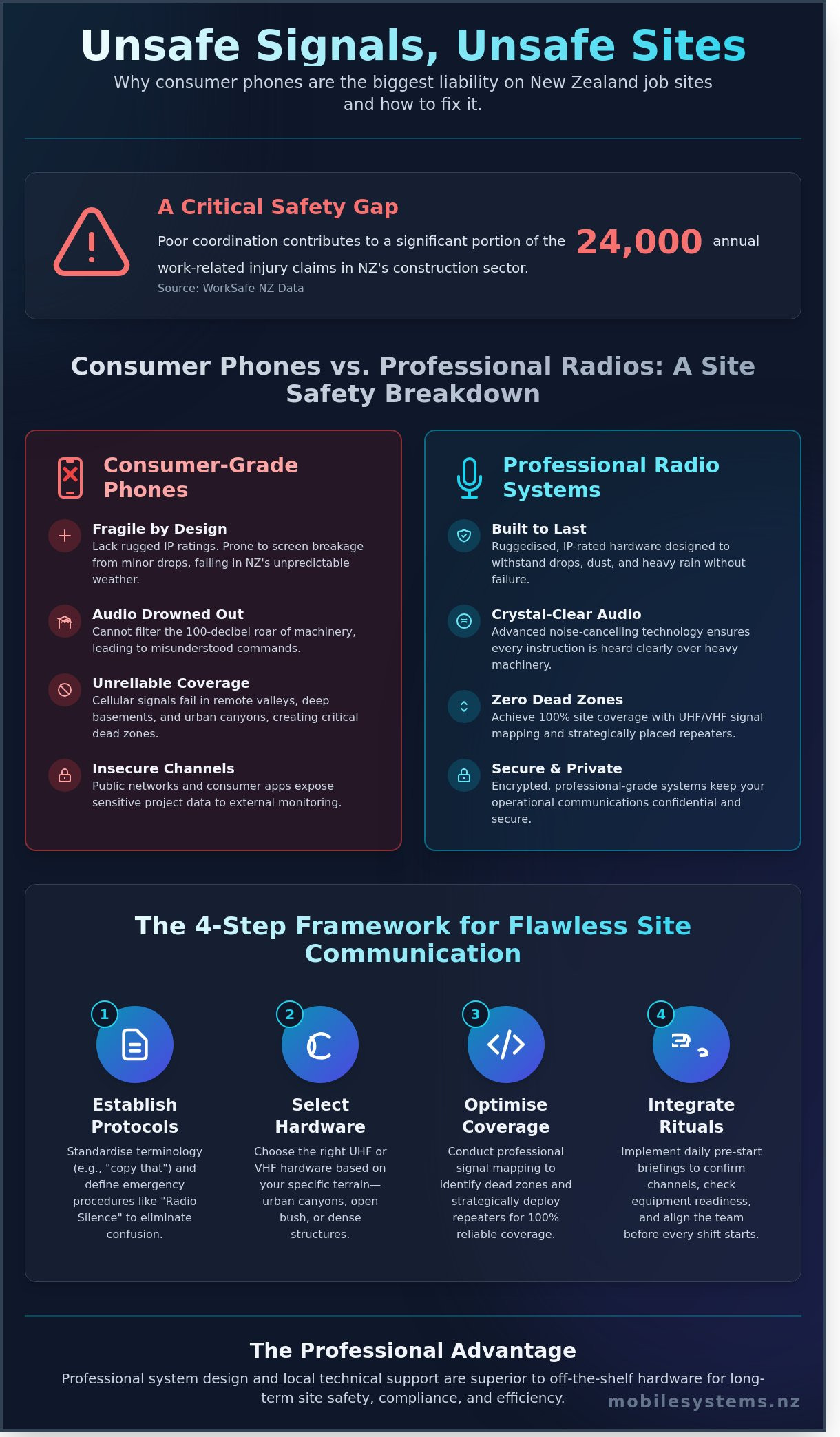
A standard mobile phone is often the most dangerous piece of equipment on a New Zealand job site. When your team relies on consumer-grade devices in deep basements or remote bush areas, communication doesn't just fail; it creates life-threatening risks. Learning how to improve team communication on site is essential when WorkSafe NZ data shows that poor coordination contributes to a significant portion of the 24,000 work-related injury claims made every year in the construction sector.
You've likely felt the frustration of a dropped call in a dead zone or struggled to hear an urgent instruction over the roar of heavy machinery. It's a common challenge for local businesses balancing tight deadlines with strict safety protocols. You know that a five-minute delay in an emergency alert can be the difference between a near-miss and a critical incident.
This guide will show you how to eliminate operational delays and safety risks by combining professional radio protocols with ruggedised hardware designed for New Zealand's terrain. You'll learn how to achieve zero dead zones and maintain full compliance with modern safety standards.
We'll examine the transition from unreliable mobile networks to high-performance systems that ensure your team stays connected, compliant, and efficient. This includes a look at hardware that thrives in high-noise environments where standard phones fail.
Key Takeaways
- Understand how establishing professional protocols and standardized terminology significantly reduces safety risks and operational delays on New Zealand job sites.
- Learn how to improve team communication on site by selecting the appropriate UHF or VHF hardware based on your specific terrain and project requirements.
- Discover the importance of conducting signal mapping to identify dead zones and deploying repeaters to ensure reliable coverage across large project footprints.
- Identify the benefits of integrating pre-start briefings to confirm communication channels and equipment readiness before every shift.
- Recognise why professional system design and local technical support are superior to off-the-shelf hardware for long-term site efficiency.
The Critical Link Between Communication, Safety, and Site Efficiency
Effective communication isn't just a management preference; it's a fundamental safety requirement on New Zealand worksites. According to WorkSafe NZ, clear instructions and immediate feedback loops are essential for managing risks in high-hazard industries. Establishing effective teamwork through robust communication protocols directly correlates with a reduction in on-site incidents.
When business owners look at how to improve team communication on site, they often focus on software while overlooking the hardware. Reliable voice communication reduces machinery idle time and eliminates the need for workers to walk across dangerous sites to deliver messages. This efficiency boost can save a medium-sized civil project dozens of man-hours every week.
To better understand this concept, watch this helpful video:
WorkSafe NZ guidelines for isolated work or high-risk zones require workers to have a reliable means of reaching help. Relying on inconsistent cellular signals in remote areas often fails this legal standard. Beyond compliance, clear audio reduces team stress. Workers who receive precise, audible instructions feel more confident, leading to higher job satisfaction and lower turnover rates.
Identifying Common Communication Barriers on Site
Environmental noise is the most frequent barrier to clear communication. Standard smartphones aren't designed to filter out the 100-decibel roar of heavy machinery or high-pressure pneumatic tools. This leads to misunderstood commands and potential safety breaches that could have been avoided with noise-cancelling industrial gear.
New Zealand's topography presents unique challenges for site managers. Deep valleys in rural regions and dense urban canyons in cities like Auckland and Wellington create signal dead zones. These gaps often lead to information silos where field crews and management become disconnected, delaying critical project decisions and creating unnecessary downtime.
The Hidden Costs of Inadequate Communication Gear
Consumer-grade mobile phones are a significant liability in rugged outdoor environments. They lack the IP ratings required to survive New Zealand's unpredictable weather and are prone to screen breakage from minor drops. A single dropped call during a critical heavy-lift operation can result in thousands of dollars in property damage or project delays.
Security is another often-overlooked factor. Using unencrypted public channels or consumer messaging apps for business operations exposes sensitive project data to external monitoring. Professional-grade systems ensure that site coordination remains private and secure. A tailored assessment often prevents these costly mistakes. You can reach out for expert advice via our contact page to discuss how to improve team communication on site for your specific project.
Establishing Professional Communication Protocols for NZ Teams
Clear communication isn't just about having the right gear; it's about how your team uses it. Standardising terminology reduces the risk of misunderstood instructions that lead to onsite accidents. Using clear call signs and phrases like "copy that" or "affirmative" ensures every message is received and understood. This discipline is a core component of knowing how to improve team communication on site effectively.
The "Pre-Start" briefing is the most critical 10 minutes of the shift. During this time, supervisors must confirm which channels are assigned to specific teams. If a critical safety incident occurs, the "Radio Silence" protocol must be activated immediately. This clears the airwaves for emergency services and site leads, a practice aligned with WorkSafe NZ Construction Guidelines for high-risk environments.
- Standardised Terminology: Use phonetic alphabets for spelling out names or locations to avoid confusion over high wind noise.
- Feedback Loops: Encourage field staff to report signal "dead zones" or equipment faults as soon as they're noticed.
- Reporting: Delaying reports of faulty gear can leave a worker isolated in a dangerous area without a lifeline.
Creating a Site-Specific Communication Plan
A robust plan assigns dedicated channels to prevent cross-talk between different workgroups. For example, crane operators and dogmen should operate on a private channel, separate from general ground crew operations. This prevents interference during heavy lifts where split-second timing is vital.
Every site plan must include clear escalation paths. If a primary radio network fails, teams should know exactly when to switch to cellular backups or satellite devices. Documenting these protocols within your site health and safety plan ensures compliance and provides a clear audit trail for regulators. A tailored assessment of your current workflow often reveals simple protocol changes that significantly boost safety.
Training Your Team for Communication Success
Technical hardware is only as good as the operator. Conduct practical training on Push-to-Talk (PTT) etiquette, such as waiting one second after pressing the button before speaking. This prevents "clipping" the start of the message, which is a common cause of repeated transmissions and wasted time.
Daily signal checks should be as routine as putting on a high-viz vest. These 30-second tests identify battery issues or antenna damage before work begins. Basic maintenance training, like cleaning battery contacts and checking belt clips, can extend the life of your fleet by 25% or more, protecting your investment in high-quality hardware.
Selecting the Right Communication Hardware for Your Environment
Selecting the correct hardware is a foundational step for those looking at how to improve team communication on site effectively. New Zealand terrain varies from dense urban builds to steep forestry blocks, meaning a "one size fits all" approach often leads to dead zones. Selecting the right frequency and form factor ensures your team remains connected regardless of physical obstacles.
VHF (Very High Frequency) signals travel further in open areas, making them the standard for NZ forestry and rural infrastructure. UHF (Ultra High Frequency) is better at penetrating concrete and steel, which is why it's the preferred choice for construction sites and multi-level buildings. Choosing the wrong frequency can result in a 40% loss of effective range in complex environments.
Using a hybrid system of handheld and vehicle-mounted units provides maximum operational reach. Handhelds offer portability for workers on foot, while 25-watt or 45-watt vehicle units provide five to nine times the power of a standard handheld. This setup ensures drivers and yard staff maintain contact over several kilometres, even when terrain is challenging.
Safety standards require intrinsically safe (IS) devices in hazardous zones like fuel depots or chemical plants. These units meet IECEx standards to prevent any electrical or thermal energy from causing an ignition in explosive atmospheres. For large-scale sites, Public Address (PA) systems serve as a critical tool for emergency alerts, ensuring safety messages reach every worker simultaneously.
Two-Way Radios: The Backbone of Site Voice
Professional walkie talkie units use Digital Mobile Radio (DMR) technology to provide clear, interference-free audio. Unlike consumer-grade radios, professional DMR units feature active noise cancellation that filters out heavy machinery sounds. This ensures instructions are heard correctly the first time, reducing errors and downtime.
Durability is essential for New Zealand weather conditions. Look for devices with an IP67 or IP68 rating, which guarantees protection against dust and total immersion in water. Professional gear also offers 12 to 18 hours of battery life, ensuring the device lasts through a full double shift without needing a recharge.
Connectivity in Remote and Isolated Locations
When planning how to improve team communication on site in remote areas, standard cellular signals are often insufficient. For forestry or remote infrastructure projects, satellite phones provide a vital safety link outside the reach of terrestrial towers. These devices ensure lone workers can call for help from any location in the country.
In fringe areas where the signal is weak but present, cellular boosters can extend coverage by up to 100dB. This allows teams to use standard smartphones for data-heavy tasks. Integration with satellite hotspots like Starlink now allows teams to maintain high-speed data connections in isolated valleys, facilitating real-time project management and video calls.
A tailored assessment of your specific site often prevents costly mistakes in hardware procurement. Choosing the right mix of satellite, cellular, and radio technology ensures your communication system is both resilient and scalable.
Meta Description: Learn how to optimize site coverage with signal mapping, repeaters, and GPS tracking to improve communication and safety for New Zealand businesses. Shopify Handle: site-communication-infrastructure.
Optimising Site Coverage and Communication Infrastructure
Reliable hardware is only half of the equation. Infrastructure determines how well that hardware performs in high-pressure environments. When considering how to improve team communication on site, businesses must first address the physical limitations of their project footprint. Dead zones in concrete-heavy builds or remote civil sites can lead to a 25% drop in operational efficiency if workers cannot reach supervisors immediately.
Professional site signal mapping identifies these vulnerabilities before they become safety risks. This process involves measuring decibel levels across the entire location to pinpoint where structural interference or topography blocks signals. Once these gaps are identified, deploying signal repeaters extends the range of your handheld units. This ensures that a team member in a sub-basement has the same clear connection as someone on the top floor.
Safety is significantly enhanced through the integration of GPS tracking. Real-time location data allows dispatchers to see exactly where personnel are positioned during an emergency. Maintaining this infrastructure requires regular system audits. Technicians should inspect antennas, cabling, and power supplies every six months. Environmental factors in New Zealand, such as salt spray or high winds, can degrade external components faster than expected, making proactive maintenance essential for 100% uptime.
Bridging the Gap Between Field and Office
Management oversight improves when radio systems integrate directly with dispatch software. This connection allows office-based coordinators to monitor channels and respond to site needs without leaving their desks. Implementing fleet tracking systems provides data-driven insights into site movements, helping managers identify bottlenecks in transport or equipment deployment.
Cellular-to-radio gateways represent a significant bridge for modern sites. These devices allow management to use their smartphones to communicate directly with radio users via secure apps. This setup is particularly useful for stakeholders who are off-site but need to provide instant approvals or guidance. It removes the barrier between different device types, ensuring the flow of information remains constant regardless of the user's location.
Future-Proofing Your Site Communication
Scalability is a core requirement for any long-term project. As a site expands from an initial earthworks phase to a full-scale construction footprint, your communication network must grow with it. Planning for this expansion early prevents the need for costly system overhauls mid-project. Many New Zealand firms are now transitioning toward LTE-based Push-to-Talk (PTT) systems to achieve nationwide coverage, which is vital for logistics and multi-site operations.
Looking toward 2026, trends indicate a shift toward AI-driven voice clear-up technology. This software filters out heavy machinery noise, ensuring only the human voice is transmitted. Automated safety alerts are also becoming standard, where sensors can trigger an emergency broadcast if a fall or impact is detected. Adopting these technologies early keeps your team safe and your business competitive.
Infrastructure planning requires technical precision to ensure no worker is left in a dead zone. A tailored assessment often prevents costly mistakes and ensures your system is ready for the demands of tomorrow.
Implementing Your System with Mobile Systems Limited
Effective communication isn't just about owning the right hardware. It's about how those tools integrate into your daily workflow. Many New Zealand businesses make the mistake of purchasing off-the-shelf equipment that fails to meet the demands of their specific environment.
Professional system design prioritizes reliability over convenience. Mobile Systems Limited provides nationwide installation and on-site servicing across New Zealand. Whether you operate in central North Island forestry blocks or on a busy Auckland construction project, our team ensures your infrastructure remains functional.
We customize solutions for high-stakes industries including emergency services and heavy industry. A tailored assessment prevents costly technical mistakes, such as purchasing frequencies that overlap with local interference. This proactive approach ensures total coverage across your entire site footprint.
Expert Design and Installation Services
Our technical process involves evaluating site topography and specific signal requirements. New Zealand's rugged terrain creates significant barriers for standard radio waves. We map these challenges before recommending a single piece of equipment.
Professional installation of vehicle two-way radios is critical for maximizing range. A poorly placed antenna or incorrect power configuration can lead to 50% signal loss. Our technicians understand these variables and calibrate every unit for peak performance.
- Detailed site surveys to identify dead zones and signal shadows.
- Frequency management to avoid cross-channel interference with neighboring sites.
- Ongoing technical support to keep your team connected 24/7 during critical phases.
- Compliance with New Zealand radio spectrum regulations and safety standards.
Accessing expert support means you don't have to troubleshoot technical failures alone. We provide the maintenance schedules required to keep your fleet operational in harsh conditions, from coastal salt spray to alpine cold.
Next Steps for Your Site Communication
Understanding how to improve team communication on site begins with a clear view of your current gaps. We recommend a site communication audit to identify where your existing systems are failing your workers or creating safety risks.
You can explore our range of portable communications and tracking tools online. These devices provide the durability needed for the New Zealand climate. Choosing the right tool for the job reduces replacement costs and ensures workers can reach help when they need it.
Contact our Mount Maunganui-based team for expert advice tailored to your project. You can reach us through our contact page to discuss your requirements. We focus on providing practical, long-term solutions that enhance safety and operational efficiency for your business.
Secure Your Site with Reliable Communication Infrastructure
Effective site communication isn't just about handing out radios. It requires a strategic approach that combines robust hardware from brands like Tait and Hytera with professional protocols tailored to New Zealand's rugged terrain. You've now seen how to improve team communication on site by focusing on infrastructure coverage and strict safety standards.
System design errors often lead to dangerous dead zones or equipment failure during critical tasks. Mobile Systems Limited leverages over 25 years of New Zealand communication expertise to ensure your team stays connected in every environment. Our nationwide fleet of on-site support vehicles provides immediate technical assistance across the country, keeping your operations running without interruption.
A tailored assessment often prevents costly technical mistakes and ensures your system meets current safety regulations. Contact our expert team today for a tailored site communication assessment.
Investing in a professional communication framework protects your staff and improves your long-term operational efficiency.
Frequently Asked Questions
What is the most effective way to communicate on a noisy construction site?
The most effective way to learn how to improve team communication on site is to use digital two-way radios with active noise-cancelling (ANC) accessories. Standard microphones often pick up 90 decibels of background machinery noise, which makes speech impossible to understand. Digital technology filters out these consistent background frequencies, ensuring only the human voice transmits to the rest of the team.
Using heavy-duty headsets that offer both hearing protection and integrated microphones is a common solution for high-noise environments. These units allow workers to hear instructions clearly without removing their ear protection, which maintains safety standards while improving operational flow.
Are professional two-way radios better than mobile phones for site work?
Professional two-way radios are superior to mobile phones for site work because they provide instantaneous communication. A mobile phone call takes 10 to 15 seconds to connect, whereas a radio transmits in under 200 milliseconds. This speed is vital during emergencies where every second counts for worker safety.
Radios are also built to IP67 or IP68 standards, meaning they survive 1.5-metre drops and water immersion that would disable a standard smartphone. Because they don't rely on external towers for local talk, they remain functional in areas where cellular signals are weak or non-existent.
How can I improve radio coverage in deep valleys or concrete basements?
You can improve radio coverage in concrete basements or valleys by installing a signal repeater or using a distributed antenna system. Concrete walls and earth can reduce signal strength by 40 decibels, which creates immediate dead zones. A repeater acts as a relay station, receiving a weak signal and rebroadcasting it at full power to reach these isolated areas.
For complex underground projects, Mobile Systems Limited often recommends leaky feeder cables. These cables act as a long, continuous antenna that radiates signal along the entire length of a tunnel or basement level. This setup ensures there are no gaps in communication for teams working in high-shielding environments.
What are the current WorkSafe NZ requirements for site communication?
WorkSafe NZ requires businesses to provide a reliable means of communication under the Health and Safety at Work Act 2015. This is a legal requirement for managing risks in remote or high-hazard environments. If a worker is injured, the 111 emergency system must be accessible at all times, which often requires a radio network if cellular coverage is unreliable.
Employers must ensure that the chosen communication system is fit for purpose and that all workers are trained to use it. Failure to provide effective communication tools can lead to significant penalties if an incident occurs and the response was delayed due to poor equipment.
How do I prevent different teams from talking over each other on the radio?
To prevent teams from talking over each other, you should assign specific digital talk groups or separate frequencies to different trades. Modern digital systems allow for hundreds of private channels on a single network. This ensures the crane crew doesn't interrupt the concrete pour team, which improves efficiency and reduces the risk of missed instructions.
Digital radios also feature a "busy channel lockout" function. This prevents a user from transmitting if someone else is already talking on that channel. Implementing a clear radio protocol, such as using "over" and "out," further reduces confusion during busy periods on site.
Is it worth investing in a repeater for a large-scale job site?
Investing in a repeater is worth it for any site exceeding 500 metres in length or featuring significant structural obstructions. While a standard hand-held radio might have a 2-kilometre range in open fields, steel and concrete structures can reduce this to less than 100 metres. A repeater ensures 100% site coverage, which is a critical safety requirement.
A tailored assessment often prevents costly mistakes when choosing between different repeater models. Mobile Systems Limited can conduct a signal propagation test to determine the exact placement needed for total coverage. This proactive approach ensures your team stays connected across the entire footprint of a large-scale project.
How can I track the location of team members on a remote site for safety?
You can track the location of team members on remote sites by using GPS-enabled digital radios integrated with dispatch software. This technology provides real-time coordinates for every active unit on a digital map. It's an essential tool for lone worker safety, allowing supervisors to locate a team member immediately if an alarm is triggered.
Most professional radios include "man-down" and "lone worker" features that use internal sensors to detect a fall or lack of movement. If the radio detects an anomaly, it sends an emergency alert with the exact GPS coordinates to the site office. This ensures a rapid response even if the worker is unable to call for help manually.
What happens to our site communication if the cellular network goes down?
If the cellular network goes down, your on-site radio communication remains fully operational. Two-way radios operate on a private frequency independent of public infrastructure, so they aren't affected by network congestion or tower failures. This independence is a primary reason why 85% of industrial sites rely on private radio networks for their emergency response protocols.
During natural disasters or major network outages, cellular systems often become overloaded within minutes. A private radio system from Mobile Systems Limited provides a dedicated "always-on" link for your team. This ensures that your site management and safety protocols continue to function without any reliance on third-party providers.
Related posts

- April 26, 2026
Searching for fishing vessels for sale NZ? Our 2026 guide covers listings, surveys, costs, and essential communication fit-outs to help...

- April 26, 2026
Heavy-Duty Eyes on Tough Industrial Sites Industrial operations in New Zealand work in conditions that are unforgiving on people and...

- April 23, 2026
A single loose connection or a poorly positioned antenna can cost a New Zealand fleet operator upwards of $500 in...