
Portable PA Systems NZ: The Professional Buyer’s Guide (2026)
A portable PA system is a critical safety and communication tool, not just a luxury for public events. When you're managing a remote site or a corporate gathering, the equipment must work the first time, every time.
A portable PA system is a critical safety and communication tool, not just a luxury for public events. When you're managing a remote site or a corporate gathering, the equipment must work the first time, every time. This guide explores how to select high-performance portable pa systems nz businesses can rely on for clear, intelligible audio in both commercial and outdoor environments.
It's frustrating when audio dropouts or battery failures happen during a critical announcement. These technical issues often stem from equipment that isn't suited to New Zealand's rugged conditions or the crowded radio spectrum. You'll learn how to identify robust systems that eliminate setup complexity for non-technical staff while ensuring long-term equipment reliability and local support.
We will examine essential technical standards, including the benefits of UHF wireless technology and modern lithium-ion batteries. This overview provides the clarity needed to choose a system that delivers fast deployment and professional results for any audience size.
Key Takeaways
- Distinguish between professional-grade integrated systems and consumer Bluetooth speakers to ensure your equipment meets commercial performance standards.
- Learn why Sound Pressure Level (SPL) and lithium-ion battery technology are superior indicators of performance for portable pa systems nz in remote or outdoor locations.
- Compare the dispersion benefits of column PA systems against the ruggedness of traditional point source speakers to match your system to your environment.
- Determine exact power needs based on audience size to maintain clear, intelligible speech even in high-noise New Zealand work environments.
- Understand why local technical support and system servicing are essential for protecting your investment and ensuring long-term operational continuity.
What is a Portable PA System and Why Does Your Business Need One?
A portable PA system is a self-contained audio reinforcement unit that integrates a loudspeaker, power amplifier, and mixer into a single mobile enclosure. Unlike fixed installations, these units are designed for rapid deployment in environments where permanent audio infrastructure is unavailable or impractical. Selecting high-quality What is a Portable PA System ensures that your message reaches every listener without the distortion typical of smaller consumer devices.
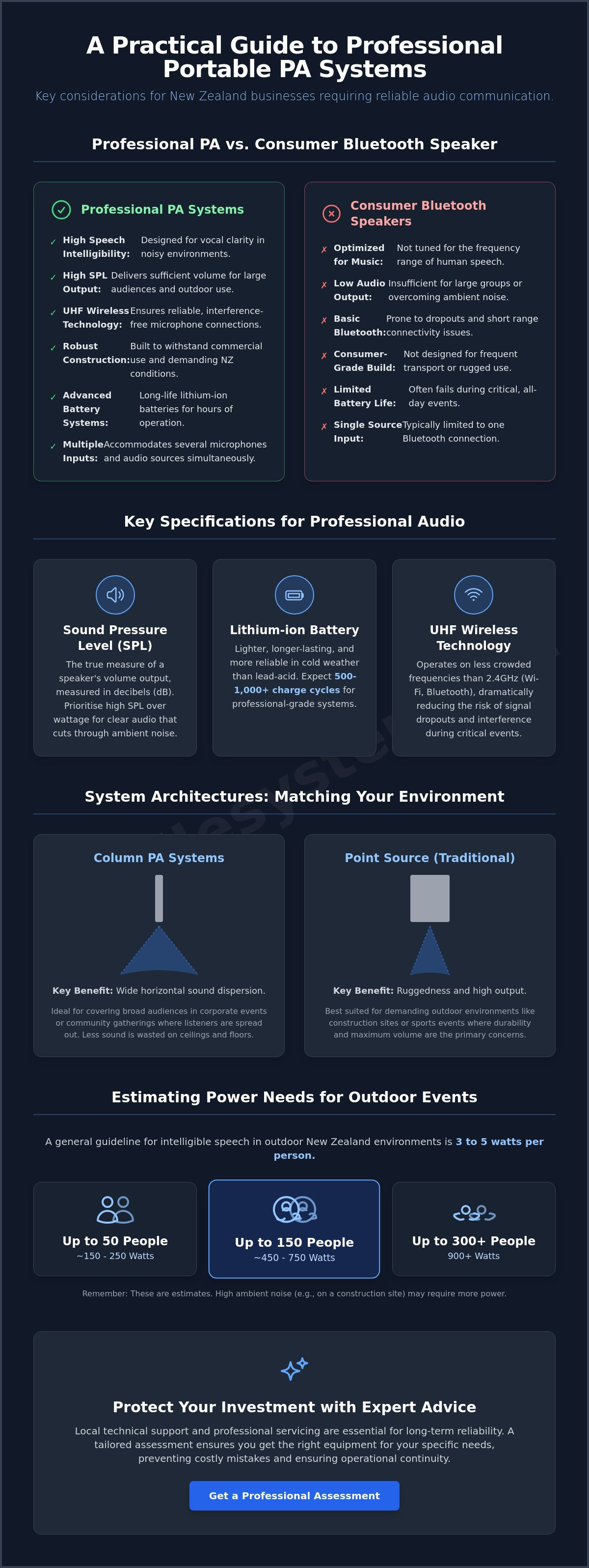
Professional equipment differs significantly from consumer-grade Bluetooth speakers. While consumer electronics focus on short-range music playback, professional portable pa systems nz prioritize speech intelligibility and high Sound Pressure Levels (SPL). These systems feature ruggedized housings, multiple input channels for microphones, and advanced battery management to survive the demands of commercial use.
To better understand how these systems operate in a professional context, watch this helpful video:
Mobility is a primary requirement for New Zealand businesses operating across varied terrains. Whether you're managing a remote forestry site or a community event on a local reserve, having an independent power source is essential. Professional systems provide the autonomy needed to operate for several hours without access to mains power, ensuring your communication remains uninterrupted.
Common Applications in New Zealand
Outdoor corporate events and community gatherings often take place in locations with challenging acoustics. In these settings, a portable system provides the necessary 3-5 watts per person required to overcome wind and ambient noise. This ensures clarity for audiences ranging from small groups to several hundred people.
Under the Health and Safety at Work Act 2015, clear communication is a legal necessity for emergency muster points and safety briefings. On construction sites and in industrial zones, high-output portable audio allows managers to deliver critical warnings that are audible above heavy machinery. Schools also utilize these systems for assemblies and sporting events where fast setup is required by non-technical staff.
Portable vs. Installed Systems
Choosing between a permanent installation and portable PA solutions depends on your frequency of use and site flexibility. Permanent systems offer optimized acoustic coverage for a specific room but lack the versatility needed for multi-site operations. For businesses that manage various venues, a mobile unit represents a more efficient capital investment.
The trade-offs involve setup time and total coverage. While a portable unit can be operational in under five minutes, it requires careful placement to avoid feedback and dead zones. A professional assessment helps determine if the convenience of a mobile system outweighs the seamless integration of a fixed architectural audio setup. Most commercial users find that the ability to transport their audio equipment between locations provides the highest long-term value.
Key Specifications for Professional Portable Audio
Selecting the right equipment requires looking beyond simple power ratings. While many retailers highlight wattage, this metric only measures power consumption. For portable pa systems nz users, the Sound Pressure Level (SPL) is the critical specification. SPL measures the actual acoustic volume output in decibels. A high-efficiency system can provide clear speech coverage for up to 150 people in an outdoor setting with only 100 watts of power, provided the SPL rating is sufficient to overcome ambient noise.
Battery chemistry is equally vital for performance in New Zealand's varied climate. Lithium-ion batteries have largely replaced lead-acid variants in professional fleets because they are lighter and maintain consistent voltage in colder temperatures. These batteries typically support between 500 and 1,000 charging cycles before capacity significantly degrades. This longevity is essential for businesses that require reliable equipment for multi-year operations.
Connectivity options must support diverse professional inputs. Look for systems featuring balanced XLR inputs for microphones and 1/4-inch jacks for line-level signals. Modern systems should also include Bluetooth 5.0. This standard provides a more stable connection and greater range than older versions, which is necessary to prevent audio dropouts when streaming from mobile devices during a presentation.
Portability is defined by more than just weight. Ergonomic handles and integrated wheels are necessary for single-person transport and rapid deployment. A system that weighs under 15kg is generally manageable for most staff members, though larger high-output units may require specialized carts. A tailored technical assessment ensures these physical specifications align with your specific site requirements.
Understanding Wireless Microphones and NZ Frequencies
In New Zealand, wireless microphones must operate on legally approved public frequencies managed by Radio Spectrum Management (RSM). Professional systems typically utilize UHF (Ultra High Frequency) bands because they are less susceptible to interference from Wi-Fi signals in urban areas. Using unapproved frequencies can lead to signal dropouts or legal compliance issues. No special license is required for standard public frequencies, but choosing a system with frequency agility allows you to switch channels if local interference occurs.
Battery Life and Power Management
Manufacturer run-time claims often reflect standby usage rather than continuous high-volume output. For commercial applications, a system should provide at least 6 to 8 hours of active use on a single charge. Systems with swappable battery modules are preferred for all-day events, as they allow for continuous operation without waiting for a recharge cycle. Proper power management, including avoiding deep discharges, will extend the total service life of your equipment fleet.
Comparing System Architectures: Column vs. Point Source
The physical design of portable pa systems nz determines how sound interacts with the environment. Professional buyers must choose between column array systems and traditional point source cabinets based on coverage requirements and site conditions. Each architecture offers distinct advantages in acoustic dispersion and physical handling.
Column systems utilize multiple small drivers stacked vertically. This creates a wide horizontal dispersion, typically around 120 degrees, which ensures listeners at the edges of a room hear the same clarity as those in the center. Because sound volume drops off less rapidly over distance with this architecture, it is highly effective for speech-heavy applications in long or wide venues.
Point source speakers consist of a single woofer and a high-frequency driver in a standard cabinet. These are the benchmark for high-impact audio. While they offer a narrower dispersion pattern than columns, they provide greater "throw" distance and superior low-frequency response. This makes them the preferred choice for music playback or large outdoor areas where high volume is the primary requirement.
Form factor also influences the selection process. Column systems often break down into multiple components, making them easier to fit into the boot of a standard passenger vehicle. Traditional cabinets are bulkier but often feature more rugged, impact-resistant housings. This makes them better suited for transport in utility vehicles or trucks where equipment might shift during transit.
The Advantages of Column Arrays
Column arrays provide consistent sound pressure levels across the entire audience area. Listeners at the back of a marquee or hall experience nearly the same volume as those at the front. This uniformity reduces the risk of microphone feedback, as the system doesn't need to be pushed to extreme volumes to reach the rear of the room.
The slim profile of professional portable audio architectures is ideal for corporate boardrooms or hospitality venues where aesthetics are a priority. Most units feature integrated mixers within the base. This design eliminates the need for external cabling and reduces setup time to under three minutes for non-technical staff.
When Traditional Cabinets Win
Traditional point source cabinets excel in durability. Their rugged enclosures are better suited for construction sites, forestry operations, or sports fields where equipment is exposed to dust and physical wear. They are significantly more resistant to impact during transport in industrial settings than the more delicate components of a column array.
Mounting versatility is another key advantage. Traditional speakers can be elevated on high-clearance stands to project sound over large crowds. This is essential for wide-area coverage at community festivals or emergency muster points. Elevating the sound source above head height ensures that the audio remains intelligible even when the audience is standing close to the unit.
Selecting the Right System for Your NZ Business
Choosing between various portable pa systems nz requires a strategy based on your most demanding use case. While a small unit might suffice for a weekly indoor briefing, it will likely fail to provide clear audio at a large outdoor community event. Decision-makers should evaluate equipment based on peak requirements rather than average daily use to ensure the system remains a versatile asset.
Audience size is the most significant factor in determining power requirements. For indoor environments, a general rule is to provide 1 to 2 watts per person. Outdoor settings are more challenging, requiring 3 to 5 watts per person to maintain clarity against wind and ambient noise. A 100-watt system typically provides clear speech for up to 150 people outdoors, with an effective range of approximately 30 to 40 meters.
Input requirements also dictate the necessary mixer complexity. If your operations only require a single wireless microphone for safety briefings, a basic system is sufficient. However, corporate presentations or sporting events often require multiple channels for background music and additional microphones. Selecting a system with an integrated multi-channel mixer allows for these complex setups without needing external hardware.
Local support is the final pillar of a successful procurement strategy. Investing in a professional portable PA collection ensures that you have access to technical advice and replacement parts within New Zealand. This prevents the operational downtime associated with shipping equipment overseas for basic repairs or battery replacements.
Audience Size and Coverage Planning
Calculating the required Sound Pressure Level (SPL) ensures that your message is intelligible over background noise. It's advisable to "over-spec" your system slightly. Running a system at 70% capacity provides better audio headroom and prevents the distortion and permanent driver damage that occurs when equipment is constantly pushed to its maximum limit.
- Use "slave" or companion speakers to extend coverage for larger crowds without increasing the volume to uncomfortable levels near the primary unit.
- Position speakers at least two meters above ground level to ensure sound waves travel over the heads of the audience.
- Link multiple units via XLR cables or wireless 5.8GHz links for synchronized audio across wide areas.
Environmental Durability Checklist
New Zealand's coastal and industrial environments demand high build quality. Equipment used near the ocean must resist salt-spray, which can quickly corrode internal electronics. Review the IP (Ingress Protection) ratings of any potential system to confirm its resistance to dust and moisture, especially if it will be used on construction or forestry sites.
Ruggedness is reinforced through physical design choices. Systems should feature recessed controls to prevent damage during transport and heavy-duty grilles to protect the speaker drivers. Utilizing custom-fitted weather-resistant covers during operation can further extend the lifespan of your equipment in unpredictable NZ weather conditions. For a professional evaluation of your site requirements, contact our technical team to discuss a tailored solution.
Professional Support and Servicing for PA Equipment
Professional audio equipment represents a significant capital investment. While consumer-grade speakers are often treated as disposable items, high-performance portable pa systems nz are designed for a decade of service. Choosing a system with a clear path for local servicing ensures that your business doesn't face total equipment replacement due to minor component failures or battery degradation.
The hidden cost of "disposable" audio becomes apparent when a system fails during a mission-critical event. Without local technical support, businesses often wait weeks for international shipping or find that replacement parts aren't stocked in New Zealand. Professional systems from Mobile Systems Limited are supported by a local service department capable of performing repairs, firmware updates, and battery health assessments to maintain peak performance.
Regular maintenance is essential for long-term reliability. This includes checking wireless microphone frequencies for compliance and ensuring that charging circuits are functioning correctly. Keeping firmware updated is particularly important for maintaining stable Bluetooth 5.0 connections, which can be affected by changes in mobile device operating systems.
Longevity is also a product of proper storage and handling. Using custom-fitted covers and original transport cases prevents physical damage to the drivers and control knobs. A proactive approach to equipment care, supported by expert technical advice, significantly reduces the total cost of ownership over the life of the system.
The Mobile Systems Difference
Our background in mission-critical communications, including vehicle-mounted radios and satellite phones, informs our approach to public address systems. We understand that in industrial and emergency settings, communication isn't just about volume; it's about reliability. We provide a level of technical oversight that consumer retailers cannot match.
A tailored assessment prevents the common mistake of under-speccing a system for challenging New Zealand environments. We evaluate your specific terrain, audience size, and ambient noise levels before recommending a solution. This consultative approach ensures that the equipment you purchase today will continue to meet your operational requirements as your business grows.
Next Steps for Your Business
Identifying the right audio solution begins with a clear understanding of your environment and audience. We recommend requesting a professional equipment demonstration to experience the clarity and build quality of our systems in person. This allows your staff to test the simplicity of the setup and ensure it meets your internal usability standards.
Customizing your package with the correct microphones, protective covers, and slave speakers is the final step in building a resilient communication tool. Whether you're managing a construction site or a corporate event, our team provides the technical advice needed to secure your investment. For a detailed assessment of your requirements, visit our contact page to speak with a technical advisor.
Securing Reliable Communication for Your Operations
Selecting the right audio equipment involves balancing acoustic performance with the physical demands of your site. Prioritizing Sound Pressure Level (SPL) and lithium-ion battery technology ensures that your message remains clear and uninterrupted, regardless of the environment. Whether you choose a column array for its wide dispersion or a traditional point source cabinet for its ruggedness, the focus should always be on long-term reliability and speech intelligibility. These technical considerations are the foundation of a resilient communication strategy.
Mobile Systems Limited specializes in communication solutions for rugged NZ commercial environments. As authorized distributors of professional-grade audio, we provide the expert technical support and servicing necessary to maintain your equipment's performance over its entire lifecycle. Investing in high-quality portable pa systems nz ensures your business meets its safety and communication obligations with confidence. Our team is ready to help you navigate these specifications to find the most effective system for your unique operational needs.
Speak with a Mobile Systems expert for a tailored PA solution to prevent costly procurement mistakes and ensure your team has the tools they need for success. We look forward to helping you achieve clear, professional audio in any setting.
Frequently Asked Questions
Do I need a license to use a wireless microphone with my PA system in NZ?
You don't need a special license for standard wireless microphones in New Zealand. These systems operate on legally approved public frequencies managed by Radio Spectrum Management (RSM). Professional users should verify their equipment operates within these designated bands to avoid interference with other local communication services.
How many people can a typical portable PA system cover?
A 100-watt portable PA system typically provides clear speech for up to 150 people in an outdoor setting. For indoor events, coverage depends on room acoustics, but a general rule is providing 1 to 2 watts per person. Outdoor environments require 3 to 5 watts per person to overcome wind and ambient noise effectively.
Can I use my portable PA system in the rain?
Most portable PA systems aren't fully waterproof and shouldn't be used in direct rain without specialized protection. While some units have basic moisture resistance, you should use weather-resistant covers to protect the electronics. If your operations require frequent outdoor use in damp conditions, check for specific IP ratings for dust and moisture resistance.
What is the difference between a 'passive' and an 'active' portable speaker?
Active speakers include a built-in amplifier and mixer, making them a self-contained solution for mobile use. Passive speakers require an external power amplifier to function. Most portable pa systems nz businesses use are active units because they simplify setup and reduce the amount of equipment staff need to transport between sites.
How long do the batteries usually last on a professional portable PA?
Professional portable PA systems generally provide 6 to 8 hours of active use on a single charge. While manufacturer standby claims may be higher, continuous high-volume output will deplete the battery faster. Modern lithium-ion batteries perform more reliably in colder New Zealand temperatures and support more charging cycles than older lead-acid alternatives.
Can I connect multiple portable PA speakers together for larger events?
You can connect multiple speakers together using XLR cables or wireless linking modules to expand coverage for larger crowds. This allows you to distribute sound evenly across a wide area without increasing the volume to uncomfortable levels at the source. Using "slave" or companion speakers is an effective way to reach audiences of 500 or more.
Is Bluetooth reliable for professional business presentations?
Bluetooth 5.0 is highly reliable for audio streaming during professional presentations within a range of 10 to 20 meters. It offers a more stable connection than older versions, though it's susceptible to interference in environments with high Wi-Fi traffic. For mission-critical audio where the source is far from the speaker, a wired connection remains the most secure option.
What happens if my PA system needs repair in New Zealand?
If your system requires maintenance, Mobile Systems Limited provides local technical support and servicing for professional public address systems. Local repair capability is essential for business continuity, as it prevents the long delays associated with international shipping. Regular maintenance and firmware updates help ensure your equipment remains operational for its full intended service life.
Related posts

- June 11, 2026
PoC or UHF/VHF? An honest comparison of coverage, cost, licensing and reliability for New Zealand worksites.

- June 08, 2026
In New Zealand’s vertical terrain, the network constellation matters more than the device features. When you're deep in the Southern...