
The Ultimate Guide to Portable Radio Hire in New Zealand
Find portable radio hire transactional service high New Zealand options for reliable team comms. Compare features, costs, and choose the right service today.
Is your team's communication truly reliable when the pressure is on? For businesses managing projects across New Zealand, from bustling Auckland construction sites to remote forestry blocks, a single communication breakdown can trigger costly delays, safety incidents, and operational chaos. When cell coverage disappears and consumer-grade walkie talkies fail, how do you keep your crew connected and safe?
This is where professional portable radio hire becomes mission-critical. It’s not just about convenience; it's a strategic decision to ensure safety, efficiency, and project success, giving your team access to reliable, professional-grade equipment without the heavy capital outlay.
The Problem: Why Standard Comms Fail in NZ Workplaces
Across New Zealand, businesses in critical industries face the same challenge: maintaining seamless communication in demanding environments where standard mobile phones are not a viable solution. The reliance on patchy cellular networks or underpowered retail store radios creates significant operational risks.
Consider these common scenarios:
- Construction & Civil: On large sites with concrete structures, steel framing, and below-ground work, mobile phone signals are notoriously unreliable. A dropped call between a crane operator and a ground crew can have catastrophic consequences.
- Forestry & Agriculture: In remote forests or sprawling rural properties, cellular coverage is often non-existent. Teams operating heavy machinery or working alone are left isolated, compromising both safety and productivity.
- Events & Traffic Management: Coordinating hundreds of staff across a large festival ground or a complex road closure requires instant, reliable group communication that mobile phones simply cannot provide.
- Manufacturing & Warehousing: In noisy factory environments with significant steel racking and machinery interference, clear audio and robust devices are essential for smooth logistics and immediate safety alerts.
- Lone & Remote Workers: For field teams, surveyors, or security personnel working alone, reliable communication is their lifeline. A missed check-in or a failed emergency call is not an option.
These operational pain points are precisely why a professionally managed portable radio hire service is essential. It provides a dedicated, reliable communication backbone designed for the unique challenges of NZ workplaces, ensuring every team member is heard, safe, and effective.
Understanding Your Options: Choosing the Right Radio Technology
Choosing the right portable radio isn't a one-size-fits-all decision. The effectiveness of your communication hinges on selecting the correct technology for your specific operational environment. In New Zealand, the choice primarily comes down to UHF, VHF, or Push-to-Talk over Cellular (PoC). Getting this right is the first step to flawless communication.
UHF vs. VHF vs. PoC: The Core Differences
- UHF (Ultra High Frequency): These radios are the champions of built-up, obstructed environments. Their shorter wavelength is exceptionally good at penetrating concrete, steel, and other physical barriers. This makes UHF the definitive choice for construction sites, multi-storey buildings, manufacturing plants, warehouses, and indoor events.
- VHF (Very High Frequency): With a longer wavelength, VHF signals travel further over open, unobstructed terrain. If your operations are in agriculture, forestry, maritime settings, or traffic management on open roads with clear lines of sight, VHF will deliver superior range and clarity.
- PoC (Push-to-Talk over Cellular): This technology leverages New Zealand’s cellular networks (Spark, One NZ, 2degrees) to provide instant, nationwide communication. PoC radios like the Hytera P50 or Motorola TLK110 are ideal for transport, logistics, and field service teams that operate across different cities or regions, eliminating the need for traditional repeater infrastructure.
A common mistake is assuming "longer range" is always better. A VHF radio will perform poorly on an urban construction site where a UHF radio would provide crystal-clear audio. The physics of the radio wave must match the physical environment.
This decision tree helps visualise which radio technology is the right tool for your operational environment.
Features That Matter on a New Zealand Worksite
Beyond the core technology, several key features distinguish a professional-grade radio from a consumer toy. These are the practical specifications that ensure reliability, safety, and productivity in tough Kiwi conditions.
- IP Rating (Durability): The Ingress Protection rating is a non-negotiable feature. It tells you how well a device is sealed against dust and water. An IP67 rating, common in professional radios from Hytera, Tait, and Motorola, means the device is completely dust-tight and can survive being submerged in one metre of water for 30 minutes. For a muddy construction site or a maritime operation, a high IP rating is essential for device longevity.
- Battery Shift-Life: A radio is useless if its battery dies mid-shift. Professional radios are engineered for long workdays, typically offering 12-16 hours of operational life on a single charge. A quality hire service ensures batteries are properly conditioned and managed, so your team stays connected for their entire shift without fail.
- Acoustic Performance: In loud environments like sawmills, processing plants, or event venues, standard audio is insufficient. Professional radios feature advanced noise-cancelling microphones and powerful speakers to ensure every transmission is heard clearly, protecting both safety and efficiency.
- Safety Features (Lone Worker & Man Down): For staff working in isolation, these features are critical for meeting your Health and Safety obligations under the Health and Safety at Work Act 2015. Lone Worker requires the user to check in at pre-set intervals, while Man Down uses an accelerometer to automatically trigger an emergency alert if the radio tilts past a certain angle, indicating a potential fall or incapacitation.
Industry-Specific Solutions: How Mobile Systems Delivers
Different industries face unique communication challenges. A professional hire service doesn't just provide hardware; it delivers tailored solutions. At Mobile Systems, our 20+ years of experience means we understand your world and provide end-to-end support.
- Construction & Civil: We supply rugged, IP67-rated UHF radios like the Entel DX485 for superior penetration through concrete and steel. Our service includes on-site coverage mapping to eliminate dead spots and multi-unit chargers to ensure radios are always ready for the next shift.
- Forestry & Agriculture: For vast, remote areas, we deploy long-range VHF solutions, often combined with vehicle radios and repeater systems to extend coverage across entire properties. For extreme remote work, we integrate satellite devices like Iridium or Inmarsat for guaranteed connectivity.
- Events & Tourism: We provide discreet, lightweight UHF radios with earpiece accessories for clear, private communication. For large-scale events spanning multiple venues, our PoC radio solutions offer seamless city-wide or even nationwide coverage.
- Transport & Logistics: Our PoC radio systems, featuring GPS tracking, are the perfect solution for fleet managers. They provide instant nationwide communication and live location data, improving driver safety and logistical efficiency.
- Maritime & Marine: We supply specialist marine VHF radios from brands like GME, Uniden, and Icom. These devices are fully waterproof, often float, and are programmed with the correct marine channels for vessel-to-vessel and ship-to-shore communication.
Our end-to-end support includes expert programming, installation, servicing, and replacement plans, ensuring your operation runs smoothly without communication headaches.
High-Value Insights: Common Mistakes NZ Businesses Make
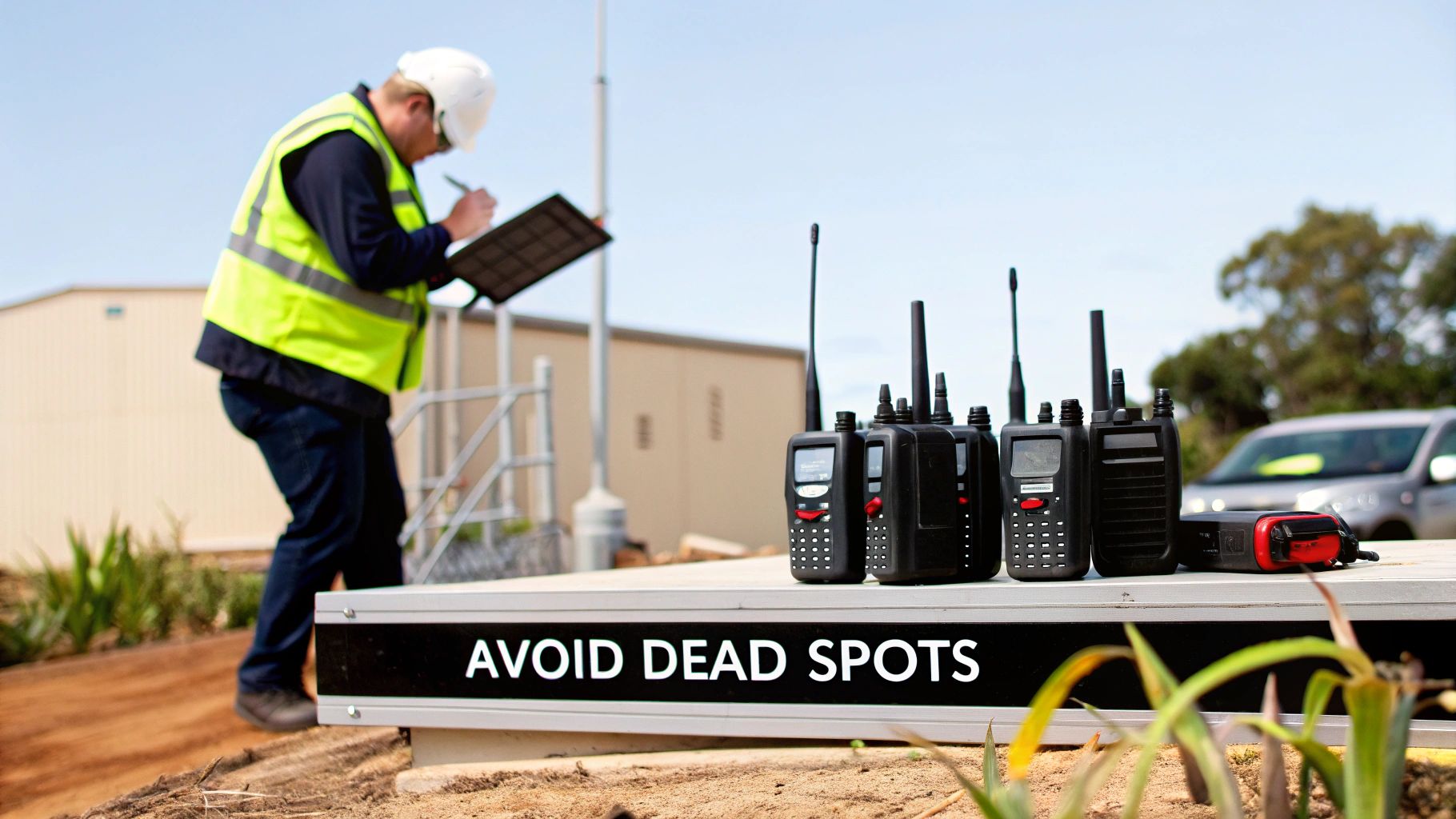
With nearly two decades of deploying communication solutions across every corner of New Zealand, we've seen what works and what doesn't. Avoiding these common pitfalls will save you time, money, and significant safety risks.
-
The Mistake: Choosing the Wrong Technology. As highlighted, selecting VHF for an urban site or UHF for open farmland is a recipe for frustration and failed communication.
- How MSL Solves It: We conduct a proper needs analysis. Our first step is to understand YOUR operational environment. We use this information to recommend the right technology, backed by coverage planning to ensure no dead spots.
-
The Mistake: Poor Battery Management. Teams arrive on-site with uncharged radios, or there's no system to manage batteries for multi-shift operations. Chaos ensues by mid-afternoon.
- How MSL Solves It: For every hire, we provide multi-bay gang chargers. This centralised system ensures every radio is returned to a charging slot at the end of a shift, guaranteeing a fully charged fleet is ready every morning. We also supply spare batteries for 24/7 operations.
-
The Mistake: Ignoring RSM Licensing. Many businesses are unaware that using commercial-grade radios requires a license from Radio Spectrum Management (RSM). Operating without one is illegal and risks interference from other users.
- How MSL Solves It: We handle 100% of the RSM licensing for you. It's a core part of our hire service. We ensure your radios are programmed onto licensed, private channels, so your communications are secure, interference-free, and fully compliant.
NZ Compliance, Safety, and Operational Considerations
Operating safely and legally in New Zealand requires an understanding of key compliance and operational standards.
- RSM Licensing: All commercial radio use is governed by Radio Spectrum Management (RSM), a division of MBIE. A professional hire service manages all licensing requirements, ensuring your channels are private and legally compliant.
- Lone Worker Safety: Under NZ law, businesses have a duty of care for employees working alone. Features like Lone Worker, Man Down, and GPS tracking are not just 'nice-to-haves'; they are essential tools for meeting your safety obligations.
- Durability & IP Ratings: New Zealand's weather and work environments demand rugged equipment. An appropriate IP rating (e.g., IP67) ensures your investment is protected from dust, rain, and accidental immersion.
- Acoustic Safety: In environments exceeding 85 dBA, hearing protection is mandatory. We provide noise-cancelling headsets and remote speaker microphones that offer acoustic shock protection and allow clear communication while wearing ear defenders.
- Device Shift-Life: Your hire provider must guarantee that batteries will last a full 12+ hour shift. This requires professional battery fleet management, which we provide as standard.
Why Choose Mobile Systems Limited?
Choosing a provider for your portable radio hire is about more than just equipment. It’s about partnership, trust, and confidence in your critical communications.
- 100% New Zealand Owned: Based in Mount Maunganui, we are a Kiwi business dedicated to serving other Kiwi businesses. We have spent over 20 years understanding the unique challenges of our local industries and environments.
- On-Site Support Fleet: Problems happen in the field, not in an office. Our mobile support fleet comes to you for installation, programming, and troubleshooting, minimising downtime and ensuring your system is perfectly optimised for your site.
- Expertise You Can Trust: We are technical experts in world-class brands like Motorola, Tait, Hytera, Icom, and Entel. Our deep product knowledge means we can design and deploy a solution that is robust, reliable, and perfectly suited to your needs.
- End-to-End Service: We are your complete communications partner. From initial consultation and coverage planning to RSM licensing, programming, and long-term aftercare, we manage every detail so you can focus on your business.
We don’t just sell or rent radios. We build long-term relationships based on trust, reliability, and real-world results. We are the safe, dependable partner for serious buyers who cannot afford to compromise on communication.
Take the Next Step to Flawless Team Communication
Reliable communication is the bedrock of a safe and efficient operation. Partnering with a specialist for your portable radio hire is the most effective way to ensure your team stays connected, no matter what the job throws at them.
Getting started is simple and pressure-free. Our goal is to provide clear, practical advice that solves your communication challenges and gives you complete confidence.
We invite you to:
- Request a tailored quote for your next project.
- Ask for a no-obligation demo to see the equipment in action.
- Speak to a communications specialist about your specific operational needs.
Let our friendly, New Zealand–based team of experts build a communication solution that keeps your people safe and your project on track.
Ready to get started? Speak to a Mobile Systems communication specialist today and let's connect your team.
Frequently Asked Questions
Here are the answers to some common questions we receive from businesses across New Zealand.
Do I need a licence to use hired two-way radios in NZ?
Yes, professional-grade two-way radios require a licence from Radio Spectrum Management (RSM) to operate legally on private commercial frequencies. When you hire from Mobile Systems, we take care of all the licensing requirements for you as part of our service. This ensures your communication is secure, private, and 100% compliant.
What is included in a standard radio hire package?
Our standard hire package is a complete solution. It includes the radio handsets, high-capacity batteries, belt clips, and multi-bay chargers. Crucially, it also includes expert programming to your specific needs, full RSM licensing management, and ongoing technical support for the duration of the hire.
How quickly can I get hire radios for an urgent job?
We understand that projects can be dynamic and needs can arise urgently. Because we are based in New Zealand and hold our own stock, we can often dispatch pre-programmed radios for next-day delivery nationwide. For urgent requirements, we recommend calling us directly to confirm availability and logistics.
What happens if a hired radio is damaged on site?
New Zealand worksites can be tough on equipment, and we understand that accidents happen. Our hire agreements include provisions for maintenance and support. We stock spare equipment, allowing us to arrange a swift repair or replacement to ensure you have minimal operational downtime.
Can you provide radios for large, multi-day events?
Absolutely. We specialise in providing large fleets of radios for major events, festivals, and concerts. We supply multi-unit chargers to keep your entire fleet operational and can provide accessories like earpieces for discreet communication and spare batteries for 24/7 operations.
Related posts

- June 16, 2026
Mobile Systems Limited's 2026 buyer's guide to satellite phones covers Iridium vs Inmarsat vs Starlink Direct to Cell, dedicated handsets,...

- June 15, 2026
Mobile Systems Limited's 2026 guide for NZ businesses covers VHF vs UHF frequency selection, Digital Mobile Radio, IP67 durability ratings,...

- June 14, 2026
A portable PA system is a critical safety and communication tool, not just a luxury for public events. When you're...