
The Ultimate NZ Guide to 2-Way Radio: Boosting Safety & Efficiency
Discover the essential guide to radio 2 way systems in NZ. Learn about UHF, VHF, and modern comms solutions to keep your business connected and safe.
How do you keep your construction crew coordinated when mobile coverage inevitably drops out on site? Or ensure your forestry team is safe while working in a remote block with zero signal?
For countless Kiwi businesses, these aren't just hypothetical worries—they are daily operational risks. A standard mobile phone simply cannot be relied upon when instant, clear communication is critical for both SAFETY and EFFICIENCY.
Why Reliable Communication is a Non-Negotiable Asset for NZ Businesses
In New Zealand's diverse and often rugged work environments, a communication breakdown isn't just an inconvenience. It can be a serious health and safety liability.
From high-country farms to the signal-swallowing concrete of urban construction sites, the limits of the mobile network are a constant reality. This is where professional radio 2 way systems become absolutely essential.
Unlike a mobile phone that depends on a network that can—and does—fail, a two-way radio gives you an independent, reliable, and instant line of communication. They are the true backbone of coordination for countless industries across Aotearoa.
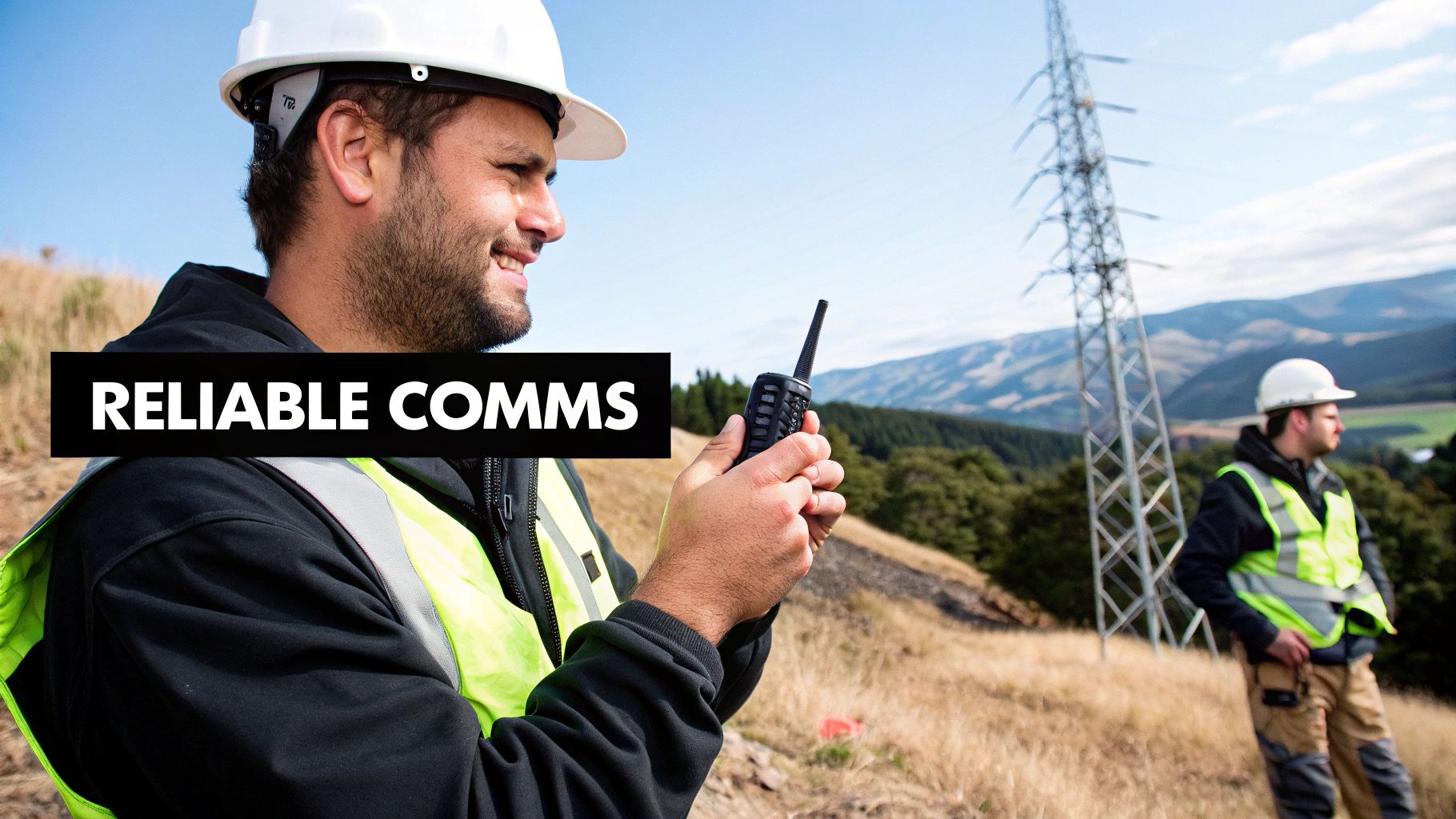
The True Cost of Poor Communication
When a call won’t connect or a message fails to send, the consequences can be huge. Operations grind to a halt, leading to expensive downtime and project delays.
Even more importantly, in an emergency, being unable to call for help can have dire outcomes. This gap in operational capability is exactly why a robust communication strategy is so vital. To get a broader perspective on this, it's worth exploring the fundamental concepts of workplace communication to understand the wider context.
Getting your communication right is the cornerstone of a safe and productive worksite. It delivers:
- Enhanced Team Safety: Instant group calls make sure everyone is aware of hazards as they happen, which is especially crucial for lone workers or teams in remote spots.
- Improved Operational Efficiency: Clear, immediate instructions cut down on mistakes, help coordinate machinery, and ultimately keep projects on schedule.
- Regulatory Compliance: Meeting your health and safety obligations, particularly for things like lone worker monitoring, is far simpler with reliable communication tools in hand.
Your Guide to Choosing the Right Solution
This guide is here to cut through the technical jargon and give New Zealand businesses a clear path forward. We'll walk you through the different types of radio 2 way technology, from traditional UHF/VHF to modern Push-to-Talk over Cellular (PoC) systems.
You'll learn which devices are best suited for your industry, what key features to look for, and how to navigate NZ's licensing requirements. Our goal is simple: to empower you to choose a communication solution that protects your people, boosts your productivity, and supports your business for years to come.
Understanding How Two-Way Radios Actually Work
At its core, a radio 2 way system is beautifully simple. It takes your voice, converts it into radio waves, and sends it flying through the air to another radio, which then turns those waves back into sound.
Think of it like skipping a stone across a pond. When you speak into the radio (the transmitter), you're creating invisible ripples (radio waves) that travel outwards. Another radio (the receiver) picks up these ripples and understands them as your voice.
This direct, point-to-point connection is what makes two-way radios so incredibly reliable. They don’t need mobile towers, which can get congested, lose power, or simply be out of range. They create their own network, right where you need it.
VHF vs UHF: What Is the Difference?
But not all radio waves are the same. They travel on different frequency bands, and for commercial use in New Zealand, the two you’ll hear about most are VHF (Very High Frequency) and UHF (Ultra High Frequency). Picking the right one is absolutely critical for getting the performance you need.
-
VHF (Very High Frequency): VHF waves are long and tend to hug the ground. This makes them perfect for wide-open spaces. Think sprawling farmland, open country, or out on the water. If you’ve got a clear line of sight with few major obstacles, VHF is your best bet. It’s no surprise that VHF marine radio is the standard for maritime safety.
-
UHF (Ultra High Frequency): UHF waves are shorter and punchier. Their superpower is the ability to penetrate solid objects—we're talking concrete, steel, and dense native bush. This makes them the undisputed champion for busy construction sites, cavernous warehouses, built-up urban areas, and rugged forestry blocks where the signal needs to navigate a maze of obstacles.
It’s not a question of which is better. It’s about choosing the right tool for the job, and your work environment dictates the choice.
Analogue vs Digital (DMR) Technology
The next big decision is between old-school analogue and modern digital radio. While analogue has been around for decades, today’s digital radios—typically using the DMR (Digital Mobile Radio) standard—offer game-changing advantages for any professional operation.
Digital radio isn't just a minor improvement; it's a complete overhaul of communication clarity, security, and capability. Digital tech actively filters out background noise, so your message cuts through the racket of a worksite, and it offers a level of privacy that’s simply impossible with analogue.
Anyone who’s used an analogue radio knows how the signal slowly degrades with distance, dissolving into a wall of static. Digital is different. The signal stays crystal clear right up to the very edge of its range, then drops off. That clarity can be the difference between a correctly understood instruction and a costly, dangerous mistake.
On top of that, digital radios pack in features that professionals love:
- Longer Battery Life: Digital radios are up to 40% more efficient, meaning your batteries will easily last through a long, demanding shift.
- Secure Communications: Digital signals can be encrypted, stopping anyone from eavesdropping on sensitive operational or security chatter.
- Data on the Go: These aren't just for voice. Digital radios can handle text messages, GPS location tracking, and even job ticketing, turning them into powerful coordination tools.
New Zealand’s emergency and transport sectors are rapidly moving to digital, driven by the need for better clarity and data features. It's a global shift, too. The professional two-way radio market is projected to be worth over USD 10 billion in 2024, as more and more businesses upgrade their old analogue fleets to powerful digital DMR systems. Learn more about the growth of the professional radio market.
Push-to-Talk over Cellular (PoC)
There's a third option shaking things up: Push-to-Talk over Cellular (PoC). Devices like the Hytera P50 look and feel just like a standard two-way radio, but they use New Zealand's mobile data network to talk to each other.
This gives them one massive advantage: nationwide range. As long as you have mobile coverage, you can talk to your team anywhere in the country, instantly. PoC is a brilliant solution for transport and logistics fleets, nationwide service teams, and any manager who needs to connect with staff across multiple sites without missing a beat.
If you want to dive a little deeper, you can check out our guide on how radio communications work.
Choosing the Right Radio for Your New Zealand Industry
Picking the right communication tool isn’t a one-size-fits-all job. The best radio 2 way system for a hectic construction site in Queenstown will be worlds apart from what a fishing crew needs off the coast of the Coromandel. The real secret is matching the tech to the unique challenges of your workplace.
A generic "walkie talkie" from a big-box retailer just won't cut it when your team's safety and efficiency are on the line. Different industries throw different curveballs—from concrete and steel killing your signal to vast, open country that stretches communication to its absolute limit. This is exactly why getting specialist advice from a communications provider with real-world experience is so important.
To get you started, the flowchart below offers a simple way to begin thinking about your options based on where you'll be working.
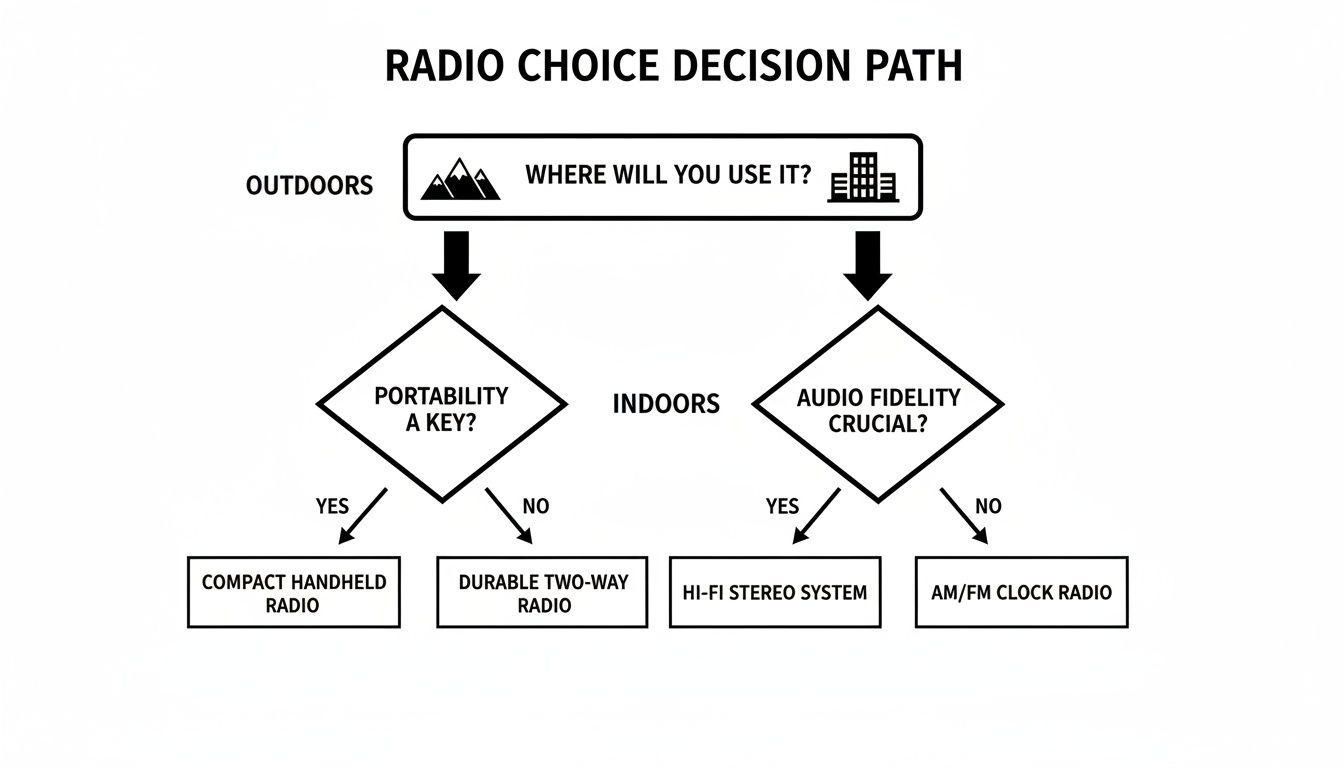
As you can see, that very first question—where do you work?—is the biggest factor in figuring out which radio technology is going to work best for you.
Construction and Traffic Management
The average Kiwi building site is a brutal place for any piece of electronics. You’ve got a chaotic mix of dust, rain, deafening machinery, and a jungle of signal-blocking obstacles like steel framing and rebar-filled concrete.
In an environment like this, durability and signal penetration are everything. Your crew needs a radio that can take a serious knock and still come through with a crystal-clear message.
- Recommended Technology: UHF Digital (DMR) Radios are the go-to for a reason. Their shorter wavelength is brilliant at punching through buildings and other solid objects on site.
- Key Features: Look for a high IP rating (like IP67 or IP68), which tells you it’s sealed against dust and water. MIL-STD 810 certification is also a must-have; it means the radio is tough enough to survive drops onto concrete.
- Top Brands: Companies like Motorola and Hytera are masters at building incredibly tough, reliable UHF radios designed specifically for these punishing conditions.
Maritime and Fishing Operations
Once you're out on the water, your communication needs change completely. You generally have a clear line of sight, but now you’re dealing with huge distances, corrosive salt spray, and the critical need to talk with other vessels and Coastguard.
- Recommended Technology: VHF Marine Radios are the only real option here. They're legally required for many vessels and operate on specific, internationally recognised marine channels.
- Key Features: A high waterproof rating (IPX7 or IPX8) is non-negotiable. Other life-saving features include a dedicated emergency Channel 16 button, GPS for broadcasting your position (DSC), and even designs that float if dropped overboard.
- Top Brands: GME and Uniden are household names in the New Zealand marine scene, offering a solid range of both fixed-mount and handheld options.
Agriculture and Forestry
Farming and forestry operations in New Zealand often span massive, hilly properties where cellphone reception is just a memory. Your comms system has to cover long distances and work around challenging topography.
- Recommended Technology: For wide-open farmland, VHF Radios are usually the best bet because of their longer wavelength. But in dense forestry blocks, UHF can often perform better. Vehicle-mounted units with a good external antenna give you a massive boost in power and range.
- Key Features: For larger properties, a repeater system is often a game-changer. By placing a repeater on a high point, it acts like a powerful relay station, blasting your signal over hills and into valleys you could never reach otherwise.
- Top Brands: We supply rugged vehicle radios and handhelds from brands like Tait and GME, all built to handle the tough demands of rural NZ.
For any business operating in remote areas, a professionally designed radio network is more than just an efficiency tool—it's a critical piece of your safety infrastructure. It’s what guarantees every worker stays connected, no matter how isolated they are.
Lone Worker Safety Across All Sectors
No matter the industry, if you have staff working by themselves, you have a legal and moral duty to keep them safe. Modern digital radios come packed with clever features designed for exactly this.
- 'Man Down' Alerts: These radios have built-in sensors. If a radio is tilted on its side for too long (indicating a potential fall or incident), it can automatically fire off an emergency alert to a supervisor or the whole team.
- GPS Tracking: In an emergency, knowing exactly where your team member is can be the difference between a close call and a tragedy. Digital radios can send out real-time GPS coordinates, slashing response times when every second counts.
These features turn a simple radio 2 way device into a life-saving tool. For a deeper dive into what’s out there, our guide on the best walkie talkie nz models breaks down the top choices for professional use. Getting the right device means giving your team the reliable connection they need to work safely and effectively, wherever the job takes them in New Zealand.
Decoding Key Features and Technical Specifications
When you start comparing different two-way radio models, you’ll quickly run into a wall of acronyms and technical terms. The key to making a smart investment isn't becoming a radio engineer; it's about understanding what these specs actually mean for your team on a day-to-day basis.
Let's cut through the jargon. Knowing which features will keep your people safe, productive, and connected when it matters most is what really counts.
Durability Ratings Built for NZ Conditions
New Zealand worksites are tough on gear. Whether it's the fine dust of a subdivision development, relentless rain on a forestry block, or an accidental drop from a ute, your radios need to be built to last. Two key ratings tell you exactly how tough a device is.
- IP Ratings (Ingress Protection): This is one of the most important specs for any outdoor equipment in NZ. The first digit rates protection against solids (like dust), and the second rates protection against liquids (like water). A radio rated at IP67, for instance, is completely dust-tight and can survive being submerged in a metre of water for 30 minutes. That’s a great baseline for most construction, agriculture, and field service teams.
- MIL-STD 810 Ratings: This is a ruggedness standard developed by the US military. If a radio is MIL-STD certified, it means it has been put through the wringer—tested against drops, vibration, shock, and extreme temperatures. It’s your guarantee that the device can handle the physical abuse of a demanding worksite.
Audio Quality in Loud Environments
Clear communication is useless if you can’t hear the message over the roar of a digger or the noise of a processing plant. For any professional radio system, this is where advanced audio technology becomes non-negotiable.
Look for radios that offer features like:
- Intelligent Audio: This tech automatically adjusts the radio's volume to compensate for background noise, so your team isn't constantly fiddling with the volume knob.
- Noise-Cancelling Microphones: Sophisticated software filters out all the ambient racket, ensuring that only the speaker's voice is transmitted. The result is crystal-clear audio, even in the loudest environments.
In high-noise industrial or construction settings, superior audio isn't a luxury—it's a critical safety feature. A misunderstood instruction because of poor audio can lead to serious accidents or costly mistakes.
Transmission Power and Range
A radio's power output, measured in Watts (W), has a direct impact on its potential range. As a rule of thumb, higher wattage means a stronger signal that can travel further and punch through obstacles more effectively.
- Handheld portable radios typically run from 1 to 5 Watts.
- Vehicle-mounted mobile radios are much more powerful, often 25 Watts or even 50 Watts, giving them a significantly greater reach.
But it's crucial to remember that range is never a single, guaranteed number. It's heavily influenced by terrain, buildings, and antenna performance. A 5-Watt UHF radio might reach several kilometres in open country but struggle to cover a few hundred metres inside a steel-reinforced building. This is why getting professional coverage planning from experts like us at Mobile Systems is so important.
Before we dive into the advanced features, let's quickly compare the core radio technologies you'll encounter. This table gives you a quick snapshot of what works best for different Kiwi businesses.
Radio Technology Comparison for NZ Businesses
| Technology | Best For | Typical Range | Key Advantages |
|---|---|---|---|
| Conventional Analogue | Small teams, simple on-site operations (farms, local events). | Short to medium | Simple, cost-effective, and easy to use. |
| Conventional Digital (DMR) | Construction, manufacturing, schools, transport. | Medium to long | Clear audio, enhanced privacy, GPS, and text messaging capabilities. |
| Trunked Digital | Large-scale operations (airports, city councils, major projects). | Extensive (city/region-wide) | Highly efficient channel use, no congestion, advanced fleet management. |
| Push-to-Talk over Cellular (PoC) | Nationwide fleets, logistics, businesses with dispersed teams. | Nationwide (cellular coverage) | No range limits, leverages existing mobile networks, low infrastructure cost. |
Each of these technologies has its place, and the best choice depends entirely on your operational needs, from a simple setup on the farm to a nationwide logistics network.
Advanced Digital Features for Safety and Efficiency
Modern digital radios are much more than just voice communication devices. They are powerful tools that can completely change your team's workflow and safety oversight.
Some of the most valuable digital features include:
- GPS Tracking: See your team's location in real-time on a map. This is invaluable for dispatching the nearest person to a job and is a critical safety feature for monitoring lone workers.
- Text Messaging: Send pre-programmed or custom messages for non-urgent updates. This cuts down on unnecessary radio chatter and provides a clear, written record of the communication.
- Emergency Button ('Man Down'): A dedicated, one-press button can instantly send an alert to a supervisor or the entire team, often transmitting the user's GPS location automatically. Some radios from brands like Motorola or Hytera even feature 'Man Down' alerts that trigger if the radio is tilted for too long, indicating a potential fall.
By understanding these key specifications, you can move past the marketing hype and choose a radio system based on how it will actually perform in your specific New Zealand work environment.
Navigating NZ Licensing Compliance and Best Practices
Operating a professional radio 2 way system in New Zealand isn't a free-for-all. To keep the airwaves clear for everyone, the radio spectrum is carefully managed by a government body, Radio Spectrum Management (RSM). Getting to grips with your obligations isn't just about ticking boxes and avoiding fines; it’s about making sure your team has a rock-solid, reliable channel when they need it most.
For any serious business, relying on public, licence-free channels is a huge gamble. These channels are often clogged with chatter from other users, leading to constant interruptions and absolutely no privacy. Securing your own private licensed channel from RSM is the only real way to guarantee your communications are secure and free from interference.
RSM Licensing for Commercial Use
Getting a private radio licence gives your business an exclusive frequency in your area of operation. It means no one else can legally jump on your channel, giving you a clear and private line to get the job done.
The benefits are immediate and obvious:
- Interference-Free Operation: Say goodbye to hearing chatter from other worksites or hobbyists. Your channel is yours, and yours alone.
- Enhanced Security: A private channel stops casual eavesdropping in its tracks, protecting sensitive operational or security information.
- Greater Reliability: You can depend on your comms being available 100% of the time, without ever worrying about channel congestion.
Here at Mobile Systems, we can handle the entire RSM licensing process for you—from the initial application to programming your fleet. It makes compliance simple. If you want to dive deeper, you can explore the basics of these frequencies in our guide to UHF Radio in NZ.
Best Practices for Your Radio Fleet
Beyond just licensing, a few simple best practices will make a massive difference to the performance and lifespan of your radios. The two-way radio market is still a commercially significant part of New Zealand's economy, which shows just how vital professional-grade equipment is. With market forecasts estimating the NZ radio broadcasting market at around NZD $412.4 million in 2025, it's clear that radio technology is here to stay. You can read more about the consumer radio market in New Zealand.
Adopting professional standards for radio use isn't just about etiquette; it's about embedding a culture of safety and efficiency. Clear, concise communication saves time, reduces errors, and ensures everyone gets the message instantly.
For top performance, focus on these key areas:
- Radio Etiquette: Keep your transmissions short, sharp, and to the point. Using standard call signs and finishing with "over" lets everyone know you're done speaking. This simple discipline keeps the channel free and makes sure every message is understood loud and clear.
- Battery Management: For operations running multiple shifts, a solid battery strategy is non-negotiable. Set up multi-bay chargers so there are always fresh batteries ready to go. A good rule of thumb is for users to swap their radio onto a charger at the start of their shift, ensuring it’s fully charged for the next person.
- Professional Programming: To get your entire fleet working together seamlessly, professional programming is a must. We configure every radio with the correct channels, privacy codes, and safety features like the emergency button, guaranteeing consistent and reliable performance across all your devices from day one.
Your Trusted Partner for NZ Communication Solutions
Choosing the right radio 2 way technology is only half the battle. Just as important is picking the right partner to design, install, and support that technology for the long haul. The wrong advice or poor after-sales support can quickly turn a significant investment into a source of constant frustration.
This is where Mobile Systems Limited really stands apart. We aren't just a retailer; we're a dedicated, end-to-end communication solutions provider right here in New Zealand.
Why Partner with Mobile Systems Limited?
As a 100% NZ-owned company based in Mt Maunganui, we've spent nearly two decades helping Kiwi businesses solve their toughest communication challenges. Our focus has always been on delivering practical, reliable solutions that perform flawlessly in demanding New Zealand conditions.
We get it – you're not just buying a box. You're investing in your team’s safety and your operation’s efficiency.
That’s why our service includes:
- Expert Local Consultation: We take the time to properly understand your specific operational needs before recommending a single piece of hardware.
- Custom Coverage Planning: Our team maps out your site or operational area to design a system that eliminates dead spots and guarantees clear coverage where it counts.
- Professional Installation: Our mobile fleet of technicians provides on-site installation and setup, ensuring everything is optimised from day one.
- RSM Licensing Support: We handle the paperwork and technical requirements to secure your private, interference-free commercial radio channels.
A communication system is only as good as the local support backing it up. We provide ongoing maintenance, expert programming, and fast, reliable service to ensure your investment delivers maximum value for years to come.
Quality Brands and Real-World Experience
We partner with the world’s leading radio manufacturers, including Tait, Hytera, Motorola, Entel, GME, and Uniden. This commitment to quality hardware is backed by our extensive field experience across every major NZ industry, from forestry to maritime.
The ongoing importance of professional radio solutions is clear. A 2024 industry report highlighted how NZ-headquartered vendors like Tait are critical suppliers for essential services in remote regions, showing that land mobile radio systems remain foundational to field operations. You can read more insights on the two-way radio equipment market.
When you work with Mobile Systems, you get more than just a radio. You get a dependable, locally supported communication partner committed to your success.
Your Questions Answered: A Comprehensive FAQ
When you're looking to kit out your team with two-way radios, a few questions always pop up. It's completely normal, and getting clear answers is the first step to finding the right gear for your New Zealand operation. Here’s a rundown of what we get asked most often.
What’s the Real-World Range of a Two-Way Radio?
This is the big one, and the honest-to-goodness answer is: it really depends. That impressive range you see printed on the box? That’s measured in a perfect world, usually with a clear line of sight from one hilltop to another. Real life is rarely that simple.
Several things have a massive impact on your actual coverage:
- Frequency Band: UHF radios are champs at punching through walls and dense bush. VHF, on the other hand, performs brilliantly over open water or flat, clear land.
- Transmission Power: A 5-watt handheld radio just won't have the same reach as a 25-watt unit bolted into a truck. More power equals more distance.
- Terrain and Obstacles: Hills, concrete buildings, and thick forest are the natural enemies of radio signals. They will all cut down your range significantly.
- Antenna Quality: Never underestimate a good antenna. A high-quality, properly tuned antenna can make a night-and-day difference to your coverage.
As a rule of thumb, a handheld UHF radio in a city might get you 1-2 kilometres. Take that same radio out to open country, and you could see that stretch to 5-10 kilometres. If you need guaranteed coverage across a tricky site, a professionally installed repeater system is almost always the way to go.
Do I Need a Licence to Use a Two-Way Radio in NZ?
For any professional outfit, the answer is a firm yes. There are some licence-free public channels out there (known as PRS bands), but they’re often clogged with chatter, totally insecure, and just not reliable enough for business.
For proper, professional communication, you need your own private licensed channel from Radio Spectrum Management (RSM). This gives you an exclusive, interference-free frequency just for your team in your specific area of operation. It's a critical step, and here at Mobile Systems Limited, we handle the entire licensing process for our clients to make sure everything is sorted and compliant.
What’s the Difference Between a Walkie Talkie and a Professional Radio?
People often use these terms interchangeably, but there's a world of difference between a consumer "walkie talkie" you’d grab for a camping trip and a professional-grade radio 2 way device built for work.
Think of it like comparing a family car to a commercial ute. They both have four wheels, but one is built for tough, daily grind.
| Feature | Consumer Walkie Talkie | Professional Two-Way Radio |
|---|---|---|
| Durability | Made of basic plastic, won’t survive a drop or a downpour. | Built tough, with high IP ratings (IP67, for example) and MIL-STD certification for drops, dust, and vibration. |
| Audio Quality | Basic speaker. Useless in a noisy environment. | Advanced noise-cancelling tech for crystal-clear audio, even on a loud construction site. |
| Battery Life | Often uses AA batteries; might die halfway through the day. | High-capacity, rechargeable batteries designed to easily last a full 12+ hour shift. |
| Security | Uses open, public channels. Anyone can listen in. | Programmed with private, licensed channels and digital encryption to keep your comms secure. |
| Features | Just basic push-to-talk. | Can include advanced safety features like GPS tracking, 'Man Down' alerts, and text messaging. |
When you invest in professional gear from brands like Motorola, Hytera, or Tait, you're not buying a toy. You're getting a reliable, purpose-built tool that won't let you down when it matters most.
How do I ensure my radio system complies with NZ Lone Worker safety rules?
Compliance with WorkSafe NZ guidelines for lone workers is a major reason businesses invest in professional radio systems. A basic mobile phone often isn't enough to meet your obligations. A professional digital radio system helps you comply by providing:
- Reliable check-in procedures via voice or data.
- 'Man Down' and lone worker alerts that automatically signal for help.
- Real-time GPS tracking so you know exactly where to send assistance.
- A dedicated emergency button for immediate alerts.
We help businesses configure these features to create a robust and compliant lone worker safety solution.
Can you provide a communication solution for an event?
Absolutely. We offer short-term and long-term hire solutions perfect for events, festivals, and temporary construction projects. Our hire fleet includes top-quality radios from brands like Motorola and Hytera, fully programmed and ready to go. We can also provide on-site support and temporary repeater systems to guarantee flawless coverage for your event.
Ready to equip your team with a communication solution that’s built for New Zealand conditions? The experts at Mobile Systems Limited are here to help you cut through the noise. Get in touch today for a free chat, ask for a demo, or get personalised device recommendations from a communications specialist.
Related posts

- June 05, 2026
Transport & Logistics Fleet-wide communication that actually works: digital radio for NZ transport and logistics Transport & Logistics 8 min...

- June 04, 2026
URL Handle: adventure-tourism-comms-nz Key Takeaways Understand how New Zealand's unique topography creates signal propagation challenges and why a single-device strategy...

- June 03, 2026
Mobile coverage on New Zealand farmland averages just 57% as of September 2025. This figure hasn't improved since 2022, leaving...