
Traffic Management Radios NZ: The Professional Buyer’s Guide (2026)
Imagine a technician managing a stop/go point on State Highway 1 during a 12-hour shift in driving rain. If their handheld unit fails at 4:00 PM, the safety of every worker and motorist on that site is compromised. You a…
Imagine a technician managing a stop/go point on State Highway 1 during a 12-hour shift in driving rain. If their handheld unit fails at 4:00 PM, the safety of every worker and motorist on that site is compromised. You already know that in high-pressure environments, reliable traffic management radios nz are the only thing standing between a smooth operation and a critical safety incident.
This guide simplifies the process of upgrading your fleet with hardware that meets 2026 industry standards. You'll learn how to select equipment that survives the 1.5-meter drops and coastal salt spray common on New Zealand worksites. We provide the technical clarity needed to ensure your investment delivers uninterrupted communication for every shift.
We'll examine the critical trade-offs between PRS and fully licensed frequencies under Radio Spectrum Management (RSM) regulations. You'll also discover which battery technologies provide the 14-hour runtime required for extended emergency call-outs. Our goal is to help you make an informed decision that protects your team and your bottom line.
Key Takeaways
- Learn how to evaluate IP ratings and battery technology to ensure your equipment survives long shifts in harsh New Zealand weather conditions.
- Understand the critical differences between handheld and vehicle-mounted units to optimize communication range across your entire traffic management fleet.
- Discover why professional licensing is superior to standard UHF CB bands for reliable traffic management radios nz and how to maintain regulatory compliance.
- Identify the operational risks of using consumer-grade gear and how professional-grade systems serve as the backbone of site safety and efficiency.
- Gain insights into custom radio system design that addresses the specific topographical and operational challenges of the New Zealand roading industry.
The Role of Communication in New Zealand Traffic Management
Effective communication serves as the primary safety control on every New Zealand roading project. It's the functional backbone of site safety, ensuring that every movement is coordinated and every hazard is identified in real-time. Without reliable Two-way radio technology, maintaining the rigorous safety standards required on modern work sites becomes impossible.
Choosing the right traffic management radios nz professionals rely on is a matter of legal compliance. Under the Code of Practice for Temporary Traffic Management (CoPTTM), clear communication is mandatory for high-risk activities. High-trust communication systems allow crews to manage traffic flow while keeping workers and the public safe from harm.
To better understand this concept, watch this helpful video:
New Zealand's geography presents unique challenges for roading crews. From the rugged terrain of the Rimutaka Hill to the dense urban corridors of Auckland, regional conditions demand equipment that can penetrate obstacles and withstand harsh weather. Consumer-grade gear often fails in these environments, leading to dangerous signal drop-outs.
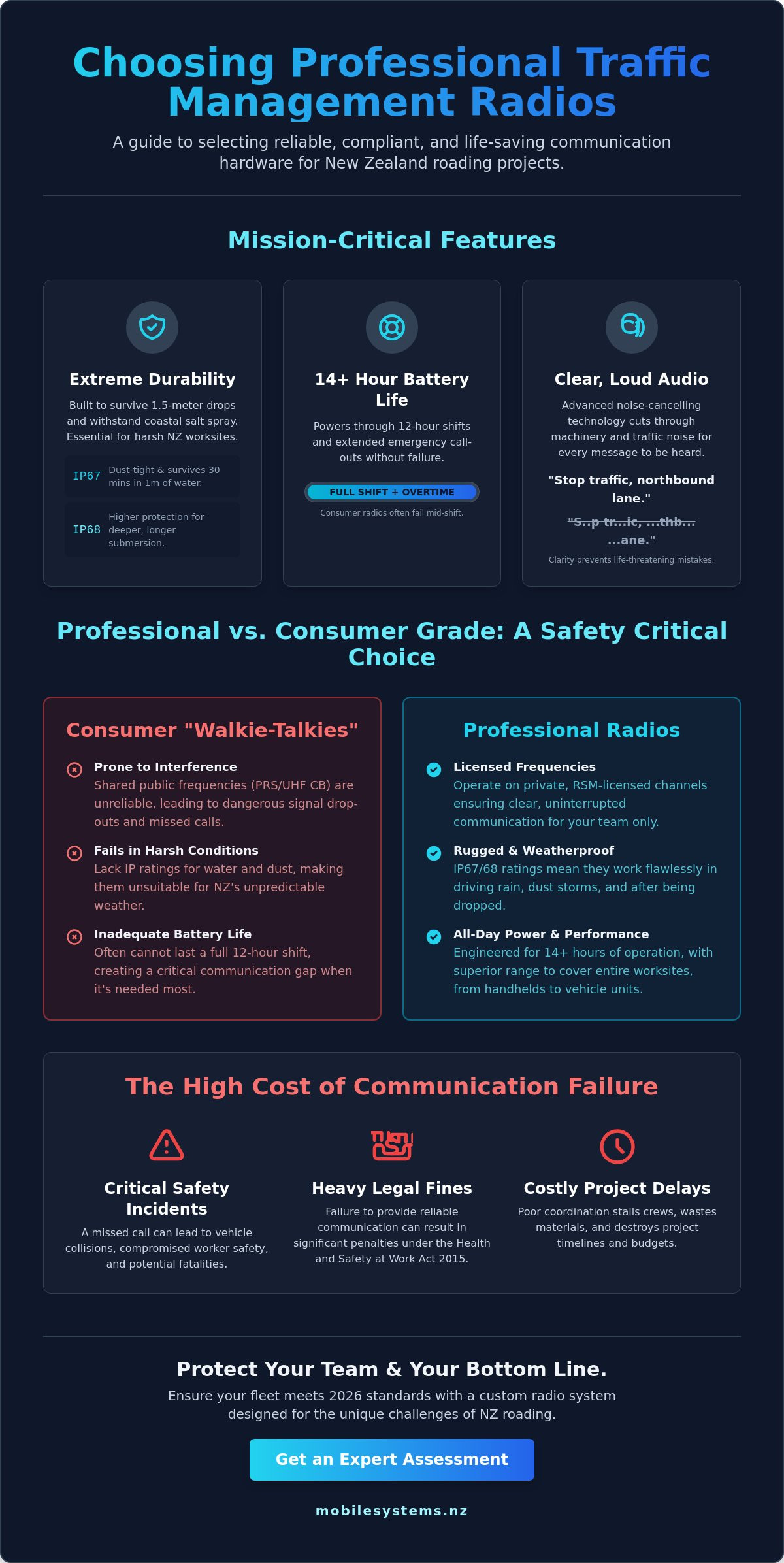
Professional-grade traffic management radios nz teams use are designed to handle 100% of the daily rigours found on-site. These devices offer superior battery life, ruggedised casing, and noise-cancelling features that consumer walkie-talkies lack. Investing in professional hardware is an investment in the lives of the crew on the ground.
Safety-Critical Applications for Two-Way Radios
Coordination is vital during Stop/Go operations, especially when operators lack a direct line of sight. Radios allow for precise timing, preventing vehicle collisions and ensuring smooth traffic transitions. In emergency scenarios, a dedicated radio channel enables rapid response alerts that can save lives within seconds.
Managing site entry and exit for heavy machinery requires constant vigilance. Radios allow spotters to communicate directly with plant operators and public vehicle drivers. This prevents bottlenecks and reduces the risk of machinery-related incidents in tight work zones.
The Cost of Communication Failure
Communication failure carries heavy legal and safety implications. If a radio dead zone or battery failure leads to an accident, the PCBU (Person Conducting a Business or Undertaking) may face significant fines under the Health and Safety at Work Act 2015. Compliance isn't optional; it's a fundamental business requirement.
Project timelines suffer when coordination breaks down. A single missed signal can stall an entire paving crew, leading to costly delays and wasted materials. Professional-grade equipment is a mandatory safety investment that protects both your people and your bottom line. A tailored assessment from Mobile Systems Limited often prevents these costly mistakes. Contact our team for expert advice.
Key Features of Professional Traffic Management Radios
Selecting traffic management radios nz operators can rely on involves more than comparing basic specifications. Roading environments are unforgiving, demanding hardware that survives heavy rain, fine dust, and accidental drops. Equipment must meet specific ingress protection (IP) ratings to remain functional over multiple seasons in the field.
Durability starts with IP67 or IP68 ratings. An IP67 rating ensures the radio stays sealed against dust and survives immersion in water up to one metre for 30 minutes. IP68 provides even higher protection, often rated for deeper submersion. These standards are vital for NZ sites where sudden downpours are common. High-capacity Lithium-ion (Li-ion) battery packs are equally critical. You should look for units providing at least 12 to 16 hours of operation to cover extended shifts without power loss.
The user interface must be functional while wearing heavy-duty work gloves. Professional models feature oversized Push-to-Talk (PTT) buttons and tactile channel knobs. This design prevents accidental channel changes and ensures workers can communicate instantly without fumbling. Simple, clear controls reduce training time and minimize user error during high-pressure traffic shifts.
Environmental Resilience and Ruggedness
NZ roadworks occur in conditions ranging from -10°C in Central Otago to 30°C in Northland. Radios must be tested to Military Standard (MIL-STD) 810G. This standard covers 29 laboratory test methods, including shock, vibration, and extreme temperature cycles. A radio built to these specs won't fail if it's dropped onto tarmac or vibrates in a vehicle cradle all day.
Reinforced antenna mounts are another essential feature. Antennas are often the first component to snap during active movement. High-impact casings made from polycarbonate materials provide the structural integrity needed for years of service. Investing in ruggedized hardware reduces the total cost of ownership by lowering the frequency of replacements.
Audio Performance and Accessories
Roadside noise levels frequently exceed 85 decibels, making standard consumer radios useless. Professional units utilize high-output speakers and active noise-cancelling technology to filter out engine roar and wind. Digital audio provides consistent clarity right to the edge of the coverage area, whereas analogue signals often degrade into static.
Safety is improved when workers use remote speaker microphones or earpieces. These accessories allow personnel to keep their eyes on the road while communicating. All units must also adhere to NZ radio licensing and compliance standards to ensure they operate on legal frequencies without interfering with emergency services.
Choosing the correct accessories for your fleet is a technical process. A tailored assessment of your specific site requirements often prevents costly mistakes when upgrading your communication gear. You can browse our full range of professional two-way radios to find models that meet these rigorous standards.
Comparing Radio Solutions: Handheld vs. Vehicle-Mounted
Effective communication on a worksite requires matching the hardware to the specific role. A Site Traffic Management Specialist (STMS) moving between zones has different needs than a pilot vehicle driver leading a convoy through a rural gorge. Selecting the right traffic management radios nz involves weighing the convenience of portability against the necessity of high-wattage signal penetration.
The legal framework for these decisions is grounded in the New Zealand Guide to Temporary Traffic Management (NZGTTM). This guide emphasizes that all parties must consult, communicate, and coordinate to manage risks. In practical terms, this means your radio setup must bridge the gap between ground staff and moving vehicles without signal dropouts.
For rural NZ projects, the terrain often dictates the tool. A handheld unit might fail to reach around a limestone bluff, while a vehicle-mounted unit provides the extra power needed to maintain safety protocols. Balancing these tools ensures the entire team stays connected regardless of the topography.
Handheld Portables for Ground Staff
Ground staff require lightweight units that don't hinder movement during long shifts. Modern handheld radios are designed to be ergonomic while providing enough power to cover the immediate worksite. For those seeking a deeper dive into specific models, our Walkie Talkie NZ Buyer’s Guide provides a detailed breakdown of current market options.
Safety is the primary driver for handheld selection in the traffic sector. We recommend units equipped with specific protection features:
- Emergency Buttons: High-visibility buttons that trigger immediate alerts across the entire fleet during a site breach.
- Man Down Alerts: Internal sensors that notify the base if the radio remains horizontal for a set period, indicating a potential fall.
- Lone Worker Functions: Automated check-in timers that require a response from the user, ensuring staff safety in remote sections of the site.
Fixed-Mount Radios for Pilot Vehicles and Trucks
Vehicle-mounted units are the backbone of long-range coordination. While a handheld typically outputs 5 watts of power, a fixed-mount radio delivers 25 watts or more. This 400% increase in power is vital for maintaining contact over several kilometers, especially in hilly New Zealand terrain where line-of-sight is rarely guaranteed.
Key considerations for vehicle integration include:
- External Antennas: Mounting a high-gain antenna on the vehicle roof significantly extends the effective range compared to the small whip antenna on a portable unit.
- Power Supply: Direct wiring into the vehicle's 12V or 24V system ensures the radio is always operational, removing the risk of battery failure during a shift.
- Integration: Modern mobile units can be linked to existing handheld fleets, allowing seamless hand-offs between the driver and the ground crew.
Choosing between these options isn't about picking one over the other; it's about creating a unified system. A tailored assessment of your typical work environments often prevents costly communication gaps. If you're unsure which configuration fits your fleet, contact our technical team for a professional site requirement analysis.
NZ Licensing and Compliance for Traffic Management
Compliance ensures that communication remains clear when safety is at stake. In New Zealand, the Radio Spectrum Management (RSM) governs all frequency use. Choosing the right band for your traffic management radios nz isn't just about hardware cost; it's about maintaining operational integrity under pressure.
Waka Kotahi (NZTA) guidelines emphasize the necessity of reliable, interference-free communication on all worksites. If a signal fails during a critical lane closure, the risk to workers and the public increases instantly. Most professional firms now move away from public bands for high-risk or long-term infrastructure projects.
PRS Channels: Pros and Cons
The Personal Radio Service (PRS) uses the standard 80-channel UHF CB band. It's accessible because it doesn't require an individual user license or ongoing fees. This makes it a frequent choice for small, short-term sites or mobile convoys where simplicity is the priority.
- Pros: Zero ongoing licensing costs and immediate hardware compatibility across different brands.
- Cons: High risk of congestion in urban areas like Auckland or Tauranga. You have no legal protection against interference from other users.
PRS is often unsuitable for complex sites. Because these channels are open to the public, your team may hear "chatter" from nearby truck drivers, hikers, or other contractors. This distraction can lead to missed instructions during a stop-go operation, which is a significant safety breach.
Commercial Licensing and Private Channels
For large-scale projects, a private commercial license is the industry standard. These licenses provide a dedicated frequency that other parties cannot legally use. It eliminates external interference and provides a secure environment for your team's coordination.
The process of obtaining a license through RSM involves technical coordination to ensure your frequency doesn't clash with existing users in the area. Mobile Systems manages this entire technical workflow. We handle the application paperwork and the precise programming of your fleet to ensure full compliance with NZ standards.
Managing frequency interference on busy multi-contractor sites requires a formal communication plan. When multiple subcontractors work on a single stretch of highway, overlapping channels cause dangerous confusion. A coordinated frequency plan ensures each team has a clear, dedicated path for their specific tasks without stepping over others.
A tailored assessment often prevents costly mistakes. Contact our technical team to discuss your licensing requirements.
Why Choose Mobile Systems for Your Traffic Management Fleet
Selecting the right communication partner is as critical as the hardware itself. Mobile Systems Limited brings decades of technical expertise to the New Zealand civil and roading sectors. We specialize in custom two-way radio system design specifically engineered for NZ conditions. Whether your crews operate in the rain-shadow of the Southern Alps or the high-density urban corridors of Auckland, our systems ensure signal clarity where consumer-grade gear fails.
We provide direct access to Tier-1 manufacturers including Tait, Motorola, and Hytera. This ensures your traffic management radios nz fleet is built on hardware that meets international IP67 or IP68 ruggedness standards. By sourcing from global leaders, we guarantee long-term parts availability and firmware support for your investment. This prevents the common trap of buying cheaper, unbranded units that lack a local repair path when things go wrong.
Our approach focuses on technical resilience. We understand that a radio isn't just a tool; it's a safety device that must function during peak traffic volumes and emergency call-outs. We don't just sell boxes. We provide integrated solutions that account for battery life, antenna gain, and frequency congestion in busy metropolitan areas.
End-to-End Service and Support
Our commitment extends beyond the point of sale. We operate a fleet of mobile support vehicles from our Mount Maunganui base to provide on-site servicing across the country. This minimizes downtime for your fleet, as we can often perform repairs and updates at your depot or site office. Our technicians handle everything from initial site coverage testing to final equipment programming.
Maintenance is a core part of our service model. We offer long-term plans that include regular signal audits and battery health checks. This proactive approach ensures your communication network remains a reliable safety asset. By identifying degrading components before they fail, we help fleet managers avoid the 15% to 20% productivity loss typically associated with communication outages on major projects.
Requesting a Tailored Communication Assessment
A one-size-fits-all approach often leads to dead zones and safety breaches. We recommend a professional evaluation to identify specific site challenges before you commit to a purchase. Our team analyzes terrain topography, local interference, and your specific safety protocols to recommend the right frequency bands and hardware. This ensures your traffic management radios nz setup is compliant with the latest 2026 safety standards.
The Mobile Systems promise is built on authoritative advice and practical solutions. We focus on what works in the field, not what looks best in a brochure. Contact our expert team to schedule a consultation for your fleet. A tailored assessment prevents the costly equipment mismatches that frequently plague large-scale roading operations.
Future-Proofing Your Fleet Communication
Selecting the right traffic management radios nz requires a balance between rugged hardware and strict regulatory compliance. Reliable communication ensures your teams remain safe while meeting the rigorous standards set by the Code of Practice for Temporary Traffic Management (CoPTTM). Choosing between handheld and vehicle-mounted units depends on your specific site requirements and the 2026 safety benchmarks.
Mobile Systems Limited provides specialized support as an authorized Tait and Motorola dealer. Our team delivers NZ-wide on-site installation to ensure your units function perfectly in the field. This technical expertise prevents the common pitfalls of signal interference and hardware failure during critical operations. It's the most effective way to maintain clear channels when coordination is vital.
Investing in professional-grade equipment protects your staff and your contract obligations. A tailored assessment often prevents costly mistakes and ensures your fleet stays connected across New Zealand's challenging terrain. We're here to provide the technical backbone your business needs to operate with total confidence.
Explore our range of traffic management radios and request a professional assessment today.
We look forward to helping you build a safer, more efficient communication network for your next project.
Frequently Asked Questions
What is the best radio frequency for traffic management in NZ?
UHF 450-470 MHz is the industry standard for traffic management radios nz. This frequency range provides the best balance between signal penetration through vehicles and antenna portability for handheld units.
Most New Zealand sites operate on these allocated commercial frequencies to ensure clear communication between Stop/Go paddles. A tailored assessment by Mobile Systems Limited often prevents costly mistakes when selecting your fleet's frequency plan.
Do I need a license to use two-way radios for my traffic control business?
You need a license from Radio Spectrum Management (RSM) to operate commercially in New Zealand. While some low-power PRS radios are license-free, professional traffic control requires a dedicated frequency to prevent interference from other users.
Operating without a valid license can result in equipment seizure or fines under the Radiocommunications Act 1989. You can contact our team here to discuss licensing your specific frequencies.
What is the difference between UHF and VHF for roading projects?
UHF is superior for urban roading projects because its shorter wavelength bounces off concrete and steel effectively. VHF is better suited for long-distance rural projects where signals must follow the curvature of hills or travel through dense bush.
Most NZ traffic teams choose UHF for its versatility across 90% of work environments. If your projects involve steep terrain or distances exceeding 5 kilometres, a VHF system might be more reliable.
How long do professional radio batteries typically last on a shift?
Professional digital radio batteries typically last between 12 and 28 hours on a single charge. For example, a Motorola DP4400e with a high-capacity battery provides 20 hours of operation, easily covering a standard 10-hour shift plus overtime.
Using Li-ion technology ensures the battery doesn't develop a memory effect, maintaining its capacity for over 300 charge cycles. We recommend rotating batteries every 18 months to ensure peak performance on site.
Are digital radios better than analogue for traffic management?
Digital radios are significantly better because they filter out 95% of background engine and wind noise. This clarity is vital for safety when working near heavy machinery or high-volume traffic.
Digital systems also offer 40% better battery efficiency compared to older analogue models. This technology allows for private calling and GPS tracking, which improves site management and worker safety during night shifts.
Can I use my existing earpieces with new Tait or Motorola radios?
Compatibility depends on the specific accessory port of the radio. While some entry-level models use a standard two-pin connector, high-end IP-rated radios often feature proprietary multi-pin ports to maintain their waterproof seal.
You should check the connector type before purchasing, as using an incompatible earpiece can damage the radio's logic board. We can help you identify which existing accessories are compatible with your new traffic management radios nz.
What IP rating should I look for in a traffic management radio?
You should look for a minimum rating of IP67 for any roading project. An IP67 rating means the radio is completely dust-tight and can survive immersion in 1 metre of water for 30 minutes.
Given that parts of New Zealand experience an average of 100 to 150 rainy days per year, this protection prevents hardware failure. Investing in IP68-rated equipment provides even greater durability against high-pressure water jets used during equipment cleaning.
How do I improve the range of my radios in rural or hilly areas?
You can improve range by using vehicle-mounted repeaters or high-gain antennas. In hilly regions like the Rimutaka Hill or Central Plateau, a standard 5-watt handheld radio might struggle with line-of-sight obstructions.
Installing a mobile radio in a lead vehicle acts as a signal booster, extending the coverage area by up to 15 kilometres. For permanent sites, a fixed repeater station can provide seamless communication across the entire project footprint.
Related posts

- June 11, 2026
PoC or UHF/VHF? An honest comparison of coverage, cost, licensing and reliability for New Zealand worksites.

- June 08, 2026
In New Zealand’s vertical terrain, the network constellation matters more than the device features. When you're deep in the Southern...

- June 05, 2026
Transport & Logistics Fleet-wide communication that actually works: digital radio for NZ transport and logistics Transport & Logistics 8 min...