
Your Ultimate Guide to Two Way Radio NZ Systems
Explore the best two way radio NZ solutions. Our guide covers VHF vs UHF, licensing, and top brands to help you choose the right system for any NZ industry.
When your mobile phone loses signal, your team's safety and efficiency shouldn't disappear along with it. This is the core problem that a professional two-way radio NZ system solves, providing a lifeline of instant, clear communication where cell coverage is patchy or simply doesn't exist.
From remote forestry blocks and sprawling construction sites to the open water, having a reliable link is essential. This guide is your complete roadmap for navigating the world of professional radio communications here in New Zealand, focusing on legal solutions from specialist suppliers.
Your Guide to Choosing the Right Two-Way Radio in New Zealand
In New Zealand's diverse and often rugged landscapes, whether it's the dense bush of the Coromandel or the rolling hills of the Waikato, maintaining a constant line of communication isn't just a nice-to-have, it’s a critical part of the job.
Unlike a mobile phone that relies on a vast (and sometimes fragile) network of towers, a two-way radio system gives you an independent, resilient communication network. It’s what makes them the go-to tool for industries where instant group communication can make all the difference, from a walkie talkie nz for simple tasks to a complex digital radio network.
Why a Professional Radio System is a Must-Have
Think about the reality for so many Kiwi businesses. A roading crew working on a remote stretch of a state highway, a construction team deep inside a new commercial building, or a vessel far off the Bay of Plenty coast—they all operate in places where a mobile phone is little more than a paperweight.
A professional two-way radio isn't just another gadget; it's an investment in safety, coordination, and productivity. It creates a closed, reliable network that you control, free from public network jams or outages.
We've put this guide together to walk you through the core concepts you need to get started. We’ll cover:
- The critical differences between VHF and UHF frequencies and, more importantly, how to pick the right one for your specific environment.
- The New Zealand-specific licensing rules, including uhf channels nz regulations, you need to know to keep your operations fully compliant.
- A look at trusted, industry-leading brands like Tait, Motorola, and Hytera that are built tough enough for Kiwi conditions.
- How to build a complete communication toolkit with the right accessories, from high-gain antennas to durable earpieces like a walkie talkie earpiece nz.
Consider this your starting point. We'll give you the insights to make sure your team stays connected, safe, and efficient, no matter where their work takes them. Getting your gear from a specialist supplier who truly understands these nuances and can offer expert product knowledge is the first, and most important, step.
Understanding Your Frequency: VHF vs UHF Radios
Picking the right frequency for your two-way radio system is the single most important decision you'll make. Get it wrong, and it's like trying to hammer a nail with a screwdriver – you just won't get the performance you need. In New Zealand, your two main choices are VHF (Very High Frequency) and UHF (Ultra High Frequency).
Let's break it down with an analogy. Think of a VHF radio wave as a long-distance runner on a flat, open road. It travels a huge distance with incredible efficiency, as long as there’s nothing in its way. This makes it a champion for wide-open spaces.
A UHF radio wave, on the other hand, is more like a nimble parkour athlete. It might not have the same raw, straight-line range as the runner, but it’s a master at navigating complex, cluttered environments by bouncing off and punching through obstacles. This is why many seek the best uhf radio nz.
When to Choose VHF Radios
VHF operates on longer radio waves, which is what gives its signal the ability to travel further across unobstructed country. This is exactly why it’s the best choice for any operation with a clear line of sight.
- Farming and Agriculture: Perfect for keeping in touch across vast, open paddocks and rolling hills where buildings or dense bush won't get in the way.
- Maritime Operations: VHF is the global standard for marine communication for a reason – signals travel exceptionally well over open water. This is why you need the best vhf marine radio nz.
- Forestry Roading: Great for coordinating machinery and logging trucks along open access roads with clear sightlines. A common application for forestry radio systems.
Basically, if your worksite has long, clear views, a vhf radio nz will likely give you the best possible range. The catch? Its long waves struggle to penetrate solid objects like concrete walls, steel structures, or thick forest canopies.
When UHF Radios Are the Best Choice
UHF uses shorter, punchier radio waves. While they don’t travel as far in open air as VHF, that shorter wavelength is their superpower—it gives them a massive advantage in penetrating and navigating around obstructions. This is why UHF is the go-to for most commercial and industrial jobs in NZ.
- Construction Sites: Ideal for communicating through concrete, steel framing, and across multiple floors of a building site.
- Urban Environments: The only real choice for security, event management, and logistics in cities where buildings block signals at every turn.
- Dense Bush and Rugged Terrain: UHF signals are much better at finding a path through thick native bush and navigating hilly landscapes.
For most Kiwi businesses, whether it's a construction site in Tauranga or a packhouse in Te Puke, a UHF radio is going to deliver more reliable and consistent coverage. This simple chart helps show the point where a two-way radio goes from a "nice-to-have" to an absolute necessity.
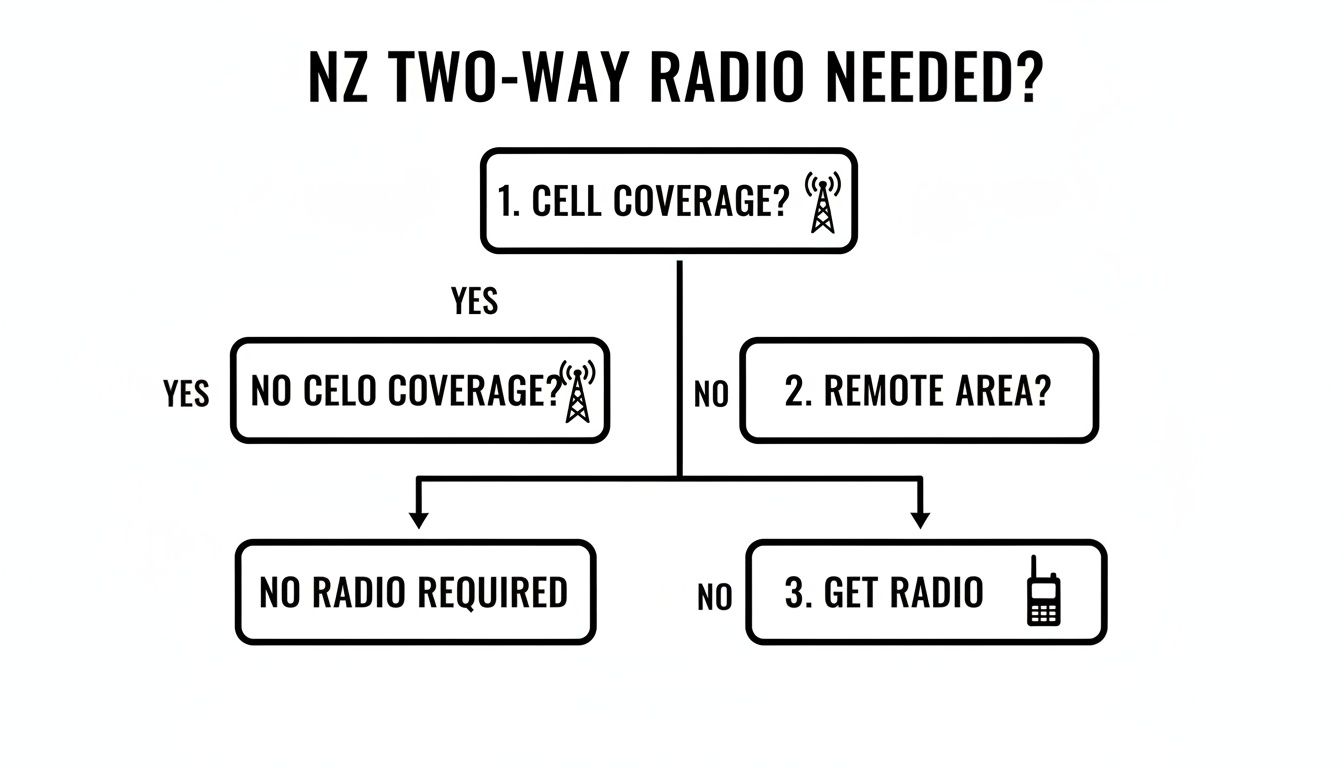
As you can see, the moment reliable cell coverage is off the table, a two-way radio becomes your essential communication tool. The next step is picking the right frequency for that environment. Understanding how different frequencies perform comes down to basic principles, like the importance of signal strength in wireless networks.
To make it even clearer, here’s a quick comparison to help you decide.
A Quick Guide to VHF vs UHF Radio Frequencies
Use this table to quickly decide whether a VHF or UHF radio is the right fit for your needs in New Zealand.
| Characteristic | VHF (Very High Frequency) | UHF (Ultra High Frequency) |
|---|---|---|
| Best For | Open, flat terrain with minimal obstructions (farms, open water, forestry roads). | Complex environments with buildings, hills, or dense bush (construction, cities). |
| Signal Range | Longer range in clear line-of-sight conditions. | Shorter range in open air but better at navigating obstacles. |
| Penetration | Poor. Struggles with concrete, steel, and dense foliage. | Excellent. Punches through walls, buildings, and thick vegetation. |
| Common Use Cases | Marine, agriculture, aviation, large-scale outdoor events. | Construction, security, manufacturing, warehousing, hospitality. |
| Licensing (NZ) | Generally requires a licence for commercial use. Marine VHF has specific rules. | Licence-free PRS channels available, but licensed channels are recommended for business. |
Ultimately, UHF's versatility makes it the workhorse for the majority of commercial applications, but for specialised long-range, open-air work, VHF still reigns supreme.
The Special Case of Marine VHF Radio
If you're heading out on the water anywhere in New Zealand, a VHF marine radio isn't just a good idea—it's a critical piece of safety gear. These radios are specifically built for the maritime environment and operate on internationally agreed marine channels.
Using a land-based UHF radio to communicate with a boat is illegal and unsafe. Marine VHF is a non-negotiable for any vessel, providing a direct link to other boats, Coastguard, and rescue services.
The most important of these is Channel 16, the international distress, safety, and calling channel. It’s monitored 24/7 by maritime authorities and is your primary lifeline in an emergency. For a deeper technical dive, check out our guide on which is right for your NZ business, UHF vs VHF radio. Choosing the right radio starts with understanding the unique demands of your environment.
Navigating Radio Licensing Requirements in New Zealand
One of the biggest misunderstandings we see with professional two-way radios is the idea you can just buy one and start talking. In New Zealand, it’s not quite that simple. To keep business communications legal and free from interference, everything is managed by Radio Spectrum Management (RSM), our national governing body.
Getting this right is about more than just avoiding fines; it’s about making sure your team has a reliable line of communication when it matters most. Skipping this step can lead to hefty penalties and even having your gear confiscated.
Public Channels vs. Private Licensed Frequencies
So, what are your options? In New Zealand, you have two main paths: using public channels or getting your own private, licensed frequency. Each is built for a completely different purpose.
Public channels—you might know them as PRS (Public Radio Service) or CB radio NZ (Citizen Band) channels—are open for anyone to use without needing a specific licence. They operate under a General User Radio Licence (GURL). While they’re free and easy to access, they come with some serious downsides for any professional operation.
- Congestion: These channels are a free-for-all, shared by hobbyists, truckies, and other businesses. The constant chatter and interruptions can make getting a clear message through almost impossible.
- No Privacy: Anyone with a scanner or another radio can tune in and listen to your conversations. For a business, that’s a massive security risk.
- Interference: With so many people on the same frequency, the chances of your signal getting blocked or cut off are incredibly high—often at the worst possible moment.
For any serious business, these limitations make public channels a non-starter for a long-term, reliable comms solution.
The Power of a Private Licensed Channel
This is where securing a private licensed channel from RSM becomes the gold standard. Think of it like having your own private, dedicated highway for your team's communications. It’s exclusively for your business to use within a specific geographical area.
A private radio licence gives your operations secure, clear, and uninterrupted communication. This isn't just a nice-to-have; it's a fundamental requirement for keeping your people safe and your business running efficiently.
This exclusivity cuts out all the noise, interference, and security worries of public channels. Your team can discuss sensitive information without risk, and you can trust that your messages will get through without being talked over.
For anyone on the water, there are also specific marine certifications you must have. You can get the full rundown in our guide on how to get your VHF Operator Certificate in NZ.
How to Get Your Radio Licence
Let’s be honest, the process of applying for a licence through RSM can look a bit daunting. It involves technical details about your location, the equipment you’re using, and how you plan to use it. This is where leaning on a specialist communications provider really pays off.
An experienced provider doesn't just sell you a portable radio; they deliver a complete, ready-to-go solution. They can handle the entire licensing application and programming for you, ensuring your radios are configured correctly, operating legally on your assigned frequency, and are fully compliant with New Zealand regulations from day one. It saves you a ton of time and prevents any costly mistakes.
Finding the Best Two Way Radio for Your Industry
Choosing the right communication tool isn't a one-size-fits-all deal. The radio that’s perfect for a security team managing an indoor concert will be completely useless for a forestry crew deep in the Kaingaroa Forest. The key to building a reliable communication system is matching the device's features to your specific world of work.
It’s about moving beyond generic solutions and really digging into what your team needs to stay safe and productive. That means looking at everything from durability and specific safety functions like lone worker alerts, to the kind of accessories required to get the job done right. Partnering with a specialist who gets these industry-specific challenges is the single most important step in finding the best two way radio for your business.
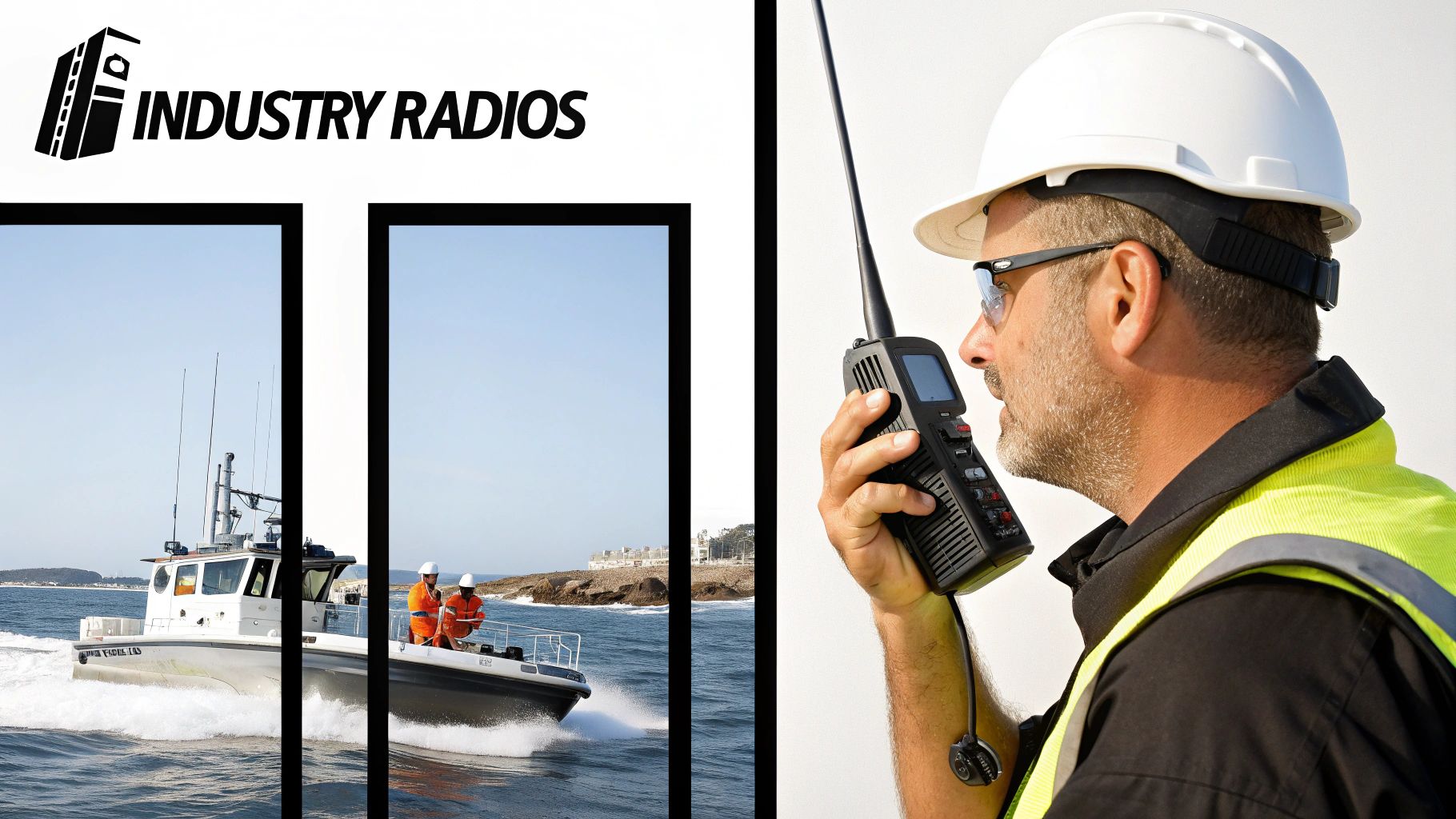
Construction and Forestry: Rugged and Resilient
For industries like construction and forestry, a standard walkie talkie just won't last the day. These environments are brutal on gear—think dust, rain, mud, and the constant risk of being dropped or knocked about. Your number one need is a radio that is exceptionally tough.
You’ll want to look for radios with a high IP (Ingress Protection) rating, like IP67 or IP68. This rating guarantees they are completely sealed against dust and can even handle being submerged in water. Brands like Tait, Motorola, and Hytera have built their reputations on creating rugged, military-standard devices designed for these exact conditions.
In high-risk sectors, good communication is a core part of health and safety. Features like a dedicated emergency button, 'Man Down' alerts, and 'Lone Worker' monitoring aren't just nice to have; they are non-negotiable for keeping your team safe in isolated or hazardous situations.
On top of that, powerful audio is essential to cut through the noise of heavy machinery, so look for radios with excellent noise-cancelling technology.
Maritime and Fishing: Waterproof and Compliant
Once you're out on the water, your communication needs change completely. The top priority is a waterproof VHF marine radio that can stand up to saltwater spray and the occasional dunking. It's no surprise that brands like GME, Uniden and Entel are staples in the New Zealand maritime community.
But it’s not just about being waterproof. Your marine radio must be compliant with maritime law, which means having access to essential channels—most importantly, the emergency Channel 16. A key feature to look for is DSC (Digital Selective Calling), which lets you send a digital distress signal with your vessel's GPS coordinates at the push of a single button.
For commercial fishing fleets or charter operations, a reliable best handheld vhf marine radio nz device is a critical piece of safety equipment, not an optional extra.
Transport and Logistics: Fleet-Focused and Efficient
When you're managing a fleet of trucks or a roading crew, communication is about much more than just voice calls. The real goal is total fleet visibility and management. In-vehicle mobile radios, often from industry leaders like Motorola or Tait, are the standard here, giving you far greater power and range than any handheld device.
The real game-changer for this sector is the integration of GPS tracking. A two way radio NZ system with GPS allows dispatchers to see the real-time location of every vehicle, which is invaluable for optimising routes and responding instantly to delays or emergencies.
This technology has become indispensable for safety and coordination in New Zealand's rugged construction and contracting sectors, particularly in regions like the Bay of Plenty and Eastern Waikato. Between 2015 and 2025, the adoption of digital two-way radios on construction sites saw a significant surge, driven by strict Occupational Health and Safety rules. During the Kaikoura earthquake recovery, for example, over 2,500 radios from trusted brands were deployed, dramatically reducing response times compared to the failing mobile networks. Recent transport ministry audits also revealed that the vast majority of major infrastructure projects now rely on licensed two-way radio channels to ensure worker safety in challenging terrain. You can discover more about the impact of two-way radios in NZ industries here.
Events and Security: Discreet and Coordinated
In the fast-paced world of event management and security, communication has to be instant, clear, and—above all—discreet. Teams need lightweight, compact radios that are easy to carry for long shifts without getting in the way.
For this industry, the accessories are just as important as the radio itself. High-quality earpieces are essential for private communication in loud or crowded environments. A solid walkie talkie earpiece nz setup lets security personnel receive instructions without disturbing patrons or alerting potential troublemakers.
Look for radios with a long battery life to last through extended events and multi-channel capability. This allows you to coordinate different teams (e.g., security, operations, medical) on separate, private channels. Brands like Hytera and Motorola offer excellent compact models that are perfect for this line of work.
Building Your System with Trusted Brands and Accessories
The performance of your two way radio NZ system is only as good as its weakest link. A powerful handset can be completely let down by a cheap antenna or a battery that can’t hold its charge. This is exactly why you need to work with a specialist supplier who offers real product knowledge and ongoing support—something you won’t find at large department stores carrying a limited range.
Choosing a specialist means you get access to top-tier brands known for their reliability and durability in tough New Zealand conditions. It’s about building a system, not just buying a box.
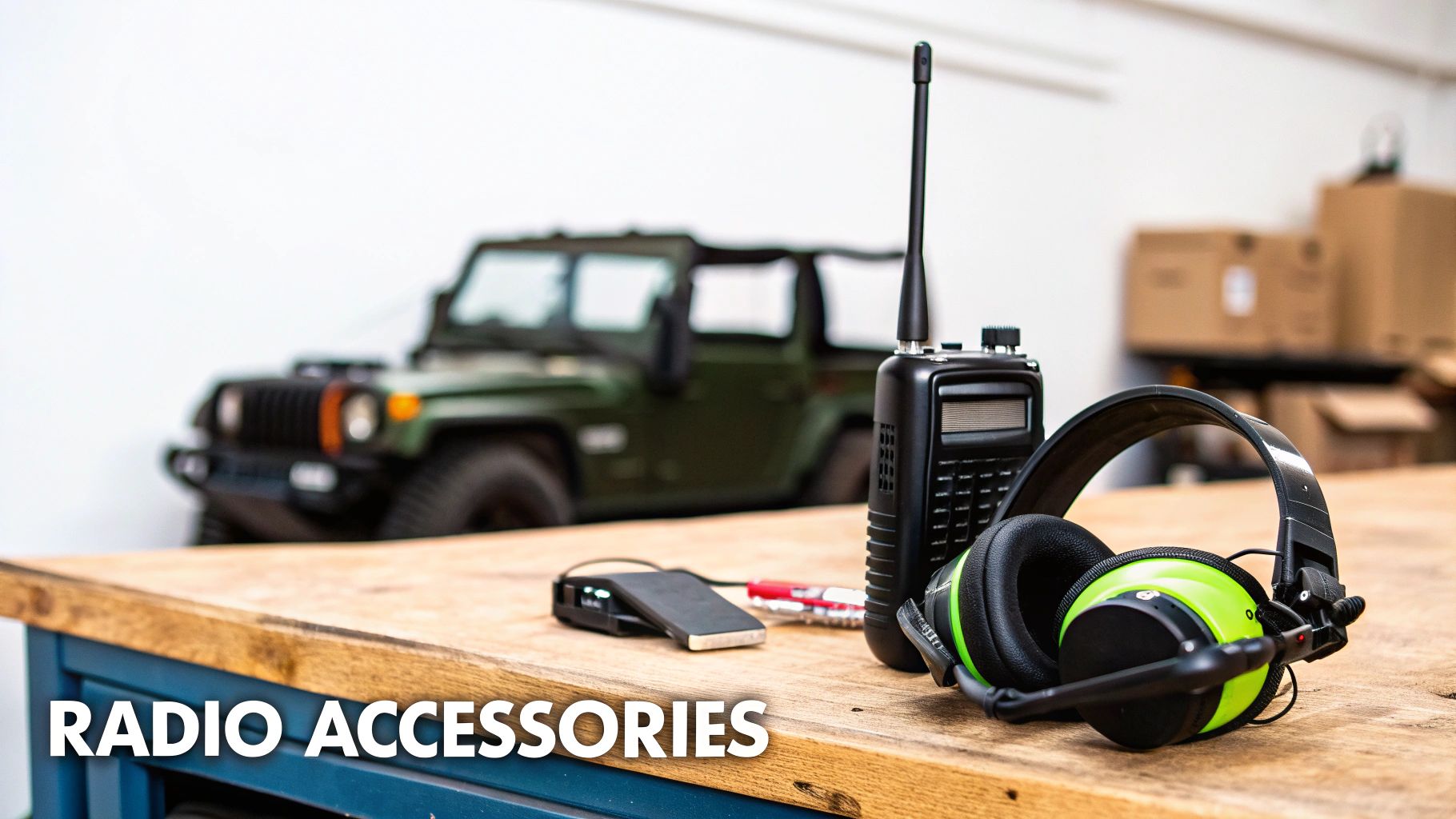
Premier Brands for Kiwi Conditions
When you invest in professional communication gear, you’re really investing in reliability. Over the years, a few key brands have consistently proven they can handle everything New Zealand's diverse environments can throw at them.
- Tait Communications: A true Kiwi success story. Tait radios are famous worldwide for their rugged build and mission-critical performance, making them a go-to choice for emergency services and heavy industry.
- Motorola: A name that’s basically synonymous with two-way radios. Motorola walkie talkie nz devices offer a massive range, from simple on-site units to complex digital systems with advanced safety features. Their reputation for quality is unmatched.
- Hytera: A leading global provider, hytera radios nz deliver innovative and feature-rich digital radios that offer fantastic value and performance, especially for commercial and industrial users.
- GME and Uniden: These brands are the heavyweights in the UHF CB and marine radio markets. They offer dependable, user-friendly radios perfect for transport, agriculture, and maritime operations.
More Than Just the Handset: Essential Accessories
An effective communication setup doesn't stop with the radio. The right accessories are what turn a standard portable radio NZ into a customised tool that perfectly fits how you work. The goal is to build a complete toolkit that boosts safety, clarity, and efficiency.
Your radio system is an ecosystem. The handset is the heart, but the accessories are the vital organs that allow it to function at its peak, especially in challenging work environments.
Think about adding these essential pieces to your kit:
- High-Gain Antennas: Upgrading your antenna is often the single most effective way to improve your signal range and clarity. For anyone struggling with coverage, learning how a quality UHF antenna in NZ from a specialist like RFI or Pacific Aerials can boost performance is a game-changer.
- Noise-Cancelling Audio Gear: On a loud construction site or in a noisy factory, clear audio isn't a luxury—it's essential. Noise-cancelling headsets and speaker mics from brands like Sensear or Otto make sure every message is heard correctly the first time.
- Durable Mounting Solutions: For radios in vehicles, a secure and ergonomic mount is critical. RAM Mounts are known for their rugged, vibration-resistant solutions that keep devices locked in and accessible, whether in a truck, tractor, or boat.
- Reliable Power: A dead battery makes your radio a paperweight. Investing in high-capacity batteries and multi-bay conditioning chargers ensures your team's gear is always ready to go for a full shift.
By focusing on a complete system of trusted brands and purpose-built accessories, you ensure your investment delivers rock-solid performance when you need it most.
Why Expert Support Is Your Most Important Asset
Buying a two way radio NZ system is just the first step. The real, long-term value doesn’t come from the box; it comes from the expert support that keeps your investment performing reliably for years to come. This is where a specialist partner, unlike a general retailer, becomes your most crucial asset.
Their value is in delivering a complete, end-to-end service designed around how your business actually works. It's a partnership that starts long before you even pick up a handset.
From Consultation to Installation
A true specialist kicks things off with a detailed consultation. They’ll take the time to get their head around your unique environment—whether it’s a noisy construction site or a sprawling rural property—to design a system that will perform without a hitch. This isn't about shifting units; it's about engineering a solution.
After the design phase comes the professional installation and, critically, the antenna tuning. You can have the most powerful radio in the world, but a poorly tuned antenna will cripple its range. This expert step is non-negotiable for getting the performance you paid for. They’ll also handle the precise channel programming and licensing management, making sure your system is compliant and free from interference right from day one.
Ongoing Maintenance and Flexible Solutions
Once your two-way radio system is up and running, the job isn’t done. These radios are essential tools, and just like any critical bit of kit, they need regular checks and the occasional repair to keep them going strong and maximise their lifespan. Looking into expert managed services can be a smart move to ensure your communication backbone stays reliable and efficient, preventing downtime that costs you money.
A specialist provider doesn't just sell you equipment; they partner with you to maintain a high-performing, compliant, and cost-effective communication network that evolves with your business needs.
This partnership approach also means you get flexible solutions. Let’s say you have a multi-day event or a seasonal project. Buying a whole system just doesn't make financial sense for short-term needs.
This is where options for radio hire become invaluable. A specialist can provide a complete, programmed set of radios for a specific period, giving you professional-grade communication without the long-term capital outlay. It’s another way a true partner works with you, ensuring you always have the right tools for the job—whether you're buying for the long haul or just hiring for a one-off project.
Got Questions About Two-Way Radios? We've Got Answers.
Here are some of the most common questions we get asked about using two-way radios here in New Zealand. Let’s clear up a few key points to help you make the right call.
What's the Real-World Range of a Walkie-Talkie in NZ?
That number you see on the box? Take it with a grain of salt. The advertised range of a handheld walkie-talkie NZ is always based on perfect, line-of-sight conditions—something you rarely find in the real world.
Out in wide-open spaces, like across Waikato farmland or over the water, a standard 5-watt radio might give you a reliable 5–10 km. But the moment you introduce hills, dense native bush, or a built-up city centre, that effective range can plummet to just 1–3 km. This is a key factor when looking for a long range walkie talkie nz.
This is where your choice of frequency really matters. UHF signals tend to punch through obstacles better in cluttered environments, while VHF is the champion for those long, clear distances. If you absolutely need to maximise your range, nothing beats a vehicle-mounted mobile radio with a professionally installed external antenna or a repeater system. They will always outperform any handheld device, hands down.
Do I Need a Licence for My Two-Way Radio in NZ?
This is a big one, and the short answer is: it depends. New Zealand has what’s called a General User Radio Licence (GURL), which covers the public UHF CB and AM CB radio NZ channels. Anyone can use these for free, no specific licence required.
But there’s a catch. These public channels are often crowded, completely unsecured, and can be frustratingly noisy with interference. If you're a business that needs private, crystal-clear communication you can rely on, a dedicated licensed channel from Radio Spectrum Management (RSM) isn't just a good idea—it's essential.
A specialist provider can handle the entire licensing and programming process for you, making sure your comms are private, legal, and interference-free.
Can I Use My Land Radio to Talk to a Boat?
No, you absolutely cannot. Using a standard UHF or CB radio to chat with a vessel on marine channels isn't just illegal; it's incredibly dangerous because you could interfere with distress calls.
To talk to a boat, you MUST use a dedicated VHF marine radio. These units are programmed specifically with the legally required marine channels, including the international distress and safety frequency, Channel 16. If your work spans both land and sea, you'll need two completely separate radio systems to stay compliant and keep everyone safe.
For no-nonsense advice on building a reliable communication system that’s right for your industry, trust the specialists at Mobile Systems. We supply, install, and support the best communication gear for New Zealand's tough conditions. Explore our range of two-way radio systems and services today.
Related posts

- June 19, 2026
Mobile Systems Limited explains how to legally boost cell signal in rural New Zealand - covering RSM-compliant repeaters, high-gain antenna...

- June 16, 2026
Mobile Systems Limited's 2026 buyer's guide to satellite phones covers Iridium vs Inmarsat vs Starlink Direct to Cell, dedicated handsets,...

- June 15, 2026
Mobile Systems Limited's 2026 guide for NZ businesses covers VHF vs UHF frequency selection, Digital Mobile Radio, IP67 durability ratings,...