
GME Manufacturing: The Engineering Behind NZ’s Most Reliable Radios
Imagine being 40 kilometres deep into the Kaimai Range when your vehicle hits a washout and your primary radio fails. For many New Zealand fleet operators, this isn't a hypothetical situation; it's a costly safety risk.
Imagine being 40 kilometres deep into the Kaimai Range when your vehicle hits a washout and your primary radio fails. For many New Zealand fleet operators, this isn't a hypothetical situation; it's a costly safety risk that occurs when hardware isn't built for our specific environment.
You've likely realized that standard consumer electronics don't survive long in the high-vibration, high-moisture conditions of a Kiwi worksite. It's frustrating to replace flimsy hardware every six months when a single failure can halt operations for an entire day.
This article explains how gme manufacturing utilizes a specialized Australian-based facility to engineer hardware that withstands these extreme conditions while maintaining superior signal quality. We'll examine the specific engineering standards GME uses and help you select the right series to ensure your communication system remains a reliable long-term investment.
Key Takeaways
- Understand how GME manufacturing processes in Sydney produce rugged hardware specifically engineered to withstand New Zealand’s high-humidity and salt-spray environments.
- Discover the technical advantages of Surface Mount Technology and precision moulding in achieving superior IP67 and IP68 durability ratings for business use.
- Learn how to evaluate hardware based on antenna gain and mounting configurations to ensure reliable signal coverage across diverse NZ terrains.
- Identify the specific trade-offs between handheld units and fixed-mount systems to better align your communication tools with your operational requirements.
- Recognize the value of professional local installation and integration to ensure your fleet’s communication systems perform at their peak from day one.
What is GME Manufacturing? Defining a Communications Powerhouse
GME is the flagship brand of Standard Communications Pty Ltd, a privately owned Australian company that's led the radio industry since 1959. Unlike general engineering firms, gme manufacturing focuses specifically on high-performance communication hardware designed for the harshest environments in the Southern Hemisphere. The brand's reputation rests on its status as the only manufacturer of UHF CB radio service equipment that maintains its production base in Australia. For New Zealand businesses, this means hardware is engineered to withstand the same high-UV and high-vibration conditions found across our own rural and maritime sectors. To better understand this concept, watch this helpful video:
The History of Standard Communications
Standard Communications began over 60 years ago, evolving from a small television tuner manufacturer into a global leader in digital radio technology. The company shifted its focus to the heavy vehicle and marine sectors in the 1970s, identifying a need for equipment that wouldn't fail under constant mechanical stress. Today, their local research and development team ensures every circuit board and casing meets strict durability metrics. This specialized engineering is critical for New Zealand operators who require reliable signals in remote areas where cellular coverage is often non-existent.
- 1959: Company founded in Sydney, Australia.
- 1980s: Pioneered the first Australian-designed UHF CB radios.
- Modern Era: Expansion into advanced PLBs and AIS marine technology.
GME vs. Global Competitors
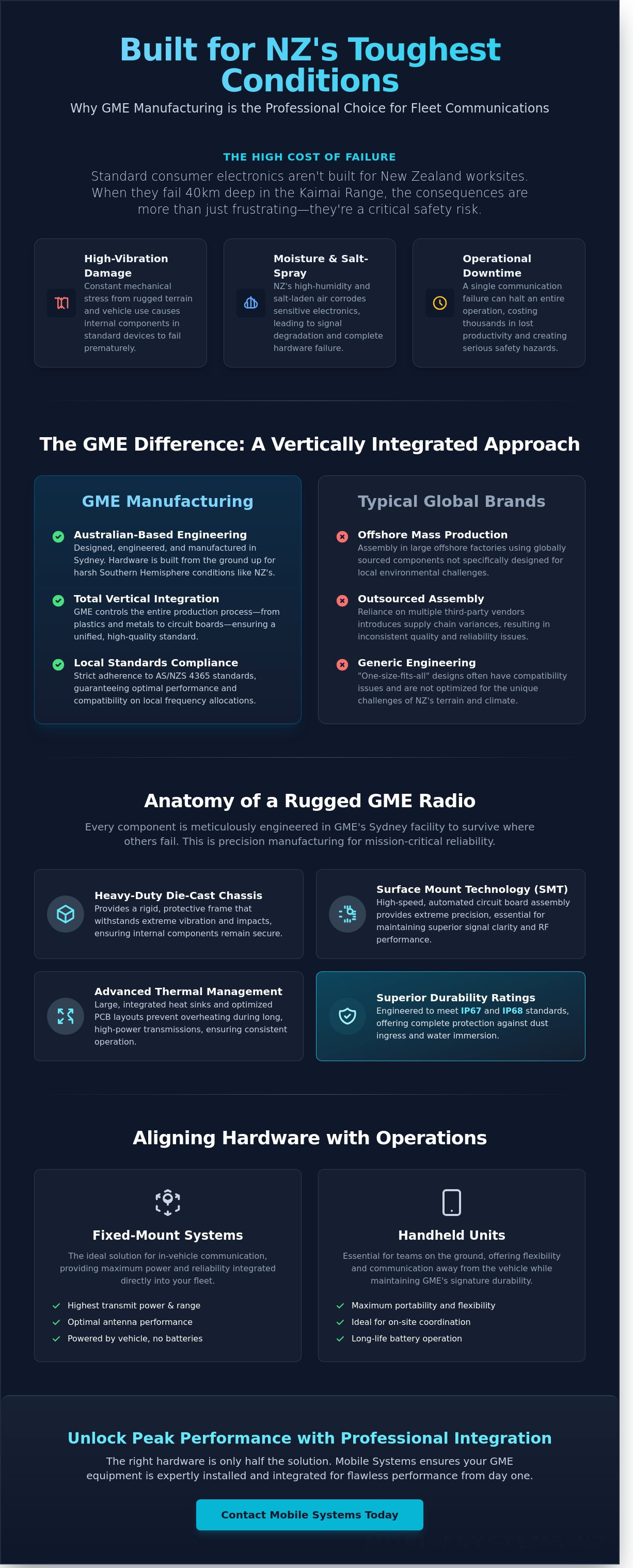
Most global radio brands rely on outsourced assembly, where components are sourced from multiple third-party vendors and put together in massive offshore factories. In contrast, GME utilizes a vertically integrated model, meaning they design, engineer, and manufacture their products in-house to maintain total oversight. Vertical integration is the practice of controlling every stage of the production process from initial design to final assembly to ensure consistent quality. This approach allows GME to strictly adhere to the AS/NZS 4365 standard, which governs the use of UHF radio equipment in New Zealand and Australia. Choosing locally engineered gear prevents common compatibility issues and ensures that the hardware is optimized for local frequency allocations. For professional users, investing in a reliable two-way radio system built through the gme manufacturing
The Engineering Process: How GME Radios are Built
GME maintains a state-of-the-art facility in Sydney, Australia, where the entire production lifecycle occurs under one roof. This commitment to gme manufacturing excellence allows for a level of vertical integration rarely seen in the communications industry. By producing their own plastics, metal components, and antennas in-house, GME ensures every part meets a unified quality standard rather than relying on disparate third-party suppliers.
This localized control is a primary reason why these units survive in the demanding New Zealand commercial sector. From the heavy-duty die-cast chassis to the precision-moulded buttons, every element is engineered to withstand high-use environments. This hands-on approach minimizes supply chain variances and guarantees that replacement parts remain consistent over decades of service.
Advanced SMT and Circuitry
Precision is the foundation of clear communication. GME utilizes high-speed Surface Mount Technology (SMT) lines to populate circuit boards with extreme accuracy. These automated systems are essential for managing complex radio frequency (RF) components that require tight tolerances to maintain signal clarity. When a radio is used in a high-power mobile configuration, managing heat becomes a critical engineering challenge.
GME designs its circuitry with advanced thermal management profiles. Large heat sinks and optimized PCB layouts prevent the internal components from overheating during long transmissions. Because they develop proprietary firmware alongside the physical hardware, the software is perfectly tuned to the electronics. This integration ensures compliance with standards regulated by the Australian Communications and Media Authority, which governs the UHF CB bands used across Australasia.
Testing for Extreme Environments
New Zealand's geography presents unique challenges for electronic equipment. GME radios undergo rigorous thermal shock testing to ensure they remain operational in temperatures ranging from -10°C in the Southern Alps to 50°C in the heat of the outback. This testing confirms that the solder joints and components won't crack or fail when moving between extreme temperature gradients.
Mechanical durability is tested through intensive vibration and impact simulations. These tests replicate the constant jarring experienced on corrugated NZ gravel roads over several years. To ensure peak performance, every GME radio undergoes individual performance calibration before leaving the factory. This final step guarantees that the unit you install meets its exact technical specifications for power output and sensitivity.
Selecting the right hardware for your fleet requires an understanding of these technical nuances. A tailored assessment often prevents costly mistakes when matching radios to specific operational needs.
Why GME Manufacturing Standards Suit the NZ Landscape
New Zealand’s environment is one of the most demanding in the world for electronic equipment. From the high-salinity coastal air of Northland to the sub-zero temperatures of the Southern Alps, hardware faces constant thermal and chemical stress. The gme manufacturing process addresses these variables by using high-impact polymers and precision-engineered seals.
IP67 and IP68 ingress protection ratings are not just labels; they represent a hardware's ability to survive 30 minutes in a meter of water or resist fine dust penetration. GME achieves these standards through advanced injection moulding techniques that ensure a perfect fit between the chassis and the gasket. This level of sealing is essential for NZ forestry workers and farmers who operate in high-rainfall regions where moisture ingress often leads to motherboard failure.
Range in New Zealand’s rugged terrain depends on the synergy between the radio unit and the antenna system. GME designs their antennas to match the specific impedance and power output of their land mobile units. This ensures maximum signal propagation in deep gullies and over steep ridges, providing a safety lifeline when cellular coverage fails. You can learn more about the brand’s evolution and GME's history in the RF space to see how they have refined these designs over decades.
Marine-Grade Engineering
GME applies the same anti-corrosion techniques to their vehicle-mounted radios as they do to their marine equipment. Using non-corrosive plastics and treated alloys prevents the salt creep that often destroys standard electronics in coastal operations. For those specifically looking for water-based solutions, The Best Handheld VHF Radio NZ: A 2026 Buyer’s Guide details how these marine-specific builds function.
Operating near the New Zealand coastline requires hardware that can withstand constant exposure to salt spray. Standard mobile radios often suffer from corroded terminals and degraded housing within two years of coastal use. GME’s commitment to marine-grade materials ensures that land-based units provide a significantly longer service life in these harsh environments.
XRS™ Connect: The Future of Smart Radio
The XRS™ Connect series represents a shift from static hardware to software-driven communication. By integrating Bluetooth into a rugged frame, gme manufacturing allows users to update firmware via a smartphone app. This future-proofs the investment for commercial fleets, as new features can be added without replacing physical units.
While the traditional TX series remains a reliable workhorse for basic voice comms, the XRS series offers programmable buttons and location services. This digital integration is vital for high-stakes environments like large-scale farming or civil engineering where team coordination requires more than just a clear voice channel. A tailored assessment of your fleet requirements often prevents costly mistakes when choosing between these two platforms.
Evaluating GME Hardware for Your Business Operations
Selecting the right hardware requires a clear understanding of your operational environment. While gme manufacturing processes ensure high standards across all product lines, the specific device must match the daily tasks of your team. Choosing incorrectly leads to coverage gaps or equipment that doesn't survive the rigours of the field.
Fixed Mount vs. Handheld Solutions
Fixed-mount units like the TX3500S provide a full 5-watt output and rely on the vehicle's power system. These are the standard for transport and heavy machinery where maximum range and constant uptime are mandatory. The external antenna placement significantly boosts signal propagation compared to portable alternatives.
Handheld units like the TX6600S prioritize mobility and ground-crew safety. These are essential for staff working outside the cab, such as spotters or forestry workers. While they offer the same 5-watt potential, their smaller antennas and battery constraints mean they serve a different tactical purpose. For a detailed comparison of portable models, refer to the Walkie Talkie NZ: The Professional Buyer’s Guide (2026).
Antenna Selection for NZ Conditions
Antenna gain, measured in dBi, determines the shape of your radio signal. It's a common mistake to assume higher gain is always better. In New Zealand's varied geography, the wrong choice can leave you in a "dead zone" even when you're close to a repeater.
- 2.1dBi Antennas: These produce a round, "doughnut" shaped signal. They're ideal for mountainous regions or deep valleys where you need the signal to travel upwards to reach a repeater on a ridge.
- 6.6dBi Antennas: This is the "sweet spot" for most New Zealand business applications. It balances distance on flat terrain with enough vertical reach for rolling hills and undulating rural roads.
- 9dBi Antennas: These project a very flat, long-reaching signal. They're best suited for highway haulage on flat plains like the Canterbury region.
GME’s heavy-duty radomes and stainless steel springs are designed to withstand the high-frequency vibrations found on corrugated gravel roads. Cheaper alternatives often snap at the base or suffer from internal wire fatigue within months of installation.
Identifying genuine gme manufacturing is vital for business continuity. Parallel-imported units often lack the specific frequency programming or compliance testing required by New Zealand’s AS/NZS 4365 standards. Using non-compliant hardware can lead to interference issues and potential fines from regulatory bodies.
Professional installation ensures the hardware performs to its engineered potential. Improper antenna placement or poor grounding leads to high Standing Wave Ratio (SWR) levels. This reflects power back into the radio, which can overheat and eventually destroy the internal power amplifier. A tailored assessment often prevents these costly mistakes.
Mobile Systems: Your NZ Partner for GME Integration
Mobile Systems Limited bridges the critical gap between gme manufacturing and the operational reality of your New Zealand fleet. While GME builds world-class hardware, the performance of that equipment depends entirely on how it's integrated into your specific vehicle environment. Our team ensures your investment delivers the reliability promised by the manufacturer.
Professional installation at our Mount Maunganui workshop or via our nationwide service network eliminates common failure points. We don't just bolt units to dashboards. We engineer communication systems that withstand the vibration, dust, and moisture typical of New Zealand's primary industries. This technical oversight is what separates a basic radio from a life-saving tool.
Professional Installation Standards
Maximum radio range is achieved only when the antenna system is perfectly matched to the transceiver. Our technicians prioritize Standing Wave Ratio (SWR) testing for every install. An SWR reading above 2.0:1 can reduce your effective range by 50 percent and eventually cause hardware failure. We calibrate every GME unit to ensure optimal power transfer and signal clarity.
We also specialize in complex integrations. This includes linking GME units with existing fleet tracking software or external PA systems for yard management. These custom configurations ensure that your team stays connected without needing to manage multiple, conflicting devices. You can view our current range of hardware in our GME inventory.
Custom Fleet Solutions
Bespoke communication design is always superior to off-the-shelf purchases. For example, a Bay of Plenty transport firm recently reduced communication-related downtime by 22 percent after we replaced their mismatched hardware with a unified GME fleet solution. By standardizing their equipment, they simplified driver training and significantly reduced spare parts inventory costs.
A long-term partnership with Mobile Systems means your hardware receives regular firmware updates and physical health checks. This proactive maintenance can extend the operational lifespan of a radio from the standard five years to over a decade. Our deep understanding of gme manufacturing standards allows us to service hardware to original factory specifications.
If you're ready to optimize your fleet's connectivity, contact our team for a tailored communication assessment. A professional evaluation prevents the costly mistake of buying equipment that doesn't fit your specific coverage requirements or regional topography.
Elevating Your Fleet’s Communication Standards
Choosing a communication system involves balancing technical specifications with real-world durability. GME radios meet these requirements by adhering to AS/NZS 4417 standards and rigorous IP67 ingress protection testing. This ensures your hardware survives the dust of a Canterbury worksite or the moisture of a West Coast forestry block.
Effective deployment relies on more than just high-quality hardware. It requires precise integration into your business workflows. By understanding the intricacies of gme manufacturing, Mobile Systems provides tailored solutions that minimize downtime and maximize signal clarity across your entire fleet.
As an authorized NZ GME dealer, we specialize in ruggedized commercial communications. Our team provides expert on-site installation nationwide to ensure every unit is calibrated for peak performance in New Zealand's challenging terrain. A professional assessment helps prevent common integration errors and ensures your investment is future-proofed.
View our range of GME professional radio hardware
A well-planned radio network is a critical safety asset that protects your team and streamlines your operations for years to come.
Frequently Asked Questions
Where is GME manufacturing located?
GME manufacturing is located in Winston Hills, Sydney, Australia. The company operates a purpose-built 12,000 square meter facility that houses its entire engineering, research, and production team. By keeping production within the Australasian region, they maintain strict control over quality standards and supply chain reliability for the New Zealand market.
Is GME a New Zealand company?
GME is an Australian-owned company, though it maintains a massive presence in New Zealand through authorized partners like Mobile Systems Limited. Founded in 1959, it remains the only Australian manufacturer of UHF CB radios. This regional focus ensures their hardware is specifically engineered for the unique topography and atmospheric conditions found across the North and South Islands.
What makes GME XRS radios different from standard UHF radios?
GME XRS radios differ from standard UHF units by integrating Bluetooth technology and smartphone app connectivity. This allows users to update firmware, customize channel settings, and access offline maps via mobile devices. The XRS Connect platform also provides 2-watt speaker audio, which is significantly louder than many entry-level alternatives that typically offer 0.5 to 1-watt output.
Are GME radios compatible with other brands like Tait or Uniden?
Yes, GME radios are fully compatible with other brands like Tait or Uniden provided they operate on the standard 80-channel UHF CB frequency range. While the core voice communication works across brands, proprietary features like XRS location sharing only function between compatible GME units. For business fleets, we ensure all units are programmed to the same narrow-band specifications required by NZ regulations.
How long is the warranty on GME manufactured products?
Most GME manufactured products, including the XRS and TX series fixed-mount radios, come with a 5-year industry-leading warranty. This coverage reflects the brand's confidence in their Sydney-based production line. Smaller accessories and handheld batteries typically carry a 12-month or 24-month warranty period to cover manufacturing defects under normal operating conditions.
Can GME radios be used for marine communication in NZ?
GME produces a dedicated range of Marine VHF radios specifically designed for New Zealand's maritime environments. These units are IP67 rated for water ingress protection, which means they can withstand immersion in 1 meter of water for 30 minutes. It's vital to remember that marine VHF frequencies are different from land-based UHF CB channels and require a Maritime Restricted Radiotelephone Operator's Certificate to use.
What does "Standard Communications" refer to on GME labels?
Standard Communications is the parent company and original name of the entity that owns the GME brand. While the products are marketed under the GME name, the manufacturing entity remains Standard Communications Pty Ltd. This name has been associated with radio frequency engineering since 1959; it provides the technical foundation for the gme manufacturing processes used today.
Why should I choose GME over cheaper UHF alternatives for my business?
Choosing gme manufacturing over cheaper alternatives ensures your business has access to local technical support and superior build quality. Many budget radios fail in high-vibration environments or extreme dust, whereas GME units are tested to military-grade standards. Investing in high-quality hardware reduces long-term costs by minimizing vehicle downtime and ensuring clear communication during critical operations.
Related posts

- December 17, 2025
In New Zealand's demanding industries, from forestry and construction to transport and public safety, clear and reliable communication isn't just...

- December 14, 2025
Discover how Tait enhancing oil and gas operations with advanced radio and digitaldigital communication solutions improves safety and efficiency across...