
What are the most common complaints about two-way radios in New Zealand?
What are the most common complaints about two-way radios in New Zealand? Learn what to look for, common issues, and fixes to keep your comms running.
Are your team communications hitting a wall of static? Wondering why your two-way radios, whether they're a UHF radio, VHF marine radio, or another mobile system, aren't delivering the crystal-clear reliability you were promised?
For businesses across New Zealand, from the rugged high country of the South Island to the bustling construction sites of Auckland, dependable communication isn't just a convenience; it's the lifeline of your operation. Unreliable radios can lead to costly downtime, serious safety risks, and immense frustration for everyone from forestry crews and transport fleets to maritime operators and lone workers.
This guide tackles the most common complaints about two-way radios we've heard over two decades in the industry. We'll break down the causes behind issues like poor coverage, interference, and frustratingly short battery life. More importantly, we provide practical, NZ-focused solutions to keep your team connected when it matters most, covering everything from the best portable radio NZ has to offer for specific terrains, to understanding UHF channels NZ correctly. Forget generic advice from large department stores that lack specialist knowledge; here you'll find actionable fixes tailored for Kiwi conditions and industries.
Ready for instant answers to your specific radio problems? Try our Walkie Talkie Advisor for quick, expert guidance: https://www.chatifyit.com/chat/walkie-talkie-advisor
1. Poor Coverage and Dead Zones
Topping the list of common complaints about two-way radios in New Zealand is, without a doubt, poor signal coverage and frustrating "dead zones". New Zealand’s rugged and varied terrain, from the dense bush of the central North Island to the towering peaks of the Southern Alps, creates significant obstacles for radio frequency (RF) signals. Users in industries like forestry, agriculture, construction, and transport frequently report communication blackouts, which are not just an inconvenience but a serious operational and safety risk.
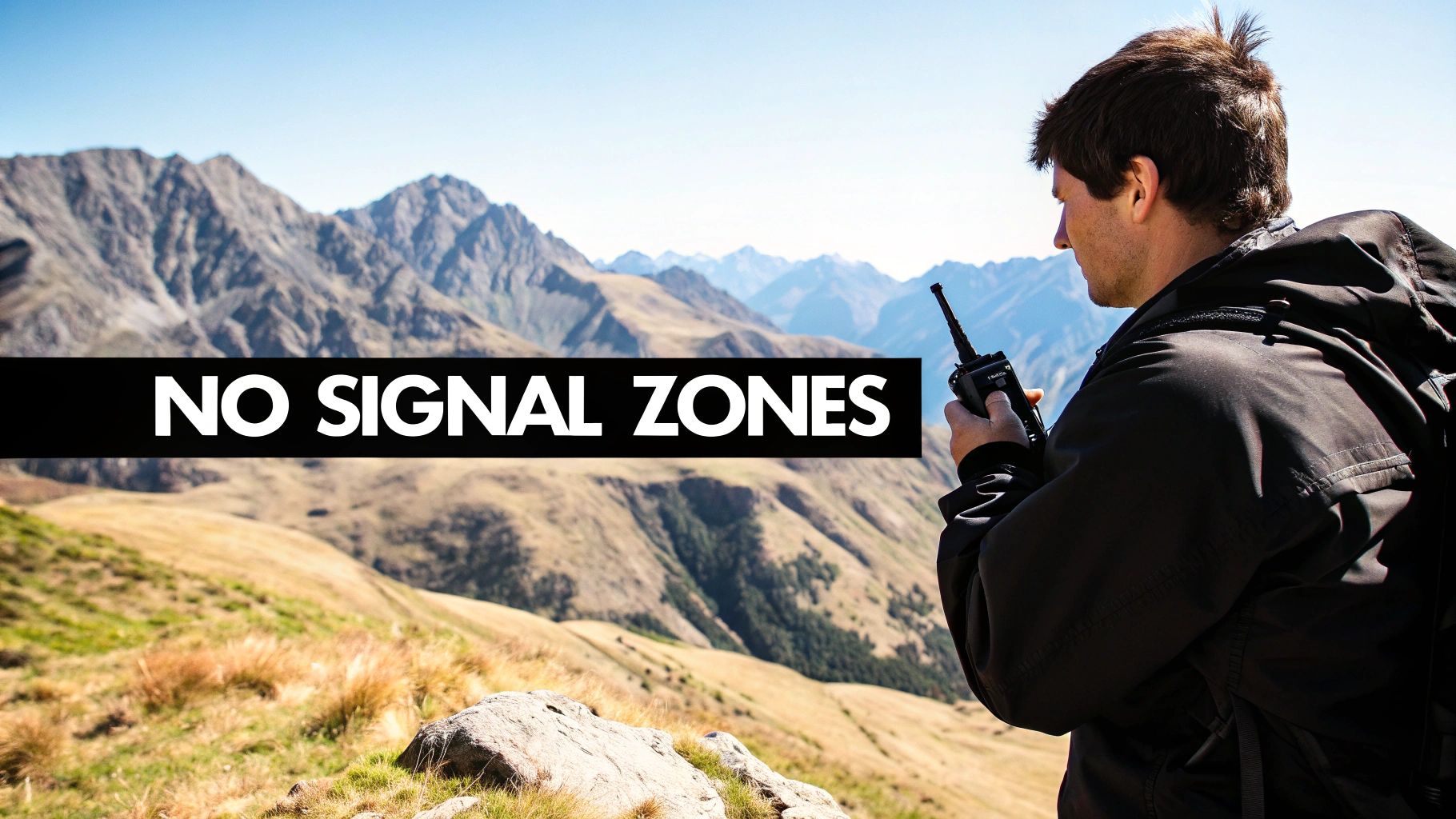
This issue becomes critical for teams operating in remote locations where cellular service is non-existent. A rural farming operation in Southland, for instance, might find their standard UHF radios are ineffective across sprawling paddocks separated by rolling hills. Similarly, a roading crew working on a winding pass like the Arthur's Pass or a search and rescue team in Fiordland National Park cannot afford to lose contact. These dead zones are caused by physical obstructions like mountains, buildings, and dense vegetation that absorb or block RF signals.
How to Mitigate Coverage Issues
Fortunately, there are several effective strategies to overcome these geographical limitations:
- Install a Repeater System: A radio repeater, strategically placed on a high point like a hill or a tall building, receives a weak signal from a handheld radio and re-transmits it at a higher power over a much wider area. This is the SINGLE MOST EFFECTIVE WAY to eliminate dead zones within a defined operational area.
- Choose High-Wattage Radios: For direct radio-to-radio communication in remote areas, a higher-wattage radio (typically 5 watts for handhelds) provides a more powerful signal that can better penetrate obstacles and travel further.
- Conduct On-Site Coverage Mapping: Before investing in a full system, work with a professional provider to conduct a coverage survey. This identifies potential dead zones and helps design a system, including antenna placement and repeater locations, that guarantees reliable communication where you need it most.
- Integrate a Satellite Backup: For truly remote operations where even repeaters are impractical, a satellite device like an Iridium satellite phone or a Garmin inReach offers a reliable backup for critical communications.
In many cases, poor coverage isn't just a radio problem but also a cellular one. To learn more about how signal boosters can help bridge communication gaps for your mobile devices, explore our information on Cel-Fi solutions.
2. High Equipment and Licensing Costs
Another significant hurdle for many Kiwi businesses is the perceived high cost associated with professional two-way radio systems. The initial outlay for quality commercial-grade handsets from brands like Tait, Motorola, or Hytera, vehicle-mounted units, and necessary accessories can be substantial. Beyond the hardware, there are the unavoidable costs of licensing through New Zealand's Radio Spectrum Management (RSM), which are essential for operating on private, interference-free frequencies. This combination of capital expenditure and ongoing operational costs is a common complaint, particularly for smaller enterprises.
For a start-up logistics company in Auckland or a small construction firm in Christchurch, the cost of a full radio fleet can feel prohibitive when compared to using mobile phones. Similarly, community volunteer groups organising local events or search efforts often struggle to justify the investment. It is not just the initial purchase; ongoing maintenance, battery replacements, and potential repairs all contribute to the Total Cost of Ownership (TCO), making it a challenging financial commitment for organisations with tight budgets.
How to Mitigate Cost Barriers
While professional radio systems are an investment, several strategies can make them more accessible and cost-effective:
- Consider Leasing or Hire Options: For short-term projects, seasonal work, or to test a system before committing, leasing or hiring equipment is an excellent way to access professional-grade radios without the large upfront capital expense. This is ideal for event management, traffic control, or construction projects.
- Evaluate Total Cost of Ownership (TCO): Don't just look at the sticker price. A durable, reliable radio from a trusted brand may cost more initially but will have a longer lifespan, fewer repairs, and better performance than cheaper alternatives, saving money in the long run.
- Start with Certified Used Equipment: Reputable specialist providers often offer certified, pre-owned professional radios that have been fully tested and serviced. This can significantly reduce the initial hardware cost while still providing the reliability of commercial-grade equipment.
- Explore Shared Frequency Licenses: In some situations, it may be possible to share licensed frequencies with other nearby organisations, reducing individual licensing fees through RSM. This requires careful planning and coordination with a professional provider.
Understanding the regulatory landscape is key to managing expenses. To get a clearer picture of frequency requirements and associated costs, you can find more information about UHF radio regulations in NZ.
3. Interference and Frequency Congestion
A frequent and disruptive complaint about two-way radios, particularly in New Zealand’s bustling urban and industrial hubs, is signal interference and frequency congestion. As more businesses, from construction sites to logistics companies, rely on radio communications, the available radio spectrum becomes increasingly crowded. This "traffic jam" on the airwaves results in garbled messages, crosstalk from other users, and a general lack of reliability that can bring operations to a standstill.
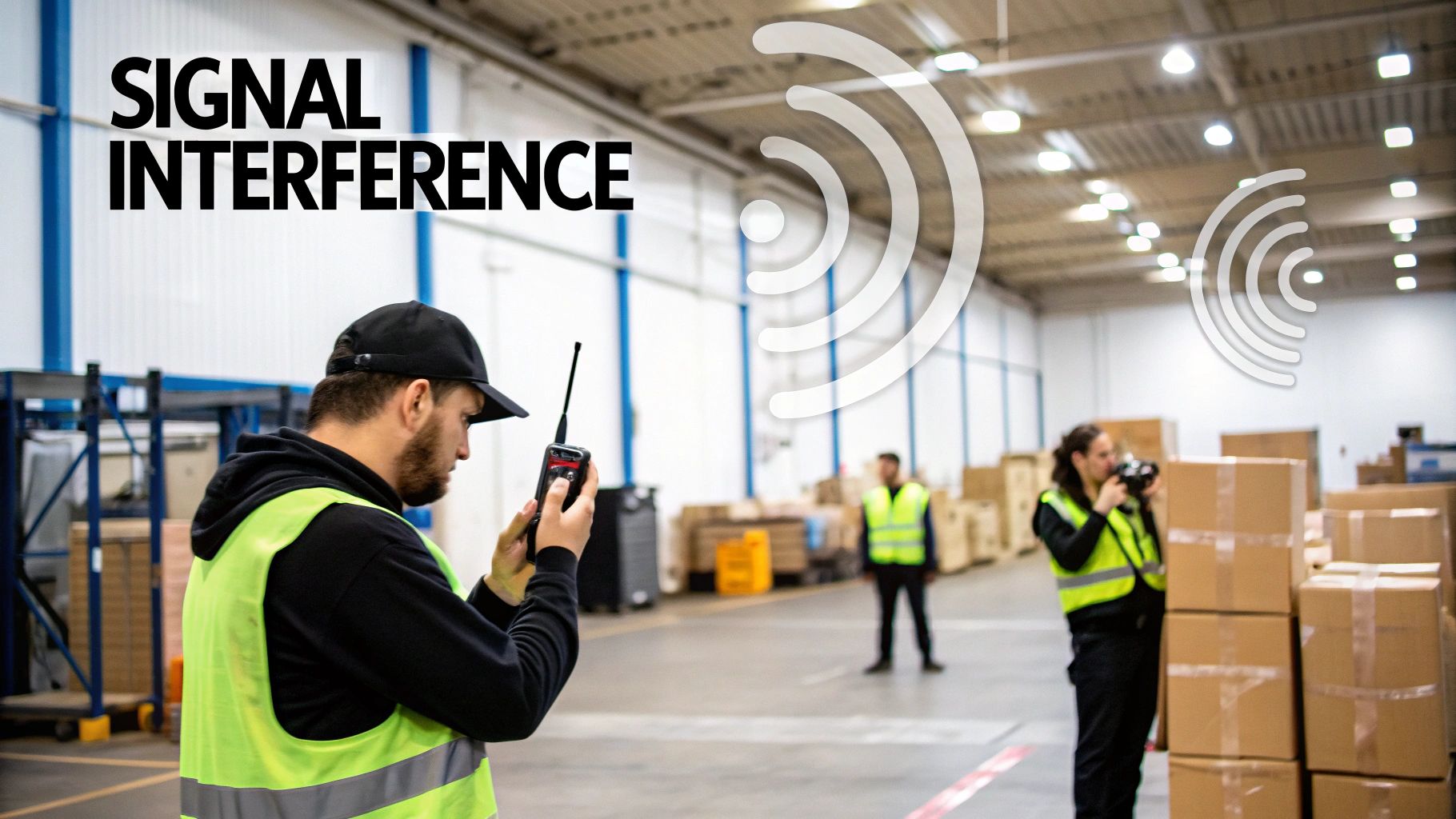
This problem is especially pronounced for users of older analogue radios or those on public CB radio channels NZ. A warehouse operation in Auckland's industrial sector might experience constant crackle and bleed-through from a nearby manufacturing plant's machinery or another company's radio network on a shared frequency. Similarly, a Wellington construction crew managing traffic on a major infrastructure project could find their critical instructions drowned out by other operators. This interference isn’t just from other radios; it can be generated by heavy electrical equipment, computers, and even atmospheric conditions, degrading audio quality when clarity is most needed.
How to Mitigate Interference Issues
Fighting through the noise is possible with modern technology and smart planning. Here are the most effective methods to ensure your messages get through clearly:
- Upgrade to Digital Radio (DMR): Digital Mobile Radio (DMR) technology is the SINGLE BEST SOLUTION for combating interference. Digital radios like those from Motorola, Hytera, or Tait use advanced software to filter out background noise and reject signals from other analogue users on the same frequency, delivering exceptionally clear audio.
- Secure a Licensed Frequency: Instead of using public PRS/CB channels, applying for a private licensed frequency from Radio Spectrum Management (RSM) gives your organisation exclusive use of a channel in your operational area. This dramatically reduces the chance of hearing other businesses on your network.
- Implement Privacy Codes (CTCSS/DCS): While not providing true privacy, Continuous Tone-Coded Squelch System (CTCSS) or Digital-Coded Squelch (DCS) codes filter out transmissions from users not using the same code. This is an effective way to quiet a congested channel, though it doesn't stop others from talking over you.
- Establish Disciplined Communication Protocols: Train your team to keep transmissions short, concise, and professional. Reducing unnecessary chatter keeps the channel clear for essential communications, minimising the impact of congestion.
For a deeper understanding of how frequencies are managed and licensed in New Zealand, you can explore our detailed guide on Radio Spectrum Management.
4. Limited Battery Life and Power Management
Another significant complaint from two-way radio users across New Zealand is the constant battle against limited battery life. A radio running out of power halfway through a shift isn't just an annoyance; it's a breakdown in operational efficiency and a severe safety risk, particularly for lone workers or teams in hazardous environments. This issue is frequently reported by teams who rely on their devices for extended periods, far from any charging points. The rugged New Zealand climate, especially the cold, damp conditions found in the South Island or at high altitudes, can dramatically reduce battery performance just when it's needed most.
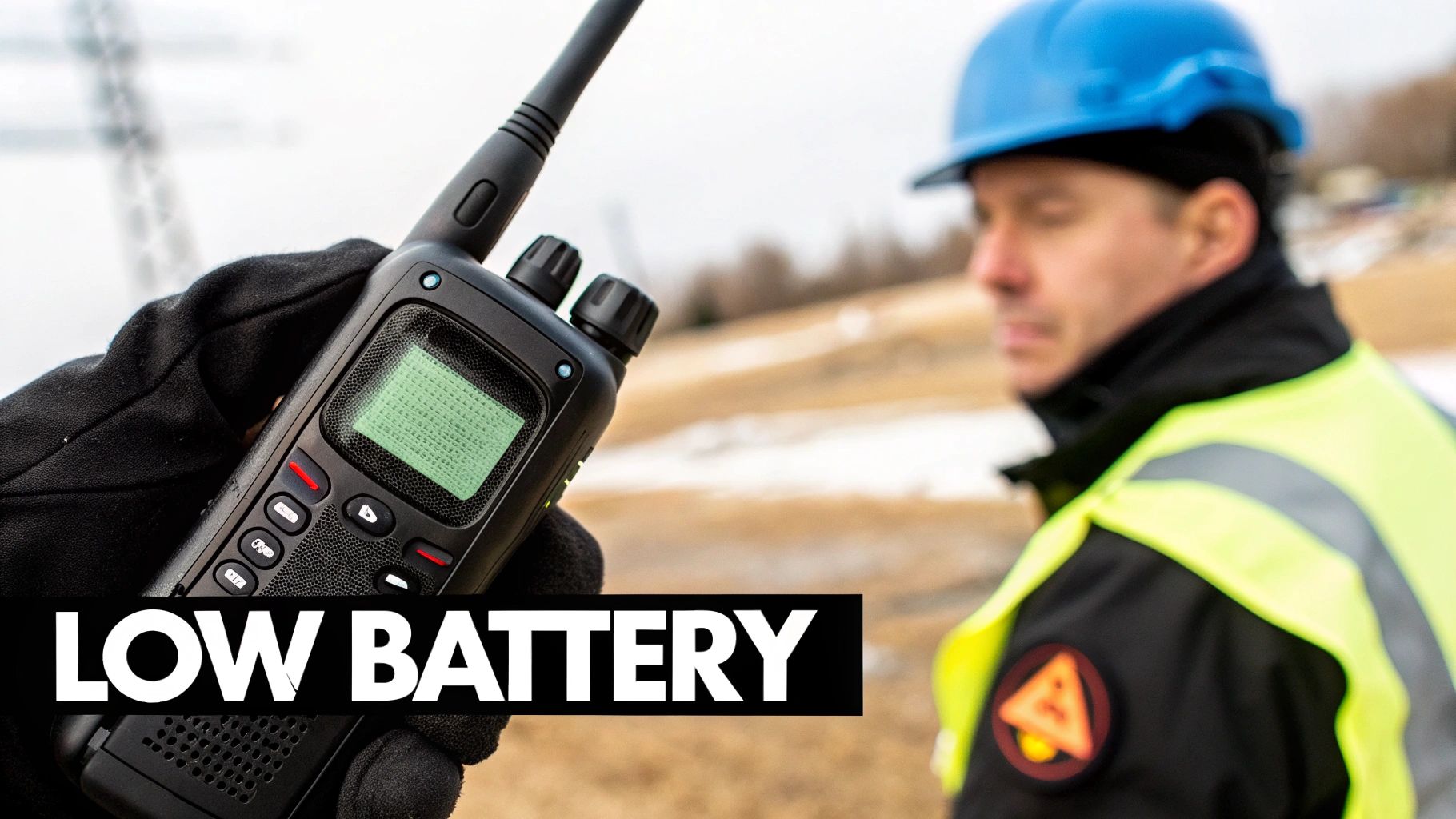
This problem is a daily reality for many Kiwi workers. Imagine a search and rescue team in the Tararua Ranges losing communication during a critical extraction, or a sheep farmer on a sprawling station in the Mackenzie Basin unable to coordinate with their team during an all-day muster. Similarly, a construction crew working on a new high-rise in Auckland or a roading team in a remote location cannot afford for their primary communication tool to fail mid-shift. High transmission frequency, constant use of features like GPS, and cold weather all contribute to accelerated battery drain, making proactive power management essential.
How to Mitigate Battery Life Issues
Fortunately, with the right equipment and practices, you can ensure your radios last the entire shift and beyond:
- Invest in High-Capacity Batteries: Many professional radio models, such as those from Hytera or Motorola, offer extended-life or high-capacity battery options. These are specifically designed for long shifts and are the SINGLE BEST UPGRADE for power-hungry users.
- Implement a Battery Rotation Schedule: For multi-shift operations, have a charged set of spare batteries ready to go. Swapping them out at the start of each shift ensures every team member begins with a full charge, eliminating guesswork.
- Use Intelligent Charging Systems: Modern multi-unit chargers can analyse battery health and optimise the charging cycle. This not only ensures a full charge but also extends the overall lifespan of your batteries, protecting your investment.
- Adjust Power Settings: Not every transmission requires maximum power. Train users to switch to a lower power setting when communicating over short distances. This simple habit can significantly conserve battery life throughout the day.
- Keep Batteries Warm: In cold environments, advise staff to keep their radios or spare batteries inside their jackets or in an insulated pouch. Maintaining a stable temperature prevents the rapid power drain associated with cold weather.
5. Outdated Legacy System Compatibility Issues
Another significant challenge, particularly for established New Zealand organisations, is grappling with outdated legacy radio systems. Many businesses, local councils, and even transport operators rely on analogue radio networks that may be decades old. While once reliable, these systems present a growing number of complaints related to maintenance, expansion, and compatibility with modern digital technologies. This creates a difficult crossroads where maintaining expensive, unsupported hardware competes with the need for a costly full-system overhaul.
This issue is widespread. A regional council might struggle to find spare parts for a 20-year-old VHF network used for civil defence and infrastructure management. A transport company with a mixed fleet of old and new trucks finds their analogue and digital radios cannot communicate effectively, creating operational silos and safety gaps. As leading manufacturers like Motorola and Hytera focus on advanced DMR (Digital Mobile Radio) technology, support for older analogue equipment is dwindling, forcing organisations to confront a challenging and often expensive transition.
How to Mitigate Compatibility Issues
Navigating the move from analogue to digital requires a strategic approach rather than a sudden switch. Here are some effective methods to manage the transition smoothly:
- Develop a Phased Migration Plan: Instead of replacing everything at once, create a staged plan. Start by upgrading critical teams or departments to digital while using hybrid radios to maintain communication with the remaining analogue fleet. This spreads the cost and reduces operational disruption.
- Invest in Hybrid (Dual-Mode) Radios: The MOST PRACTICAL SOLUTION for a gradual transition is to purchase hybrid radios. These devices, like many from the Hytera or Tait ranges, can operate on both analogue and digital channels. This allows new radios to communicate seamlessly with your existing legacy system while future-proofing your investment for an eventual full digital migration.
- Thoroughly Document Your Current System: Before making any changes, create a detailed record of your existing system’s configuration, including all frequencies, channels, and user groups. This documentation is invaluable for a new provider to understand your setup and plan a smooth integration.
- Prioritise Interoperability in Procurement: When purchasing new equipment, make interoperability a key requirement in your specifications. Ensure any new radios can be programmed to work with your existing analogue channels, preventing the creation of isolated communication groups.
6. User Interface Complexity and Training Requirements
While advanced features offer incredible capability, another of the most common complaints about two-way radios in New Zealand is their increasing complexity. Modern digital radios, packed with functions like private calling, GPS tracking, and text messaging, can present a steep learning curve for users. Staff across various sectors, from agricultural contractors in Canterbury to volunteer emergency services in the Bay of Plenty, often express frustration with complicated menu navigation and the difficulty in accessing essential features under pressure.
This complexity isn't just an inconvenience; it can lead to operational errors and compromise safety. When a user misunderstands a function or cannot quickly switch to the correct channel during an incident, communication breaks down. For many New Zealand businesses, the time and cost associated with training staff to use these sophisticated devices proficiently is a significant and often underestimated factor. A volunteer firefighter struggling to activate an emergency alert or a traffic management operator accidentally changing a critical setting are real-world scenarios that highlight this challenge.
How to Mitigate Complexity and Training Issues
Addressing user interface complexity is crucial for ensuring your radio system is an asset, not a liability. Here are several practical strategies:
- Choose User-Friendly Models: When selecting radios, prioritise models known for intuitive design. Some devices, like certain Hytera or Motorola radios, offer simplified operation modes that can be pre-programmed to hide non-essential features, presenting a clean, easy-to-use interface for frontline staff.
- Implement Comprehensive Training: Don’t just hand a radio to a new team member. A structured training programme that covers both basic operation and emergency procedures is essential. This builds confidence and muscle memory, ensuring correct use when it matters most.
- Create Laminated Quick-Reference Guides: For radios deployed in the field or in vehicles, provide durable, pocket-sized guides. These should visually illustrate core functions like changing channels, adjusting volume, initiating a private call, and activating the emergency button.
- Establish a Mentoring System: Pair new operators with experienced users who can provide hands-on guidance and answer questions in a real-world setting. This peer-to-peer learning is often more effective than classroom-style instruction alone and helps maintain proficiency across the team.
7. Regulatory Compliance and Spectrum Management Challenges
Navigating the rules and regulations governing two-way radio use is another significant pain point for many New Zealand businesses. The radio spectrum is a finite, nationally-owned resource, and its use is tightly controlled by Radio Spectrum Management (RSM) to prevent interference and ensure fair access. For many operators, the bureaucratic process of obtaining the correct licenses, managing frequency allocations, and ensuring all equipment is compliant can be a complex and time-consuming administrative burden.
This isn't just a minor inconvenience; it's a legal requirement. Operating powerful commercial radios on the wrong frequencies or without the correct license can result in significant fines and the confiscation of equipment. For example, a new mining operation in the Waikato might face project delays while waiting for their exclusive frequency allocation to be processed. Similarly, a small tourism business in Queenstown might be uncertain about its compliance obligations, risking penalties for unintentional misuse of public channels. The need for specialist knowledge to navigate the RSM frameworks often becomes a barrier for businesses that just want to get their communication systems up and running.
How to Overcome Regulatory Hurdles
Staying on the right side of the regulations is crucial for uninterrupted operations. Here’s how you can simplify the process:
- Work with an Approved Radio Engineer (ARE) or Certifier: For complex applications, such as setting up a private repeater or securing an exclusive commercial frequency, partnering with an RSM-approved consultant is essential. They have the expertise to manage the entire application process, ensuring it's done correctly and efficiently.
- Plan Ahead: Don't leave licensing until the last minute. Frequency allocation and licensing can take time. Plan your radio system needs well in advance of when you need them to be operational to avoid costly delays.
- Maintain Detailed Records: Keep a comprehensive log of all your radio equipment, including serial numbers, certifications, licensed frequencies, and license expiry dates. This documentation is vital for audits and makes managing renewals straightforward.
- Use a Professional Radio Provider: Experienced providers like Mobile Systems handle the licensing process on behalf of their clients. This is the EASIEST AND MOST RELIABLE WAY to ensure your system is fully compliant from day one, removing the administrative headache and letting you focus on your core business. They can advise on the correct license type for your needs, whether it's a private land mobile license or a general user radio license (GURL).
Top 7 Two-Way Radio Complaints in New Zealand
| Issue | 🔄 Implementation Complexity | ⚡ Resource Requirements | 📊 Expected Outcomes | 💡 Ideal Use Cases | ⭐ Key Advantages |
|---|---|---|---|---|---|
| Poor Coverage and Dead Zones | High — terrain and repeater planning required | High — repeaters, elevated sites, or satellite backups | Improved reach if invested; otherwise unreliable comms in remote areas | Remote farming, tramping, mining, forestry | Encourages coverage planning and repeater investment |
| High Equipment and Licensing Costs | Moderate — procurement straightforward, licensing administrative | Very high — capital purchase, annual fees, maintenance | Reliable, durable systems for paying users; barrier for small operators | Large contractors, logistics firms, regulated services | Licensing reduces interference; professional gear is robust |
| Interference and Frequency Congestion | High — requires coordination and technical upgrades | Moderate–High — digital radios, filters, spectrum management | Better clarity with digital solutions; unresolved congestion reduces intelligibility | Urban/industrial sites, large events, emergency services | Drives adoption of digital standards (DMR/P25) and better filtering |
| Limited Battery Life and Power Management | Low–Moderate — operational changes and accessory adoption | Moderate — spare batteries, chargers, solar or vehicle power | Extended uptime with backups; without them risk of mid-operation loss | SAR teams, remote crews, long shifts in cold climates | Portable designs and improving Li‑ion tech offer incremental gains |
| Outdated Legacy System Compatibility Issues | High — phased migration and interoperability engineering | High — hybrid gear, migration costs, vendor support | Smooth transition if phased; otherwise rising maintenance and obsolescence | Organisations with long‑running analog fleets (councils, hospitals) | Legacy systems are paid‑off and familiar to users |
| User Interface Complexity and Training Requirements | Moderate — training programs and simplification needed | Moderate — training time, documentation, standardized devices | Better operator proficiency after training; initial errors likely | Volunteer emergency services, small businesses, field crews | Advanced configurable features available for trained users |
| Regulatory Compliance and Spectrum Management Challenges | High — complex applications and ongoing audits | High — consultant fees, application delays, documentation | Legal, interference‑safe operation if compliant; delays and penalties if not | Any licensed operator; projects needing dedicated frequencies | Ensures fair spectrum access and prevents harmful interference |
Your Partner in Clear Communication: Why Mobile Systems is the Right Call
Navigating the landscape of professional two-way radio communications in New Zealand can feel like a trek through rugged terrain. As we've explored, the path is filled with potential pitfalls, from frustrating coverage dead zones in the back country to the persistent crackle of interference on a busy construction site. Issues like inadequate battery life derailing a long shift, or the complexities of RSM licensing causing compliance headaches, are not just minor annoyances; they are significant operational risks that can impact safety, efficiency, and your bottom line.
The core takeaway is this: the most common complaints about two-way radios in New Zealand almost always stem from a mismatch between the equipment and the environment it's used in. A generic solution is rarely the answer for the demanding conditions faced by Kiwi industries. Whether you're coordinating a vessel in the Cook Strait, managing a forestry crew in the central North Island, or ensuring traffic management runs smoothly in Auckland, your communication system must be purpose-built for the task. This requires a deep understanding of radio technology, New Zealand's unique geography, and specific industry regulations.
Mastering these concepts means moving from a reactive approach-fixing problems as they arise-to a proactive strategy. It involves:
- Strategic Coverage Planning: Understanding your operational area and deploying the right combination of high-gain antennas, repeaters, or even cellular and satellite solutions to eliminate dead spots.
- Proactive Power Management: Selecting radios with proven battery performance and implementing robust charging routines to ensure your team is never left without a lifeline.
- Expert System Design: Choosing the right technology, whether it's DMR for clarity and data capabilities, PoC for nationwide coverage, or a robust VHF marine radio for safety at sea.
This is where specialist expertise becomes your most valuable asset. The difference between a system that fails under pressure and one that performs flawlessly is often the partner you choose. An expert provider doesn’t just sell you a box; they assess your needs, design a solution, handle the licensing, professionally install and programme the equipment, and provide ongoing support. This end-to-end approach transforms your radio system from a source of frustration into a powerful tool for productivity and safety. Don't let common radio issues dictate your operational success. Partner with an expert and make clear, reliable communication the standard for your team.
Ready to eliminate the guesswork and build a communication system that truly works for your New Zealand operations? The team at Mobile Systems Limited has spent nearly two decades solving these exact problems for businesses just like yours, providing tailored solutions from VHF marine setups to advanced nationwide PoC networks.
Contact us today for a no-obligation chat with a communications specialist and discover how professional advice makes all the difference.
Related posts

- November 22, 2025
Discover accepted radio communications ettequite in New Zealand with this clear guide to essential rules, prowords, and practices for effective...

- November 01, 2025
pa for sports tournaments – outdoor audio that performs, rain or shine: A guide to choosing a reliable outdoor PA...