
Finding your way with GPS
Master finding your way with GPS for commercial operations. Learn how to track assets and ensure team safety across New Zealand's rugged terrain.
For many Kiwi businesses, GPS isn't just about getting from A to B—it's a lifeline. In Aotearoa's rugged backcountry, where mobile reception is often a distant memory, knowing the exact location of your team and assets is non-negotiable. This guide isn't about the GPS on your phone; it's about professional-grade solutions that keep your operation connected, productive, and safe when it matters most.
Navigating New Zealand's Toughest Terrain with Confidence
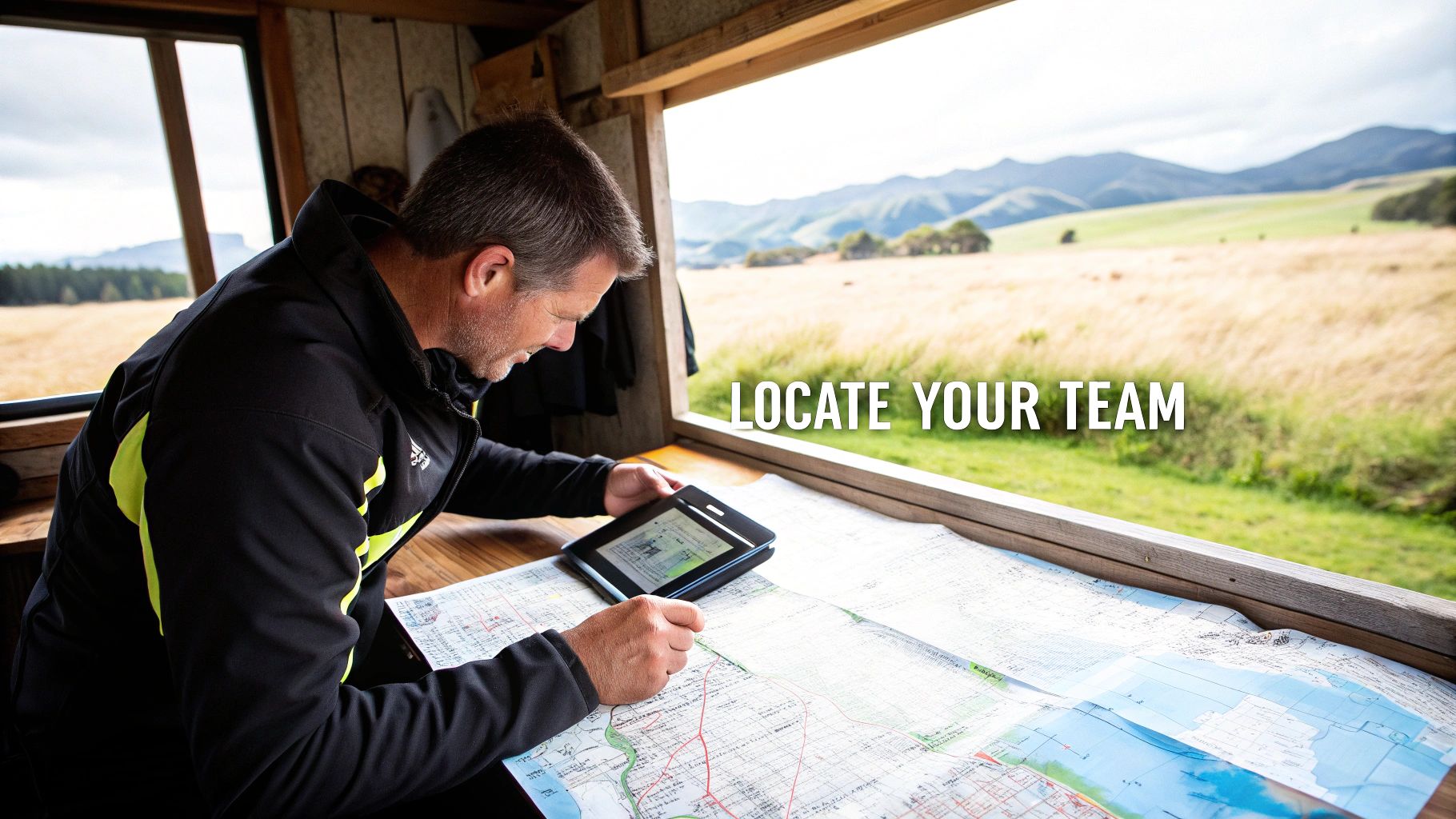
Look at a map of New Zealand's remote high country or dense native bush. Now ask yourself a critical question: do you know exactly where every member of your team is right now?
For industries like forestry, agriculture, and rural logistics, working beyond the reach of cell towers isn't an occasional challenge—it's just another Tuesday. This is where standard smartphone apps and consumer GPS devices completely fall short. Frankly, they weren't built for the demands of a commercial worksite.
The Professional-Grade Difference
Relying on inadequate tech out in the field isn't just risky; it's expensive. Inefficient routing burns through fuel and precious time, hitting your bottom line directly. More critically, a delayed emergency response in an isolated spot can have devastating consequences, a major concern for any business that takes health and safety seriously.
Trying to manage lone workers without a reliable GPS tracker is a compliance nightmare waiting to happen, putting your people in harm's way. You need a system that's tough, dependable, and designed for the real-world conditions your team faces day in and day out.
Professional GPS technology isn't a nice-to-have. It's a mission-critical tool for safety, efficiency, and peace of mind across Aotearoa. When you simply can't afford to be out of touch, you need a solution built for the job.
This guide is based on our 20+ years of hands-on experience in the field. We'll walk you through how commercial-grade GPS technology—from dedicated vehicle trackers to two-way radios with integrated location services—delivers the certainty you need. It’s all about making sure every person on your team can be located, communicated with, and kept safe, no matter how far off the beaten track their work takes them.
The Real-World GPS Challenges Across Kiwi Industries
Here in New Zealand, the difference between a productive day and a potential disaster often boils down to one simple thing: knowing exactly where your people and assets are. From the rolling hills of the King Country to the dense bush of the West Coast, standard comms tools often drop out, leaving teams exposed and operations vulnerable. Finding your way with GPS isn't just a nice-to-have; it's a fundamental requirement for keeping people safe and the business running smoothly.
Across Aotearoa, Kiwi industries are up against unique operational headaches that consumer-grade tech simply wasn’t built to solve. These aren't just hypotheticals; they're daily realities that hit safety, compliance, and your bottom line.
Agriculture and Forestry
For farmers and forestry crews, the "office" can span thousands of hectares of rugged, isolated land with zero mobile signal. The core challenges are constant.
- Lone Worker Safety: How do you guarantee the wellbeing of a fencer checking a remote boundary line? Or a machinery operator working deep inside a forest block? A simple trip or mechanical failure can become critical without a reliable way to call for help.
- Asset Management: High-value gear like tractors, harvesters, and log haulers are often left on-site. Without a robust GPS tracker, theft or unauthorised use is a major risk, and just locating a specific machine across a massive property can burn hours of valuable time.
- Productivity: Trying to coordinate teams for mustering, spraying, or harvesting without a clear, real-time picture of everyone's location is a recipe for massive inefficiency.
Construction and Traffic Management
On a busy construction site or a sprawling roading project, precision and coordination are everything. Crews are in a dynamic, often hazardous environment where knowing the exact location of people and plant is critical for health and safety.
- Site Coordination: Managing the constant flow of heavy vehicles, personnel, and subcontractors across multiple zones demands pinpoint accuracy. It's the only way to prevent accidents and keep the project on schedule.
- Asset Security: Leaving diggers, rollers, and other expensive equipment on unsecured sites overnight is a huge liability. Geofencing alerts from a quality GPS tracker can give you an immediate heads-up if a machine moves outside its designated area after hours.
- Worker Safety: In high-risk zones, knowing a worker's precise location is vital for a rapid emergency response. This is especially true for traffic management crews working just metres away from live traffic lanes.
For transport and logistics fleets navigating our demanding road network, it’s about more than just finding the best route. It's about optimising every litre of fuel, managing driver fatigue, and having a reliable system to ensure their safety from Cape Reinga to Bluff.
Maritime and Marine Operations
Out on the water, there’s simply no room for error. Whether it's a commercial fishing vessel on the Chatham Rise or a charter boat in the Marlborough Sounds, reliable location data is a non-negotiable lifeline.
- Emergency Response: When things go wrong at sea, an EPIRB or PLB isn't a luxury; it's a critical piece of safety equipment. The GPS signal it sends is the single most important factor for search and rescue teams, allowing them to launch a fast and accurate response.
- Fleet Coordination: For commercial fishing companies, tracking the real-time location of their entire fleet is essential for operational efficiency, safety monitoring, and complying with maritime regulations. Accurate GPS data ensures vessels stay within their designated fishing zones and can be located in a hurry if an emergency strikes.
Choosing the Right GPS Technology for Your Operation
When it comes to using GPS for commercial operations, picking the right tool for the job is everything. This isn't about grabbing a one-size-fits-all device from a retail shelf; it's about matching professional-grade technology to your unique work environment, safety protocols, and how your team actually communicates in the field.
The choice usually boils down to a few key categories, each with its own clear strengths. Getting your head around these differences is the first step to building a reliable system that keeps both your people and your gear safe.
Dedicated GPS Trackers
For many businesses, the main goal is simple: know where your assets are, all the time. This is where dedicated GPS trackers absolutely shine.
They’re perfect for keeping tabs on your fleet of utes, trucks, or heavy machinery, giving you real-time location data, route history, and alerts if a vehicle leaves a designated area. Their job is purely to report location data back to a central platform. They’re streamlined, efficient, and built for one purpose—giving you accurate, reliable tracking you can count on.
Two-Way Radios with Integrated GPS
What if your team needs to stay in constant contact and be locatable? A two-way radio with built-in GPS is the answer. It combines two mission-critical functions into a single, rugged device that can handle the knocks of a worksite.
Radios running on DMR (Digital Mobile Radio) or PoC (Push-to-Talk over Cellular) technology deliver crystal-clear voice comms alongside precise location data. Think of it this way: a supervisor can see their entire crew on a single map and talk to them instantly. This is a game-changer for coordinating tasks on large construction sites, managing logistics, or directing emergency response teams.
If you want to dig a bit deeper into the nuts and bolts, we've got a great guide on how GPS technology works.
Satellite Communicators
Once your work takes you beyond the reach of cell towers and radio repeaters, satellite communicators become non-negotiable. For crews working in New Zealand’s remote high country, dense bush, or out on the water, these devices are often the only reliable lifeline back to base.
When you have absolutely no cellular or radio coverage, devices from providers like Iridium and Inmarsat are what you need. They guarantee you can send and receive messages, share your location, and trigger an SOS alert from literally anywhere on the planet.
For businesses that need to protect assets in these remote spots, specialised tools can offer an extra layer of security. For instance, a trail camera with GPS tracking can be invaluable for monitoring sites in forestry or agriculture.
Making an informed choice from the get-go saves you from the costly mistake of deploying consumer-grade gear for a problem that demands a tough, commercial-grade solution.
GPS Technology Comparison for NZ Businesses
To help you decide, we've put together a quick comparison of the main GPS-enabled solutions we see businesses using across New Zealand. This should help clarify which tool is the best fit for your specific needs.
| Technology Type | Primary Use Case | Coverage Dependency | Key Benefit |
|---|---|---|---|
| Dedicated GPS Trackers | Vehicle & asset monitoring | Cellular Network | Single-purpose, reliable location data |
| Two-Way Radios with GPS | Team communication & tracking | Cellular or Radio Network | Combines voice and location in one device |
| Satellite Communicators | Remote worker safety & communication | Satellite Network | Works anywhere, even without cell/radio |
Ultimately, the best technology depends entirely on where your team operates and what you need to achieve. A logistics company in Auckland has very different needs from a backcountry survey crew in Fiordland, and the right GPS solution reflects that reality.
Going Beyond a Dot on the Map to Drive Real Results
Modern GPS is so much more than just finding your way from A to B. For Kiwi businesses, the real power lies in turning that raw location data into intelligence that genuinely improves how you operate. This is where professional-grade GPS systems completely outclass the consumer apps on your phone, offering features that boost safety, security, and efficiency right across your business.
It’s one thing to see a vehicle on a map; it's another thing entirely to use that information to make smarter decisions.
From Location to Intelligence
Imagine getting an instant, automated alert the moment a digger or valuable piece of machinery leaves your worksite after hours. That’s the simple but powerful concept of Geofencing. It lets you draw a virtual perimeter around any location, giving you a massive security boost and complete peace of mind over your assets. A quick alert can be the difference between a minor issue and a major loss.
Another incredibly useful tool is historical route playback. I've seen clients use this to optimise delivery runs by spotting inefficient detours, verify timesheets against actual hours on site, or investigate an incident with total clarity. It gives you a clear, factual record of a vehicle's movements, taking all the guesswork out of the equation and improving accountability. For a closer look at these features, check out our guide on the benefits of a vehicle GPS tracker.
Safety and Performance Integration
Beyond just tracking assets, GPS technology is a cornerstone of modern health and safety. You've got features like 'Man Down' detection and automated emergency alerts, which are genuine lifesavers for lone workers out in remote forestry blocks or on the farm. If a team member has a fall or becomes unresponsive, the system can automatically fire off an alert with their exact coordinates, making sure help gets there fast.
The data you gather also gives you powerful insights into vehicle health and driver behaviour. You can monitor things like speed, idle times, and harsh braking. This lets you provide targeted training to your drivers, which helps cut down on fuel costs and general wear-and-tear. When you integrate this with your maintenance schedules, you ensure your whole fleet stays reliable and on the road, which has a direct impact on your bottom line.
This flowchart can help you visualise which type of solution might be the best fit, depending on your team's core needs.
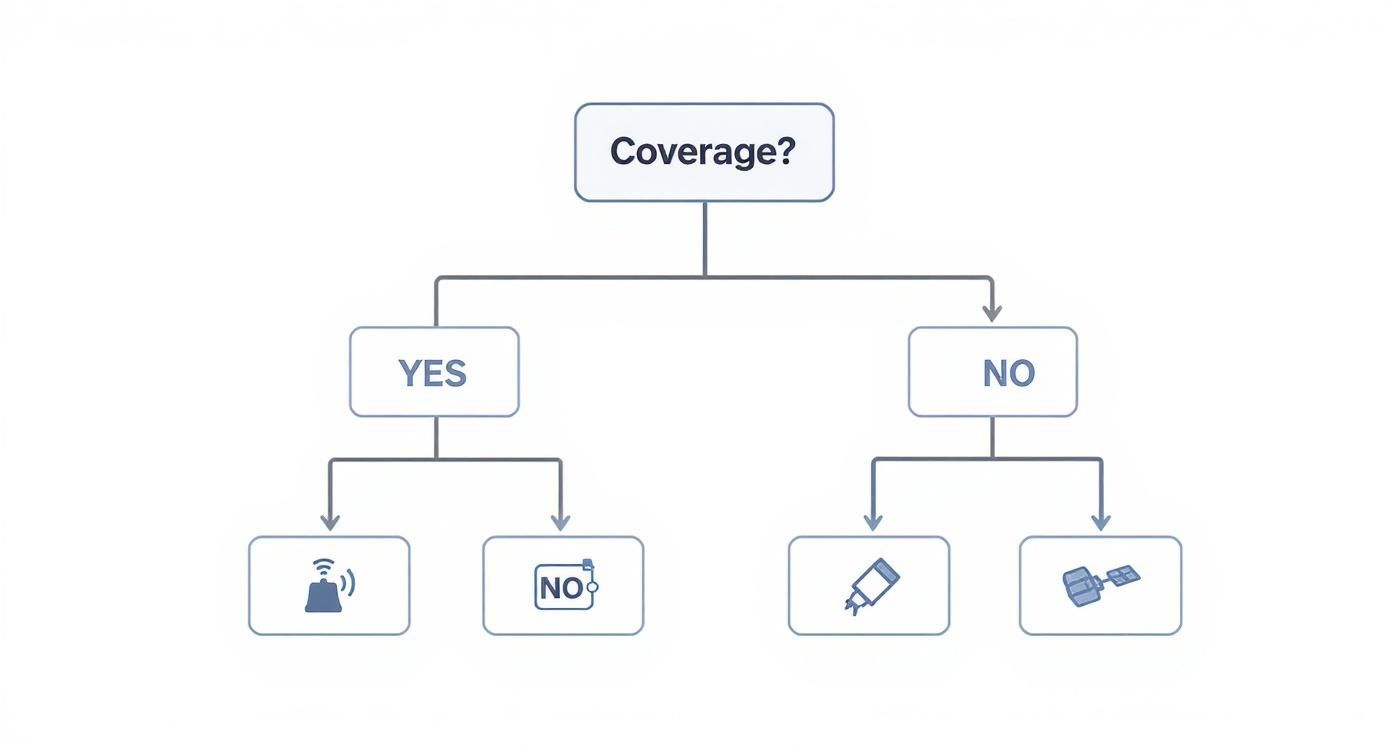
Ultimately, the right device always comes down to what your team needs to do and where they need to do it.
Insider Knowledge from Two Decades in the Field
When you've spent nearly two decades deploying professional communication and GPS solutions across every corner of New Zealand, you learn a few things the manuals don't tell you. We've seen firsthand what works out in the field and, just as importantly, what fails when it matters most. These are some of the hard-won insights we share with our clients to help them get it right the first time.
Don't Underestimate the Antenna
This is hands-down one of the most common mistakes we see. A business invests in a quality GPS tracker but then cuts corners on the antenna installation. A poorly placed antenna, often tucked away inside the dash or blocked by metal, is going to give you weak, unreliable, and frustratingly inaccurate satellite fixes. It just won't work properly.
For genuine accuracy, especially when finding your way with GPS is critical to the job, that antenna needs a clear, unobstructed view of the sky. A professional installation makes sure it’s mounted correctly, properly sealed against NZ’s damp conditions, and connected for the best possible performance. It’s a small detail that makes a massive difference.
The Reality of Coverage in New Zealand
Many GPS solutions you’ll see on the market rely on the cellular network to send location data back to you. And while our mobile network is pretty robust in the towns and cities, it's far from universal. As of early 2024, New Zealand had 6.22 million active cellular mobile connections, and while about 99.8% of the population has broadband access, that doesn't translate to 100% land coverage. You can discover more insights about New Zealand's digital landscape here.
The moment your team heads into the high country, deep into a forestry block, or out on the water, that cell coverage can simply vanish.
Relying solely on a cellular-based GPS system is a recipe for creating dangerous blind spots in your operation. For complete awareness, you need a hybrid approach. That means combining cellular with radio networks or, for ultimate reliability in the most remote spots, satellite communicators.
Battery Life and Actually Getting Your Team on Board
A device with a dead battery is just dead weight. We've seen teams get caught out by choosing devices that can't last a full, demanding 10-12 hour shift. Real-world battery performance, not just the specs on the box, is a critical factor to consider.
Just as important is getting your people to actually use the new gear. The best system in the world is worthless if your staff find it too complicated or a hassle to use. Involving your team in the selection process, providing clear, simple training, and choosing user-friendly devices are key to getting it right. The whole point is to make safety and efficiency second nature, not another chore.
Your Trusted Partner for GPS Solutions in New Zealand
When your team’s safety and operational efficiency are on the line, the partner you choose is just as critical as the technology you deploy. For a mission-critical system like GPS tracking and communication, there's no substitute for a dedicated local specialist.
At Mobile Systems, we're not just another online shop. We are a 100% New Zealand-owned and operated company, proudly serving Kiwi businesses from our base in Mt Maunganui for nearly two decades. This isn't just a dot on the map for us; it’s our home. It means we have a deep, firsthand understanding of the unique challenges that come with operating in New Zealand’s demanding environments.
Hands-On Support Where You Need It
We believe in being there for our clients, which is why we run our own mobile on-site support fleet. Our expert technicians come directly to you, providing professional installation, programming, and servicing wherever your operation is based. This hands-on approach ensures your system is set up for peak performance from day one.
We don’t just sell boxes. We build long-term partnerships designed to deliver real, lasting value and reliability.
Our commitment to you includes:
- Custom Coverage Planning: We design solutions that tackle the specific coverage gaps in your operational areas, from dense urban sites to the most remote backcountry.
- RSM Licensing Support: We take the complexity out of Radio Spectrum Management licensing, ensuring your communication system is fully compliant from the get-go.
- Reliable Aftercare: Our support doesn’t end when the installation is complete. We provide ongoing maintenance and advice to keep your system running flawlessly for years to come.
Choosing Mobile Systems means choosing a local partner invested in your success. You get direct access to experienced specialists who understand your industry and are committed to keeping your team connected and safe.
For a solution you can depend on, trust the team that has been helping New Zealand businesses find their way for almost 20 years.
Your Top Questions About Commercial GPS Answered
When Kiwi businesses are looking to get serious about their GPS systems, a few key questions always come up. We hear them all the time, so let's get you some straight answers based on what we see out in the field every day.
Just How Accurate is Commercial GPS Tracking?
This is a big one. The GPS on your phone is great for getting around town, but it's not in the same league as a professional setup. While your phone might place you within a 5-10 metre circle, a high-quality commercial tracker with a properly installed external antenna nails that down to just 1-2 metres.
That level of precision isn't just a nice-to-have; it’s essential for things like coordinating machinery on a packed construction site or proving a vehicle was exactly where it needed to be for compliance reports. The gear and the quality of the installation make all the difference.
What Happens When a Device Loses Cell Signal?
It's a fair question for anyone working outside of the main centres in New Zealand. The good news is, a professional GPS unit doesn't just give up when it loses mobile coverage. It keeps tracking and saves all that location data right on the device.
As soon as it finds a cellular network again, it automatically uploads all the stored history. This means you never have gaps or blind spots in your records. For genuine live, up-to-the-minute tracking in the true back-country, though, you’d be looking at a satellite communicator—that's the only way to guarantee a constant connection.
Is This Tech Going to be a Headache for My Staff to Use?
Absolutely not. Modern commercial GPS systems are built for the real world. Whether it's a dedicated tracker or a two-way radio with GPS built-in, they’re designed to be tough and simple.
Think of devices from leading brands like Motorola or Hytera. They have straightforward interfaces and are rugged enough to handle being dropped, rained on, and covered in dust. Once we run your team through a quick training session, they'll see the gear as a reliable tool that makes their job safer and a whole lot easier.
What are the Legal Rules for Tracking Staff in NZ?
Putting a GPS tracker in a company vehicle is pretty standard stuff. Tracking people, however, requires you to be mindful of New Zealand's privacy laws.
The most important thing is transparency. You need a clear, written policy explaining why and when tracking is used—almost always for health and safety reasons, like lone worker monitoring. For anyone in high-risk, remote roles, dedicated safety devices are non-negotiable. You can get a better sense of this by reading about how Personal Locator Beacons (PLBs) keep you safe. We always point clients toward the official guidance from the Privacy Commissioner to make sure they’re doing things by the book.
Ready to get your team the safety and efficiency benefits of a rock-solid GPS solution? The expert crew at Mobile Systems Limited is here to help you find the perfect setup for your New Zealand operation.
Related posts

- June 11, 2026
New Zealand's workplace fatality rate is 1.7 times higher than Australia's, a stark figure that highlights the urgent need for...

- June 10, 2026
Did you know that approximately 15% of New Zealanders work in isolated conditions, with many operating entirely outside of reliable...

- May 30, 2026
Could your business withstand a $3 million fine for a health and safety oversight? Under the Health and Safety at...