
Hearing Protection Communication Systems: The Professional Guide to Safe Site Coordination
What if the equipment designed to protect your team’s hearing is actually the biggest threat to their safety on a 105dB work site? You likely recognize that while passive earmuffs prevent long-term damage.
What if the equipment designed to protect your team’s hearing is actually the biggest threat to their safety on a 105dB work site? You likely recognize that while passive earmuffs prevent long-term damage, they often create a "cone of silence" that hides approaching vehicles or emergency shouts. Modern hearing protection communication systems eliminate this risk by suppressing dangerous impulses while enhancing the frequencies of the human voice.
It's frustrating when safety compliance leads to communication breakdowns and costly site delays. This guide provides a clear path to integrating high-performance headsets that meet AS/NZS 1270 standards and survive rugged New Zealand conditions. We'll examine the technical trade-offs between Bluetooth and radio integration to help you build a seamless, high-noise coordination strategy that protects your crew and your bottom line.
Key Takeaways
- Learn the critical difference between passive earplugs and active systems that maintain situational awareness while suppressing harmful industrial noise.
- Understand how to select hearing protection communication systems based on your specific environment, balancing impact noise protection with all-day wearability.
- Discover how Bluetooth, Mesh, and noise-cancelling microphones ensure crystal-clear coordination even in high-wind or heavy machinery zones.
- Identify the technical requirements for integrating advanced headsets with your current New Zealand two-way radio fleet to avoid compatibility issues.
- Gain insights into how professional hearing conservation strategies can simultaneously enhance site safety and overall team productivity.
Meta Description: Discover how hearing protection communication systems combine noise attenuation with situational awareness to keep New Zealand workers safe and connected.
URL Handle: hearing-protection-comm-guide
What are Hearing Protection Communication Systems?
Hearing protection communication systems represent a significant advancement in personal protective equipment (PPE). These units integrate high-grade noise attenuation with sophisticated electronic components to allow for seamless team interaction. Unlike traditional earmuffs that simply block all sound, these systems use active technology to filter environmental noise while amplifying human speech.
The primary goal is to solve the isolation problem. In high-decibel environments, workers often remove their protection to hear a colleague or a warning signal. This brief exposure can lead to permanent threshold shifts in hearing. Modern hearing protection device technology ensures the wearer stays protected while maintaining full situational awareness.
These systems consist of three core hardware elements. First, noise-cancelling boom microphones use beam-forming technology to isolate the user's voice from background machinery. Second, high-fidelity internal speakers deliver clear audio. Third, external connectivity ports or Bluetooth modules allow the headset to interface with two-way radios, mobile phones, or mesh intercom networks.
Standard passive earmuffs are often a safety liability in dynamic New Zealand work environments. When a worker is totally cut off from their surroundings, they can't hear approaching forklifts, alarms, or verbal warnings. Research indicates that over-protection is just as dangerous as under-protection. Hearing protection communication systems mitigate this by allowing critical sounds to pass through at safe volumes.
The Evolution of Industrial Hearing Safety
The industry has moved far beyond the basic foam plugs of the 1970s. We've transitioned into the era of level-dependent protection. This technology uses Digital Signal Processing (DSP) to analyze incoming sound waves in real-time. The system differentiates between the steady drone of a generator and the sharp, transient frequencies of human speech.
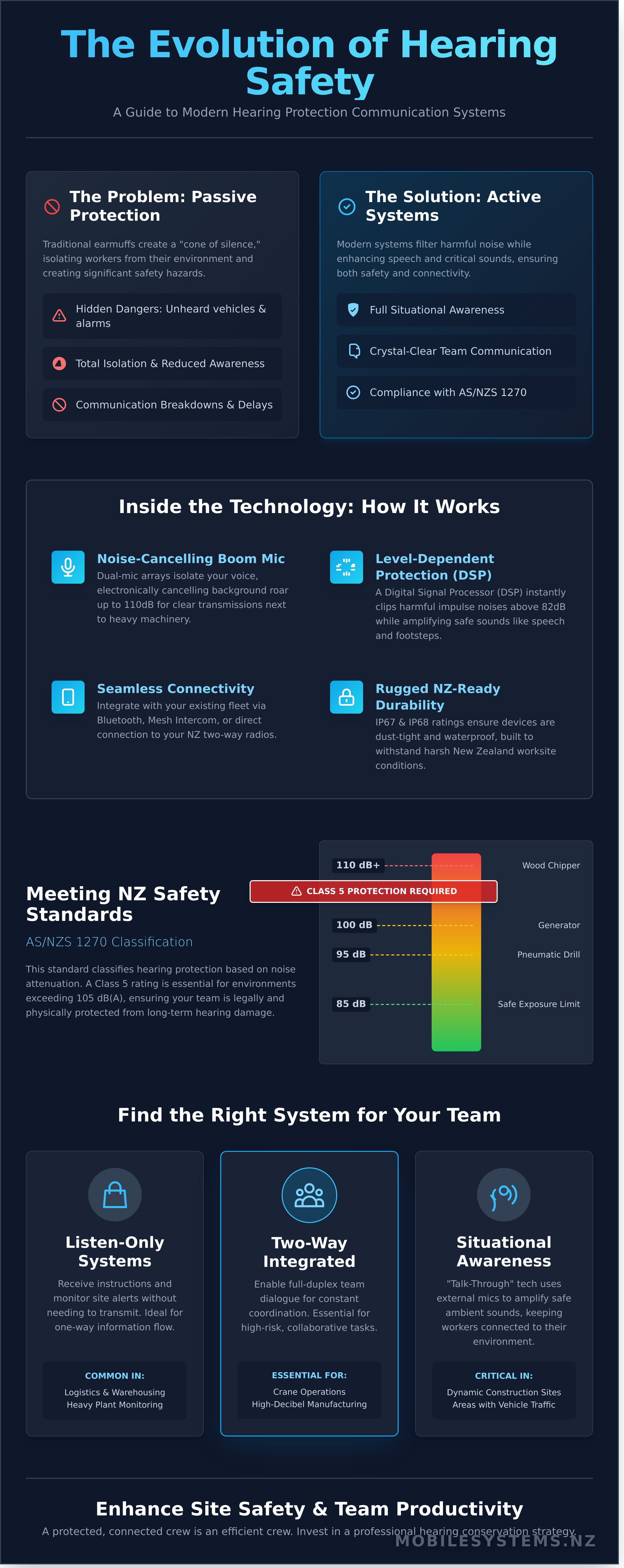
In New Zealand, all equipment must meet the AS/NZS 1270 standards. This regulation classifies devices based on their Mean Threshold Attenuation. A Class 5 headset, for example, is designed for environments where noise levels exceed 105 dB(A). Mobile Systems Limited ensures all recommended systems comply with these rigorous local safety benchmarks to protect your team’s long-term health.
Key Categories of Communication Headsets
Choosing the right system depends on your specific operational needs. There are three primary categories used in the local market:
- Listen-only systems: These are designed for workers who need to receive instructions or monitor site alerts but don't need to transmit. They're common in logistics and heavy plant monitoring.
- Two-way integrated systems: These allow for full-duplex team dialogue. They're essential for crane operations, technical maintenance crews, and high-decibel manufacturing zones where constant coordination is vital.
- Situational awareness (talk-through): These headsets use external microphones to pick up ambient sounds. The electronics clip any noise above 82dB, but amplify quieter sounds like footsteps or voices, keeping the worker connected to their environment.
A tailored assessment often prevents costly mistakes. If you choose a system that doesn't align with your specific noise profile, you risk either non-compliance or equipment abandonment by staff. Mobile Systems Limited provides the technical expertise to match the right hardware to your unique site requirements.
Understanding the Technology: Bluetooth, Mesh, and Radio
Selecting the right hearing protection communication systems requires a deep dive into how these devices handle audio signals and environmental stress. In high-noise environments like New Zealand timber mills or civil construction sites, the technology must do more than just muffle sound. It has to intelligently separate human speech from the roar of heavy machinery.
Noise-cancelling boom microphones utilize a dual-microphone array to isolate the wearer's voice. The primary microphone faces the mouth, while a secondary microphone faces outward to capture ambient noise. By inverting the phase of the ambient sound and combining it with the primary signal, the system electronically cancels out background roar up to 110dB. This allows clear instructions to be heard even when a worker is standing next to a 95dB wood chipper or a high-pressure pneumatic drill.
Durability is another non-negotiable factor. New Zealand conditions are notoriously harsh, meaning an IP67 or IP68 rating isn't optional for outdoor crews. An IP68 rating ensures the headset is dust-tight and can survive continuous immersion in water up to 1.5 metres deep. This level of protection prevents internal corrosion from the heavy rain and mud common in the Central Plateau or the West Coast forest blocks.
Full-shift operations in remote locations demand high-capacity lithium-ion batteries. Most professional units provide 12 to 18 hours of continuous talk time. This ensures the headset doesn't fail during a standard 12-hour shift in a remote area where charging isn't an option. Reliability in these zones is critical for safety, as a dead battery effectively silences a worker in a high-risk environment.
Bluetooth vs. Mesh Communication
Bluetooth serves as a reliable link for 1-to-1 connections, such as pairing a headset to a mobile phone or a specific handheld radio. However, it struggles with range, typically dropping out after 10 to 15 metres. Mesh technology creates a dynamic, self-healing network between all users. If one worker moves out of range, the rest of the team stays connected without interruption. Mesh supports full-duplex conversation, meaning workers can speak and hear simultaneously. This is superior for dynamic teams moving through complex terrain where line-of-sight is frequently lost.
Direct Radio Integration (VHF/UHF)
Direct integration with VHF or UHF radios remains the gold standard for long-range, mission-critical connectivity. Hard-wired connections provide 100% reliability, while wireless PTT (Push-To-Talk) adapters offer a cable-free experience for those needing maximum mobility. Push-to-Talk (PTT) systems prevent accidental channel jamming because the transmitter only activates during intentional manual engagement. For teams operating across vast distances, a tailored assessment of your radio infrastructure ensures your hearing protection communication systems work seamlessly with existing fleet hardware.
Choosing the Right System for Your Industry
Selecting the right hardware requires a deep understanding of your specific acoustic environment. Not every headset is built for every task. A mismatch between the device and the noise profile can lead to "over-protection," where workers feel isolated, or "under-protection," which leads to permanent hearing loss. Hearing protection communication systems must balance noise attenuation with the need for clear, instantaneous data exchange.
Noise profiles generally fall into two categories: impact and continuous. Impact noise, such as a nail gun or a drop forge, creates a pressure wave that peaks at 130 to 140dB in less than a millisecond. Continuous noise, like a diesel generator or a ventilation fan, stays at a steady level for hours. Digital systems use active compression to "clip" impact sounds instantly while allowing the wearer to hear a colleague speaking during the quiet gaps between those sounds.
Wearability determines whether your team actually uses the equipment provided. For an eight-hour shift, the physical configuration is as vital as the electronics. We categorize these into three main types:
- Headband configurations: These are the standard choice for factory floors where no other head-borne PPE is required. They provide the most consistent clamping force for a reliable seal.
- Helmet-mounted systems: Essential for sectors like forestry or heavy construction. These clip directly into the accessory slots of safety helmets, ensuring the earcups stay aligned even when the wearer is moving through dense bush or climbing scaffolding.
- Neckband models: These are the preferred solution for workers who need to wear wide-brimmed sun hats or specialized headgear that interferes with a top strap.
In New Zealand, the AS/NZS 1270 standard is the benchmark for safety. For most heavy industrial sites, Class 5 protection is the requirement. This class is designed for environments where noise levels exceed 105dB. Using a lower-rated system in these zones doesn't just risk the employee's health; it puts the business at risk of non-compliance with the Health and Safety at Work Act 2015. WorkSafe NZ can issue significant fines, often exceeding NZ$100,000, for failing to provide adequate PPE for known hazards.
The cost-benefit analysis of high-end systems often surprises business owners. While a standard pair of passive earmuffs might cost NZ$40, a sophisticated communication headset can exceed NZ$800. However, the ROI is found in reduced incident rates. Industry data suggests that clear communication can reduce on-site mishaps by up to 30%. When you factor in the cost of a single lost-time injury or a permanent disability claim, the initial investment in quality hardware is a fraction of the potential loss.
Forestry and Land Management Requirements
Forestry teams operate in rugged terrain where cellular signals are often non-existent. Range and durability are the primary drivers here. Systems like the Protos Integral are popular because they integrate seamlessly with chainsaw protection gear. For remote staging areas, we recommend utilizing portable communications to ensure that workers on the slope stay connected to the landing crew, even when they're out of direct line-of-sight.
Construction and Manufacturing Solutions
On a busy construction site, the priority is managing the "acoustic clutter." Hearing protection communication systems for this sector must filter out high-frequency metal-on-metal noise while maintaining the clarity of verbal instructions. This is critical for crane operators who rely on precise directions from ground crews. Site managers also benefit from cellular device integration, allowing them to take urgent calls via Bluetooth without ever lifting their earmuffs in a high-noise zone.
Integrating Headsets with Your Existing Radio Fleet
Successful integration of hearing protection communication systems requires a technical approach beyond simply plugging in a cable. If your team already relies on a fleet of two-way radios, you must follow a structured process to ensure seamless connectivity and user safety.
Identify the specific connector type of your current hardware first. Manufacturers like Tait, Hytera, and Motorola use proprietary multi-pin or threaded connectors that aren't interchangeable. A mismatch here leads to intermittent signals or physical damage to the radio's accessory port.
You'll also need to decide between dedicated headsets or adapter-based solutions. Dedicated headsets feature a hard-wired lead for a specific radio model, which reduces potential failure points. Adapters offer flexibility if you swap radio brands, but they can introduce moisture ingress points in harsh New Zealand coastal or alpine environments.
Next, configure your frequency matching and privacy codes. Clear channels are essential for operational safety. If your headsets use different sub-tones or digital encryption keys than your handhelds, your team will hear silence even when a critical transmission is occurring.
Finally, conduct a rigorous field test. You must verify that audio levels are balanced for your specific site. In high-noise environments, a radio signal that's too quiet is a safety hazard, while a signal that's too loud can cause "startle" reactions or secondary hearing fatigue.
Common Integration Pitfalls to Avoid
Impedance mismatching is a frequent issue where high-impedance headsets are paired with low-output radios. This results in distorted audio that's impossible to understand over the roar of heavy machinery. It's a common reason why DIY setups often fail in industrial settings.
Don't use consumer-grade Bluetooth headsets in professional radio environments. These devices lack the ruggedness required for NZ worksites and often suffer from significant latency. In a fast-moving construction or forestry environment, a half-second delay in communication can be the difference between a near-miss and an accident.
The "occlusion effect" often catches managers off guard. This occurs when a user's own voice sounds boomy or hollow inside the earcups, making them want to remove the PPE to speak. High-quality hearing protection communication systems use side-tone technology to feed a natural level of the user's voice back into their ears.
The Role of Professional System Design
A tailored assessment prevents the NZ$5,000 mistake of purchasing incompatible hardware for a large team. Our technical team ensures your Tait or Hytera fleet is fully compatible with your chosen PPE before you sign off on the investment.
We prioritise onsite testing in your specific noise environment. A headset that performs well in a quiet showroom may fail when standing next to a 110dB wood chipper or an industrial press. Professional design accounts for these variables by measuring ambient noise floors and adjusting gain settings accordingly.
Ensuring your fleet and headsets work as a single, cohesive unit is vital for site safety. Contact Mobile Systems for a technical compatibility check to verify your equipment is fit for purpose.
Investing in Safety: Why Mobile Systems is Your Partner
Mobile Systems operates on a "Communication First" philosophy. Standard earmuffs often isolate workers, which leads to 20% more workplace accidents due to missed verbal cues or warning signals. We fix this by integrating high-level attenuation with reliable, crystal-clear audio.
Our team brings over 25 years of experience in designing industrial radio networks across New Zealand. We've built infrastructure for forestry, aviation, and heavy manufacturing from Invercargill to Whangarei. We understand the local topography and the signal challenges unique to NZ industrial zones.
Effective hearing protection communication systems require more than just a purchase. They need a partner who understands New Zealand's specific radio frequency regulations and environmental demands. We ensure your fleet remains compliant, functional, and perfectly tuned to your operational needs.
Maintenance is where many businesses lose money. A poorly maintained headset fleet can see a 30% failure rate within the first two years. Our technical servicing team provides the preventative care and genuine parts needed to keep your team connected and protected for the long term.
Local Expertise and On-Site Support
Our mobile support vehicles provide nationwide assistance, bringing technical expertise directly to your facility. This reduces downtime since we can often perform repairs or configurations on-site without you needing to ship gear back to a depot. It's a practical approach that keeps your fleet operational.
We provide customised training for your staff on equipment care and radio etiquette. This ensures clear, concise communication across your channels and reduces accidental damage to hardware. Our Mount Maunganui base serves as a hub for NZ innovation, allowing us to test and refine wireless solutions specifically for the local market.
Next Steps for Your Business
Start your transition by requesting a site audit. This process identifies specific communication gaps and acoustic challenges in your facility. We often find that a strategic hardware layout can reduce noise exposure while increasing overall team productivity by 15% through better coordination.
We tailor hardware packages to scale with your team size. Whether you're managing a crew of six or a site of 60, our hearing protection communication systems grow with you. This modular approach prevents the need for expensive, full-system replacements as your business expands or your safety requirements change.
A tailored assessment often prevents costly mistakes and ensures you meet all NZ safety standards. You can reach out by contacting our team for a professional consultation to discuss your specific operational requirements and safety goals.
Future-Proofing Your Site Safety and Connectivity
Selecting the right hearing protection communication systems isn't just about noise reduction. It's about maintaining situational awareness and clear team coordination in high-stakes New Zealand work environments. Whether you're integrating 3M Peltor headsets with an existing Tait or Hytera radio fleet, the goal is seamless connectivity that meets local safety standards. Investing in the wrong hardware often leads to expensive downtime or safety breaches on-site.
With over 20 years of New Zealand communication expertise, Mobile Systems provides the full nationwide mobile technical support needed to ensure your gear works across every environment. As authorised dealers for world-leading brands like Tait, Hytera, and 3M Peltor, we help you navigate the technical trade-offs between Mesh and Bluetooth technology to find the most reliable solution. A professional review ensures your team stays protected while remaining fully reachable, preventing costly mistakes before they happen.
Contact Mobile Systems for a tailored hearing protection assessment to secure your site's communication future. We're ready to help you build a safer, more efficient workplace.
Frequently Asked Questions
Do I need a license for communication headsets that use radio frequencies?
You require a license for most professional hearing protection communication systems that operate on private frequencies in New Zealand. While the 80 channels on the PRS (Personal Radio Service) band are license-free for general use, commercial-grade UHF systems usually need a specific frequency allocated by Radio Spectrum Management (RSM). Mobile Systems Limited helps businesses navigate this process, which typically involves an annual fee of approximately NZ$150 per site.
Can I use Bluetooth hearing protection with my existing UHF walkie-talkies?
You can't connect Bluetooth headsets directly to standard UHF walkie-talkies because they use different transmission protocols. To bridge this gap, you'll need a Bluetooth adapter or a dedicated PTT (Push-to-Talk) dongle plugged into the radio's accessory port. This setup allows your hearing protection to receive audio from the radio while maintaining a wireless connection to the device, preventing tangled cables during physical tasks.
What is the difference between Class 4 and Class 5 hearing protection in NZ?
The primary difference lies in the level of noise reduction as defined by the AS/NZS 1270 standard. Class 4 protectors are rated for noise environments between 100 and 105 decibels, while Class 5 provides the highest level of protection for environments exceeding 105 decibels. Selecting the correct class is vital, as over-protecting in quieter areas can prevent workers from hearing essential safety warnings or moving machinery.
How long do the batteries typically last in electronic communication earmuffs?
Battery life in electronic communication earmuffs typically ranges from 12 to 50 hours of continuous use depending on the features activated. High-end models often provide 20 hours of operation when using both Bluetooth and active noise cancellation simultaneously. It's practical to charge units daily or keep spare batteries on hand to ensure the equipment lasts through a full 10-hour shift without interruption.
Are these headsets compatible with safety helmets and other PPE?
Yes, most professional hearing protection communication systems come in three specific configurations: headband, neckband, or helmet-mounted. Helmet-mounted versions use standardized clips that fit 95 percent of safety helmets sold in New Zealand, including brands like Scott and MSA. Using a neckband model is a smart choice if you frequently swap between different headgear or need to wear wide-brimmed sun hats for UV protection.
What happens if the communication system fails during a shift?
If the electronic communication system fails or the battery dies, the headset still functions as passive hearing protection. The physical ear cups and specialized foam cushions provide the rated Class 4 or 5 attenuation regardless of the electronic status. Workers should always have a secondary communication plan, such as hand signals, to ensure safety remains a priority if they lose the ability to speak via the radio.
Can these systems filter out wind noise for outdoor workers?
Modern headsets use Digital Signal Processing (DSP) and foam windsocks to filter out wind noise for outdoor workers in New Zealand. These systems suppress wind interference at speeds up to 30 kilometers per hour, ensuring your voice remains clear during radio transmissions. This feature is particularly important for coastal worksites or high-altitude forestry blocks where gusty conditions are a daily reality.
Is it possible to connect my mobile phone and a two-way radio simultaneously?
It's possible to connect a mobile phone and a two-way radio simultaneously using Multipoint Bluetooth technology. This allows you to manage phone calls while still monitoring the radio channel for critical safety alerts from your team. The system automatically prioritizes the radio transmission, lowering the volume of your phone call or music whenever someone speaks on the two-way frequency.
Related posts

- March 11, 2026
Discover the right communication systems for high risk work. Our 2026 NZ guide covers radio, cellular, and satellite solutions to...

- March 10, 2026
Explore GPS vs manual check-ins safety. This guide compares reliability, HSWA compliance, and costs to help NZ businesses protect their...