
Beat Starlink Outages in NZ: Your Essential Communications Backup Plan
Facing a Starlink outage NZ? Learn how to diagnose issues, understand the real impact on your operations, and build a resilient backup communications strategy.
When a Starlink outage hits NZ, does your entire operation grind to a halt? For Kiwi businesses in remote or rural locations, Starlink is a lifeline, but relying on it as your only connection is a significant operational and safety risk.
When that connection drops, what's your next move? Can your team still communicate, access critical data, or call for help in an emergency? A robust backup communication plan isn't a luxury; for a professional New Zealand operation, it's mission-critical.
Why a Starlink Backup is Critical for NZ Businesses
Starlink has been a game-changer, bringing high-speed internet to NZ regions long ignored by traditional providers. But total dependency on a single system creates a single point of failure. A Starlink outage is more than an inconvenience; it's a direct threat to productivity, safety, and your bottom line.
The High Stakes of Connectivity Failure
Consider these real-world scenarios across New Zealand’s core industries:
- Forestry: A remote crew in the Central North Island loses contact with base. Lone workers are now isolated without a reliable way to check in or signal for help, creating a serious Health and Safety risk.
- Construction: A site manager in rural Canterbury can't access cloud-based architectural plans or safety protocols. An entire crew and expensive machinery are forced into a costly standstill.
- Maritime & Fishing: A commercial vessel off the coast loses its connection to real-time weather data from MetService. This isn't just a hassle; it's an immediate and severe safety threat to the crew and vessel.
- Transport & Logistics: A fleet manager loses GPS tracking and communication with drivers in remote parts of the South Island, disrupting schedules and compromising driver safety.
The problem is the same in every case: putting all your communication eggs in one basket. Relying solely on Starlink means a software glitch thousands of kilometres away can paralyse your entire New Zealand operation.
Diagnosing a Starlink Outage: A Professional Approach
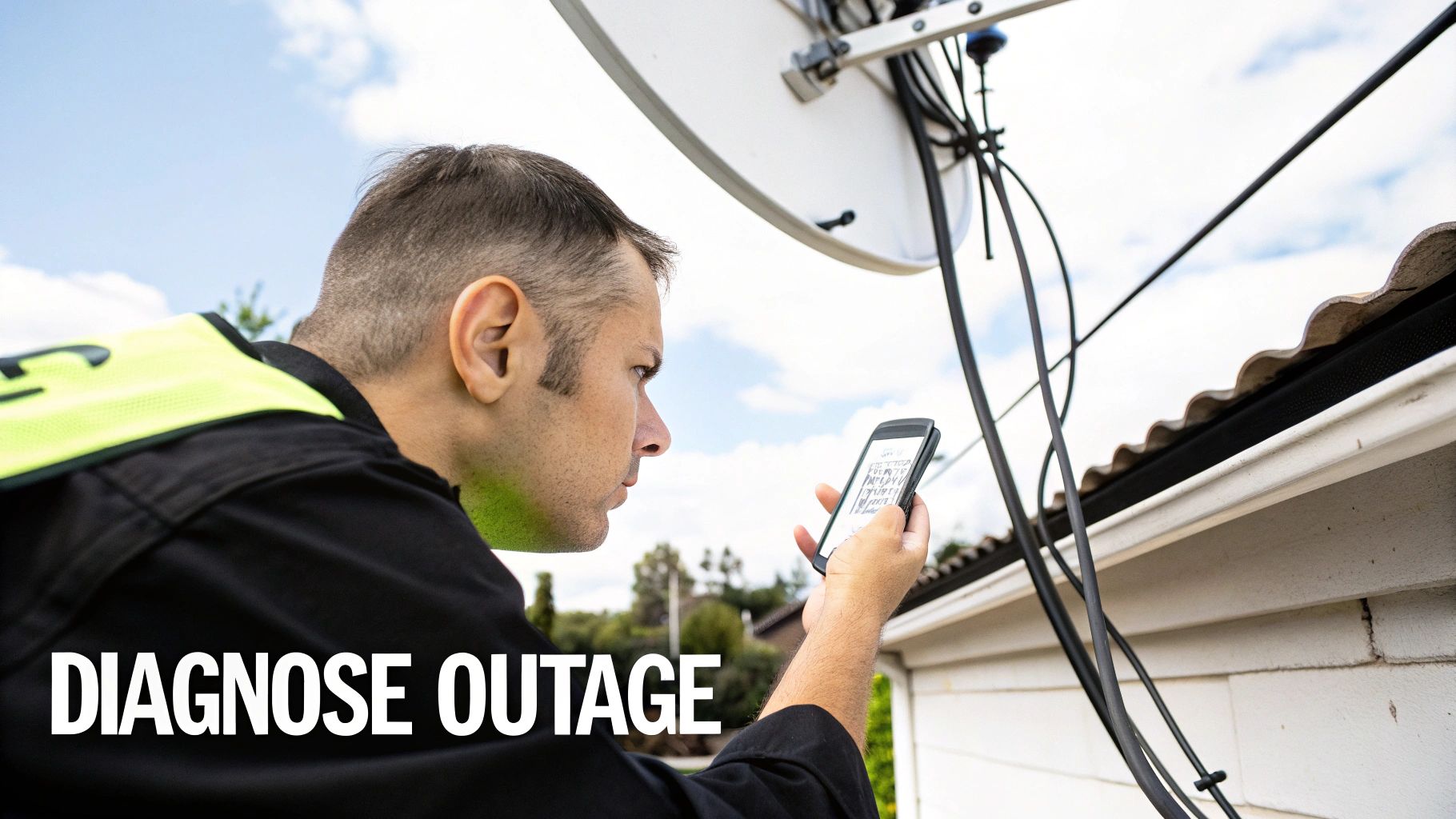
When your connection drops, the first question is always the same: is the fault on my site, or is it a widespread Starlink outage NZ is experiencing? A methodical approach saves time and frustration, allowing you to switch to your backup systems immediately.
On-Site Physical Checks
Before diving into software, conduct these simple but essential hardware checks. It’s surprising how often the issue is physical.
- Power and Cables: Check that all cables are securely plugged in at the wall, the router, and the dish itself. A loose connection is a common and easily fixed culprit.
- Dish Visibility: Your Starlink dish needs a clear, unobstructed view of the sky. Has anything changed? Look for new obstructions like tree growth, scaffolding, or even a heavy build-up of snow or grime on the dish face.
If the physical setup is sound, your next step is the Starlink app.
Using the Starlink App for Diagnosis
The Starlink app on your smartphone is your most powerful diagnostic tool. Open it and check for any status alerts on the home screen. Starlink is effective at flagging known network problems or issues specific to your terminal.
The app provides real-time data to help you determine if the problem is local or network-wide. Check the 'Outages' log; frequent, short dropouts can indicate a minor obstruction, while a single, extended outage suggests a more significant network event.
The 'Obstructions' map is also invaluable, showing any areas of the sky your dish can't see. For a deeper understanding of how the system communicates, our guide on how Starlink works in NZ is an excellent resource.
Confirming a Widespread Outage
If your hardware checks out and the app shows no local faults, the problem is likely external. To confirm if there is a wider Starlink outage in NZ, check a third-party status website like Downdetector. These sites aggregate user reports in real-time, so a sudden spike is a clear indicator of a major network failure.
Following these steps allows you to quickly diagnose the problem, stop wasting time on an external issue, and immediately activate your backup communication plan to keep your operation running.
The Real Cost of Downtime for NZ Operations
A Starlink outage in NZ has immediate and expensive consequences for businesses operating in remote or challenging environments. The difference between a prepared and an unprepared operation becomes painfully clear the moment that primary connection vanishes.
These aren't just hypotheticals. They are the real-world impacts of relying on a single point of connection. A forestry crew cut off from their safety check-in system, a construction site where digital plans become inaccessible, or a fishing vessel losing critical weather data—these events carry significant financial and safety costs.
Beyond Lost Productivity: A Domino Effect
The financial impact of an outage extends far beyond paying staff who cannot work. It triggers a cascade of operational problems that can damage your business.
- Safety Risks & Compliance Breaches: The most critical cost is the risk to your team. A lone worker unable to call for help is a worst-case scenario. Under the Health and Safety at Work Act 2015, ensuring reliable communication for remote staff is a legal obligation. A communication failure isn't just an operational problem; it can be a serious compliance breach investigated by WorkSafe New Zealand.
- Project Delays and Penalties: Every hour of downtime on a construction site or in a manufacturing plant pushes deadlines out. This can lead to contractual penalties and damage your professional reputation.
- Loss of Client Confidence: When customers cannot reach you or your services are unavailable, their trust in your reliability evaporates. In a competitive market, rebuilding that confidence is a slow and difficult process.
To manage these risks, a robust business continuity plan template that specifically addresses communication failure is essential. Understanding the true cost of an outage frames the investment in a backup system not as an expense, but as critical business insurance. For more on this, check our detailed breakdown of Starlink costs for NZ businesses.
Building a Resilient Communications Strategy
A Starlink outage in NZ should not mean your entire operation stops. The professional standard is not hope; it's a multi-layered communication strategy that guarantees connectivity for your team, no matter what.
This is about intelligently backing up Starlink, not replacing it. True resilience comes from having independent, parallel communication systems ready to take over the moment your primary internet fails. This proactive approach turns a potential crisis into a manageable event.
This decision tree illustrates the stark difference in outcomes between a prepared and an unprepared team during an outage.
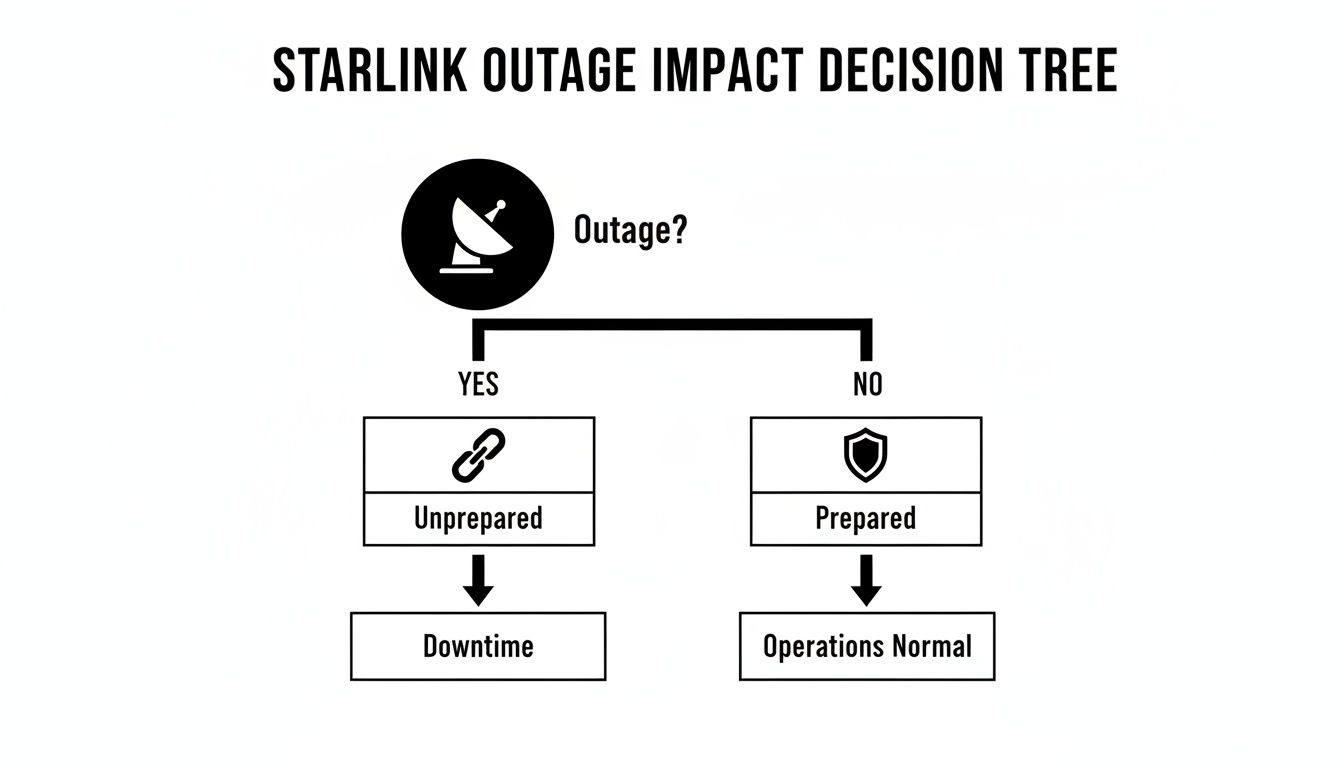
The insight is simple but powerful: preparation is the only way to maintain operational continuity during an internet disruption.
Your Multi-Layered Communications Plan
Think of your communications in layers, like a safety net. Starlink is your high-speed data connection. When it fails, you need alternative routes for essential traffic.
A robust strategy for a professional NZ business often includes:
- Primary Layer (High-Speed Data): Starlink for cloud-based software, video calls, and large file transfers.
- Secondary Layer (Team Voice Comms): Professional two-way radios (UHF/VHF) from trusted brands like Tait, Hytera, or Motorola. This is your guaranteed voice lifeline, completely independent of internet or cellular networks. It is ideal for on-site coordination.
- Ultimate Fail-safe (Global Voice & Messaging): Dedicated satellite devices from providers like Iridium or Inmarsat. This layer provides true off-grid reliability for critical calls or messages from anywhere in New Zealand, anytime.
The value of this approach was proven during recent extreme weather events. One NZ reported its Starlink-powered direct-to-cell service saw a 300% surge in text messages as traditional networks collapsed. This highlights the critical role satellite backups play for emergency response and rural contractors when storms take out local infrastructure. You can read more about these findings on telecoms.com.
Comparing Backup Communication Options
Choosing the right backup tools depends on your specific operational needs, environment, and risk profile. What works for a construction site in Auckland may not suit a fishing vessel off the West Coast.
This table breaks down the most effective backup solutions for NZ businesses.
Starlink Backup Communication Options Compared
| Technology | Best Use Case | Pros | Cons |
|---|---|---|---|
| PoC Radio | Nationwide team coordination where cellular coverage is reliable. | Uses existing 3G/4G networks for wide-area push-to-talk; GPS tracking. | Dependent on cellular service; fails in a mobile blackspot. |
| UHF/VHF Radio | On-site team communication (construction, forestry, events). | Independent of ALL external networks; rugged, instant, and reliable. | Range is limited by terrain; requires RSM licensing. |
| Satellite Phone | Critical voice/text from any remote location. | True global coverage; works when all other networks are down. | Higher call costs; not designed for high-speed data. |
| PLB / InReach | Lone worker safety and SOS distress signals. | Dedicated global rescue network for life-threatening emergencies. | One-way emergency signal only (PLB) or limited messaging (InReach). |
The strongest strategy often combines these technologies. For example, a forestry company might use UHF radios for daily on-site operations and keep an Iridium satellite phone in the supervisor's vehicle for emergency check-ins. This ensures every communication vulnerability is covered.
Why Mobile Systems is Your Partner in Reliability
Choosing the right backup solution for a Starlink outage in NZ is not about buying a product from a catalogue. It's about partnering with a specialist who understands the unique pressures of your industry and the reality of New Zealand's demanding conditions.
That is the Mobile Systems difference. We are not a faceless online seller. We are a 100% NZ-owned and operated company based in Mount Maunganui, and for nearly two decades, we have been the trusted communications partner for Kiwi businesses.
We Provide a Complete Solution, Not Just a Box
When you work with Mobile Systems, you are investing in a complete communication reliability solution that is guaranteed to work when you need it most. Our decades of hands-on experience mean we provide the critical services that transform equipment into a bulletproof strategy.
Here’s what we deliver:
- Expert Programming & Licensing: We ensure your radios are programmed correctly for your specific operation and are fully compliant with Radio Spectrum Management (RSM) regulations. We handle the licensing for you.
- Professional On-Site Installation: Our mobile installation fleet comes to you, providing expert on-site fitting for vehicles, machinery, and base stations to guarantee optimal performance from day one.
- Long-Term Service & Support: We are your long-term partner. We provide the maintenance, repairs, and aftercare to ensure your communication equipment is always ready for action.
You can get a clear overview of the comprehensive services we offer to businesses right across New Zealand on our website.
Local Expertise for Local Conditions
Based in the Bay of Plenty, our team has spent years on the ground with forestry crews in the Central Plateau, maritime operators around the Coromandel, and construction teams across the Waikato. We know what works—and what doesn’t—in the real world of NZ industry. We understand the terrain, the weather, and the absolute requirement for communication systems that are tough, dependable, and simple to use under pressure.
Choosing Mobile Systems means choosing a partner genuinely invested in your operational continuity and the safety of your people. We don’t just ship boxes; we build long-term relationships based on trust, expert advice, and practical, on-the-ground support.
We take the time to understand your operation and design a custom solution that fits seamlessly. For serious commercial operators who cannot afford to take chances with their communications, we are the safe, dependable choice.
If you’re ready to build a communication strategy that never lets you down, we’re here to help. Speak to a communications specialist today and get expert, NZ-based guidance tailored to your business.
FAQ: Your Questions About Starlink Outages Answered
Here are straight answers to the most common questions we hear from Kiwi business owners about preparing for a Starlink outage in NZ.
How often do Starlink outages happen in New Zealand?
While Starlink is generally reliable, outages are an operational reality. They are not a daily occurrence, but they happen.
Minor interruptions are often caused by severe weather like heavy rain, a phenomenon known as 'rain fade'. More significant outages are typically due to global software or network faults. These are less frequent but can last several hours, impacting thousands of users at once. Planning for these larger events is the most critical part of building a resilient communication strategy.
What is the first thing my team should do during an outage?
The first step is diagnosis, not panic. The team should immediately check the official Starlink app using a mobile device with a cellular connection. The app will often display an alert if there’s a known network issue or a problem specific to your dish.
If the app shows no local faults, check a third-party status website like Downdetector to see if other users in New Zealand are reporting a widespread Starlink outage. This two-minute process stops your team from wasting time trying to fix an external problem.
Is a satellite phone a good enough backup?
A satellite phone is an outstanding backup for critical voice and text communication, but it is not a complete business continuity solution by itself. It is an essential lifeline for remote teams and lone workers who need to make an emergency call when all other networks are down.
However, a satellite phone will not run your cloud-based software, process online payments, or allow access to digital plans. It is a crucial part of a layered strategy for voice and messaging, not a replacement for your primary internet connection.
How do two-way radios work when the internet is down?
This is where professional two-way radio systems (UHF/VHF) are essential. Their key advantage is that they are completely independent of both the internet and cellular networks. Radios communicate directly with each other (device-to-device) or through a local repeater system powered by your own infrastructure.
This means that during a total Starlink outage in NZ, a cellular network failure, or even a power cut impacting public infrastructure, your two-way radio network will continue to operate flawlessly. For on-site team coordination in industries like construction, forestry, or traffic management, this independent reliability is non-negotiable.
Related posts

- June 19, 2026
Fall detection, no-motion sensors, and GPS - here's exactly how a man down alarm knows something's wrong, and how the...

- June 13, 2026
In 2024, New Zealand recorded 70 work-related fatalities and more than 209,000 injury claims. These statistics underscore the heavy responsibility...

- June 11, 2026
New Zealand's workplace fatality rate is 1.7 times higher than Australia's, a stark figure that highlights the urgent need for...