
A Kiwi Boater's Guide to Uniden Marine Radio Safety
The ultimate guide to choosing a Uniden marine radio in NZ. Compare fixed vs handheld models, understand DSC, and ensure your safety on the water.
When you're miles offshore and mobile reception is just a distant memory, how do you call for help? For any Kiwi boater, a reliable Uniden marine radio isn’t an optional gadget—it's arguably the most critical piece of safety gear on your vessel. Let's cut through the technical jargon and look at why Very High Frequency (VHF) radio is the absolute gold standard for staying connected when it matters most.
Your Lifeline on New Zealand's Unpredictable Waters
Anyone who has spent time on our waters knows how fast things can change. A glassy morning in the Bay of Islands can turn into a rough, squally afternoon in the blink of an eye. A routine fishing trip off the Coromandel can become a serious situation if your engine gives out. In these moments, your smartphone is often little more than a paperweight. So, how do you get that urgent weather update or let Coastguard know you’re in trouble?
This is exactly where a professional-grade VHF marine radio proves its worth. It operates completely independently of cell towers, giving you a direct, reliable link to help and vital information. It's the communication backbone for everyone who takes their safety seriously, from the weekend angler to the seasoned commercial skipper.
Why VHF is Non-Negotiable for Kiwi Boaters
A Uniden marine radio is so much more than a way to chat with other boats; it’s an integrated safety system. Unlike a mobile phone that connects you to one other person, a VHF broadcast is a one-to-many signal. That might not sound like a big deal, but in an emergency, it's everything.
A distress call made on the emergency Channel 16 is heard by every single vessel and shore station listening within range, including Coastguard New Zealand. In an instant, every boat nearby becomes a potential rescuer, massively increasing your chances of getting help, fast.
Your radio is your direct connection to:
- Emergency Services: Straight to Coastguard for immediate assistance.
- Other Vessels: Essential for coordinating movements in busy channels like the Marlborough Sounds or helping another boatie in need.
- Maritime Radio Updates: Receive continuous weather forecasts, navigational warnings, and local safety information.
- Shore-Based Contacts: Talk to marinas, port authorities, and other services on shore.
Setting the Scene for Safety
Across New Zealand's diverse and often challenging maritime environments—from agriculture and fishing to transport and tourism—solid communication is the bedrock of every safe operation. It allows teams to make smart decisions, react to changing conditions, and call for help effectively. Without it, your people are isolated and vulnerable.
Investing in a quality Uniden marine radio and learning how to use it properly is one of the most important steps you can take to protect yourself, your passengers, and your vessel. This guide will walk you through the essential features and models that have made Uniden a trusted choice for thousands of Kiwi boat owners and commercial operators.
Fixed vs Handheld VHF Radios: Choosing Your Onboard Comms
When it comes to your boat's comms, one of the first big decisions is whether to go for a permanent, fixed-mount radio or a portable handheld unit. Honestly, the right answer really boils down to your vessel, how you use it, and what level of safety and operational reliability you require.
While both have their place, for many Kiwi boaties and commercial teams, the ultimate setup is actually a combination of the two.
The biggest difference right off the bat is power. A handheld radio is capped at a maximum of 6 watts of transmit power. A fixed-mount unit, on the other hand, can broadcast a signal at up to 25 watts. That’s more than a four-fold jump in power, and it translates directly into a massive increase in range – something that’s absolutely critical when you’re a long way from shore.
Let's break down the practical differences to help you figure out what’s best for your operation.
The Powerhouse: Fixed-Mount Radios
A fixed-mount Uniden marine radio, like the ever-popular UM725GBT, is the heart and soul of any serious marine communication system. It’s professionally installed right into your dashboard or console, becoming a fully integrated part of your vessel’s electronics.
Its main game is power and range. Because it's wired directly to your boat's battery and hooked up to a large, externally mounted antenna, a fixed-mount unit gives you the strongest, most reliable signal you can possibly get. This is the gear that gives you the confidence to talk to shore stations and other boats miles away, even when the weather turns nasty.
Key Advantages of a Fixed-Mount Radio:
- Maximum Power and Range: Pushing out 25 watts, it ensures your call gets through when it matters most, cutting through the noise and reaching distant receivers. This is mission-critical for lone workers and remote field teams.
- Superior Antenna Performance: A large, high-mounted antenna makes a world of difference for both sending and receiving, letting you hear faint signals and ensuring you come through loud and clear.
- Integration with Boat Systems: Many fixed models can connect to your boat's GPS and other NMEA 2000 gear, meaning they can automatically send your precise location in a DSC distress call, a key feature for Health & Safety compliance.
- Reliable Power: Running off the boat's main battery means you never have to stress about a handheld battery dying mid-shift or halfway through an urgent conversation. This reliability reduces downtime and improves safety.
Think of a fixed-mount radio as your boat’s command centre. It’s the most powerful, dependable link you have to the outside world, built to perform when conditions are at their worst.
The Go-Anywhere Option: Handheld Radios
A handheld VHF radio is all about portability and convenience. For smaller craft like tenders, kayaks, or trailer boats without a battery system, a handheld is often the main (or only) form of communication. They’re compact, waterproof, and always ready to go at a moment's notice.
But even on bigger boats with a top-of-the-line fixed unit, a handheld is a non-negotiable piece of backup and safety gear. If you ever had to abandon ship, a handheld in your grab bag is your lifeline. Need to talk to the skipper on the helm while you're up on the bow? A handheld is the perfect tool for the job, improving operational efficiency.
Key Advantages of a Handheld Radio:
- Ultimate Portability: Chuck it in the tender, clip it to your lifejacket, or stash it in the emergency grab bag.
- Self-Contained Power: It runs on its own rechargeable battery, totally independent of your boat’s electrical system, making it a crucial backup.
- Ideal for Small Vessels: It provides mission-critical comms for boats that don't have the space or power for a fixed installation.
- Excellent Backup: If your boat loses all power, your handheld will still be good to go, giving you a critical layer of redundancy and meeting lone worker safety requirements.
For most boat owners in New Zealand, the question isn't really "which one should I get?" but "why not have both?" A powerful fixed-mount Uniden marine radio acts as your primary communication hub, while a tough handheld provides that crucial backup, versatility, and on-the-go safety. This two-pronged approach means you’re ready for just about anything our unpredictable waters can throw at you.
Understanding Lifesaving Tech: DSC, GPS, and AIS
Today's Uniden marine radios are a world away from the crackly old sets of the past. They're not just for chatting; they are sophisticated digital safety hubs designed to be your lifeline when things go wrong. To really get the most out of them, you need to get your head around three key pieces of technology: Digital Selective Calling (DSC), integrated Global Positioning System (GPS), and Automatic Identification System (AIS).
When these features work together, they transform your radio from a simple communication tool into a proactive safety system. Think of DSC as the modern, digital equivalent of a flare gun, only a whole lot smarter and more effective.
Digital Selective Calling: The One-Button Distress Call
When you're in a genuine emergency, the last thing you want to be doing is fumbling with channels, trying to remember your coordinates, and hoping someone can hear your panicked voice call. DSC cuts through all that stress. Activate the distress function on a DSC-equipped Uniden marine radio, and it instantly fires off a digital mayday on the dedicated emergency channel (Channel 70).
This isn't a voice call. It's a tightly packed burst of data containing the critical info rescuers need:
- Your Unique ID: It sends your vessel’s nine-digit Maritime Mobile Service Identity (MMSI) number, so they know exactly who you are.
- Your Exact Location: With a built-in GPS, it broadcasts your precise coordinates.
- The Nature of Distress (Optional): Many radios let you specify the emergency, like fire, flooding, or man overboard.
This digital signal is automatically picked up by Coastguard stations and other DSC-equipped vessels in range. It sounds an alarm on their end and puts your details right on their screen. It takes the guesswork out of a rescue and ensures help is sent to the right place, even if you can't get a single word out.
Integrated GPS: The Key to Being Found
A distress call is useless if rescuers don't know where to go. That’s why a built-in GPS is an absolute must-have feature for any modern marine radio. This receiver constantly tracks your boat's position, feeding that critical location data to the DSC function.
Without GPS data, a DSC alert only tells rescuers who is in trouble, not where. The integration of GPS is what makes the system so powerful, automatically providing your precise latitude and longitude with every distress call.
This infographic breaks down the two main flavours of VHF marine radios you'll come across.
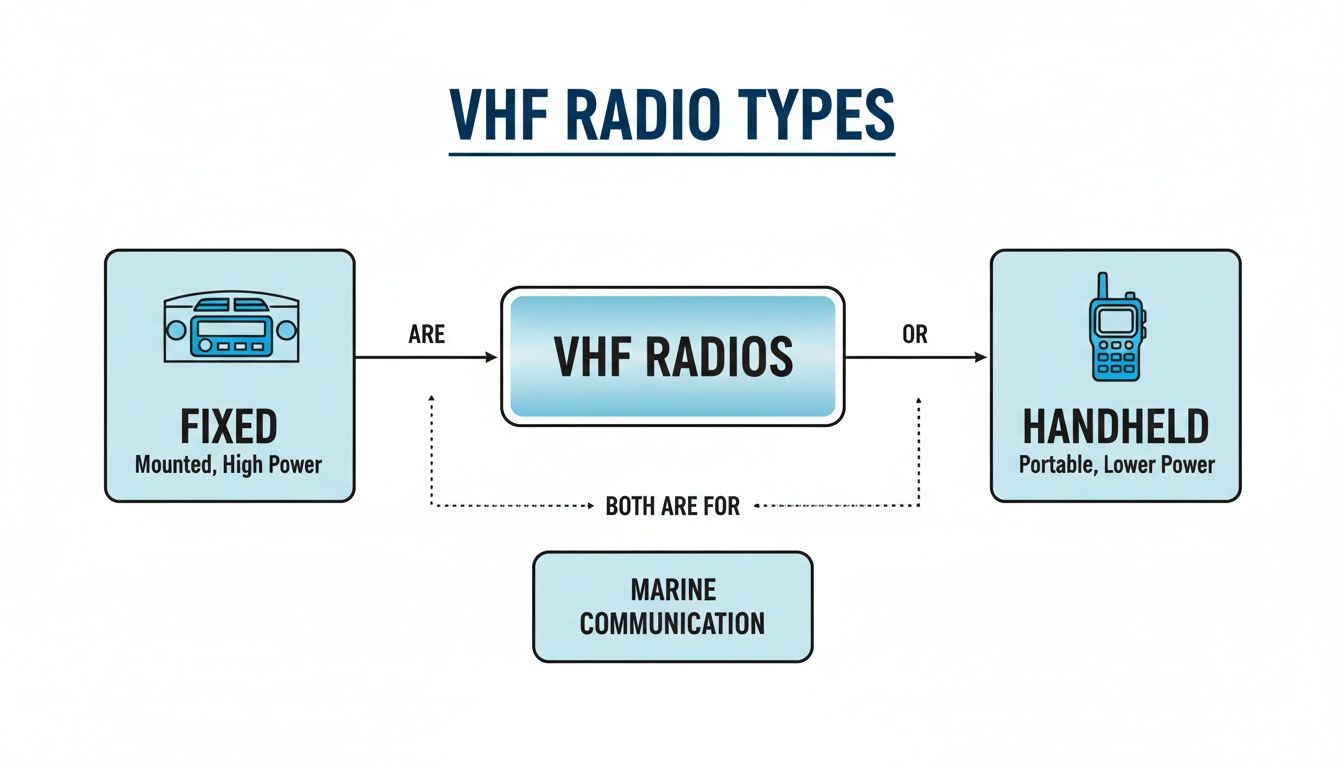
As you can see, the fixed-mount units are your high-power workhorses, while handhelds give you that vital portability and serve as a brilliant backup.
While the GPS in your radio is fantastic for emergencies, you might also want to look into the best marine GPS systems for dedicated navigation. And for those after a powerful all-in-one portable solution, check out our write-up on the Garmin GPSMAP 86i Marine Handheld with inReach.
AIS for Collision Avoidance
If DSC and GPS are about getting you found during an emergency, AIS is all about stopping one from happening in the first place. Higher-end Uniden marine radio models, like the UM725 series, often include an AIS receiver, which is a massive boost to your situational awareness.
The system lets you "see" other large vessels on your radio's screen or a connected chartplotter, even if they're miles away or around a headland. It picks up transmissions from other AIS-equipped boats, which broadcast their:
- Name and call sign
- Position
- Course and speed
For anyone navigating busy shipping lanes like the Hauraki Gulf, Cook Strait, or the approaches to Tauranga Harbour, this is an absolute game-changer. It helps you spot big ships long before they become a visual hazard, allowing you to make smarter, safer navigation choices, especially in fog, rain, or at night. It seriously reduces the risk of a collision.
Matching a Uniden Marine Radio to Your Vessel
Picking the right Uniden marine radio isn't a case of finding the single 'best' model on the market. It’s about finding the best fit for your boat and the kind of adventures you have on it. The communication needs of a weekend fisherman in a 5-metre tinny are worlds away from a commercial charter skipper running a 15-metre launch offshore.
This guide cuts through the noise and matches popular Uniden models to the Kiwis who use them every day.
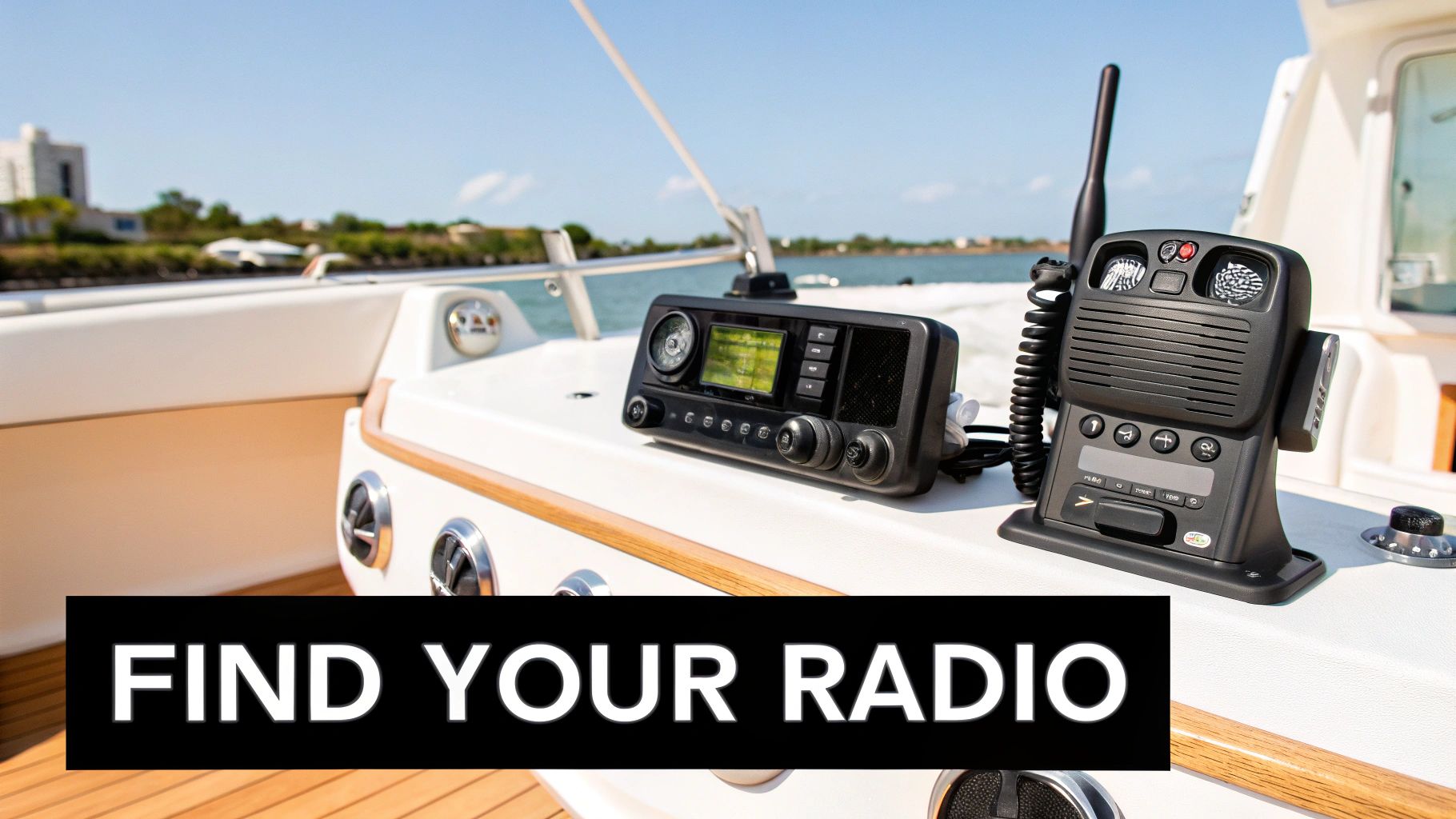
We'll skip the jargon and focus on what really counts out on the water—things like solid waterproof ratings that survive an accidental dunking, bright displays you can actually read in the harsh New Zealand sun, and the right connections to talk to your other electronics.
For the Small Trailer Boat and Tender
If you’re launching the trailer boat for a day's fishing or zipping from the mooring in a tender, a handheld VHF is your lifeline. It's a completely self-contained, grab-and-go bit of kit that delivers essential communication.
The Uniden MHS135UV is a real standout here. It's much more than just a radio; think of it as a rugged, go-anywhere safety tool.
- It Floats: This radio is submersible and designed to float if you drop it over the side. In a small, open boat where things are bound to get wet, that’s a massive plus.
- Self-Sufficient Power: With up to 6 watts of transmit power and a rechargeable battery, it works reliably without being wired into your boat’s power system.
- Perfect for NZ Boating: Its portability is brilliant for moving between your main boat and a smaller tender, ensuring you're never without a way to call for help or check in.
For the All-Round Kiwi Recreational Boater
Most Kiwi boaties own a vessel somewhere between 5 and 10 metres. For this crowd, a fixed-mount VHF is the absolute cornerstone of their safety gear, offering the power and reliability you need for coastal cruising and chasing fish offshore.
The Uniden UM355VHF is a classic workhorse that fits this role perfectly. It’s compact enough for a crowded dash but still packs all the features you genuinely need for safe boating.
- DSC is a Must-Have: Its DSC capability gives you a one-touch distress button—a non-negotiable safety feature for any boat heading out of sight of land.
- Serious Range: The full 25 watts of transmission power gives you excellent range, making sure your call will reach Coastguard and other boats when you're out wide.
- Built for Kiwi Conditions: This is a tough, affordable unit that ticks all the boxes, from getting the latest marine weather forecast to coordinating with your mates on where the fish are biting.
For the Serious Offshore and Commercial Skipper
When your boat is your office or your adventures take you far over the horizon, you need more than just a radio. You need a powerful communication hub that integrates seamlessly with your entire navigation setup.
The Uniden UM725GBT is the top-shelf solution for this demanding environment. It’s a complete VHF and GPS combo designed for skippers who can’t afford to compromise on safety or performance.
- A Truly Connected Helm: It has an integrated GPS and NMEA 2000 connectivity. This means it can show your position and share data with your chartplotter, fishfinder, and other electronics.
- Power and Clarity: The big, bright LCD is easy to read at a glance, and the built-in 2-way 25W loud hailer is invaluable for talking to other boats or crew on deck when the engine and wind are roaring.
- Offshore Reliability: Its robust build and advanced features deliver the situational awareness and reliability you need for navigating busy channels, bad weather, and remote coastlines.
To make the choice even clearer, here’s a quick comparison of these three popular models.
Uniden Marine Radio Model Comparison
| Model Feature | Uniden UM355VHF | Uniden MHS135UV | Uniden UM725GBT |
|---|---|---|---|
| Best For | All-round recreational boats (5-10m) | Tenders, small trailer boats, kayaks | Offshore, commercial, serious fishers |
| Type | Fixed Mount | Handheld | Fixed Mount |
| Max Power | 25 Watt | 6 Watt | 25 Watt |
| DSC | Yes | No | Yes |
| Waterproof | IPX4 | IPX7 (Submersible & Floating) | IPX7 |
| GPS Built-in | No | No | Yes |
| NMEA 2000 | No | No | Yes |
| Loud Hailer | No | No | Yes (25W) |
Each radio is designed with a specific boater in mind. By understanding how you use your vessel, you can easily find the Uniden that offers the right mix of power, features, and durability for your needs on the water.
Choosing the right radio means investing in the right level of safety for your adventures. By matching the model to your vessel, you ensure the features you pay for are the ones you'll actually rely on.
Still weighing up your options? You can find out more about another great model in our Uniden VHF Radio product focus article. Of course, the team at Mobile Systems is always here to help you assess your needs and recommend the perfect Uniden model to keep you safe and connected on New Zealand waters.
NZ Compliance, Installation, and Licensing Explained
Owning a powerful piece of safety kit like a Uniden marine radio comes with a few responsibilities. Getting the compliance side of things sorted isn't just about ticking boxes; it's about making sure your radio will actually do its job when you need it most. Let's break down the key rules for New Zealand waters in plain English, so you can get out there with total confidence.
These rules exist for a good reason—to keep our maritime communication network clear, reliable, and effective, especially when things go wrong. Following them means your vessel is a responsible and safe part of our shared marine environment.
Your MMSI Number: The Key to DSC
If you've invested in a modern DSC-equipped radio, its most powerful safety feature is essentially locked until you program it with a Maritime Mobile Service Identity (MMSI) number.
Think of an MMSI as your boat's unique phone number for the maritime world. This nine-digit code is what identifies your vessel during a DSC distress call. Without it, the "red button" distress function can't tell rescuers who you are. Getting one is straightforward but absolutely essential.
- Who issues it? In New Zealand, MMSI numbers are managed by Radio Spectrum Management (RSM).
- How do you get one? You can apply for an MMSI online through the RSM website. It's a simple process that links your vessel's details to this unique code.
- Why is it so critical? When you hit that DSC distress button, your radio instantly transmits this number along with your GPS coordinates. Coastguard immediately knows your vessel's name, size, and emergency contact details, saving precious time when every second counts.
Once you have your MMSI, it needs to be programmed into your radio. It's vital to get this right—you often only get one shot at entering it yourself before the unit needs a technician to reset it.
A DSC radio without a programmed MMSI is like having a parachute with no ripcord. It has the potential to save your life, but only if you take that final, critical step to make it functional. We can program your MMSI for you at Mobile Systems, ensuring it's done correctly from the start.
The Non-Negotiable: Professional Installation
It can be tempting to save a few dollars and install your new fixed-mount radio yourself, but this is one job where cutting corners can have serious, even dangerous, consequences. Hands down, the most common reason for poor VHF radio performance—or outright failure—is a dodgy installation.
A professional technician from Mobile Systems does more than just connect a few wires. We ensure every part of your system works in harmony for peak performance and reliability.
This includes:
- Correct Antenna Placement: Where you put your antenna is everything. It needs to be mounted as high as possible, well clear of other electronics and metal objects that could cause interference. This is the secret to getting the best possible transmission range.
- Rock-Solid Power Connections: A radio that loses power in a rough sea is completely useless. We wire your radio directly to a reliable power source using waterproof, corrosion-resistant connections that won’t let you down when you need them most.
- Waterproofing and Cable Routing: Every exterior cable entry point must be perfectly sealed to stop water getting in. We also route all cables carefully to make sure they won't get pinched, chafed, or damaged over time.
On the water in New Zealand, reliable gear is everything. Investing in a professional installation ensures your communications are dependable, your team is safe, and your operation remains compliant.
Operator Certification and Licensing
Finally, to legally operate a VHF marine radio in New Zealand, you need more than just the right gear. You must hold a Maritime VHF Radio Operator Certificate.
This certification proves you know the correct procedures for making calls, understand what to do in an emergency, and can use your radio effectively and responsibly. If you’re not sure where to start, we've got a great resource to help you out: how to get your VHF Operator Certificate in NZ. It's a vital part of being a safe, competent skipper.
Why Work with Mobile Systems for Your Marine Radio?
Choosing the right Uniden marine radio is a great first step, but it’s really only half the story when it comes to genuine safety and peace of mind on the water. A radio is only as reliable as its installation, programming, and the support behind it. This is where a specialist communications provider makes all the difference, and it’s precisely where Mobile Systems stands out.
We aren't just a retailer shipping boxes from a warehouse. We’re a team of hands-on communication experts who live and breathe this technology. Based right here in Mount Maunganui, we've spent nearly two decades helping Kiwi businesses and boaters stay safe in our unique and often demanding maritime conditions.
Local Expertise You Can Trust
As a 100% New Zealand-owned and operated business, our reputation is built on giving practical, honest advice. We know the challenges of boating in the Bay of Plenty, navigating the Coromandel coast, or running a commercial fleet out of any local port. Our recommendations are grounded in real-world experience, not just a spec sheet.
When you work with us, you’re not just buying a product. You’re getting an end-to-end solution designed to perform flawlessly when you need it most.
Our commitment to your safety includes:
- Expert Advice: We’ll help you pick the exact Uniden model that fits your vessel and operational needs, making sure you don't overspend on features you don’t need or miss out on ones you do.
- Professional Installation: Our mobile technicians come to you. We provide meticulous on-site installation that guarantees the best antenna placement, secure power connections, and waterproof integrity. A professional installation is the foundation of a reliable radio system.
- Correct Programming & Licensing Support: We handle the critical job of programming your MMSI number and setting up your channels correctly. We can also assist with RSM licensing to ensure your fleet is fully compliant.
The Mobile Systems Difference
Unlike online stores or electronics retailers with limited knowledge, our focus is specialised and our support is personal. We're all about building long-term relationships with our clients, providing the aftercare and technical support that keeps your gear in top condition, season after season.
Choosing a communications partner is as important as choosing the radio itself. At Mobile Systems, we provide the expert installation and local support that turns a quality Uniden radio into a truly dependable lifeline for you and your team.
Our dedicated team and mobile support fleet are ready to help you across the Bay of Plenty, Coromandel, and beyond. We are your local partners in marine safety, committed to delivering the reliability and confidence you deserve every time you leave the shore. For a tailored solution, speak to one of our communication specialists today.
Common Questions About Marine Radios
Getting your head around marine electronics can feel a bit daunting. We get it. To help clear things up, we've put together some straight answers to the questions we hear most often from fellow Kiwi boaties.
Do I Need a Licence to Use a VHF Radio in New Zealand?
Yes, you absolutely do. To legally use a VHF marine radio in New Zealand, you need to hold a Maritime VHF Radio Operator Certificate. This isn't just a piece of paper; it proves you know the right way to use the radio, especially when things go wrong.
On top of that, if you want to use the life-saving Digital Selective Calling (DSC) features, your boat needs its own Maritime Mobile Service Identity (MMSI) number. This is a unique ID for your vessel, issued by Radio Spectrum Management (RSM), and it's what makes DSC work.
What's the Real-World Range of a VHF Marine Radio?
VHF is what we call 'line-of-sight', which means its range is limited by the curve of the earth and anything in the way. In the real world, how far you can talk depends on a few things:
- Fixed-Mount Radios: A good 25-watt radio, hooked up to a quality antenna that's mounted properly, should give you a solid 20-25 nautical miles (that's about 35-45 km) of range to another boat or a coastal station.
- Handheld Radios: These are much less powerful (topping out at 6 watts) and have a small built-in antenna. Expect a much shorter range, usually around 3-5 nautical miles (5-9 km), which is perfect for tender-to-boat comms.
The single biggest thing you can do to improve your range is to get your antenna up high. The higher it is, the further the signal can "see." Bad weather can also mess with your signal, so keep that in mind.
Which VHF Channel Is for a General Yarn?
This is a big one. Channel 16 is the international channel for distress calls, safety messages, and hailing other boats. It must be kept clear for emergencies.
Think of it like this: you use Channel 16 to knock on the door, but you don't have the conversation in the doorway. Make your initial call, and as soon as they answer, move straight over to a working or 'chitchat' channel to talk. In New Zealand, common ones to use are 6, 8, 72, and 77.
Keeping Channel 16 clear isn’t just good manners—it’s a critical responsibility for every single boatie. Unnecessary chatter could easily block a genuine distress call and put lives on the line.
Can I Just Install a Fixed-Mount Marine Radio Myself?
You could, but we really wouldn't recommend it. A surprising number of radio failures we see come down to a dodgy installation.
Getting a professional to do the job means you can be sure of:
- Optimal Antenna Placement: Squeezing every last bit of range and clarity out of your signal.
- Secure, Waterproof Connections: Stopping corrosion in its tracks and making sure you have reliable power, even when it gets rough.
- Interference-Free Wiring: Running cables away from other electronics that could cause static or disrupt your radio's performance.
Putting a bit of money into a professional installation for your Uniden marine radio is the best way to guarantee it'll work perfectly when you need it most. It’s a small price for real peace of mind out on the water.
Related posts

- February 26, 2026
Learn portable pa system hire transactional service high New Zealand for clear communication at events and worksites.

- January 12, 2026
Is your team constantly battling scratchy signals and dropped conversations on site? The frustration of unreliable comms, the worry of...