
The Ultimate Guide to Body Worn Camera Solutions in New Zealand
Discover how a body worn camera can improve safety, accountability, and efficiency for your NZ business. Get expert advice on choosing the right solution.
How do you protect your team during tense, on-the-job interactions? And what about proving a job was completed to specification, or settling a client dispute without it spiralling into a messy "he said, she said" argument?
A body worn camera is more than just a gadget that records video; it's your impartial 'digital witness'. Think of it as a proactive tool for backing up your team's health and safety, de-escalating confrontations, and ensuring complete transparency.
Why Your New Zealand Team Needs a Digital Witness
Today's work environments across New Zealand are more demanding than ever. Keeping your people and your business safe is absolutely non-negotiable. It doesn’t matter if your crew is on a remote forestry block in the central North Island, a hectic civil construction site in Auckland, or managing logistics in Christchurch—unpredictable situations are part of the job.
So, how do you give them a tool that doesn't just record what happened, but actively helps prevent incidents from escalating in the first place?
A professional body worn camera adds a powerful layer of protection. Just having it visible often encourages everyone involved to be more professional and civil. It’s a well-documented phenomenon: when people know they are being recorded, their behaviour tends to improve.
Taking the Edge Off and Keeping Everyone Safe
At its core, a body camera captures an unbiased, first-person perspective of events exactly as they unfold. This footage quickly becomes an indispensable asset for several key reasons:
- De-escalation: The simple awareness of a camera running can calm tense situations, lowering the risk of aggression or verbal abuse.
- Evidence Integrity: It provides clear, undeniable proof for incident reports, performance reviews, or resolving customer complaints.
- Worker Protection: It shields your team from false accusations and creates a clear record showing they acted professionally and followed procedure.
We've seen this "civilising effect" proven time and again. An international analysis showed that when officers wore body cameras, assaults or resistance against them dropped by an average of 15.9 percent. You can read more about these findings from the NZ Police Association. It's a clear example of how simply recording an interaction can change its entire dynamic for the better.
This technology is empowering workers right across New Zealand's key sectors—from transport and security guards to lone workers in forestry and civil construction. It’s not about watching over their shoulder; it’s about creating a safer, more accountable work environment where a clear and accurate record protects everyone.
How a Modern Body Worn Camera Actually Works
First things first, let's clear up a common misconception. When we talk about a professional body worn camera, we are not talking about the flimsy consumer gadgets you might find online or in electronics stores. A true Body Worn Camera (BWC) is a purpose-built, ruggedised eyewitness designed for the harsh realities of New Zealand worksites.
Think of it as much more than just a camera. It's a dedicated safety and accountability tool that captures a clear, first-person view of events exactly as they unfold. The goal isn’t just to hit 'record'; it’s to create an undeniable digital record that protects both your staff and your business.
At their heart, these devices are engineered for simplicity, especially under pressure. They aren't meant to be complicated video cameras. They are integrated safety systems, with many modern units combining high-definition video, crystal-clear audio, and precise GPS tracking data into a single, durable package.
More Than Just a Lens: A Unified Communication Tool
The most effective body cameras today are often unified communication devices. Many now integrate Push-to-Talk over Cellular (PoC) technology, which essentially turns the camera into a fully functional two way radio.
This is a complete game-changer for NZ businesses. It means one single device gives your team:
- Video and Audio Recording: Capturing irrefutable evidence of every interaction.
- GPS Tracking: Pinpointing the exact location of a team member or an unfolding incident.
- Instant Communication: Allowing staff to talk directly to supervisors and each other over the cellular network, just like a traditional radio.
This infographic neatly shows how the core functions of a body worn camera—safety, de-escalation, and transparency—all work together to create a powerful digital witness.
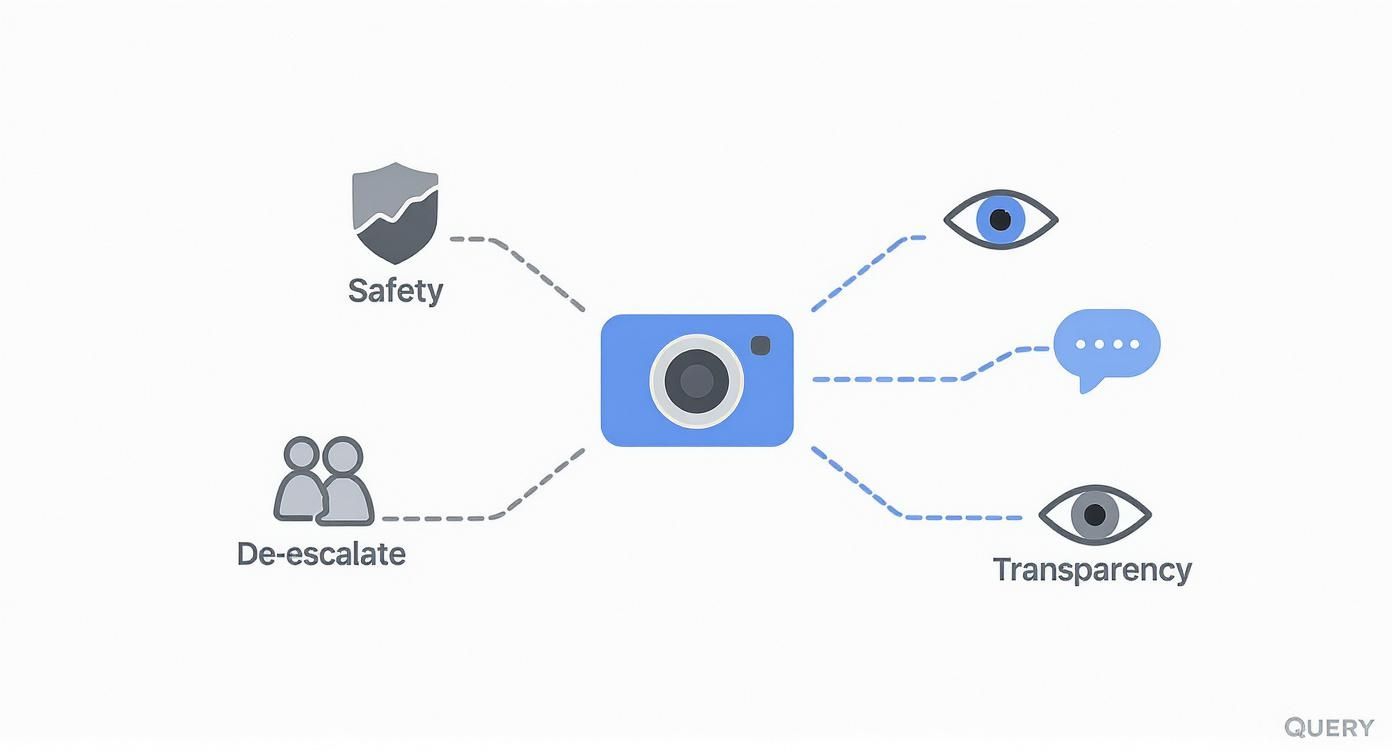
As you can see, the BWC acts as a central hub for improving accountability and boosting on-site safety through reliable recording and communication.
The Technology That Makes It All Work
A few key technologies really set professional body cameras apart from the rest. A wide-angle lens, for instance, is non-negotiable. It captures a broad field of view, ensuring no crucial details are missed off to the side. This is vital for recording the full context of a situation, not just a narrow, misleading snapshot.
Another CRITICAL feature is the pre-record buffer. Imagine a sudden incident; by the time an operator hits the record button, the first few vital seconds could already be gone. The pre-record function solves this by continuously capturing a rolling buffer of video (e.g., the last 30 seconds). When the record button is pressed, that preceding footage is automatically added to the start of the main recording. Nothing is missed.
Finally, secure data handling is paramount. At the end of a shift, when a camera is docked, its footage is automatically and securely offloaded to a central management system. The data is encrypted and stored with a clear chain of custody, ensuring its integrity is maintained for incident reports or even legal proceedings. To dig a bit deeper, you can learn what goes into the making of a best-in-class body camera and the design principles that ensure they're reliable when it counts.
Key Features That Deliver Real-World Business Benefits
Technical specs on a product sheet can feel abstract. What truly matters is how those features solve real-world problems for your New Zealand business. A professional body worn camera isn't just a recording device; it's a tool for tackling operational headaches, cutting risk, and building a more accountable workplace.
Let's break down the functions that actually deliver these tangible benefits.
Capturing the Full Story, Every Time
High-Definition Wide-Angle Lens A narrow field of view can be seriously misleading, easily cutting out crucial context during an incident. A quality wide-angle lens, on the other hand, captures a full, first-person perspective. It ensures you see the whole picture, not just a tiny slice of it, which is vital for accurately reviewing what really happened.
Pre-Record and Post-Record Buffers Picture this: a situation suddenly escalates. By the time your team member hits the record button, the critical moment that triggered the incident might have already passed.
The pre-record buffer is a non-negotiable feature that completely solves this. The camera is always passively recording a short loop of video (e.g., the last 30 seconds). When the button is pushed, that buffered footage is automatically stitched to the beginning of the official recording. Just like that, you’ve captured the lead-up.
A post-record buffer works similarly, keeping the camera rolling for a set time after the button is pressed again to capture the immediate aftermath.
Built for the Toughest NZ Workdays
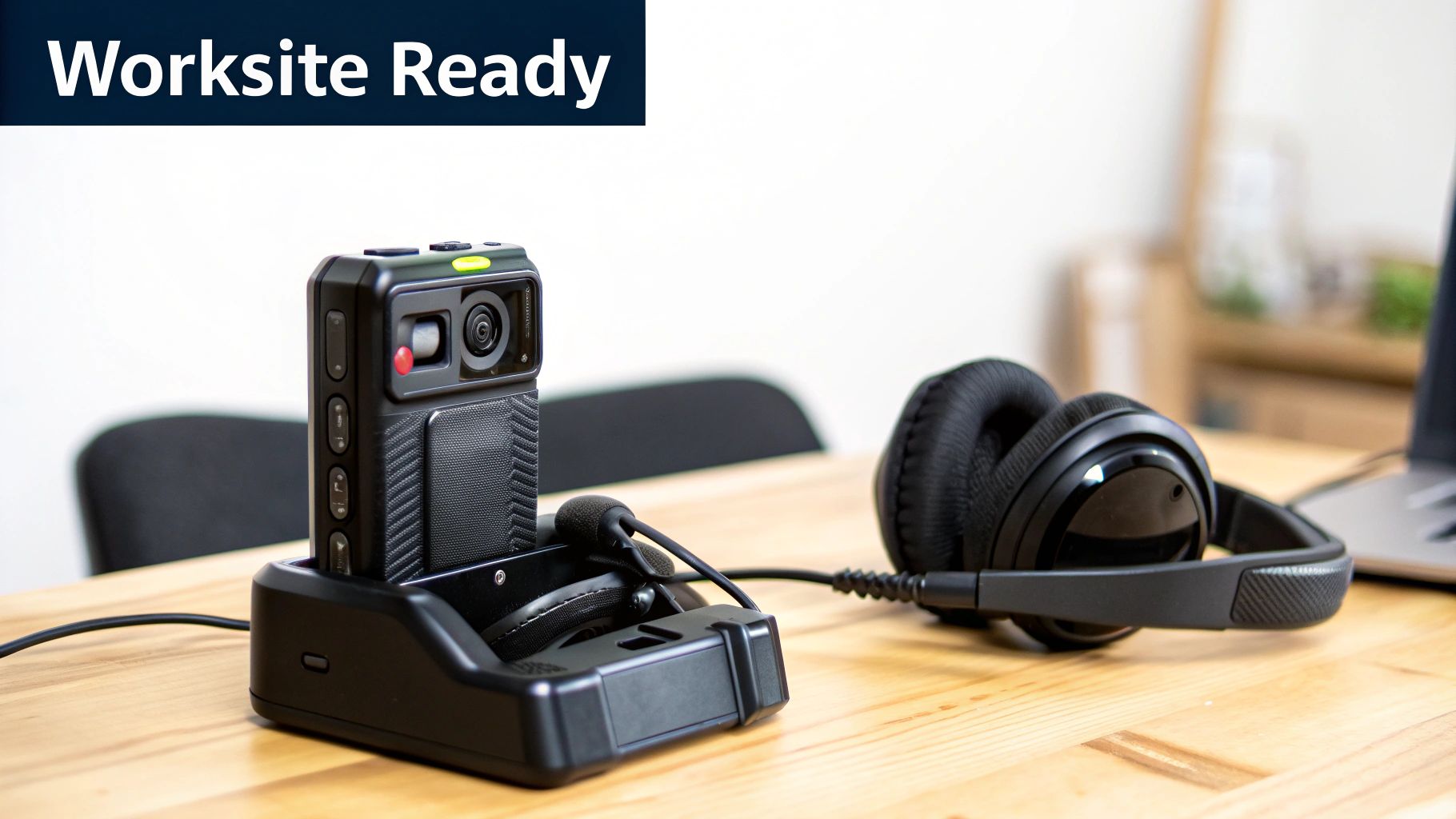
Shift-Long Battery Life A camera with a dead battery is just dead weight. Professional devices are built with high-capacity, often swappable, lithium batteries designed to easily last an entire 12-hour shift on a single charge from a multi-bay battery charger. This gives your team continuous coverage without them ever having to worry about finding a power outlet mid-job.
Rugged Durability and High IP Ratings Let’s be honest, New Zealand worksites can be brutal. From dusty construction sites to wet marine environments, your gear has to be tough enough to handle it all. That’s why you need to look for a high IP rating, like IP67 or IP68. This number is a certification that proves the device is waterproof and sealed against dust, ensuring it won't fail you, no matter the weather.
Essential Body Worn Camera Features for NZ Industries
This table breaks down key body worn camera features and explains their practical benefits for New Zealand workplaces, helping managers prioritise what matters most for their specific operational needs.
| Feature | What It Does | Why It Matters for Your Business |
|---|---|---|
| Pre-Record Buffer | Captures video from before the record button is pressed. | Provides crucial context for incidents, preventing "he said, she said" disputes and capturing the true cause of an event. |
| Long Battery Life | Ensures the device operates for a full 12+ hour shift. | Guarantees uninterrupted recording, eliminating reliability concerns and downtime during critical operations. |
| High IP Rating (IP67/68) | Seals the device against dust and water intrusion. | Gives you confidence that your investment will survive harsh NZ conditions, from dusty quarries to heavy rain on the wharf. |
| Secure Data Offload | Automatically transfers and encrypts footage when docked. | Protects evidence integrity, ensures compliance with NZ privacy laws, and creates an auditable chain of custody for all recordings. |
When you put these features together, you get far more than just a camera. You get a reliable system that strengthens accountability, helps resolve disputes in minutes, and fosters a genuine culture of safety and professionalism across your entire operation.
Body Worn Camera Applications Across NZ Industries
This is where the theory behind a body worn camera meets the hard reality of a Kiwi worksite. The real value of this technology shines when you see it solving the specific, everyday challenges your teams face on the ground.
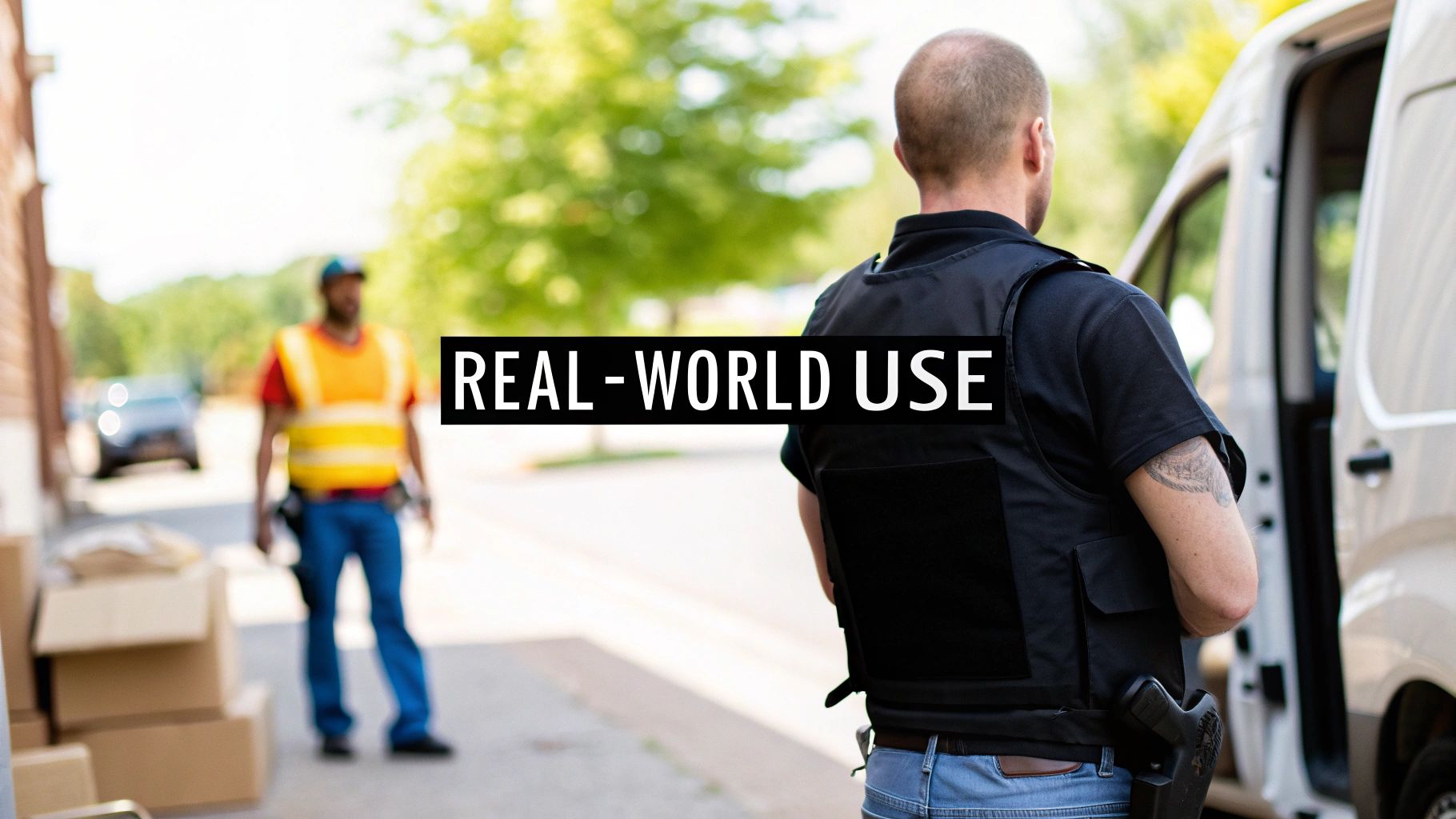
Whether it’s a chaotic construction site, a remote forestry road, or a busy freight depot, having an impartial digital witness is a powerful layer of protection and clarity.
Civil Construction and Infrastructure
The fast-moving nature of a construction site opens the door to all sorts of disputes, from phantom damage claims to serious safety breaches. A body worn camera gives your site supervisors and foremen a straightforward tool to create a rock-solid record of what actually happened.
- Pre-Work Site Scans: Before a hydro-excavation or earthworks begin, a supervisor can do a quick walk-through with the camera running. This captures a time-stamped video of existing conditions, instantly shutting down any bogus claims of damage to neighbouring properties or council infrastructure.
- Health and Safety Compliance: The footage provides a crystal-clear record for any incident investigation. Even better, it’s a brilliant training tool to show your crew exactly what went right—or wrong—on the job. It's an essential tool for robust health and safety management.
- Contractual Disputes: Need to prove a certain stage of the build was completed to specification on a specific date? The video evidence doesn't lie, protecting you from payment hold-ups and arguments.
At Mobile Systems, we provide end-to-end support for the civil construction sector, ensuring your devices are programmed, installed, and maintained to handle the toughest conditions.
Transport and Logistics
Your drivers are the public face of your company, but they’re often out there on their own, walking into unpredictable situations. A body worn camera, especially one integrated with PoC communication like the Motorola VB400, gives them the backup they need.
Think about a driver dealing with a difficult delivery where a customer is claiming goods arrived damaged. Instead of it turning into a messy "he said, she said" drama, the driver can simply record the interaction. This footage not only protects your employee from unfair accusations but also gives your business a clear, factual account to resolve the complaint quickly and professionally. Reliability here is key, and our solutions are built to last.
Security, Enforcement, and Lone Workers
For security guards, parking wardens, or any lone worker whose job involves dealing with the public, conflict is an ever-present risk. A visible body worn camera is a proven de-escalation tool.
The simple presence of a camera often changes people’s behaviour for the better, encouraging a more civil interaction.
When an incident does occur, that footage becomes the single source of truth. It provides unbiased, concrete evidence for internal reports, police follow-ups, or issuing trespass notices. It removes all guesswork. Devices with integrated GPS tracking and 'Man Down' alerts add another critical layer of safety, ensuring help can be dispatched to a worker's exact location in an emergency.
New Zealand's own Department of Corrections is a major adopter, having rolled out around 2,500 cameras to prison officers nationwide since 2021. It’s the single largest deployment of body camera tech in any NZ government agency, showing just how effective it is in high-stakes environments. Mobile Systems supports these critical sectors by providing robust, reliable devices and custom programming to meet their specific safety protocols.
Navigating NZ Compliance and Data Management
Rolling out a body worn camera solution in your New Zealand workplace involves much more than just handing out the gear. You absolutely need a solid plan for compliance, privacy, and data security to protect everyone involved—your staff, your business, and the public.
Get this part wrong, and you're setting yourself up for serious legal and operational headaches.
At its heart, any video you capture of people must be managed according to the New Zealand Privacy Act. That means you have a legal duty to be upfront about when and why you're recording.
Your Privacy and Policy Obligations
Before a single camera gets switched on, your organisation needs a clear, fair, and documented policy for their use. Think of this as your rulebook. It needs to cover everything from when staff are required to record, to how that footage is used and who gets to see it.
This isn't just a box-ticking exercise; it's fundamental to building and keeping trust. Your policy must be clearly explained to all staff so they know exactly what's expected of them. For a deeper dive into the legal side of things, check out our guide on privacy obligations regarding CCTV in New Zealand.
The Hidden Costs of Data Storage
One of the biggest surprises for many organisations is the sheer cost and complexity of managing all the video data. The price of the cameras themselves is often just the tip of the iceberg. The real challenge is storing, managing, and securing the mountains of video footage your team will generate every single day.
As seen in discussions around a potential NZ Police rollout, the initial hardware cost can be dwarfed by the ongoing operational expenses of data storage and management. These recurring costs are one of the biggest financial hurdles for any large-scale body camera project. You can learn more about these data storage challenges on RNZ.
When setting up your data handling procedures, it’s wise to look at established best practices for information security. A great starting point is understanding how to go about implementing robust Information Security Management Systems.
An effective body camera strategy must be sustainable. It requires a robust, secure, and cost-effective plan for data management from day one, ensuring evidence is protected and privacy is respected without breaking your budget.
This is where having a specialist partner really makes a difference. We can help you build a system that not only works perfectly on the front line but is also compliant, secure, and financially sustainable for the long haul.
Why Choose Mobile Systems Limited?
When you're investing in a critical health and safety tool like a body worn camera system, the equipment is only half the story. The support you get is just as important. The last thing you need when a problem arises is to be stuck dealing with an overseas call centre that has no idea what a real New Zealand worksite is like. You need a local expert who can get you sorted, fast.
That's where we come in. At Mobile Systems, we’re not just another supplier; we're your dedicated communications partner, right here on the ground.
Your Local On-the-Ground Experts
As a 100% New Zealand owned and operated business based in Mt Maunganui, we’ve spent nearly two decades helping Kiwi companies stay connected and safe. We’ve seen firsthand what works—and what doesn’t—in the demanding environments of civil construction, forestry, transport, and marine operations.
We provide true end-to-end solutions, which means we’re with you for the entire journey:
- Custom Coverage Planning: We don't do 'off-the-shelf'. We design communication systems that deliver solid performance where you actually work, from cellular networks to dedicated radio networks.
- Expert Programming: We configure every single device—from a Hytera PoC radio to a Tait TP9355—to meet your specific operational needs and internal policies before it even leaves our workshop.
- Mobile On-Site Support: Our dedicated service vehicles bring installation, maintenance, and troubleshooting directly to your site, keeping your downtime to an absolute minimum.
- Local Support When It Matters: When you call us, you're talking to an expert in the Bay of Plenty, not a call centre halfway around the world.
Choosing Mobile Systems means you're getting far more than just a box. You're getting a long-term partnership with a team that has the field experience to deliver a solution that is practical, compliant, and built to last. We’re here to provide local, expert support when it matters most.
Your Body Worn Camera Questions, Answered (FAQ)
When businesses start looking into body worn cameras, a few key questions always come up. Here are some clear, straightforward answers based on our experience helping Kiwi companies get it right.
Are Body Worn Cameras legal for businesses in New Zealand?
Yes, they are absolutely legal—but you must do it by the book. The key is strict compliance with New Zealand's Privacy Act.
This isn't something you can afford to get wrong. It means you MUST have a rock-solid, documented policy on how the cameras are used. You are also required to clearly notify people that they are being recorded, and that footage can only be used for its specific, legitimate purpose. Honesty and transparency aren't just good practice; they're your legal safeguard.
How is the footage kept secure?
Forget about pulling out a memory card and plugging it into any old laptop. Professional-grade body worn camera systems are built from the ground up with evidence integrity in mind.
The moment a camera is placed back into its charging dock, all footage is automatically offloaded to a secure, centralised server. This could be a physical server on your premises or, more commonly, a secure cloud platform. Every bit of data is fully encrypted, both during transfer and while stored. Access is locked down tight, with every view and action logged in a complete audit trail to prevent any chance of tampering. This makes it a crucial part of any modern surveillance and security system.
Are the cameras complicated for staff to use?
Not at all. In fact, a professional body worn camera is designed for dead-simple operation, especially when things get stressful. They almost always have a single, large, easy-to-find button that starts and stops recording. It's that simple.
The real learning isn't in handling the hardware; it’s about the human side. The most important part of any rollout is the training. We provide comprehensive training to get your team comfortable with the company's usage policy, their privacy obligations, and knowing exactly when it's appropriate—and necessary—to hit that record button. This ensures the technology is used effectively and confidently every single time.
Ready to see how a body worn camera system could protect your team and your business? The specialists at Mobile Systems Limited are here to offer expert, no-obligation advice shaped around your unique workplace needs.
We can help you navigate everything from choosing the right device to setting up a compliant, secure, and effective system for your entire operation.
Related posts

- July 04, 2026
Most 3G-era phone boosters stopped doing their job when NZ's 3G networks switched off in March 2026. Here's what actually...

- May 24, 2026
Our expert Starlink review NZ looks at speed, pricing, and reliability for business, farm, and maritime use. See if it's...

- May 23, 2026
Approximately 40% of New Zealand's landmass remains outside the reach of traditional mobile networks. For professional teams operating in remote...