
The Future of Connectivity in NZ: What the British Airways Starlink Deal Means for Your Business
Imagine your crew sending massive data files from a remote construction site just as easily as they would from an office in downtown Auckland. That reality is a lot closer than you might think. The recent deal between British Airways and Starlink to provide free, high-speed Wi-Fi from gate-to-gate isn't just an upgrade for air travel; it's a massive signal for what's coming in global connectivity, and it has profound implications for New Zealand businesses.
Are you struggling with communication black spots that compromise safety and slow down your operations? Do you wonder how your team can stay productive when working far beyond the reach of traditional mobile networks? This technology shift is the answer.
A New Era of Connectivity for New Zealand
The news that International Airlines Group (IAG)—British Airways' parent company—will roll out Starlink's high-speed satellite internet NZ businesses have been waiting for across its fleet is a genuine game-changer. For travellers, it spells the end of sluggish, unreliable in-flight Wi-Fi. But for businesses here in New Zealand, the implications run much deeper.
This partnership is a powerful demonstration of what is now possible with Low Earth Orbit (LEO) satellite technology. Think of it like the jump from old dial-up internet to the ultra-fast fibre we have in our cities today. That’s the kind of leap Starlink represents for anyone operating outside traditional network coverage.
Why This Matters for NZ Businesses
For years, Kiwi industries working in our rugged and remote landscapes have wrestled with a critical challenge: a lack of reliable, high-speed communication. This isn't just an inconvenience; it's a serious barrier to SAFETY, PRODUCTIVITY, and GROWTH.
From agriculture and forestry to construction and maritime operations, the inability to connect reliably creates daily operational headaches. When teams can't communicate, safety is compromised, decisions are delayed, and efficiency plummets. This is the core problem that Mobile Systems has been solving for Kiwi businesses for nearly two decades.
The British Airways deal shows us that this barrier is finally being dismantled. The very same technology that lets a passenger stream a movie at 35,000 feet can now empower:
- A forestry radio user in the central North Island to send real-time safety alerts and operational data.
- A commercial fishing vessel far out in the Tasman Sea to maintain a constant, clear connection to shore with the best VHF marine radio NZ has available, backed by satellite data.
- An agricultural operation in rural Canterbury to manage remote sensors and autonomous machinery with precision, leveraging the best satellite internet NZ can offer.
- A construction team building vital infrastructure to stay connected to head office, bridging communication gaps where even the best cell phone booster for rural areas NZ can't reach.
This technology moves robust internet access from a "nice-to-have" luxury to an essential, accessible tool for any Kiwi business, no matter how remote their operations are. It's not just about internet; it's about building a complete, reliable communications ecosystem with solutions from trusted specialists.
The Connectivity Gap in New Zealand
New Zealand's geography is both our greatest asset and our biggest communications hurdle. From the rolling hills of the Waikato to the mountains of Fiordland, reliable mobile and internet coverage can be patchy or completely non-existent. This "connectivity gap" directly impacts a wide range of sectors that are the backbone of our economy.
When traditional options like cellular networks or older satellite technology fall short, businesses face significant operational headaches. Simple tasks in an urban office—accessing cloud-based software, holding a video call, or transmitting large data files—become impossible. This is where the future of connectivity, heralded by the British Airways-Starlink deal, becomes so vital for New Zealand's commercial landscape. It promises to bridge that gap once and for all.
So, what’s the big deal with Starlink's technology, anyway? To understand why this is such a leap forward, you need to look at how it’s different from the satellite systems that have frustrated remote businesses across New Zealand for years.
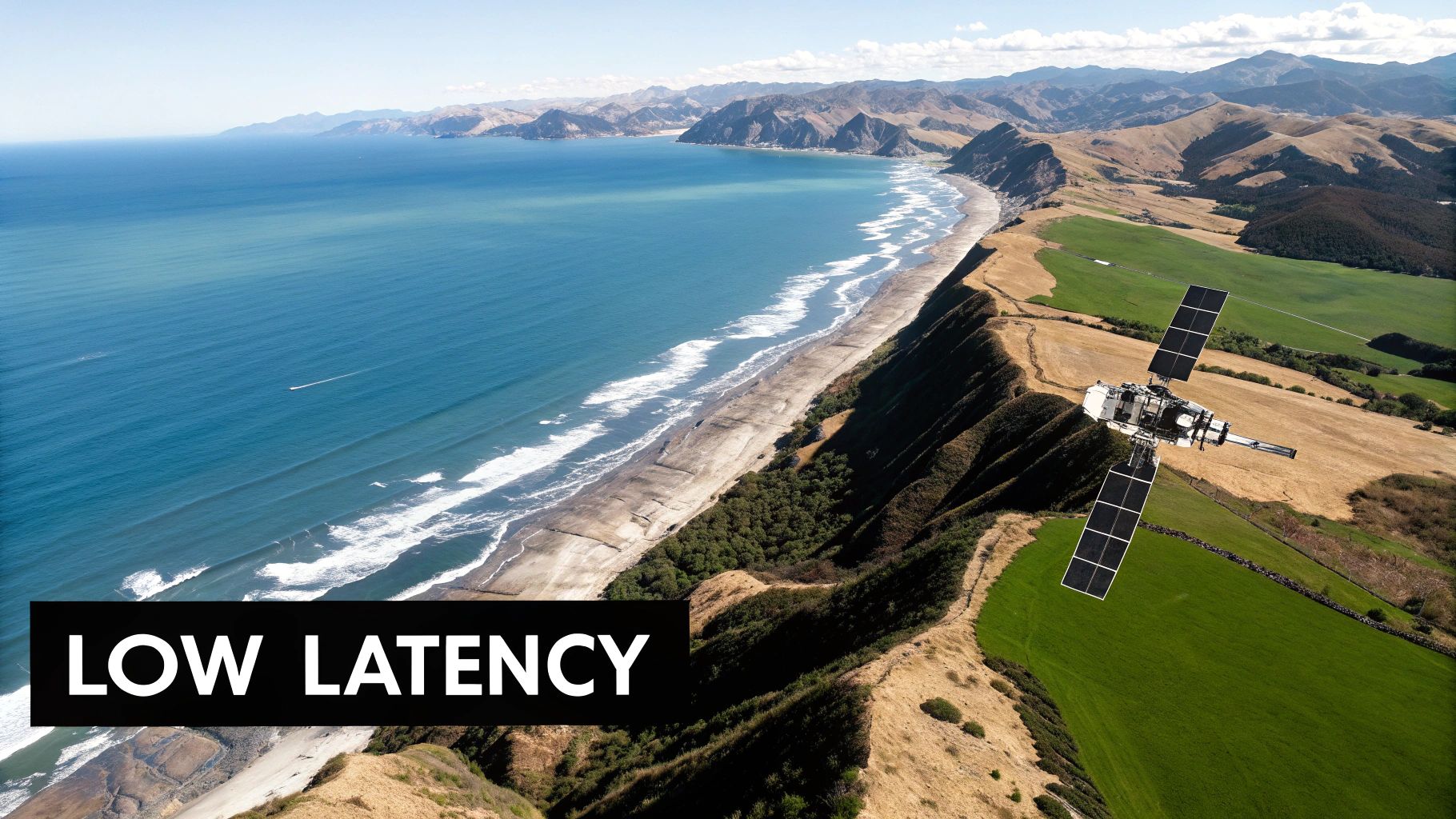
The secret is Starlink’s massive network of satellites whizzing around in Low Earth Orbit (LEO). Imagine a dense, fast-moving web of signal carriers flying just 550 kilometres above us, constantly passing data between each other and back down to the ground. That close proximity is the game-changer.
Old vs New Satellite Technology
For decades, we’ve relied on geostationary (GEO) satellites. These are huge, single satellites parked much, much further away—around 36,000 kilometres from Earth.
Think of it like trying to have a conversation. You can chat instantly with someone standing next to you, but if they were on the other side of a rugby field, there would be a noticeable delay. That lag, or latency, is exactly the problem with GEO satellites. It’s what causes those sluggish speeds and frustrating delays that make video calls or cloud access feel impossible.
The British Airways Starlink deal is only happening because LEO technology cracks this problem. Here’s how:
- Extremely Low Latency: With satellites so much closer, the signal's round-trip time is slashed. That annoying lag that plagues older systems? Gone. This is critical for real-time applications.
- High-Speed Data: The sheer number of satellites in the Starlink constellation means there’s always one overhead, ready to deliver a strong, fast connection for streaming, large file transfers, and other data-hungry work.
- Continuous Coverage: As one satellite flies out of range, another one seamlessly picks up the signal. This gives you a stable, uninterrupted connection, even when you’re on the move.
From In-Flight Wi-Fi to On-the-Ground Solutions
The same high-performance internet that British Airways passengers will soon be enjoying is what’s set to transform operations for businesses here in New Zealand. And we’re already seeing proof of its potential locally. An Air New Zealand trial in June 2025 on domestic flights recorded 95% passenger satisfaction. A massive 78% of passengers were able to get work done mid-flight, a huge jump from just 32% previously. Discover more about these passenger experience findings.
This kind of reliability brings real, tangible benefits to your team on the ground:
- Forestry Crews: Can send high-resolution drone imagery from deep within a forest for better safety checks and planning, enhancing their forestry radio network with data capabilities.
- Maritime Operations: A fishing vessel can get real-time weather data and stay in constant contact, even in notorious black spots, using the best handheld vhf marine radio nz alongside satellite broadband.
- Remote Agriculture: Farmers can manage irrigation, monitor livestock with live video, and use cloud-based software from the back paddock, solving the problem of poor rural connectivity.
The core innovation is clear: Starlink brings fibre-like internet speeds to places where fibre could never go. This closes the digital divide for industries that form the backbone of New Zealand's economy.
At Mobile Systems, we’re at the forefront of putting this powerful technology to work for commercial use. We specialise in taking this global innovation and adapting it to the unique challenges of your New Zealand operation, ensuring you have the connectivity you need, wherever your work takes you.
For a deeper dive into the mechanics, you might be interested in our guide on how Starlink works for NZ businesses.
A Glimpse of the Future for New Zealand Industries
The kind of high-speed connectivity British Airways passengers will soon take for granted at 35,000 feet isn't just an airline upgrade. It’s a preview of what’s now possible for New Zealand’s most critical industries, both on the ground and at sea. This technology gets right to the heart of the connection problems that have long held back productivity and safety in any operation far from a city centre.
The reality for many Kiwi businesses is that the work doesn't stop where the cell towers do. Whether it’s a construction site tucked away in a remote valley or a fishing vessel navigating coastal black spots, the lack of a reliable link creates serious operational risks and slows everything down.
When Starlink is integrated into a proper communication ecosystem by experts like Mobile Systems, it solves these headaches directly. This isn't just about faster internet—it's about creating smarter, safer, and more efficient ways to work, no matter how far off the beaten track you are.
Agriculture and Horticulture
Picture a sprawling farm in rural Canterbury. A constant frustration is not being able to check on remote equipment or pull up real-time data from soil sensors because of patchy coverage. With a professionally installed Starlink solution from Mobile Systems, that whole problem just disappears. Farmers can now:
- Keep an eye on remote assets in real-time.
- Use cloud-based farm management software from anywhere.
- Massively improve lone worker safety with constant connection for staff, GPS tracking, and instant comms.
Construction and Infrastructure
For a construction crew, communication is everything. A vehicle-mounted Starlink system creates an instant, on-site office. This allows for seamless project management, safer work sites with real-time data from IoT sensors, and less downtime by running equipment diagnostics instantly.
Maritime, Marine, and Fishing
Vessel operators in New Zealand battle communication black spots daily. Starlink for maritime delivers:
- Constant weather and safety updates.
- Reliable crew communication, a huge boost for morale on long trips.
- Efficient operational reporting, sending catch data and compliance reports to shore instantly.
Transport, Logistics, and Fleet Management
A transport fleet manager needs eyes on their vehicles across the entire country. Integrating Starlink into fleet management systems provides:
- Unbroken GPS tracking, even in the most remote parts of NZ.
- Real-time data transfer for proof of delivery and driver logs.
- Better driver welfare and safety with a constant connection for support or emergencies.
From remote mining operations to forestry crews, the applications are endless. For a deeper dive, see our overview of communication strategies for the gas and mining industries in NZ. By layering technologies like Starlink, Iridium satellite phones, and Cel-Fi cellular boosters, Mobile Systems builds robust communication ecosystems that make sure your team is always connected and always safe.
Choosing the Right Connectivity Tool for the Job
With so many ways to stay connected these days, how do you pick the right tool for the job? The buzz around the British Airways Starlink deal certainly shows what’s possible with satellite internet NZ, but that doesn't automatically make it the best fit for every Kiwi business.
The secret is to match the technology to your actual, on-the-ground operational needs. What works for a forestry crew needing the best UHF radio NZ has to offer is worlds away from a traffic management team. At Mobile Systems, our expertise lies in understanding these nuances and recommending a solution that is both effective and cost-efficient.
Key Factors for Your Decision
Before investing in new communications gear, we recommend a thorough assessment of your operational needs.
- Coverage Area: Where does your team actually work? Are they static or mobile?
- Data Requirements: Is it just about clear voice comms like a walkie talkie NZ team would use, or do you need to send data, use video, and access cloud software?
- Durability and Conditions: What is the working environment? Durability and IP ratings are non-negotiable for gear used in harsh NZ conditions.
- Total Cost of Ownership: We help you look beyond the sticker price to factor in subscriptions, installation, and long-term maintenance.
This decision tree gives you a good visual on how different operational needs—from basic remote safety to advanced data flow—shape the technology choices for New Zealand industries.
It maps out a clear path from fundamental safety comms right through to the high-level efficiency that modern connectivity can unlock.
Comparing Your Options
Let's break down the main contenders. Each of these technologies has its own sweet spot.
| Technology | Best For | Coverage | Data Speed | Best NZ Use Case |
|---|---|---|---|---|
| Starlink (LEO Satellite) | High-speed internet in remote areas. | Global (clear sky view) | 100-200+ Mbps | Remote construction site needing video calls. |
| UHF/VHF Two-Way Radio | Instant, push-to-talk voice. | Site-specific (extendable) | N/A (Voice only) | A farm or factory needing the best two way radios for coordination. |
| Cel-Fi GO Booster | Strengthening weak mobile signal. | Extends existing cell coverage | Boosts 3G/4G/5G | Ensuring mobile calls in a vehicle or rural workshop. |
| Satellite Phone (Iridium/Inmarsat) | Critical voice & basic messaging anywhere. | Truly Global | Very Low | A lone worker needing a reliable emergency sat phone NZ. |
As you can see, there's no single "best" option. It all comes down to what you need to achieve.
A Deeper Dive into the Tech
Starlink (LEO Satellite Internet): Your go-to when you need proper, high-speed internet where there’s zero cellular reception. If your team needs to run a temporary office from a remote site, Starlink is in a league of its own.
UHF/VHF Two-Way Radio: For instant, reliable, and subscription-free voice comms, two-way radio is still king. Brands like Hytera, Tait, Motorola, and Uniden are purpose-built for harsh Kiwi conditions. Whether you need the best portable radio NZ offers or a fixed vehicle unit, this is your workhorse.
Cel-Fi Cellular Boosters: A brilliant and cost-effective fix for frustrating mobile black spots. A Cel-Fi GO grabs a faint signal, boosts it, and rebroadcasts it for strong, stable coverage inside a vehicle or building.
Satellite Phone: For ultimate reliability in life-or-death situations, a dedicated satellite phone or device like a Garmin inReach provides a lifeline for voice calls and SOS messaging from anywhere on the planet.
For more detailed comparisons, check out our comprehensive NZ Buyer's Guide to Satellite Devices.
Integrating Satellite Tech into Your Operations
So, you're thinking about making the move to satellite? The British Airways Starlink deal is a fantastic showcase, but for your business, success comes down to a smart, practical deployment designed for New Zealand's unique environment. This is where getting expert advice from a specialist communications provider like Mobile Systems makes all the difference.
Step 1: Start with a Needs Assessment
We start by digging into the problems you need to solve. We’ll work with you to get clear on crucial questions about your communication headaches, operational black spots, and data requirements. This ensures you invest in a system that delivers real-world value from day one.
Step 2: Select the Right Hardware for NZ Conditions
We build solutions with trusted brands like Starlink, Iridium, GME, Uniden, Tait, Motorola, and Hytera to make sure every component is up to the job. We focus on:
- Power Management: Robust solutions that keep you connected without killing your vehicle’s battery.
- Durability: Hardware with high IP ratings for dust and water resistance, tough enough for constant vibration and knocks.
- Integration: Getting your new satellite tech talking to your existing UHF/VHF radios and other systems.
Step 3: Professional Installation and Configuration
For any commercial operation, professional installation is non-negotiable. Our mobile on-site support fleet comes directly to you. A DIY setup might look cheaper, but it almost always leads to poor performance, damaged equipment, and safety risks. As organisations embrace these advanced network solutions, the challenge of processing and integrating the resulting data becomes critical, requiring robust approaches for real-time data integration to improve operational agility.
A professional install from Mobile Systems is your guarantee of reliability when you need it most.
Why Choose Mobile Systems Limited?
You need a partner you can trust, one who understands that technology is only half the story. The real value comes from the expertise, support, and local know-how that makes it work flawlessly for your Kiwi operation.
We are not a big box store with limited stock and product knowledge. Mobile Systems is a 100% NZ-owned and operated company, based right here in Mt Maunganui and serving businesses across the country for nearly two decades. We are the trusted experts in mobile communications and mobile systems.
Your End-to-End Solutions Partner
- Expert Needs Assessment: We take the time to properly understand your pain points.
- Custom Coverage Planning: We design systems that deliver reliable coverage exactly where you need it.
- Professional On-Site Installation: Our mobile on-site support fleet comes directly to you.
- RSM Licensing Support: We manage the entire licensing process for you.
- Long-Term Aftercare: We provide expert programming, servicing, and reliable aftercare.
Choosing Mobile Systems means getting a partner invested in your team’s safety and your business’s success. We bring together world-class technology from brands like Starlink, Tait, Motorola, and Hytera and combine it with practical, on-the-ground Kiwi expertise.
Got Questions? We've Got Answers.
Here are some common questions from NZ businesses about satellite connectivity.
Is Starlink Reliable Enough for Critical Operations in NZ Weather?
Yes, it’s remarkably resilient. Starlink was built to handle a huge range of weather conditions, including the heavy rain, wind, and thick cloud cover we know all too well in New Zealand. Its performance stays solid, making it a dependable tool for mission-critical work.
What's the Difference Between Starlink for Business and for Home?
Starlink for Business comes with a higher-gain antenna, faster speeds, and, most importantly, prioritised network traffic. When the network gets busy, business users get pushed to the front of the queue, ensuring consistent performance for your operations.
What Does Installation Involve for a Fleet of Vehicles?
A professional installation from Mobile Systems is essential. We use heavy-duty mounts from specialists like Ram Mounts, install dedicated power solutions, and run all cabling safely and securely to withstand the demands of a working vehicle.
Can Starlink Work with My Existing Two-Way Radio System?
Absolutely. This is how you create a truly unified communications setup. We can integrate these systems so your team can run data-heavy applications over Starlink while keeping critical voice comms on their Hytera, Tait, or Motorola two-way radios. It’s the best of both worlds: powerful data and bomb-proof voice.
Ready to see how the future of connectivity can transform your New Zealand operations? The expert team at Mobile Systems Limited is here to design a solution that fits your exact needs.
Request a quote, ask for a demo, or get personalised device recommendations.
Related posts

- December 17, 2025
Discover how m-View Matrix body-worn cameras enhance workplace safety and accountability. Your guide to implementing this technology in NZ workplaces.

- December 05, 2025
The NZ Buyer’s Guide to Satellite Devices: Starlink compares Starlink, Iridium, and Inmarsat to help NZ businesses choose the best...