
A Guide to Choosing a Cell Network Booster in New Zealand
Struggling with weak signal? Discover how a legal cell network booster can transform connectivity for your NZ business, vehicle, or rural property.
That sinking feeling when a call drops mid-sentence or a website just spins and spins? It's more than just annoying—it's a roadblock to getting business done, staying safe, and just living in the modern world. A legal cell network booster is the answer to these connection headaches across New Zealand. Think of it as a powerful megaphone for the weak signal you already have, turning it into a strong, reliable connection inside your building, vehicle, or boat.
Understanding Your Connection Problem
Dropped calls, painfully slow data, and messages that refuse to send are all symptoms of a weak mobile signal. Here in New Zealand, the culprits are often predictable: you might be in a rural area far from the nearest cell tower, or working inside a building made of signal-killing materials like concrete and steel. Even our beautiful landscape, with its hills and dense forests, can get in the way of a clear signal path.
This isn’t just a small hassle. For businesses, it translates directly into lost productivity and missed opportunities. If you're optimizing your remote work setup, you already know a stable connection isn't a luxury—it's essential. For anyone in a remote spot, a reliable signal is quite literally a lifeline.
What Is a Cell Network Booster?
A cell network booster, sometimes called a signal repeater, is a system that does one thing incredibly well: it finds a weak external mobile signal, amplifies it, and then broadcasts that beefed-up signal into a specific area. It’s crucial to remember that these devices can't create a signal out of thin air. They need at least a faint, usable signal outside to work their magic.
The whole system is a team of three core parts working together:
- An External Antenna: This gets mounted outside your home, vehicle, or vessel where it can catch the best possible signal from the nearest cell tower. A brand like Pacific Aerials or RFI offers robust options.
- An Amplifier: This is the heart of the operation. It grabs that weak signal from the outside antenna and gives it a massive power boost.
- An Internal Antenna: This final piece broadcasts the newly strengthened signal indoors, creating a bubble of strong, dependable coverage where you need it most.
You can think of it like a rainwater collection system. The external antenna is the roof, catching every available drop. The amplifier is the tank, collecting and concentrating it. And the internal antenna is the tap, giving you a strong, steady flow whenever you turn it on.
Why Specialist Suppliers Matter
When you start searching for the best cell phone booster for rural areas NZ, going to a specialist supplier is absolutely CRITICAL. Unlike a general electronics retailer, communication experts have deep-seated knowledge of the products and, just as importantly, New Zealand's unique regulatory landscape.
They'll set you up with legally compliant, high-performance systems from trusted brands like Cel-Fi, Tait, or Motorola, making sure your investment is both effective and above board. Getting the right advice from a company like Mobile Systems means you walk away with a solution that's perfectly matched to your specific environment—whether that's a forestry radio network, a boat requiring the best vhf marine radio NZ has to offer, or a remote rural property. That expertise is the real difference between a frustrating purchase and a flawless connection.
How a Signal Booster Brings Your Connection to Life
So, how does a cell network booster actually work? It’s not magic, just a clever and incredibly efficient process that takes a frustratingly weak mobile signal and gives it a clear path to becoming strong and reliable. The whole system hinges on three key components working together in perfect harmony.
Think of it this way: a booster system is designed to overcome all the physical stuff that kills your mobile reception—things like distance from the tower, hilly terrain, or even the materials your building is made of. Each part of the system has a very specific and critical job to do in capturing, strengthening, and then delivering a solid signal right where you need it.
The Three Pillars of a Stronger Signal
A complete cell booster system, like the Cel-Fi GO units we often recommend, acts like a well-drilled team. The best analogy is a relay race for your mobile signal, where each component takes the signal and flawlessly passes it on to the next.
These are the three core components:
- The Outdoor Antenna (The Catche): This is the first and most critical link in the chain. We place this antenna outside your building or vehicle, where its only job is to find and "catch" the best possible signal from the nearest cell tower. A good quality external antenna, perhaps a ground independent antenna, is highly sensitive, designed to pull in even the faintest of signals.
- The Amplifier (The Powerhouse): Once that signal is caught, it travels down a low-loss cable to the amplifier. This is where the real muscle is. The amplifier takes that weak, often unusable signal and gives it a massive boost. For example, a Cel-Fi unit can amplify a signal by up to 100dB—a colossal increase that turns a barely-there whisper into a crystal-clear voice.
- The Indoor Antenna (The Broadcaster): Finally, the newly beefed-up signal is sent to an indoor antenna. This component’s job is simple: to broadcast that strong signal throughout your desired coverage area. This creates a reliable bubble of connectivity inside your truck cab, workshop, or home office.
We’ve all been frustrated by dropped calls and slow data. While a booster does the heavy lifting, it's worth remembering that a phone's own ability to receive a signal, through parts like the iPhone 8 Plus Top Left Antenna, is the foundation. A booster just makes sure the signal reaching that internal antenna is as strong and clean as it can possibly be.
From Tower to Device: A Step-by-Step Flow
Let’s picture it. You’re in a rural valley, and your phone is clinging to one flickering bar of service. Here’s a breakdown of how a cell network booster breathes new life into that connection.
First, the high-gain outdoor antenna, mounted up on your roof, sniffs out and locks onto that weak signal from the distant tower. The quality of this antenna and exactly where it’s placed are absolutely vital; a better "catch" at the start gives you a much better result at the end. This is where knowing about concepts like antenna gain really pays off. If you want to get into the nitty-gritty, you can check out our guide where we've thoroughly explained antenna gain.
Next, the captured signal zips down the cable and into the amplifier. A quality amplifier, like one from the Cel-Fi range, doesn’t just make the signal louder; it intelligently cleans it up and boosts its power. It’s about improving the signal's quality and clarity, which is crucial for both voice calls and fast data speeds.
Finally, the strengthened signal is rebroadcast by the indoor antenna. All of a sudden, that single, unreliable bar on your phone jumps to four or five solid bars. Your phone now has a powerful, stable connection to work with, giving you crystal-clear calls, quick downloads, and smooth streaming.
The best part? This entire process happens instantly. It’s a seamless, behind-the-scenes operation that just works, delivering the result you need: a connection you can count on, no matter where your work takes you in New Zealand.
This three-part harmony is exactly why getting expert advice is so important. A specialist from a company like Mobile Systems knows how to select and match the right antennas with the right amplifier for your specific situation, ensuring every piece of the puzzle works at peak efficiency to give you a flawless connection.
How to Select the Right Cell Network Booster
Picking the right cell network booster is never a one-size-fits-all job. The perfect setup for a rural bach will be worlds away from what a commercial fishing vessel or a fleet of delivery trucks needs. Getting this decision right from the start is what turns frustratingly patchy service into a flawless, reliable connection.
The first, most important question to ask is: where do you need the signal? Boosters are built for two main scenarios: static locations like homes and offices, or mobile applications like vehicles and boats. Each type uses specific antennas and components designed for its environment, so figuring out your primary use case is the essential first step.
Matching the Booster to Your Environment
For a fixed building, the aim is to create a large, stable bubble of indoor coverage. These systems typically use a powerful, directional outdoor antenna pointed squarely at the nearest cell tower to pull in the strongest possible signal. An indoor panel or dome antenna then broadcasts this amplified signal throughout the space.
On the other hand, a mobile setup uses an omnidirectional outdoor antenna. This is absolutely critical because a vehicle or boat is always moving, constantly changing its orientation to the cell tower. This type of antenna is designed to capture signals from any direction, ensuring you maintain a consistent connection while on the go.
The flowchart below gives you a simple decision-making path to help figure out the right type of booster for your situation.
This visual guide strips away the complexity, breaking down the choice based on whether you need a better signal outdoors, inside a building, or within a vehicle.
To make it even clearer, this quick table breaks down the best booster types for common Kiwi applications.
Booster Type Selection Guide
| Application | Recommended Booster Type | Key Consideration | Example Brands |
|---|---|---|---|
| Rural Home or Bach | Static Indoor (Directional) | Maximising weak signal from a single, distant tower. | Cel-Fi |
| Commercial Office | Static Indoor (Directional) | Providing even coverage across a large floor plan. | Cel-Fi |
| Ute or Fleet Vehicle | Mobile (Omnidirectional) | Maintaining a stable connection while moving. | Cel-Fi GO |
| Commercial Vessel | Marine-Grade Mobile | Saltwater corrosion resistance and signal stability on water. | Cel-Fi GO |
| Construction Site | Static or Portable | Durability and ability to cover temporary structures. | Cel-Fi, Motorola, Hytera |
Ultimately, selecting the right booster comes down to a clear understanding of where and how you'll be using it.
Understanding Technical Specifications
Once you know the type of booster you need, it’s time to look at the tech specs. While it can all seem a bit intimidating, there’s one number that matters most: Gain.
Gain is the measure of a booster's amplification power, and it's expressed in decibels (dB). Put simply, the higher the gain, the more powerful the booster. A high gain is absolutely essential in areas with a very weak existing signal, making it the most important factor when you're looking for the best cell phone booster for rural areas NZ. For example, a booster with 100dB gain offers massively more power than one with 70dB gain.
Think of gain like the volume knob on a stereo. If the original radio signal is just a faint whisper, you need to turn the volume way up to hear it clearly. A high-gain booster turns that signal whisper into a clear, strong voice for your phone.
Another key detail is network compatibility. Here in New Zealand, you must make sure any booster you buy is approved to work with our main network providers: Spark, One NZ, and 2degrees. Using a non-compliant device isn't just illegal; it can actively interfere with the public network, causing problems for everyone.
Why You Must Choose a Specialist Supplier
This brings us to the most critical point: where you buy your gear. It's tempting to look online for a cheap, quick fix, but sourcing your booster from a specialist communications provider is non-negotiable.
Here’s why a specialist is your best partner in this:
- Guaranteed Compliance: They only stock legally approved, RSM-compliant hardware. This protects you from the risk of fines and ensures your device plays nicely with NZ networks.
- Expert Advice: They have the real-world technical knowledge to assess your unique situation and recommend the perfect combination of antennas and amplifiers for maximum performance.
- High-Performance Brands: Specialists give you access to industry-leading brands known for their reliability and power. Cel-Fi, for instance, is a brand renowned for its smart signal boosters that are carrier-approved and deliver exceptional results. To get a better handle on what makes these systems so effective, you can explore our detailed overview of Cel-Fi technology.
- Ongoing Support: From installation advice to troubleshooting down the line, a specialist supplier offers a level of support that generic retailers simply can't match.
Choosing the right cell network booster is an investment in reliable communication. By understanding your environment, focusing on key specs like gain, and partnering with an expert supplier, you guarantee that your investment pays off with a strong, dependable signal wherever you need it most.
Understanding Legal Compliance in New Zealand
Before you even think about buying a cell network booster in New Zealand, it’s crucial to get your head around the legal side of things. This isn't just about getting a better signal; it's about protecting our national mobile network and avoiding some pretty serious penalties. Grabbing the wrong bit of kit can do a lot more harm than good.
Here in New Zealand, it's actually ILLEGAL to operate just any signal booster you might find online. A lot of the uncertified devices, usually brought in from overseas, can create massive interference with our public mobile networks. That interference can knock out essential services for whole communities, affecting everything from 111 calls to day-to-day business.
The Role of Radio Spectrum Management
The government body in charge of all this is Radio Spectrum Management (RSM), which is part of the Ministry of Business, Innovation and Employment. RSM’s job is to manage the radio spectrum—the invisible airwaves that all our wireless communications depend on.
Their rules are straightforward: only specific, pre-approved devices are allowed. This is to stop what's known as "network pollution," where a poorly made booster ends up jamming the very signals it's meant to be helping. You can get a deeper understanding of how this government body operates in our detailed guide on Radio Spectrum Management.
Why Approved Brands Like Cel-Fi Are Essential
This is exactly why certified brands like Cel-Fi are so important. Cel-Fi boosters are fully compliant, having been rigorously tested and given the green light by New Zealand's mobile network operators—Spark, One NZ, and 2degrees.
When you choose a Cel-Fi system, you're getting total peace of mind. These aren't just dumb amplifiers; they're smart boosters designed to:
- Prevent Interference: They constantly monitor the network and adjust their own power so they never disrupt the wider mobile service.
- Guarantee Performance: They're engineered to give you a powerful, stable signal boost without causing any harm to network integrity.
- Ensure Legality: Operating a Cel-Fi device is 100% legal in New Zealand, keeping you safe from fines and legal headaches.
Buying an approved cell network booster isn't just a good idea—it's a legal requirement. It ensures your signal solution works in harmony with the national infrastructure that connects all of us.
New Zealand's mobile network has seen a huge amount of investment and expansion. As of 2025, 4G coverage now reaches an incredible 98.35% of the country. This network is a vital national asset, and using compliant hardware is key to protecting it.
The Risk of Uncertified Equipment
That cheap, parallel-imported booster might look tempting, but the risks are huge. These devices are often illegal, don't work properly, and can land you with fines of up to $30,000. For a business, the fallout can be even more damaging.
Your best guarantee is to purchase from a reputable New Zealand specialist like Mobile Systems. We only stock RSM-approved equipment from trusted brands like Cel-Fi, Hytera, and Uniden, so you know your investment is safe, legal, and effective. It’s the only way to protect your own connectivity and the integrity of the network every Kiwi relies on.
Installation Tips for Maximum Signal Gain
Getting the most out of your cell network booster is about more than just plugging it in. A thoughtful installation is the single biggest factor in transforming a weak, frustrating signal into a strong, reliable connection. The whole point is to get each component working at its best so you see a real return on your investment.
Proper setup isn't just a suggestion; it’s the difference between a system that barely works and one that absolutely sings. The two golden rules are nailing the placement of the outdoor antenna and making sure there’s enough separation between the indoor and outdoor antennas. Get these right, and you'll wring every last drop of performance out of your booster.
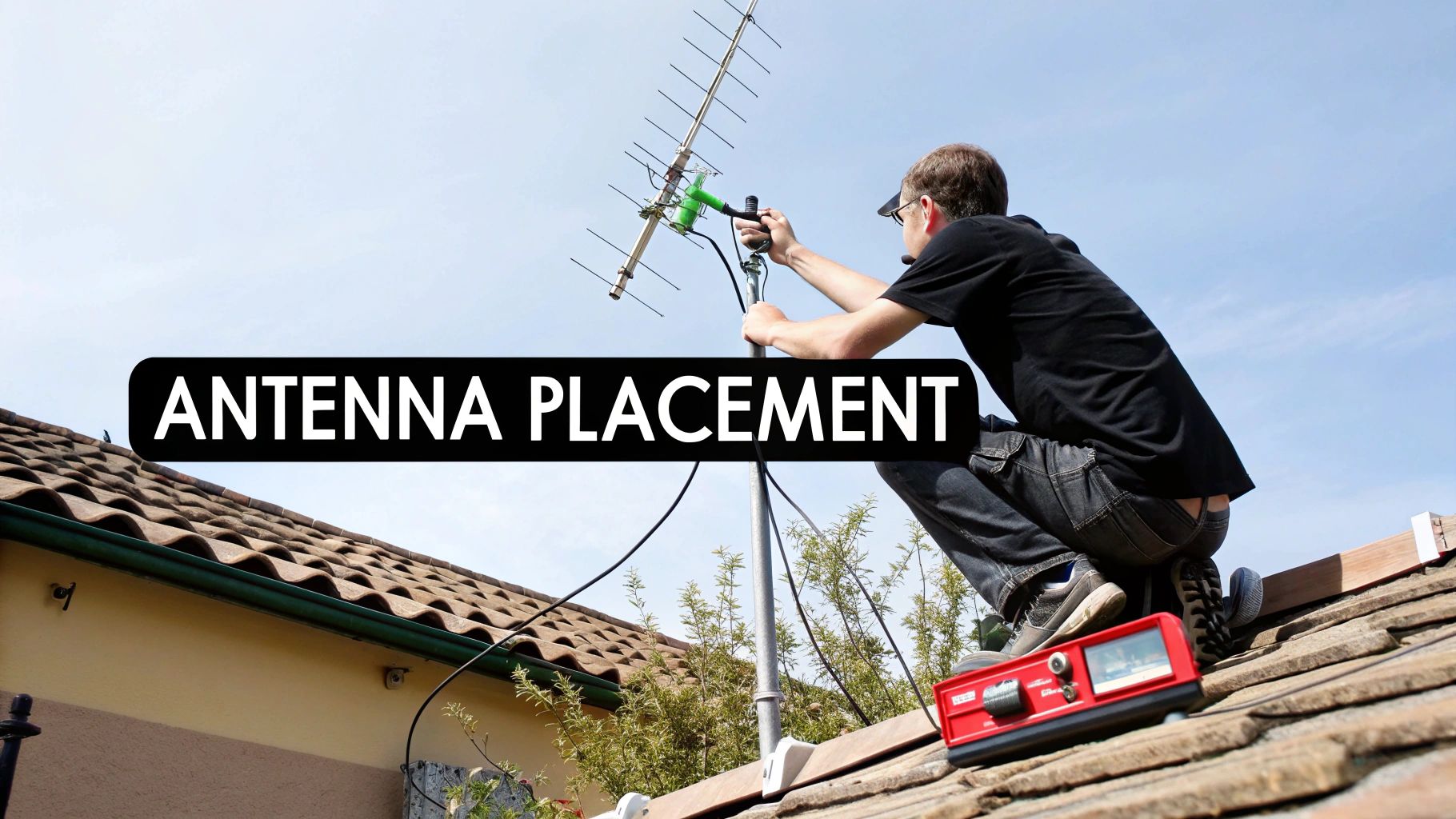
Finding the Sweet Spot for Your Outdoor Antenna
The placement of your outdoor antenna is, without a doubt, the most important step in the entire process. Its job is to grab the best possible signal from the nearest cell tower, so where you put it directly impacts the performance of the whole system. A weak signal coming in means a weak signal going out—no matter how powerful your amplifier is.
To find the best spot, you need to think like an antenna: get as high and clear as you can.
- Height is Might: The higher you mount the antenna, the better its chances of getting a clear line of sight to a cell tower. This helps it avoid obstructions like trees, hills, or the neighbour's new extension. The roof is almost always your best bet.
- Use Your Phone as a Scout: Before you start drilling holes, grab your mobile and walk around the property. Keep a close eye on the signal bars. Check every corner of the roof and the highest points of your building to find where the signal is naturally strongest.
- Point it in the Right Direction: If you’re using a directional antenna (which is common for buildings), it needs to be aimed precisely at the nearest compatible cell tower. There are plenty of apps and websites that can help you pinpoint local towers.
Think of the outdoor antenna like an old-school satellite dish. If you were off by just a few degrees, you'd get a screen full of static instead of a clear picture. The same principle applies here—precise aiming is crucial for capturing the strongest possible signal to feed the amplifier.
The Importance of Antenna Separation
Once you've got the outdoor antenna perfectly positioned, the next critical job is ensuring there's enough space between it and the indoor antenna. If they're too close together, the system can create a feedback loop, a condition known as oscillation.
It’s just like the horrible screeching sound you get when a microphone gets too close to a speaker. In a booster system, oscillation forces the amplifier to shut down to protect the wider cell network, making your whole setup useless.
To prevent this from happening:
- Maximise Vertical Separation: The best way to create separation is vertically. Putting the outdoor antenna on the roof and the indoor antenna on a lower floor is the ideal scenario.
- Increase Horizontal Distance: If you can't get much vertical separation, create as much horizontal distance as you can between the two antennas.
- Use Barriers: Walls, ceilings, and floors act as natural shields that help isolate the signals from each antenna, seriously reducing the risk of a feedback loop.
For more complex jobs—like large commercial buildings, vehicle fleets, or marine vessels—getting a professional in is often the smartest move. A specialist technician has the tools and experience to find the perfect signal, calibrate every component, and guarantee a flawless, oscillation-free setup. This ensures your cell network booster delivers peak performance from day one, giving you the reliable connectivity your business depends on.
Real-World Applications for New Zealand Businesses
A reliable mobile signal is more than just a convenience; it’s a powerful business tool that directly impacts safety, efficiency, and coordination. For many Kiwi industries, a cell network booster isn't an upgrade—it's essential infrastructure. It's the key to unlocking new levels of productivity in some of our most challenging environments.
Let's move beyond the tech and look at the real-world outcomes for businesses across New Zealand.
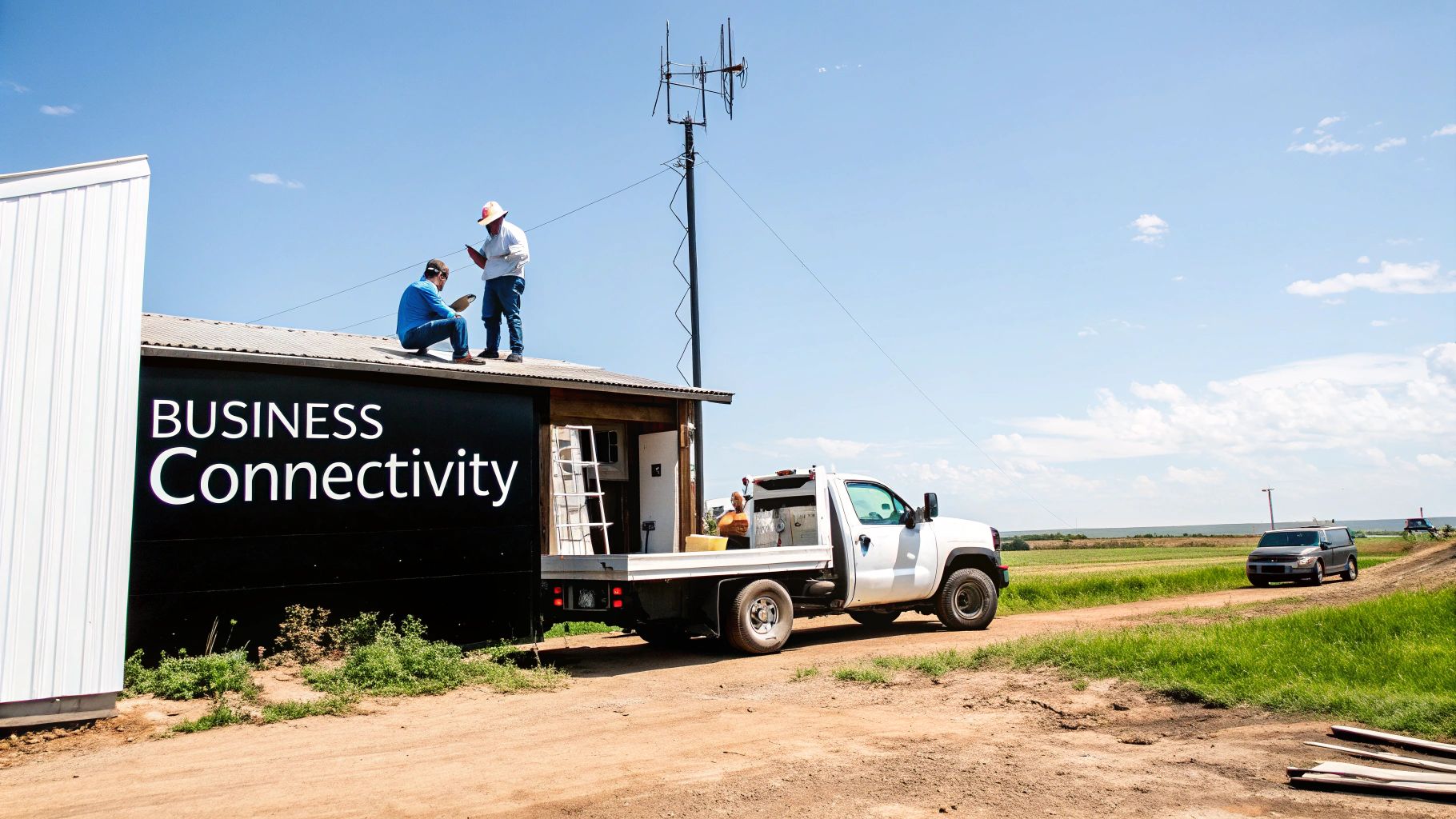
Whether you’re on the rugged hills of a forestry block or the bustling floor of a packhouse, consistent communication is the backbone of a successful operation. Dropped calls and non-existent data can grind work to a halt, compromise safety protocols, and create infuriating bottlenecks.
By capturing a weak external signal and amplifying it, a booster ensures your team stays connected, no matter how remote the worksite.
Construction and Contracting
On a busy construction site, clear and constant communication is completely non-negotiable. A cell network booster makes sure site managers, crane operators, and ground crews can always reach each other, instantly.
- Enhanced Safety: Instant, reliable contact is critical for safety briefings, emergency coordination, and daily hazard checks. A strong signal means help is just a call away.
- Improved Project Management: Teams can send and receive plans, photos, and updates directly from the site. This cuts down delays and prevents the kind of costly miscommunications that blow out budgets.
Transport, Logistics, and Fleet Management
For any business with vehicles on the road, connectivity is the key to efficiency. A mobile cell network booster installed in a truck, van, or ute transforms the vehicle into a reliable mobile office.
This simple addition ensures drivers stay in constant touch with dispatch, access real-time navigation updates, and use data-heavy logistics apps without a single interruption. Think about it: uninterrupted GPS tracking and crystal-clear driver communication are vital for modern fleet operations, allowing for smarter route planning and better resource management.
Agriculture and Forestry Operations
New Zealand's primary industries often operate in areas with notoriously poor mobile coverage. For farmers, growers, and forestry crews, this isolation poses serious risks to both safety and productivity. A booster installed in a vehicle or a rural building provides that crucial link back to civilisation.
A strong signal bridges the gap between a remote worksite and the outside world. It means lone workers are never truly alone, and critical operational data can be shared instantly, turning isolated pockets of activity into connected, efficient hubs.
This newfound connectivity allows for better coordination of harvesting teams, instant access to weather reports, and a reliable channel for lone worker safety monitoring. It empowers rural businesses to operate with the same digital efficiency as their urban counterparts.
Maritime and Marine Services
Out on the water, a mobile signal can fade surprisingly quickly. For commercial fishing vessels, charter boats, and marine service operators, a marine-grade cell network booster is an indispensable tool. It might be paired with the best handheld VHF marine radio NZ can offer for ultimate safety.
It pushes reliable communication much further from shore, supporting everything from operational logistics and crew welfare to, most importantly, safety. Maintaining a connection for weather updates and operational chats is critical for any successful marine venture.
The demand for reliable mobile data is exploding. In 2024, the average monthly data usage was 7.6GB per person, a figure projected to surge to 13.8GB by 2029—that’s an 81% increase. You can explore more about the trends driving this growth in mobile data consumption. This rising demand hammers home the need for robust connectivity solutions like a cell network booster, which ensures businesses can meet these data-heavy requirements both now and in the future.
Your Questions Answered: Getting to Grips with Cell Network Boosters
When you're struggling with poor mobile reception, diving into the world of signal boosters can bring up a lot of questions. That’s perfectly normal. Getting clear, straightforward answers is the first step to figuring out if a cell network booster is the right move for you. We've pulled together the most common queries we hear from Kiwis to help cut through the noise.
This section tackles the big questions head-on, giving you direct answers based on New Zealand's specific rules and what you can actually expect in the real world.
Are Cell Network Boosters Actually Legal in New Zealand?
Yes, but this comes with a big, important "if". A cell network booster is only legal to use in New Zealand if it's an approved device, authorised by Radio Spectrum Management (RSM) and the mobile network carriers themselves.
In New Zealand, the only brand that ticks all these boxes for both business and personal use is Cel-Fi.
Be wary of uncertified, non-compliant boosters, which are often sold through overseas online stores. Using one of these is illegal. They can create serious interference on the public mobile networks, knocking out essential services for everyone around you. Getting caught operating an illegal booster can lead to hefty fines, so it’s critical to buy your gear from a reputable NZ specialist.
Will a Booster Work if I Have Absolutely Zero Signal?
Unfortunately, no. A cell network booster can’t create a signal out of thin air; its job is to amplify an existing weak signal. For the system to do its magic, the outdoor antenna has to be able to pick up at least a faint, usable signal from a nearby cell tower. This is also true for other technologies like satellite internet NZ services rely on; there must be a line of sight to a satellite.
Think of it like a magnifying glass for a signal. A magnifying glass can make tiny text readable, but it can't make words appear on a blank page. Similarly, a booster needs something to work with, even if it's just one flickering bar of service.
Before you invest in a system, it's absolutely vital to check that there's some signal available at your location, usually at a high point like the roof.
Can I Install a Cell Network Booster Myself?
You certainly can. Many booster kits, particularly those designed for a single vehicle or a small home, are built for a straightforward DIY installation. They come with clear instructions to walk you through mounting the antennas and connecting everything up.
However, for more complex setups, we strongly recommend getting the professionals in. This includes situations like:
- Large commercial buildings or workshops where you need coverage over a big area.
- Commercial fleets that need tough, standardised installations across dozens of vehicles.
- Marine vessels, where specific mounting techniques and serious weatherproofing are non-negotiable.
In these cases, a specialist installer like Mobile Systems makes sure every part is positioned and calibrated for peak performance, safety, and long-term reliability. That professional touch is what guarantees you get the best possible return on your investment.
Ready to finally solve your signal problems with a legal, high-performance solution? The expert team at Mobile Systems Limited can help you select, install, and support the perfect Cel-Fi cell network booster for your specific needs, whether you're on land or at sea.
Related posts

- March 10, 2026
If you found yourself immobilised in a deep West Coast valley, would you trust your life to a device designed...

- March 02, 2026
Picture this: you're addressing your team at a remote building site in the Waikato, or leading a school sports day...

- February 28, 2026
Discover vms trailer hire transactional service high New Zealand and how this model delivers compliant, safe, and efficient trailer rentals.