
Cost of Satellite Phones in NZ: A 2026 Buyer’s Pricing Guide
What if the initial purchase price of your handset is actually the least significant factor when calculating the cost of satellite phone nz hardware? For many local businesses, the sticker price represents less than 30% of the total ownership expense over a three year lifecycle.
What if the initial purchase price of your handset is actually the least significant factor when calculating the cost of satellite phone nz hardware? For many local businesses, the sticker price represents less than 30% of the total ownership expense over a three year lifecycle.
You likely find that budgeting for remote connectivity feels like a moving target. It's common to feel frustrated by the lack of transparency between prepaid credits that expire and monthly subscriptions that carry hidden emergency call fees. You need to know your team can communicate from the Southern Alps or the East Cape without a surprise invoice arriving at your office.
This guide provides a precise breakdown of hardware investment, airtime structures, and the specific fees associated with the major networks operating in our region. We'll show you how to calculate your total expenditure and which network configurations offer the most reliable performance for New Zealand's unique geography.
Key Takeaways
- Identify the initial hardware investment required for different device categories, ranging from basic satellite messengers to professional-grade handheld units.
- Analyze subscription models and prepaid options to effectively manage the ongoing cost of satellite phone nz connectivity for your business operations.
- Understand the total cost of ownership by accounting for essential accessories and external antenna installations necessary for reliable remote performance.
- Compare the value of Iridium and Inmarsat networks to ensure your chosen technology provides adequate coverage for New Zealand’s unique topography.
- Utilize a practical decision framework to select a communication solution that balances ruggedness, data needs, and budget for forestry or marine applications.
Understanding Upfront Investment: Satellite Phone Hardware Prices in 2026
Understanding the initial capital expenditure for remote communication is the first step for any New Zealand operation. It is helpful to define what a satellite phone is in the context of your specific field requirements, as hardware choices dictate your long-term operational costs. The 2026 market offers three primary categories: dedicated handhelds, satellite hotspots, and fixed-mount terminals for vehicles or vessels.
The cost of satellite phone nz hardware is currently shaped by the shift toward LEO (Low Earth Orbit) constellations and the stabilisation of global electronics supply chains since 2024. While basic messaging devices remain affordable, units capable of high-quality voice and data carry a significant premium due to the complex antenna arrays required for reliable connectivity in New Zealand’s rugged topography.
To better understand the practical implications of these technologies in a local context, watch this video:
Industrial users often require MIL-STD 810G certified units. These devices are tested against shock, vibration, and extreme temperatures. In the Southern Alps or coastal Fiordland, these ruggedised features aren't optional luxuries. They prevent hardware failure during critical safety incidents, which justifies the 25% to 40% price increase over consumer-grade hardware.
Handheld Satellite Phone Tiers
Budget-friendly options like the Inmarsat IsatPhone 2 remain popular for users who primarily operate with a clear view of the northern sky. It offers a reliable battery life of up to 160 hours on standby. However, for those requiring global coverage, including the poles, the Iridium 9555 and the Extreme 9575 are the industry standards. The 9575 model includes an integrated SOS button and GPS tracking, making it a preferred choice for lone-worker safety compliance.
Professional handheld satellite phones in New Zealand typically range from NZ$1,600 to NZ$3,100 depending on the specific model and included accessories.
Satellite Hotspots and Smartphone Integration
The Iridium GO! exec and similar hotspots allow teams to use their existing smartphones via a Wi-Fi bridge. This "Bring Your Own Device" (BYOD) approach reduces training time, as staff use familiar interfaces for email and messaging. It is a cost-effective way to provide data access to multiple users without purchasing individual handsets.
For messaging-only needs, Garmin inReach hardware provides a lower entry point. These devices are excellent for basic GPS tracking and two-way SMS but lack full-voice capabilities. When calculating the cost of satellite phone nz, consider that while hotspot hardware is often cheaper than a dedicated handset, the reliance on a smartphone's battery and Wi-Fi connection introduces additional points of failure in an emergency. A tailored assessment often prevents costly mistakes when choosing between these platforms.
Airtime and Subscription Plans: The Ongoing Cost of Connectivity
The initial hardware purchase is only one part of the total investment. For many New Zealand organizations, the long-term cost of satellite phone nz is driven by airtime and subscription choices. These fees cover the access to orbital networks and vary based on how often you intend to communicate from the field.
Monthly Post-Paid vs. Prepaid Vouchers
Monthly post-paid plans are the standard choice for commercial operations in forestry, civil engineering, or maritime sectors. These plans offer the security of a constant connection and typically feature lower per-minute rates. Most NZ providers require a minimum contract term, often 12 months, with activation fees ranging from NZ$50 to NZ$100 depending on the network.
- Post-Paid: Best for consistent monthly usage and predictable budgeting.
- Prepaid: Ideal for seasonal tourism operators or emergency kits. Vouchers usually have an expiry date, often 30 days to 2 years.
New Zealand businesses can optimize costs by utilizing seasonal suspension features. Some networks allow you to keep a SIM active at a reduced monthly rate during off-peak months. This prevents the need to pay new activation fees when the busy season returns.
Network Specific Airtime Pricing
Iridium remains a premium option due to its 66-satellite LEO constellation. It provides 100% global coverage, including deep South Island valleys where other signals fail. Because of this reliability, Iridium airtime often carries a 20% to 30% price premium over geostationary alternatives.
Inmarsat utilizes geostationary satellites. While the hardware and airtime are often more affordable, the device must have a clear line of sight to the equator. This can be a limitation in the far south of New Zealand or in dense bush. Overage charges on these networks can be steep; therefore, monitoring usage is critical for budget control.
A significant factor in the New Zealand market is the availability of a Standard NZ Number. Traditional satellite numbers use international prefixes that are expensive for landlines or mobiles to call. By opting for a plan with a local NZ mobile number, the person calling the satellite phone only pays standard local rates. This shift moves the cost burden away from your staff or family members.
Data usage is the most common area for bill shock. Satellite data is priced by the kilobyte, not the gigabyte. A standard text-based email might cost a few cents, but an unoptimized smartphone background update could cost hundreds of dollars in minutes. Understanding these technical nuances is vital. A tailored assessment often prevents costly mistakes when selecting your network provider and plan structure.
Beyond the Sticker Price: Total Cost of Ownership (TCO) in NZ
When you evaluate the cost of satellite phone nz, the price tag on the box rarely tells the full story. For New Zealand businesses, the true investment includes the hardware and support needed to ensure the device works when it's needed most. A standalone handset often loses signal inside a vehicle or under a heavy forest canopy without the right peripheral equipment.
Total Cost of Ownership (TCO) accounts for the initial purchase, specialized accessories, and ongoing maintenance. In rugged environments like the King Country or the Southern Alps, a "cheap" setup often becomes expensive if it fails during an emergency. Investing in professional-grade components from the start prevents these hidden costs.
- External Antennas: These are essential for marine or vehicle-based operations to maintain a clear line of sight to the satellite constellation.
- Battery Management: Lithium-ion batteries in satellite units typically require replacement every 24 to 36 months to ensure reliability in cold climates.
- Hardware Lifecycle: Most industrial users should budget for a hardware refresh every five to seven years to stay compatible with network upgrades.
Critical Accessories for NZ Conditions
Vehicle docking kits are a primary consideration for forestry and civil engineering teams. These kits provide a secure mount and connect the handset to an external signal boost antenna. This configuration can improve signal retention by up to 25 percent in deep valleys where a standard handset might struggle. It's a practical necessity for hands-free compliance while driving on private access roads.
Solar charging solutions are another vital add-on for long-term off-grid work. Portable solar blankets allow teams to maintain communication without relying on vehicle power. For industrial durability, protective hard cases and spare battery kits are standard requirements. These accessories protect your investment from the high-impact environments typical of New Zealand’s primary industries.
Professional Support and Servicing
Local technical support offers a distinct advantage over international call centres. Dealing with a provider who understands New Zealand’s unique topography and local frequency regulations saves time and frustration. You can access specialized assistance through Mobile Systems Servicing to ensure your fleet remains operational and compliant with local safety standards.
Regular firmware updates and safety checks are mandatory for many corporate health and safety protocols. Professional installation of vehicle kits prevents common field failures like water ingress or cable damage from vibration. A tailored assessment of your fleet's needs often prevents costly mistakes and ensures that your team stays connected in the most remote corners of the country.
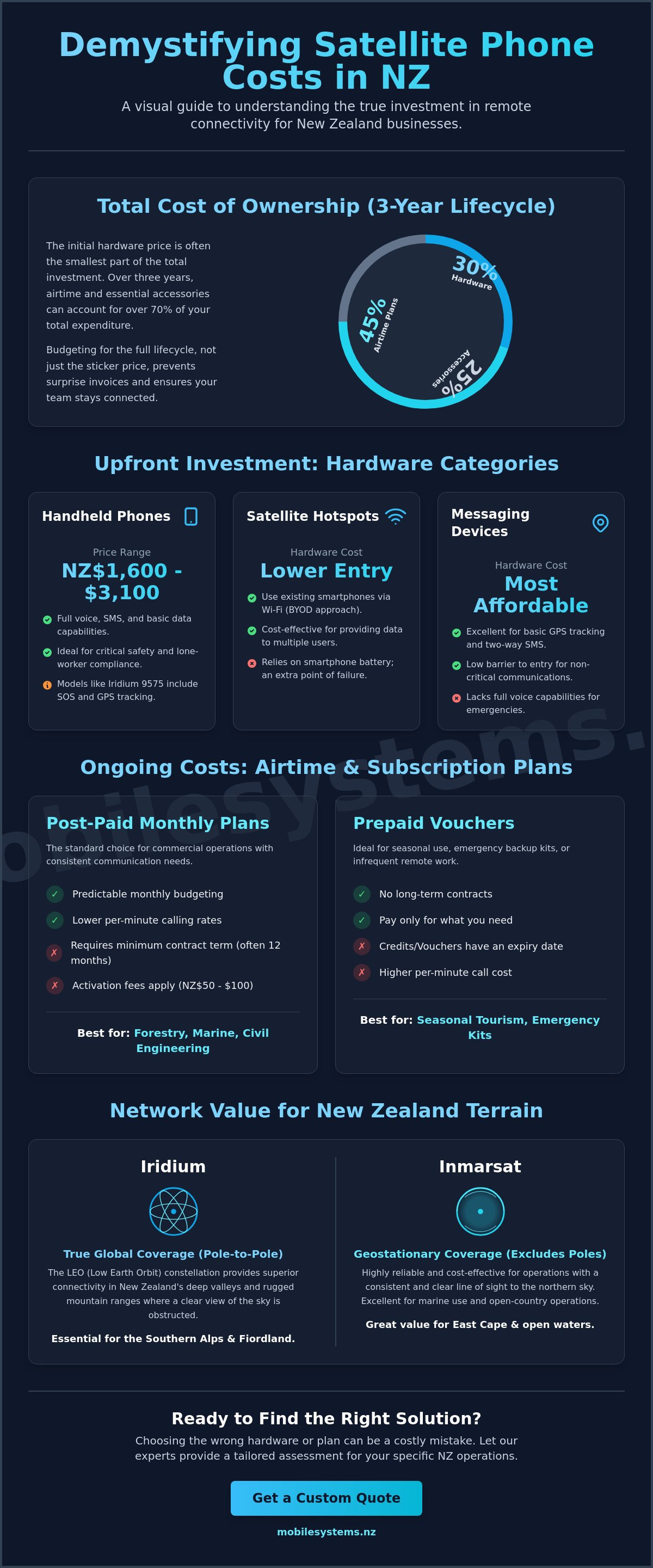
Iridium vs. Inmarsat: Comparing Value for New Zealand Terrain
Choosing between Iridium and Inmarsat significantly impacts the long-term cost of satellite phone nz ownership. These two providers use entirely different satellite architectures. Iridium operates a Low Earth Orbit (LEO) network, while Inmarsat uses Geostationary (GEO) satellites. This technical distinction isn't just academic; it dictates where your phone will work and how much you'll pay for that reliability.
LEO satellites sit roughly 780km above the Earth. Because they're closer, the signal travel time is shorter, resulting in lower latency and better voice quality. GEO satellites sit much higher, at approximately 35,786km. While GEO systems are often more affordable, the distance can cause a noticeable delay in conversation. For New Zealand businesses, understanding how these networks affect the long-term cost of satellite phone nz services is vital for operational safety.
Iridium: The Premium for 100% Global Coverage
Iridium's 66-satellite constellation is the only network that offers truly gap-free coverage across the entire planet. This includes the North and South Poles and every inch of the New Zealand backcountry. The higher subscription costs associated with Iridium reflect the massive overhead of maintaining such a large, active fleet of satellites. You can view the current range of compatible hardware in our Iridium Device Collection.
- Terrain Performance: In the Southern Alps or deep-cut ravines of the West Coast, Iridium is superior. Because the satellites are constantly moving, a blocked signal will usually clear within minutes as the next satellite passes overhead.
- Reliability: The network doesn't rely on a single point of failure. If one satellite is obstructed by a peak, another will soon be in view.
- Wait Times: Call connection times are typically under 30 seconds, which is critical during emergency situations in remote bush.
Inmarsat: Cost-Effective Reliability for Open Skies
Inmarsat is often the preferred choice for marine users and those working in flatter terrain. Because their satellites are geostationary, they stay in a fixed position relative to the Earth. This allows for simpler ground station technology and lower monthly plan costs. The IsatPhone 2 is a popular choice for coastal NZ because it offers a rugged build and long battery life without the premium price tag of LEO handsets.
- Marine Advantage: On the open ocean, there are no mountains to block the line of sight to the equator. Inmarsat provides a very stable, cost-effective connection for offshore vessels.
- ROI for Business: For transport companies or farms in the Canterbury Plains, Inmarsat offers a high return on investment by keeping monthly airtime fees lower than Iridium.
- Limitations: If you're in a steep valley facing south, you might lose the signal entirely because the satellite is fixed in the northern sky. This makes it less ideal for high-country mustering or alpine trekking.
Selecting a network based solely on the initial hardware price is a common error. If your team works in the shadows of the Southern Alps, a cheaper Inmarsat unit might become a liability rather than an asset. A tailored assessment often prevents costly mistakes and ensures your communication gear matches your specific geographic needs.
Decision Framework: Choosing the Right Solution for Your Budget
Selecting the right hardware depends on your operational environment. A device that works for a weekend tramper won't necessarily survive a commercial forestry site or a high-salt marine environment. Matching the device to the specific risk profile of your industry ensures you don't overspend on unnecessary features or underspend on critical safety tools.
Forestry operators require IP68-rated ruggedness to withstand the harsh conditions of the central North Island or West Coast. Under the Health and Safety at Work Act 2015, reliable SOS functionality is a legal necessity for remote workers. The total cost of satellite phone nz for this sector includes the hardware and the long-term assurance that it will function after a 1.5-meter fall on steep terrain.
Commercial fishing and blue-water sailing require more than just voice. These users need integrated GRIB weather files and reliable data speeds to navigate changing NZ weather patterns safely. Balancing these data needs with voice costs requires a plan that prioritizes maritime safety standards over basic connectivity, ensuring you stay compliant with coastal regulations.
Adventure tourism group safety relies on two-way messaging and real-time tracking. Tourism operators often choose devices that integrate with GPS and tracking solutions to monitor multiple guides across remote NZ Great Walks simultaneously. This provides a centralized safety net for both staff and clients without the high costs of continuous voice calls.
Budgeting for a Small Team vs. Large Fleet
Scaling your communication needs changes the pricing dynamic. Large organizations with 10 or more units can often access volume hardware discounts. Fleet management software becomes essential here to monitor device health, battery status, and usage patterns from a single central dashboard, reducing administrative overhead.
Modern airtime plans now offer shared data and voice pools. Instead of paying for 20 individual subscriptions, you can purchase a single pool of minutes that all devices draw from. This reduces the risk of "bill shock" when one user exceeds their individual limit during an emergency, making the cost of satellite phone nz much more predictable for large-scale operations.
Next Steps: Getting a Professional Quote
Generic online prices often exclude the complexities of NZ business requirements. A standard retail price won't account for specialized mounting kits, external antennas for vehicles, or custom firmware configurations needed for specific industries. These physical additions are often what make a satellite solution truly functional in the field.
To get an accurate quote, prepare your specifics: the exact coverage area, expected monthly usage, and the total number of users. A tailored assessment from Mobile Systems often prevents over-investment in features your team won't use while ensuring no safety gaps remain in your communication strategy.
You can contact Mobile Systems for a tailored assessment to ensure your solution meets your operational budget and safety needs.
Securing Reliable Connectivity for Your Remote Operations
Selecting the right device requires balancing initial hardware outlay with long-term airtime commitments. A clear understanding of the cost of satellite phone nz helps business owners avoid unexpected fees while ensuring safety in the most remote corners of the country. Whether you're operating in dense forestry or navigating offshore, the total cost of ownership depends on your specific data and voice requirements.
Mobile Systems Limited provides a practical advantage as an authorised dealer for Iridium, Inmarsat, and Garmin. Our team supports New Zealand industries with on-site mobile service vehicles and deep technical knowledge of ruggedised communication. Choosing the wrong network for the unique local terrain can be a costly error that compromises safety when it's needed most.
A tailored assessment often prevents expensive mistakes and ensures your equipment meets local safety standards. Request a tailored satellite communication assessment to find a solution that fits your operational budget and technical needs. We're ready to help you stay connected across the rugged New Zealand landscape.
Frequently Asked Questions
How much does a satellite phone cost per month in New Zealand?
Monthly service plans for a satellite phone typically range from NZ$70 to over NZ$250 depending on the network and airtime bundle. Iridium monthly subscriptions for voice and data often start around NZ$100, while basic messaging plans for devices like the Garmin inReach can be as low as NZ$30. You'll need to choose a plan that matches your expected usage to avoid high overage rates.
Can I use my own smartphone as a satellite phone to save money?
You can turn your smartphone into a satellite-capable device by using a portable hotspot like the Iridium GO! or a Motorola Defy Satellite Link. These devices connect to your phone via Bluetooth and use an app to send messages or make calls. This approach reduces the initial cost of satellite phone NZ hardware while allowing you to keep your existing contacts and interface.
Are there any hidden fees when buying a satellite phone NZ?
Beyond the hardware price, you'll encounter one-time activation fees that usually cost between NZ$50 and NZ$100. You should also factor in the cost of a physical SIM card and potential shipping fees. Some emergency features or advanced mapping tools require additional annual subscriptions that aren't always included in the base monthly airtime price.
Is it cheaper to rent or buy a satellite phone for a one-off trip?
Renting is the most economical choice for trips lasting less than 14 days, with daily rental rates in New Zealand typically falling between NZ$15 and NZ$25. If you spend more than three weeks a year in the backcountry, purchasing your own handset is more cost-effective. Owning a device also means it's ready for immediate use during local natural disasters or unexpected power outages.
Do satellite phones work inside buildings or vehicles without extra equipment?
Satellite phones won't work inside buildings, heavy forest cover, or vehicles because they require a direct line of sight to the sky. To use a phone inside a vehicle or a remote cabin, you must install an external antenna and a docking station. These accessories capture the signal from outside and transfer it to your device via a specialized cable.
What is the cheapest satellite phone option for emergency use only?
The most affordable hardware options for emergency communication are satellite messengers like the Zoleo or Garmin inReach Mini 2. These units cost significantly less than voice-capable phones, with hardware prices often starting around NZ$350. They provide reliable two-way SMS messaging and SOS functionality, which is sufficient for most trampers and hunters who don't need voice calls.
How much does it cost to call a satellite phone from a standard NZ mobile?
Calling a satellite handset from a standard New Zealand mobile or landline is very expensive, often exceeding NZ$10 per minute. Most standard mobile providers treat these as premium international calls and don't include them in monthly minute allowances. It's much cheaper to send a text message to the satellite device or have the satellite user call you first.
Do I need a specific licence to operate a satellite phone in New Zealand?
You don't need a personal radio operator's licence to use a satellite phone in New Zealand for standard communication. The devices operate under a General User Radio Licence (GURL), which means the regulatory requirements are managed by the network provider. As long as your equipment is NZ-compliant and you have a valid service plan, you're legally cleared to operate it anywhere in the country.
Related posts

- May 24, 2026
Our expert Starlink review NZ looks at speed, pricing, and reliability for business, farm, and maritime use. See if it's...

- May 23, 2026
Approximately 40% of New Zealand's landmass remains outside the reach of traditional mobile networks. For professional teams operating in remote...

- May 14, 2026
A complete guide to Starlink setting up for NZ businesses. Learn pro tips on site survey, mounting, network integration, and...