
GME TX6165 Product Review: Best Use Cases for NZ Businesses in 2026
A single dropped call in a remote forestry block or on a high-country station doesn't just waste time. It creates a critical health and safety breach that can halt operations for an entire 12-hour shift. This GME TX6165 is rugged.
A single dropped call in a remote forestry block or on a high-country station doesn't just waste time. It creates a critical health and safety breach that can halt operations for an entire 12-hour shift. This GME TX6165 product review and best use cases analysis explores why New Zealand businesses are moving away from entry-level hardware in 2026. You likely understand that fragile equipment and dead batteries are more than an inconvenience; they're a liability on a busy site.
We promise to deliver a professional-grade assessment of the TX6165's technical capabilities, focusing on its IP67 water and dust resistance and 5-watt power output. You'll learn how this radio maintains clear signals across challenging NZ terrain where consumer-grade units frequently fail. A tailored assessment of your fleet often prevents the costly mistakes of under-speccing your communication tools.
This guide provides an overview of the specific operational benefits for the civil construction, agriculture, and forestry sectors. We'll detail how the 2600mAh lithium-ion battery handles extended workdays and why Mobile Systems recommends this rugged model for ensuring strict OSH compliance in the field.
Key Takeaways
- Understand the technical advantages of a 5-watt handheld radio and how its 5km to 15km range performs across New Zealand’s diverse terrain.
- Learn why the IP67 ingress protection rating is essential for equipment durability against coastal salt spray and alpine frost.
- Discover how to integrate handheld units as a communication bridge between vehicle-mounted operators and ground crews for improved site efficiency.
- Explore this GME TX6165 product review and best use cases to see how it solves communication blackspots and meets NZ health and safety requirements.
- Evaluate the long-term benefits of localized technical support and warranty servicing provided by the Mobile Systems team in Mount Maunganui.
GME TX6165 Review: A Professional Overview of the 5-Watt Powerhouse
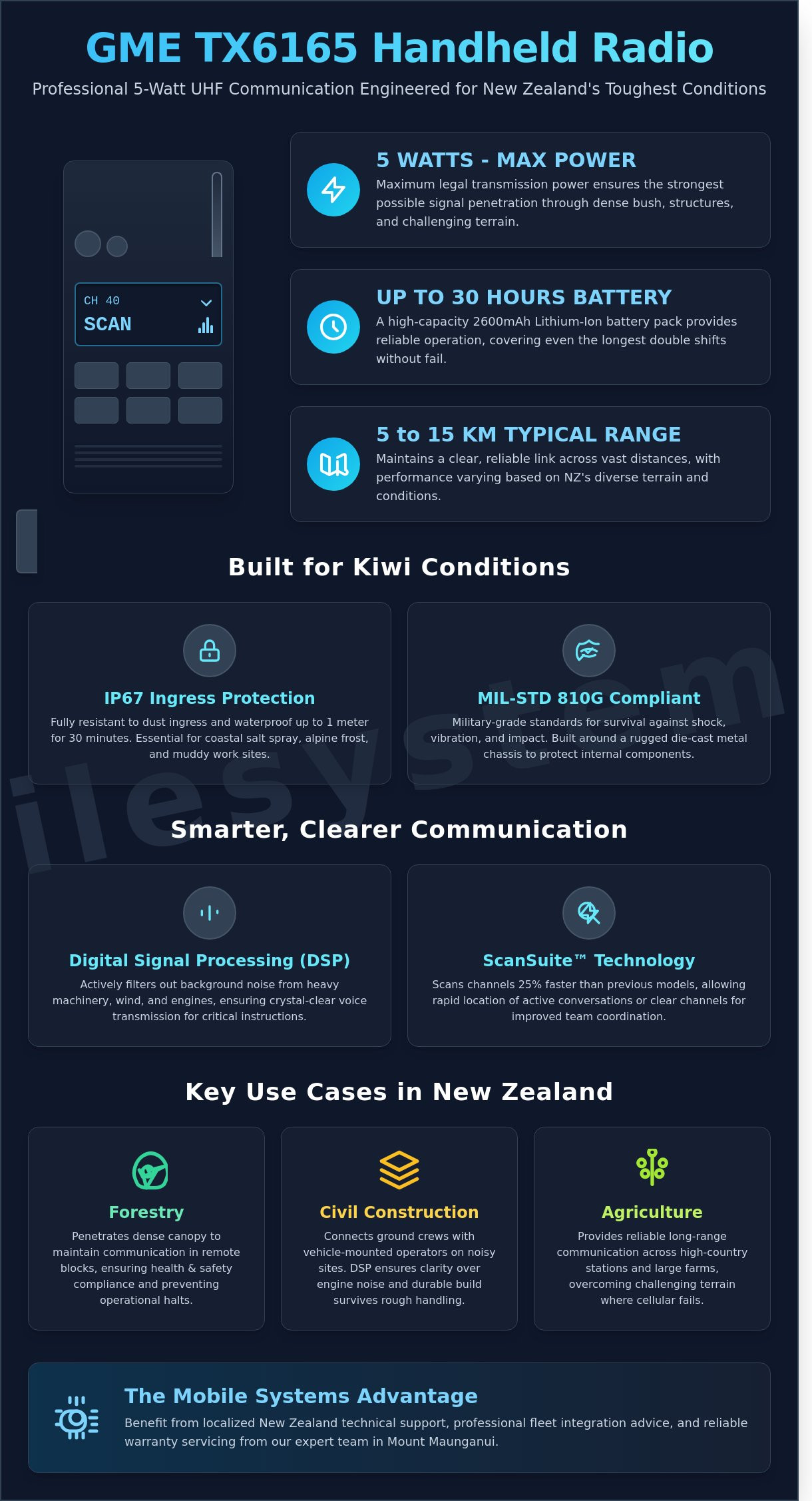
The GME TX6165 is a professional-grade 5-watt UHF CB handheld radio specifically engineered for high-stakes environments. It's built for those who require absolute reliability when communication failure is not an option. This GME TX6165 product review and best use cases guide highlights how the device provides a reliable 5km to 15km range, depending on the ruggedness of New Zealand terrain and local atmospheric conditions. In the dense bush or deep valleys of the Southern Alps, having this level of power is a safety requirement rather than a luxury.
Operating at 5 watts is critical for professional users. This is the maximum legal output for the UHF CB radio service in New Zealand, ensuring the strongest possible signal penetration through thick vegetation or steel-reinforced structures. While lower-powered units struggle with interference, the TX6165 maintains a clear link. The GME TX6165 stands as the industry benchmark for handheld UHF durability in 2026.
To see this hardware in action, watch this detailed video assessment:
First Impressions and Build Quality
The chassis feels substantial in the hand. It weighs approximately 315 grams with the battery attached, offering a sense of density that consumer-grade units lack. The buttons provide clear tactile feedback, which is essential when operators wear heavy work gloves on a construction site or in a forestry block. The Push-To-Talk button is textured and large, making it easy to locate by touch alone in low-light conditions.
The high-contrast backlit LCD is a standout feature for New Zealand contractors. It remains legible under the harsh mid-day sun and provides clear data during night operations or in the shadows of the bush. Most retail packs for the New Zealand market include a twin-antenna system. This allows users to switch between a flexible high-gain antenna for maximum distance and a compact stubby antenna. The stubby option is better for close-quarter work where a long antenna might snag on gear or machinery.
Key Specifications at a Glance
The device features full 80-channel UHF CB capability. It also allows for user-programmable extra channels between 450 and 520 MHz, which is useful for organizations with private commercial frequencies. Digital Signal Processing (DSP) is a core technical advantage. It filters out background noise from heavy machinery, diesel engines, or high winds. This ensures the recipient hears clear voice audio rather than static. This level of clarity is vital for maintaining safety standards on busy worksites.
ScanSuite technology changes how teams coordinate in the field. It scans channels 25 percent faster than previous models, making it easier to find active conversations or clear channels. This GME TX6165 product review and best use cases summary confirms that the hardware is designed for maximum efficiency. The 2600mAh lithium-ion battery typically provides up to 30 hours of operation, which covers even the longest double shifts. A tailored assessment often prevents costly mistakes when equipping a large team. If you need expert advice on fleet integration, seeking a professional consultation is crucial to prevent costly mistakes when equipping a large team.
Built for Kiwi Conditions: Engineering and Durability Standards
New Zealand's environment is notoriously harsh on electronic equipment. From the corrosive salt spray of the Bay of Plenty to the sub-zero frosts of the Southern Alps, gear must be resilient to survive. This GME TX6165 product review and best use cases analysis highlights how the unit’s engineering meets these specific local challenges.
The TX6165 is built around a rugged die-cast metal chassis. This internal frame protects sensitive circuit boards from the mechanical shock of a 1.5-metre drop onto concrete or rocky terrain. GME adheres to the MIL-STD 810G specification, which is a rigorous testing protocol used by the US military to ensure equipment survives vibration, impact, and thermal shock.
For New Zealand business owners, this durability translates to a lower total cost of ownership. A radio that survives five years of hard daily use provides a much higher return on investment than a cheaper consumer-grade alternative that fails after a single winter. Reliability in the field also ensures staff safety, as communication remains functional when it's needed most.
Ensuring your fleet remains compliant with local laws is vital for long-term operations. All GME units sold by Mobile Systems meet the technical standards set by Radio Spectrum Management (RSM). This compliance ensures your 5-watt transmissions don't interfere with critical services while providing the maximum legal range for a handheld unit.
Waterproofing and Dust Protection (IP67)
The IP67 rating signifies the unit is completely dust-tight and can withstand immersion in 1 metre of fresh water for up to 30 minutes. This is a critical feature for NZ forestry crews working in heavy rain or maritime support teams operating near the shoreline. The seals are engineered to prevent moisture ingress even during rapid temperature changes.
To maintain this protection over several years, we recommend inspecting the rubber seals around the battery and accessory port every six months. If the seals appear dry or cracked, replacing them immediately prevents expensive internal corrosion. A tailored assessment of your fleet's maintenance needs can often prevent these types of avoidable hardware failures.
Battery Performance in Cold Climates
Cold weather often drains standard batteries, but the 2600mAh Li-Ion pack in the TX6165 is designed for stability. In temperatures as low as -10°C, the high-capacity cells maintain consistent voltage output. This ensures your team isn't left without communication mid-shift during a Central Otago winter or on a high-country station.
The intelligent power-saving mode reduces current draw during standby periods, which often extends operational life to 15 or 20 hours. Mobile Systems recommends using genuine GME charging cradles for all fleet deployments. These cradles use specific charging profiles that prevent overcharging, which preserves the chemical health of the battery over hundreds of cycles.
By choosing the TX6165, you're investing in a tool designed for the reality of the New Zealand landscape. This GME TX6165 product review and best use cases guide demonstrates that when durability is a non-negotiable requirement, the engineering of this handheld radio stands apart from the competition.
Handheld vs. Fixed-Mount: When to Choose the TX6165
Choosing between a handheld and a fixed-mount unit depends on your specific operational environment. While a vehicle-mounted radio provides the maximum possible range, the GME TX6165 offers the portability required for ground-based tasks. This device acts as a critical link between a driver and personnel working outside the cabin, ensuring that communication doesn't stop when someone leaves the vehicle.
The TX6165 serves as an ideal bridge in complex workflows. In many New Zealand industries, a driver needs to coordinate with a spotter or a site manager. Having a handheld that shares the same 80-channel UHF CB frequencies as the vehicle's fixed radio ensures seamless coordination. This flexibility is a core component of this GME TX6165 product review and best use cases analysis.
Tactical Flexibility for Ground Teams
In New Zealand's agricultural and civil sectors, personnel frequently move away from their vehicles. For instance, during stock drafting or when a spotter guides heavy machinery on a Canterbury construction site, a fixed-mount radio is inaccessible. The TX6165 provides the mobility needed to stay in contact while moving across uneven terrain or through dense worksites.
One practical advantage is the high-power and low-power switchable modes. While the 5-watt maximum power is excellent for distance, switching to 1-watt for close-range communication significantly extends the life of the 2600mAh battery. Many teams enhance this setup by using portable communications accessories like remote speaker microphones. This allows the radio to stay protected on a belt or in a pocket while the user communicates clearly through a shoulder-mounted mic.
Range Limitations and External Antenna Options
Handheld radios face physical limitations compared to fixed-mount units. A standard handheld typically covers 2 to 5 kilometres in open terrain. However, in the deep valleys of the Southern Alps or dense bush, terrain masking can reduce this distance to less than 1 kilometre. A vehicle-mounted antenna sits higher and uses the vehicle's metal body as a ground plane, which naturally provides superior signal gain.
To mitigate these limitations, the TX6165 features a removable SMA connector. This allows users to attach an external magnetic vehicle antenna to the handheld. This simple addition can increase the effective range by 30% or more, making it a viable temporary solution for vehicle use without the need for a permanent XRS installation. For long-haul transport where range is the primary priority, a fixed-mount unit remains the standard, but the TX6165 is the best choice for short-range tactical coordination.
The TX6165 integrates effortlessly with existing two-way radio systems. In New Zealand, these devices operate under the General User Radio Licence for CB Radio. This legal framework, managed by Radio Spectrum Management, allows businesses to deploy these radios without the recurring costs or administrative delays of individual frequency licensing. This makes the TX6165 a cost-effective tool for scaling a fleet's communication capabilities quickly.
Deciding between handheld and fixed units often involves trade-offs in power and mobility. For most New Zealand businesses, a combination of both provides the most robust solution. A tailored assessment often prevents costly mistakes when determining the right mix of equipment for your specific site conditions.
Best Use Cases: Where the TX6165 Excels in New Zealand
Health and Safety at Work Act 2015 compliance remains the primary driver for professional radio adoption across New Zealand. For businesses operating in high-risk environments, the GME TX6165 isn't just a communication tool; it's a critical safety control. This GME TX6165 product review and best use cases analysis highlights how the device bridges the gap left by New Zealand's fragmented cellular network.
Mobile blackspots cover approximately 75% of the New Zealand landmass, making cellular reliance a dangerous gamble for rural teams. Reliable radio communication prevents lone worker incidents in remote blocks by providing an instantaneous link to base or colleagues. When a worker is isolated, the difference between a minor injury and a critical event often depends on the speed of the initial alert.
A tailored assessment of your specific site often prevents costly communication gaps before they occur. Mobile Systems Limited provides these evaluations to ensure your fleet configuration matches your unique topographical challenges. The TX6165 excels because it balances professional-grade power with the flexibility required for New Zealand's diverse industrial landscape.
Agriculture and High-Country Farming
High-country stations in the South Island require coordination across thousands of hectares where cellular towers don't reach. The TX6165 allows teams to manage muster operations effectively, ensuring every rider is accounted for during stock movements. Its 5-watt output provides the range necessary to push signals through deep gullies and over ridgelines.
Durability is essential when equipment is mounted on quad bikes or UTVs. The TX6165 withstands the constant vibration and fine dust common in summer farming operations. The dedicated Emergency button is a vital feature for isolated farm workers; it allows for an immediate distress signal even if the user is unable to conduct a full voice transmission.
Civil Construction and Traffic Management
In high-density urban projects across Auckland or Christchurch, clear communication prevents onsite accidents. Crane operators must have instant, lag-free coordination with ground crews to manage heavy lifts safely. The TX6165 uses advanced noise-cancelling technology to filter out the roar of heavy machinery, ensuring instructions are heard correctly the first time.
- Sub-channel Privacy: Use CTCSS or DCS tones to avoid interference from other nearby construction sites.
- Rugged Build: The IP67 ingress protection rating means the radio survives drops into mud or heavy rain on site.
- Battery Life: The 2600mAh battery easily outlasts a standard 12-hour shift, reducing downtime.
Forestry and Remote Resource Extraction
Forestry crews on the West Coast face some of the harshest working conditions in the country. The TX6165 plays a critical role in "calling the road," a safety protocol where logging truck drivers announce their position to avoid head-on collisions on narrow forest tracks. It's built to survive high-vibration environments and the extreme moisture levels typical of New Zealand bush.
For operations in the deepest valleys, we recommend integration with satellite solutions for a comprehensive remote safety net. This layered approach ensures that if a worker moves beyond radio range, they still have a lifeline to emergency services. This GME TX6165 product review and best use cases guide demonstrates that while the hardware is robust, its true value lies in how it integrates into a wider safety management system.
Ensuring your team stays connected in remote New Zealand environments requires expert planning. Contact Mobile Systems Limited for a professional site assessment to identify the best communication strategy for your business.
The Mobile Systems Advantage: Support and Servicing in NZ
Purchasing a GME TX6165 is more than a simple hardware transaction; it is a long-term investment in your team's operational safety. At Mobile Systems, we treat every radio as a critical component of a professional communication network. Operating from our specialized facility in Mount Maunganui, we provide the localized technical expertise and warranty support that overseas retailers cannot offer.
Our team understands the specific radio frequency (RF) challenges found in the New Zealand landscape. If a unit requires servicing or a warranty claim, our technicians manage the process directly from our Bay of Plenty base. This local presence reduces equipment downtime from weeks to days, ensuring your fleet remains active and your staff stay protected.
This GME TX6165 product review and best use cases analysis emphasizes that professional configuration is the difference between a tool and a toy. We don't just hand you a box; we ensure the device is optimized for the specific environment where you work, whether that is a high-rise construction site in Auckland or a remote forestry block in the central North Island.
Expert Installation and Fleet Programming
Standard "out of the box" settings are rarely sufficient for commercial applications. Most factory configurations use generic squelch levels that allow excessive background static, leading to user fatigue and missed calls. We calibrate your GME fleet to filter out this interference, ensuring only clear, actionable voice traffic reaches your team.
Security is another critical factor. We program custom channel naming and private frequencies to prevent "channel hopping" from nearby users. By labeling channels as "Site Office" or "Crane Op" instead of just numbers, your staff can navigate the system intuitively. You can learn more about our full service capabilities to see how we customize these units for maximum efficiency.
- Channel Customization: We implement specific alpha-numeric tags for easier fleet management.
- Squelch Optimization: Tailored settings prevent the TX6165 from opening the speaker to weak, distracting signals.
- Congestion Management: We select frequencies that minimize overlap with other local commercial operators.
Ongoing Maintenance and On-Site Support
Radio performance naturally changes over time due to environmental wear and battery degradation. A standard lithium-ion battery typically loses 20 percent of its effective capacity after 500 charge cycles. For a worker on a 12-hour shift, this loss can lead to a communication failure at a critical moment. We provide comprehensive battery health checks to ensure your power reserves meet your operational needs.
Our technicians also perform Voltage Standing Wave Ratio (VSWR) testing on antennas to ensure the TX6165 is transmitting at its full 5-watt potential. For organizations with large fleets, our mobile support vehicles offer on-site diagnostics across the country. This proactive approach prevents small issues from becoming expensive failures. For complex requirements or fleet audits, contact our team for a professional consultation.
As we move through 2026, the GME TX6165 remains the most robust handheld choice for New Zealand businesses. Its IP67 rating and 5-watt output provide the foundation, but the support from Mobile Systems provides the reliability. Choosing a partner who understands the NZ market ensures your communication system is an asset, not a liability.
Optimising Your Fleet Communications for 2026
The GME TX6165 remains a benchmark for 5-watt handheld performance in New Zealand. Its IP67 ingress protection ensures reliability in the high-moisture environments typical of Waikato forestry or South Island high-country stations. Choosing this model means investing in a device that meets rigorous OSH-compliant communication standards, reducing workplace safety risks through better site coordination.
This GME TX6165 product review and best use cases analysis highlights why local businesses prefer professional-grade hardware over consumer alternatives. While the investment reflects its rugged engineering, the 5-year warranty provides a lower total cost of ownership through 2030. It's a practical choice for teams that can't afford signal failure in remote areas.
As a GME Authorized NZ Dealer, Mobile Systems Limited provides more than just hardware. Our fleet of on-site mobile support vehicles delivers technical expertise directly to your yard or job site. Contact Mobile Systems for a tailored fleet communication assessment to ensure your team stays connected when it matters most.
Reliable communication is the backbone of any successful field operation, and we're ready to help you build a system that lasts.
Frequently Asked Questions
What is the real-world range of the GME TX6165 in NZ terrain?
In typical New Zealand bush or hilly terrain, you can expect a reliable range of 2 to 5 kilometres. On open ground with a clear line-of-sight, this distance often extends to 15 kilometres or more. Factors like canopy density and weather conditions influence performance, but the 5-watt output ensures the TX6165 remains a top performer for this GME TX6165 product review and best use cases analysis.
Is the GME TX6165 waterproof enough for NZ forestry work?
Yes, the TX6165 carries an IP67 ingress protection rating, which means it's fully dust-tight and waterproof. It can withstand immersion in up to 1 metre of water for 30 minutes. This rating makes it ideal for the high-rainfall environments of New Zealand forestry sites where mud and heavy downpours are daily challenges for equipment.
How long does the TX6165 battery last during a standard workday?
The 2600mAh lithium-ion battery provides up to 30 hours of operating time under standard conditions. For a typical 10-hour commercial shift, this leaves a 60% safety margin. If you're using high-power transmissions frequently, the battery still comfortably lasts the full day without needing a midday charge.
Can I use the TX6165 with other brands of UHF radios?
You can use the TX6165 with any other brand of UHF radio that operates on the 80-channel narrow-band standard. This includes brands like Uniden, Icom, or Motorola. As long as the other units are tuned to the same frequency and don't have proprietary encryption active, communication is seamless across your entire fleet.
Does the GME TX6165 require a license to operate in New Zealand?
No individual license is required to operate the GME TX6165 on the 80 UHF PRS channels in New Zealand. These frequencies fall under the General User Radio License, which allows anyone to use the equipment for personal or commercial purposes. If you require private frequencies for high-security commercial work, Mobile Systems Limited can assist with specialized licensing requirements.
What accessories are essential for using the TX6165 in a commercial fleet?
For commercial fleets, the MC007 heavy-duty speaker microphone and a BCV007 vehicle cradle are essential. The speaker mic allows operators to communicate without removing the radio from their belt, which reduces the 15% risk of accidental drops. A vehicle-based rapid charger ensures the unit stays at 100% capacity during long transit times between job sites.
How does the TX6165 compare to the GME XRS-660 handheld?
The TX6165 is a rugged, straightforward workhorse, whereas the XRS-660 includes Bluetooth connectivity and app integration. While the XRS-660 offers GPS tracking and software customization, the TX6165 is often preferred by crews who want a tactile, simple interface without extra digital complexity. Both units share the same 5-watt power and IP67 durability for this GME TX6165 product review and best use cases comparison.
What happens if I drop my TX6165 on a concrete construction site?
The TX6165 features a die-cast metal chassis designed to survive impacts from a height of 1.2 metres onto hard surfaces. If dropped on a concrete construction site, the reinforced casing absorbs the energy to protect the internal circuitry. We recommend a protective leather case to prevent cosmetic scuffs and further improve the unit's 5-year lifespan in harsh environments.
Related posts

- May 24, 2026
Our expert Starlink review NZ looks at speed, pricing, and reliability for business, farm, and maritime use. See if it's...

- May 23, 2026
Approximately 40% of New Zealand's landmass remains outside the reach of traditional mobile networks. For professional teams operating in remote...

- May 14, 2026
A complete guide to Starlink setting up for NZ businesses. Learn pro tips on site survey, mounting, network integration, and...