
Personal Locator Beacon NZ: The Definitive Professional Guide (2026)
Would your current emergency device actually transmit a signal through the dense canopy of the Ureweras or the deep valleys of the Southern Alps? You likely understand that in New Zealand’s rugged backcountry, the line between having reception and not is thin.
Would your current emergency device actually transmit a signal through the dense canopy of the Ureweras or the deep valleys of the Southern Alps? You likely understand that in New Zealand’s rugged backcountry, the line between a manageable incident and a tragedy often depends on a single button press. Many professionals mistakenly believe their satellite messenger offers the same rescue certainty as a dedicated personal locator beacon nz, but these technologies operate on entirely different satellite networks with varying levels of signal penetration.
You need total confidence that your distress signal will reach the Rescue Coordination Centre New Zealand (RCCNZ) without delay or subscription failures. We've developed this resource to clarify the technical differences between PLBs and messaging devices, ensuring your gear meets the 406 MHz Cospas-Sarsat standards. You'll gain a clear understanding of NZ-specific coding requirements and how to maintain compliance with local health and safety regulations for remote workers.
We'll examine the latest 2026 hardware innovations designed for heavy canopy environments and provide a step-by-step framework for correct device registration. This guide ensures your team is equipped with the most reliable signaling technology available in the New Zealand market.
Key Takeaways
- Understand the technical superiority of the 406 MHz Cospas-Sarsat system over commercial satellite messengers for life-critical emergency situations.
- Learn how to select the optimal personal locator beacon nz based on your specific operational environment, from the Southern Alps to coastal maritime regions.
- Discover the critical legal requirements for registration with Beacons NZ and how accurate data significantly accelerates search and rescue response times.
- Evaluate advanced professional features such as Return Link Service (RLS) and ruggedness ratings to ensure your device performs in New Zealand's harshest conditions.
- Identify how to integrate PLBs into a multi-layered remote communication strategy alongside satellite phones and two-way radios for comprehensive safety.
Understanding Personal Locator Beacons (PLBs) in the New Zealand Context
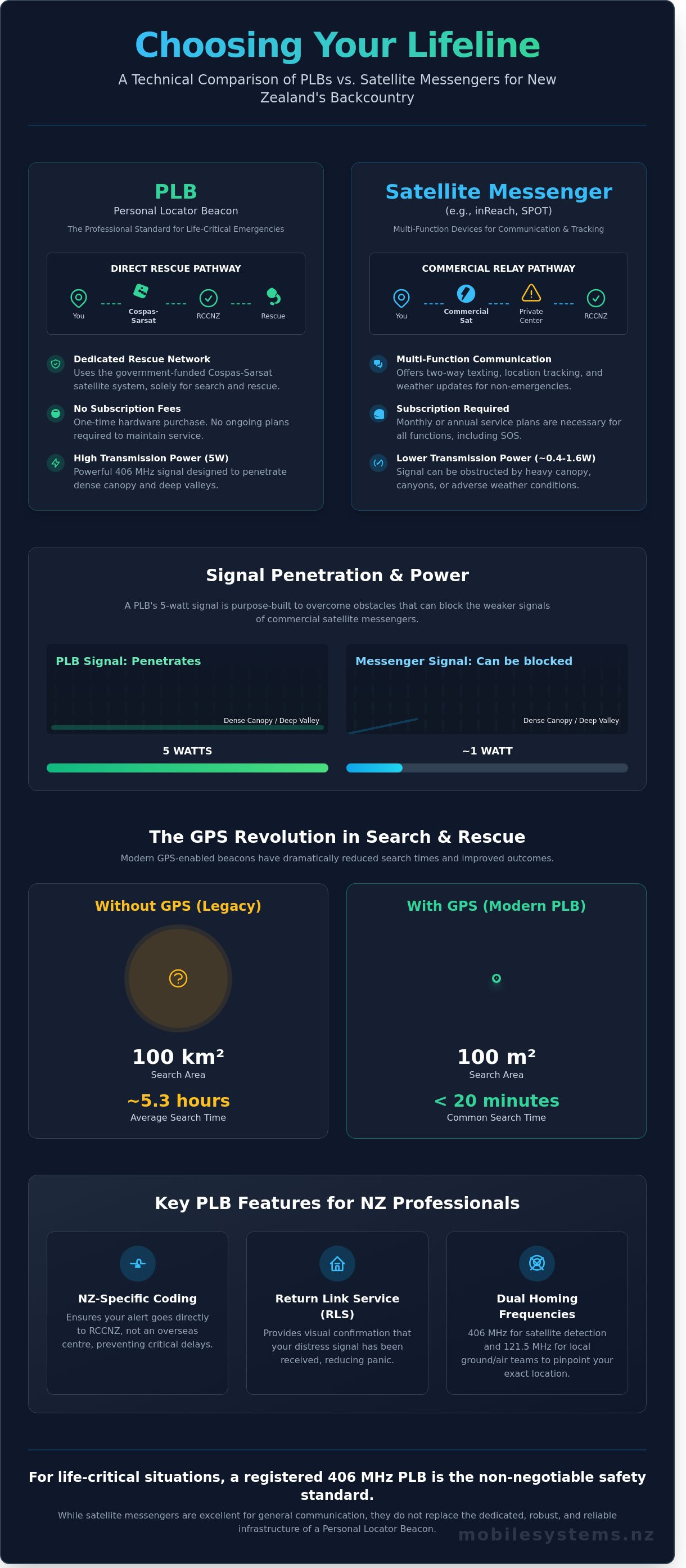
A Personal Locator Beacon (PLB) is a high-powered, 406 MHz distress radio beacon designed specifically for individual use in life-threatening situations. Unlike consumer-grade messaging devices or mobile phones, these units connect directly to the Cospas-Sarsat satellite system, an international network dedicated to search and rescue. A PLB is a dedicated emergency transmitter that bypasses commercial cellular and satellite networks for direct rescue coordination.
Investing in a personal locator beacon nz is the single most important safety decision for anyone working or recreating in the backcountry. The "Personal" designation is vital; it distinguishes these compact units from EPIRBs used in maritime environments and ELTs used in aviation. While they share similar technology, a PLB is small enough to be carried on a belt or in a pocket, ensuring it remains with the individual if they become separated from their vehicle or vessel.
To better understand this concept, watch this helpful video:
The Role of the Rescue Coordination Centre NZ (RCCNZ)
The Rescue Coordination Centre NZ (RCCNZ) manages all beacon activations within the New Zealand Search and Rescue Region. This area is vast, covering approximately 30 million square kilometres from the Pacific Islands to the Antarctic. When a beacon is activated, RCCNZ receives the alert via satellite and immediately begins verifying the emergency and identifying the owner through the national beacon registry.
The response process is highly efficient. Once a signal is confirmed, RCCNZ coordinates the deployment of specialized assets such as LandSAR ground teams or Westpac Rescue Helicopters. The speed of this response depends heavily on the registration of the device. NZ-specific coding on your beacon is critical because it ensures the alert is routed directly to RCCNZ rather than an overseas agency, preventing delays in the rescue chain.
How the 406 MHz Satellite System Operates
The technical superiority of a personal locator beacon nz lies in its 406 MHz frequency. This high-powered signal is designed to penetrate heavy forest canopy and withstand atmospheric interference better than lower-frequency consumer devices. While cellular signals often fail in deep valleys or remote bush, the 406 MHz transmission is specifically tuned for satellite detection from almost any location on Earth.
- 406 MHz Signal: Provides the primary alert and location data to global satellites.
- 121.5 MHz Homing: A secondary, lower-power signal that allows ground rescue teams to "home in" on your exact position once they arrive in the area.
- GPS Integration: Modern GPS-enabled units include precise coordinates in the initial burst.
The inclusion of GPS technology has revolutionised search and rescue outcomes. In the past, non-GPS beacons provided a search area of roughly 100 square kilometres, often requiring an average search time of 5.3 hours. Modern GPS-enabled beacons narrow this search area to approximately 100 square metres. This precision has reduced search times from several hours to under 20 minutes in many documented New Zealand cases.
PLB vs. Satellite Messengers (SEND): Navigating the Technical Trade-offs
Choosing between a Personal Locator Beacon (PLB) and a Satellite Emergency Notification Device (SEND) isn't just a matter of picking features. These devices operate on fundamentally different infrastructures with varying levels of reliability. A personal locator beacon nz connects directly to the Cospas-Sarsat network, a global, government-funded satellite system dedicated solely to search and rescue. In contrast, SEND devices like the Garmin inReach or SPOT use commercial satellite constellations such as Iridium or Globalstar. While commercial networks allow for two-way texting, they don't offer the same raw rescue priority as the 406 MHz frequency used by PLBs.
The technical gap is most evident in transmission strength. A professional-grade PLB transmits a 5-watt burst signal on the dedicated 406 MHz emergency frequency, while typical satellite messengers are limited to a ~1.6-watt output on commercial L-band frequencies. This extra power is often the deciding factor when trying to reach a satellite from the bottom of a steep ravine or through heavy cloud cover. Understanding the difference between a PLB and SEND is essential for anyone heading into the New Zealand backcountry, where terrain frequently blocks weaker signals.
When to Choose a Dedicated PLB
For high-risk solo remote work or professional forestry and agricultural operations, a PLB is the only acceptable safety standard. It operates as a "set and forget" tool, requiring no active subscription to function. Once you register the device with the Rescue Coordination Centre New Zealand (RCCNZ), it's ready for life-saving use for the duration of its battery life. This makes PLBs an ideal choice for long-term fleet management, as businesses avoid the recurring monthly costs of NZ$20 to NZ$100 per device common with commercial plans.
The battery shelf life of a PLB is another significant advantage. Most units are designed to sit in a pack or vehicle for 5 to 7 years without needing a charge. You don't have to worry about the device being flat when an emergency occurs. If your primary goal is survival rather than social check-ins, the reliability of a dedicated PLB is unmatched.
The Limitations of Commercial Satellite Messengers
Satellite messengers offer excellent logistical convenience through two-way messaging, but they rely on active subscriptions. If a credit card payment fails or a subscription lapses, the SOS functionality on a SEND device can be disabled by the provider. This introduces a commercial gatekeeper into a life-or-death situation. Additionally, the lower 1.6-watt power output means these devices struggle with signal attenuation in deep bush or narrow valleys.
Two-way messaging should be treated as a secondary "convenience" function rather than a primary survival tool. While it's helpful for coordinating non-emergency pickups, it doesn't replace the robust, high-power link provided by a PLB. A tailored assessment of your communication needs often prevents costly mistakes when equipping a team for remote New Zealand environments. Relying on a commercial messenger in high-stakes terrain requires an understanding of these power and subscription-based risks.
Selecting the Right Beacon for NZ’s Unique Remote Environments
New Zealand's geography presents distinct challenges for satellite signaling. A personal locator beacon nz must perform across diverse micro-climates and topographies. Mobile Systems Limited recommends assessing the specific terrain of your operations before finalizing a fleet purchase. A beacon that works on a flat coastal plain may struggle in the deep shadows of the Southern Alps.
High-altitude operations require devices that handle extreme cold and rapid pressure changes. In contrast, teams working in dense native forests, such as the Ureweras or the West Coast, need high-gain antennas to punch through heavy canopy. Coastal maritime workers face constant salt corrosion and submersion risks, making buoyancy and IP68 ruggedness ratings non-negotiable for their survival gear.
Weight and size are critical for workers already carrying heavy equipment or tool belts. Modern professional units weigh under 150 grams, ensuring they don't become a burden that gets left in the vehicle. Choosing a device that balances a small footprint with a large, glove-friendly activation button is a practical necessity for New Zealand's winter conditions.
Essential Features for Professional Beacons
Return Link Service (RLS) is a critical advancement for professional safety. It uses the Galileo satellite network to send a signal back to the beacon, activating a dedicated blue light. This confirms the distress message was received by rescue coordinators. It effectively reduces the psychological stress for an injured worker waiting in isolation, as they know help is definitely on the way.
Professional fleets should generally avoid user-replaceable batteries. While they seem convenient, they often compromise the waterproof seal during DIY changes. Factory-sealed units typically offer a 7 to 10 year shelf life. This ensures the device remains airtight and functional when it's needed most. It's a small trade-off for guaranteed structural integrity in the field.
Consider how the device integrates with existing gear. A beacon tucked at the bottom of a pack is useless during a sudden fall or flash flood. Look for dedicated holsters that attach securely to life jackets, fall-arrest harnesses, or vehicle interiors. Quick-release mechanisms allow the user to activate the device without removing their gloves or primary safety equipment.
Commercial vs. Recreational Grade Equipment
Industrial users shouldn't rely on entry-level recreational units. Professional-grade hardware utilizes multi-constellation GPS, pulling data from Galileo, Glonass, and GPS networks simultaneously. This provides a precise location fix in 30 to 60 seconds. This speed is vital in deep ravines or steep valleys where a single-network device might struggle to find a signal for several minutes.
Night rescues are common in New Zealand's rugged backcountry. Professional beacons feature high-intensity LED strobes and high-visibility yellow or orange casings. These features ensure rescuers can spot a worker in low-light conditions or heavy bush. For teams requiring specialized hardware, browsing Portable Communications & GPS options ensures the gear meets commercial durability standards.
Choosing the wrong grade of equipment often leads to higher long-term costs due to device failure in harsh environments. Investing in ruggedized, multi-constellation units provides the reliability required for health and safety compliance. If you're unsure which model fits your specific industry, contact our technical team for a fleet assessment.
Compliance, Registration, and Maintenance Standards for NZ Users
In New Zealand, every 406 MHz beacon must be registered with Beacons NZ, which is operated by Maritime NZ. This is a legal requirement under Maritime Rules. Registration is free and can be completed online in minutes. It's the only way to ensure the signal is linked to your specific identity and vessel or vehicle details.
When you register your personal locator beacon nz, you provide critical data that helps the Rescue Coordination Centre NZ (RCCNZ). This includes your emergency contact details and relevant medical notes. Having this information on hand can reduce search times by up to 60 minutes, as authorities don't have to spend time identifying who owns the device or what specific needs the person might have.
Regular maintenance is non-negotiable for life-saving equipment. You should perform a monthly self-test using the dedicated button on your device. This protocol checks the internal circuitry, battery health, and signal transmission without alerting emergency services. For commercial operators, a physical inspection by a qualified technician is required every 24 months to ensure the unit meets Health and Safety at Work Act standards.
The Registration Process Step-by-Step
Start by locating your 15-character Hex ID, also known as the Unique Identification Number (UIN). You'll find this on the device casing or the original packaging. If you manage a commercial fleet, you must update these records whenever there's staff turnover to ensure contact people are always reachable during an incident.
- Visit the Beacons NZ website to create a secure account.
- Enter the 15-character Hex ID and your primary activity type.
- List at least two emergency contacts who are likely to know your typical routes.
- Apply the physical "proof of registration" sticker to your device once it arrives in the mail.
These stickers are vital for workplace safety audits. They provide immediate proof to inspectors that your equipment is compliant, traceable, and currently registered within the national database.
Battery Maintenance and Disposal
Every personal locator beacon nz has a specific battery expiry date printed on the unit. Using an expired unit is a significant risk. Over time, lithium batteries lose the peak voltage required to transmit a signal through dense forest canopy or in extreme Southern Alps temperatures. Most professional units require battery replacement every five to seven years.
Never throw old beacons in the general rubbish. Compacting equipment in landfills can cause lithium fires or accidental activation, leading to costly and unnecessary search operations. Mobile Systems provides full technical support for fleet maintenance, including scheduled battery replacements and signal strength verification. We track battery cycles for our clients to ensure no device in the field is ever out of date.
A tailored assessment of your fleet's compliance status often prevents costly regulatory mistakes. Contact the Mobile Systems team to discuss your maintenance schedule.
Integrating PLBs into a Comprehensive Remote Communication Strategy
A personal locator beacon nz shouldn't be viewed as a standalone solution for field teams. While it's the most reliable tool for life-saving intervention, it's a one-way, binary device. It tells rescuers where you are, but it can't tell them what's wrong or allow you to manage daily operational risks. Effective remote safety relies on redundancy. Relying solely on a PLB often leads to "SOS abuse," where workers activate a beacon for non-life-threatening issues like a vehicle breakdown because they've no other way to call for help.
A layered approach ensures your team can communicate throughout the entire risk spectrum. By implementing a "Primary, Secondary, Emergency" (P.S.E.) plan, you provide staff with the tools to solve minor problems before they escalate into search and rescue operations. This strategy reduces downtime and ensures that emergency services are only engaged when a life is truly at risk.
The Hierarchy of Remote Communication
Professional organizations in New Zealand use a tiered framework to ensure continuous connectivity. This hierarchy prevents communication gaps in deep terrain or during cellular outages. It's the standard for high-risk industries like forestry, civil engineering, and conservation.
- Primary: Two-way radios or UHF/VHF systems serve as the foundation. These allow for instant, cost-free coordination between team members. For large-scale operations, Tait Radios provide the ruggedness required for New Zealand's demanding environments.
- Secondary: Satellite phones fill the gap when you're out of radio range. They're essential for detailed status reporting, requesting mechanical support, or updating logistics without triggering a national rescue response.
- Emergency: The PLB is the final link. It's a dedicated life-saving tool reserved for situations where there's an immediate threat to life and other systems have failed.
Training and Deployment Protocols
Deploying hardware is only half the battle. Your health and safety policy must clearly define activation triggers. RCCNZ coordinates over 800 incidents annually, and false alarms can account for a high percentage of beacon activations. This diverts vital resources away from actual emergencies. Training staff on when not to activate a beacon is just as important as showing them how to use it.
Staff must understand the "Line of Sight to Sky" rule. In New Zealand's deep bush or steep ravines, a 406MHz signal needs the clearest possible path to the horizon to reach a satellite quickly. Training should include moving to higher ground or a clearing before activation if the injury allows. This simple step can reduce rescue response times by 30 minutes or more.
Integrating these devices into lone-worker check-in procedures is vital for compliance under the Health and Safety at Work Act 2015. A personal locator beacon nz provides the ultimate safety net, but a tailored assessment from a specialist often prevents costly mistakes in remote safety procurement. We help you choose the right mix of technology to keep your team protected and your business compliant.
Securing Your Remote Operations for 2026
Choosing the right personal locator beacon nz ensures your team remains connected to emergency services in the most isolated regions. Reliability hinges on deploying NZ-coded hardware that adheres to current Cospas-Sarsat standards. Proper registration with the Rescue Coordination Centre New Zealand isn't just a legal requirement; it's the difference between a rapid recovery and a delayed response.
Professional safety strategies now require a calculated balance between the dedicated rescue power of a PLB and the operational flexibility of satellite messengers. Mobile Systems Limited provides nationwide support as an authorized dealer for leading brands. We specialize in commercial fleet communication integration, ensuring your gear works when it's needed most.
A tailored assessment often prevents costly mistakes. Contact our expert team at Mobile Systems Limited for a professional remote safety consultation.
Equipping your staff with the correct tools today builds a foundation of confidence for every remote project.
Frequently Asked Questions
Do I need a subscription for a personal locator beacon in NZ?
You don't need a subscription or any ongoing monthly fees for a personal locator beacon nz users purchase locally. These devices operate on the 406 MHz frequency and communicate directly with the Cospas-Sarsat international satellite system at no cost to the owner.
This makes a PLB a cost-effective safety investment compared to satellite messengers. While messengers require active plans that can cost NZ$25 to NZ$100 per month, a PLB is a one-off purchase that remains ready for use for up to a decade.
Can I use an overseas-purchased PLB in New Zealand?
You can use an overseas beacon in New Zealand, but it must be registered in its country of origin. Each beacon has a unique 15-digit HEX ID coded to a specific country. If you activate a US-coded device in the Southern Alps, the distress signal goes to the US Coast Guard first before being routed back to New Zealand.
We recommend buying a New Zealand-coded unit to ensure the Rescue Coordination Centre NZ (RCCNZ) receives your data directly. This direct communication can save vital minutes during a Category 1 search and rescue operation.
What happens if I accidentally activate my PLB?
Switch the device off immediately and contact the Rescue Coordination Centre NZ at 0508 472 269. There are no fines for genuine accidents in New Zealand as long as you report the mistake promptly to prevent emergency services from launching a full-scale search.
In 2023, roughly 25% of activations were non-distress related. Quick communication allows authorities to stand down Westpac Rescue Helicopters or LandSAR teams before they leave the hangar or base, saving thousands of dollars in public resources.
How long does the battery last on a typical PLB?
A typical personal locator beacon nz retailers provide features a battery life of 7 to 11 years in standby mode. Once the device is activated in an emergency, it's required by international standards to transmit for a minimum of 24 hours continuously.
You should check the expiry date printed on the side of your unit every 12 months. Most modern units, such as those from ACR or Ocean Signal, perform a self-test to confirm battery health and internal circuitry are functioning correctly.
Is a PLB better than a Garmin inReach for emergency use?
A PLB is superior for life-safety SOS situations because it transmits at 5 watts of power. In contrast, satellite messengers like the Garmin inReach typically transmit at about 1.6 watts. The higher power of a PLB is more effective at punching through thick cloud cover or heavy foliage.
PLBs also use a dedicated network of search and rescue satellites rather than commercial networks. While you lose the ability to send casual "I'm okay" texts, you gain a more robust link to emergency services that doesn't rely on a paid subscription.
Do PLBs work in deep bush or under heavy tree canopy?
PLBs work under tree canopies, but the signal may take longer to reach a satellite compared to an open ridge. Wet foliage and deep canyons are the most challenging environments for any satellite-based communication device.
For the best performance, try to find a clearing or move to higher ground if possible. Modern 406 MHz beacons use multi-constellation GNSS sensors to acquire a location fix much faster than older models, even in difficult terrain.
How do I register my new beacon with Maritime NZ?
You register your beacon for free through the Maritime NZ online portal at beacons.org.nz. You'll need to provide your 15-character HEX ID, your personal contact details, and the phone numbers of at least two emergency contacts.
Registration is a legal requirement under New Zealand maritime rules and is critical for rescue teams. An updated registration profile can reduce the time it takes to identify your location and needs by up to 60 minutes.
Can I take a PLB on a commercial flight in New Zealand?
You can carry a PLB on domestic flights, but it must be kept in your carry-on luggage. Because these devices contain lithium metal batteries, airline safety regulations prohibit them from being stored in checked-in suitcases.
Ensure the unit is stored in a way that prevents accidental activation during the flight. Most PLBs have a physical guard or a two-step activation process to meet these safety requirements for air travel.
Related posts

- May 24, 2026
Our expert Starlink review NZ looks at speed, pricing, and reliability for business, farm, and maritime use. See if it's...

- May 23, 2026
Approximately 40% of New Zealand's landmass remains outside the reach of traditional mobile networks. For professional teams operating in remote...

- May 14, 2026
A complete guide to Starlink setting up for NZ businesses. Learn pro tips on site survey, mounting, network integration, and...