
PLB vs Satellite Messenger Safety: Choosing the Right Device for the NZ Bush
If you found yourself immobilised in a deep West Coast valley, would you trust your life to a device designed for social messaging or one built solely for global search and rescue?
If you found yourself immobilised in a deep West Coast valley, would you trust your life to a device designed for social messaging or one built solely for global search and rescue? Many adventurers assume that modern connectivity guarantees a rescue, but the technical reality of PLB vs satellite messenger safety depends entirely on the terrain and whether you are using the 406 MHz COSPAS-SARSAT network or a private commercial constellation.
You likely understand that carrying some form of emergency communication is non-negotiable in the New Zealand bush. However, the confusion over monthly subscription fees and the fear of a signal failing to penetrate thick canopy can make it difficult to choose the right gear. It's frustrating when you're trying to balance cost against the absolute reliability required in a life-or-death situation.
This guide provides a technical breakdown of how these devices operate within the unique New Zealand landscape. As specialists in radio and satellite technology, we've analysed how each system interacts with local emergency services so you can invest in a tool that won't fail when it matters most.
We'll compare signal reliability across different terrains, explain the Rescue Coordination Centre New Zealand (RCCNZ) chain of command, and help you decide which technology fits your specific outdoor activities.
Key Takeaways
- Understand why the 5-watt transmission power of a PLB provides superior signal penetration through dense New Zealand canopy compared to lower-powered commercial messengers.
- Evaluate PLB vs satellite messenger safety by comparing the reliability of government-monitored emergency networks against the convenience of two-way messaging.
- Identify which device best meets the legal requirements of the New Zealand Health and Safety at Work Act for commercial remote workers and high-risk soloists.
- Learn how to correctly register and link your device to New Zealand emergency contacts to ensure a rapid and coordinated rescue response.
- Discover the proper protocols for performing device self-tests to ensure equipment readiness without accidentally triggering an emergency rescue operation.
Meta Description: Compare PLB vs satellite messenger safety for NZ conditions. Learn the technical differences between SOS beacons and two-way messaging for remote adventures. URL Handle: plb-vs-satellite-messenger-nz
Understanding the Core Difference: What are PLBs and Satellite Messengers?
In the remote reaches of the Southern Alps or the dense bush of the Urewera, cellular coverage vanishes. For anyone venturing into these "black spots," the choice between a PLB vs satellite messenger safety depends on your specific risk profile. Both devices bridge the gap where your smartphone fails, but they serve different roles. One is a dedicated emergency tool, while the other is a versatile communication hub. Understanding these technical distinctions is the first step toward making an informed safety investment.
New Zealand's geography presents unique challenges for radio and satellite signals. High mountain peaks and deep valleys can obstruct line-of-sight to satellites. Because of this, the reliability of your device's network is just as important as the device itself. A Personal Locator Beacon (PLB) is designed for one purpose: to signal for help in a life-threatening situation. Conversely, satellite messengers allow for non-emergency check-ins, weather updates, and two-way texting with family or colleagues.
The PLB: A Dedicated Lifeline
A Personal Locator Beacon is a high-powered device that operates on the 406 MHz frequency. This frequency is reserved globally for search and rescue operations. When you activate a PLB, it transmits a powerful 5-watt signal directly to the Cospas-Sarsat satellite system. This is an international, government-funded network. In New Zealand, this alert goes straight to the Rescue Coordination Centre New Zealand (RCCNZ), which manages all major search and rescue responses across the country.
The technical foundation of these devices is shared with the Emergency position-indicating radio beacon (EPIRB) used in maritime environments. Unlike messengers, PLBs don't require any ongoing subscription fees. Once you buy the unit, it's yours to use for the life of the battery, which typically lasts 5 to 7 years. This makes them a cost-effective choice for trampers or hunters who only want a "break glass in case of emergency" solution without monthly overheads.
- Direct Government Link: Alerts go to RCCNZ, not a private call center.
- No Subscriptions: You pay once for the hardware, with no recurring NZ$ costs.
- High Power: The 5-watt output is significantly stronger than messenger signals.
- Battery Life: Designed to remain dormant for years but work instantly when triggered.
The Satellite Messenger: A Communication Hub
Satellite messengers, such as the Garmin inReach or SPOT series, use commercial satellite constellations like Iridium or Globalstar. These devices are lower-powered, typically around 1.6 watts, but they offer the advantage of two-way communication. This allows you to confirm that help is on the way or tell a contact that you're running late but are otherwise safe. This "peace of mind" feature is why many professionals choose them for PLB vs satellite messenger safety in the field.
These devices require an active subscription to function. Depending on the plan, you might pay between NZ$25 and NZ$100 per month. If you stop paying, the device becomes a paperweight. Furthermore, when you trigger an SOS on a messenger, the signal first reaches a private monitoring center, such as the International Emergency Response Coordination Center (IERCC). They verify the emergency before contacting New Zealand authorities to initiate a rescue. This extra step is brief but represents a different chain of command compared to a PLB.
- Two-Way Messaging: You can send and receive texts, which is vital for coordinating non-life-threatening logistics.
- Tracking Features: Friends can follow your progress on a live map in real-time.
- Subscription Dependent: Requires a valid NZ$ monthly or annual payment plan.
- Private Routing: Alerts pass through a commercial intermediary before reaching NZ emergency services.
At Mobile Systems Limited, we've seen that the best choice often comes down to how often you're off the grid. If you're a casual hiker, a PLB offers simplicity and reliability. If you're managing a remote work crew or embarking on multi-week expeditions, the communication features of a messenger are often indispensable. A tailored assessment of your typical terrain and team size often prevents costly mistakes in your safety kit.
Technical Reliability: Signal Strength and Satellite Constellations
The fundamental difference in PLB vs satellite messenger safety lies in raw transmission power. A Personal Locator Beacon (PLB) transmits a distress signal at 5 watts, which is significantly more powerful than the 1.6 watts typically found in satellite messengers. This power gap isn't just a technical specification; it's a critical safety factor when you're pinned down in difficult terrain.
In the dense, wet canopy of the New Zealand bush, signal attenuation is a major hurdle. The 406 MHz frequency used by PLBs is specifically designed to penetrate heavy foliage and cloud cover. While a messenger might struggle to find a gap in the trees, the 5-watt burst from a PLB is more likely to "punch through" to the overhead satellite network.
Reliability also extends to the "last mile" of a rescue operation. Every PLB includes a secondary 121.5 MHz homing signal. When LandSAR teams or rescue helicopters arrive in your general vicinity, they use directional finders to lock onto this low-frequency pulse. This allows rescuers to pinpoint your exact location even if you're hidden under a thick forest ceiling or tucked inside a deep ravine where GPS coordinates may fluctuate.
Battery architecture represents another vital distinction. PLBs utilize high-capacity lithium metal batteries with a shelf life of 5 to 7 years. These devices are designed to sit in a pack for years and still provide 24 hours of continuous transmission in sub-zero temperatures. Satellite messengers use rechargeable lithium-ion batteries. These require regular maintenance and lose their charge much faster, especially when the device is constantly "searching" for a signal in deep valleys.
Government vs. Commercial Satellites
PLBs operate on the Cospas-Sarsat system, a global, non-commercial network managed by international treaty. This system is monitored 24/7 by government agencies like the Rescue Coordination Centre New Zealand (RCCNZ). Because it's a dedicated search and rescue network, your distress signal is prioritized instantly without passing through a third-party commercial dispatch centre.
Some satellite messengers utilize the Iridium constellation. This network offers true pole-to-pole coverage, which is essential for missions in the Southern Alps. Other satellite communication devices use the Globalstar network. In New Zealand, users of devices on the Globalstar network must be aware of satellite "pass" timing, as coverage can occasionally be intermittent depending on your specific latitude and the surrounding topography.
According to the NZ Department of Conservation beacon advice, choosing the right device depends heavily on your intended environment. For those entering remote areas where communication is secondary to survival, the government-backed reliability of a PLB is often the preferred standard.
Signal Obstructions in NZ Terrain
New Zealand’s geography presents unique challenges for "line-of-sight" satellite connections. In deep gorges or steep-sided valleys, the "view" of the sky is restricted. A satellite messenger needs to maintain a consistent connection to transmit data packets, which can be difficult if the device only sees a small sliver of the horizon.
A PLB's higher power output allows the signal to reflect off rock faces and terrain more effectively. While both device types perform best with a clear view of the sky, the PLB is engineered to function in the "worst-case" scenario. This technical resilience is why many professionals carry a PLB as a fail-safe alongside a messenger for daily check-ins.
Selecting the right hardware for your specific region is a critical step in trip planning. Seeking expert advice for a tailored assessment of your typical routes often prevents costly mistakes when investing in life-safety equipment.
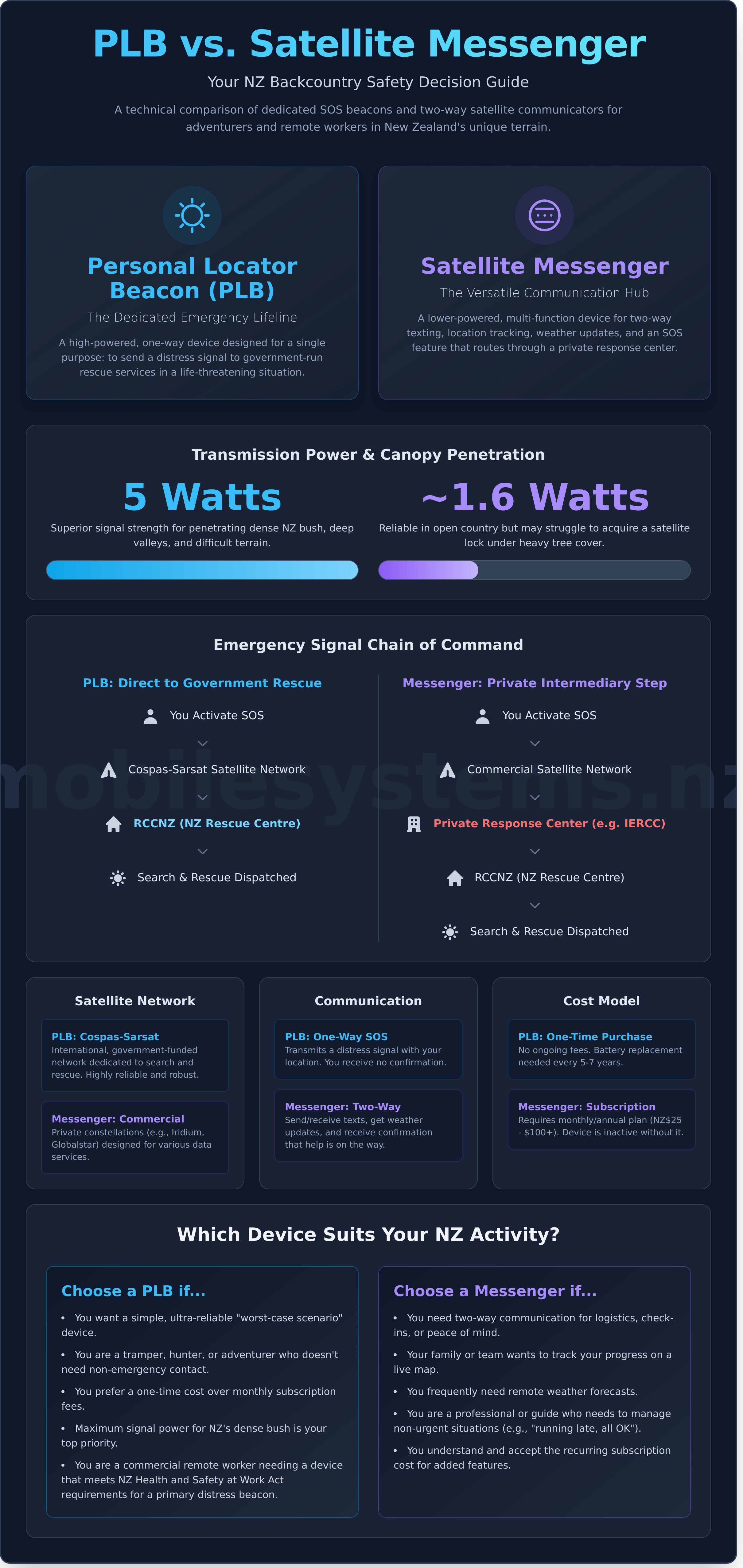
Safety vs. Convenience: The Practical Trade-offs
Personal Locator Beacons (PLBs) operate on an "all-or-nothing" principle. When you trigger a PLB, you aren't sending a status update; you're calling for an immediate, high-level search and rescue response. This simplicity is its greatest strength in a crisis because it removes the burden of decision-making when every second counts.
Satellite messengers offer a different kind of reassurance. They allow for "I'm okay" check-ins and non-emergency coordination with family or colleagues. However, this convenience introduces a critical dependency on active subscriptions and frequent battery management that doesn't exist with a PLB. Understanding the nuances of PLB vs satellite messenger safety involves weighing absolute reliability against flexible communication.
The New Zealand Mountain Safety Council emphasizes that the best device is the one that matches your specific activity and risk profile. While a messenger is excellent for logistics, a PLB remains the gold standard for dedicated emergency signalling in the harshest New Zealand environments.
Two-Way Communication as a Safety Feature
A significant advantage of two-way messaging is the ability to describe the nature of an injury to rescuers. If a tramper suffers a broken limb versus a cardiac event, the Rescue Coordination Centre can tailor the response team and medical equipment accordingly. This specific data can significantly improve the quality of the initial medical intervention upon arrival.
This dialogue also helps reduce "false alarms" which strain New Zealand's emergency resources. If a party is simply delayed by a flooded river but remains safe and sheltered, they can message family to prevent an unnecessary emergency call. This keeps rescue helicopters available for genuine life-and-death situations.
Conversely, high-stress trauma events can make complex digital interfaces difficult to use. Fiddling with touchscreens, Bluetooth pairing, or nested menus while in shock or wearing thick gloves is a documented risk. In contrast, a PLB requires a single physical action to summon help, ensuring the device works even when your cognitive abilities are compromised.
Cost of Ownership Over Five Years
Financial considerations differ greatly between these two technologies. A PLB involves a one-time purchase price, typically ranging from NZ$450 to NZ$650. Registration is free through Beacons NZ and remains valid for the life of the battery, which usually spans seven years.
Satellite messengers require an initial hardware investment plus ongoing monthly or annual service fees. If a payment fails or a plan expires, the device becomes a "brick" in an emergency. This creates a maintenance burden where the user must ensure the account is active before every trip into the bush.
- PLB: NZ$550 average one-time cost with zero ongoing fees.
- Messenger: NZ$600 hardware + NZ$350 annual subscription (NZ$2,350 over five years).
- Maintenance: PLBs require a battery swap every 6-7 years; messengers require charging every few days of use.
Over a standard five-year battery cycle, a PLB costs approximately NZ$550 total, while a satellite messenger on a basic plan will likely exceed NZ$2,300 when including hardware and 60 months of subscription fees. For many New Zealanders, the "set and forget" nature of the PLB offers better long-term value and higher PLB vs satellite messenger safety reliability.
Durability is the final trade-off. Most PLBs are built to military specifications, designed to withstand extreme pressure, deep immersion, and significant impact. While many commercial messengers are ruggedized, they are consumer electronics at heart and may not survive the same level of mechanical abuse as a dedicated distress beacon.
Decision Framework: Which Device Suits Your NZ Activity?
Selecting the right hardware for PLB vs satellite messenger safety depends on your specific risk profile and operational environment. For solo hunters and trampers traversing the Kaimanawa Range or the Southern Alps, a PLB is the primary recommendation. These devices are engineered for a single purpose: saving lives. With a high-powered 5-watt transmission on the 406 MHz frequency, a PLB provides a much stronger link to the Rescue Coordination Centre New Zealand (RCCNZ) than the 1.6-watt signal typically found in messengers. Because they don't require a subscription and feature a battery life of 7 to 10 years, they're the most reliable "set and forget" safety tool for high-risk soloists.
Commercial and Industrial Duty of Care
Under the New Zealand Health and Safety at Work Act 2015, 100% of employers are legally required to provide effective communication systems for workers in remote or isolated areas. Forestry crews, agricultural contractors, and civil engineers often work in "black spots" where cellular signals fail. Relying on a worker's personal mobile phone is a common mistake that creates significant liability. Integrating satellite devices with fleet tracking systems allows managers to monitor staff movements in real-time. These systems provide automated check-ins and man-down alerts, ensuring that help is dispatched even if the worker is unconscious. A tailored assessment often prevents costly mistakes in choosing fleet safety gear.
Professional operators often adopt a hybrid approach for maximum redundancy. This involves carrying a satellite messenger for daily logistical updates and a PLB strapped to the person as a failsafe. If the messenger's battery dies after three days of heavy messaging, the PLB remains ready with its decade-long shelf life. This dual-device strategy is becoming the standard for NZ surveyors and conservation workers who spend weeks in the field. It separates "convenience comms" from "life-safety comms," ensuring that a dead battery or a failed subscription payment doesn't result in a tragedy.
One of the most dangerous mistakes is relying on a modern smartphone with "emergency SOS via satellite" as a primary safety device. While these features are improving, consumer phones lack the ruggedized housing and external antennas required for NZ's harsh conditions. In sub-zero temperatures or heavy bush cover, a dedicated beacon's signal is significantly more likely to reach a satellite. Phones are also prone to screen damage and rapid battery drain in cold weather, making them a poor substitute for purpose-built hardware.
Activity-Specific Recommendations
- Alpine climbing: Weight and simplicity are the priorities. Choose a PLB for its compact size and one-handed SOS activation. If you're navigating a technical face in the Remarkables, you need a device that works instantly without scrolling through digital menus.
- Offshore sailing: You must use a device that's waterproof and buoyant. If a vessel capsizes, your beacon needs to float and continue transmitting. Ensure your device is registered with the NZ beacon database to provide rescuers with your boat's specific details.
- Multi-day tramping: The value of "check-in" messages for family peace of mind is high. A satellite messenger allows you to send a "camped for the night" text, which prevents unnecessary anxiety or false alarms for emergency services when you're simply delayed by a swollen river.
Choosing the wrong device can lead to delayed rescue times or equipment failure when it's needed most. If you're unsure which technology fits your specific operational requirements, contact our technical team for a professional consultation.
Meta Description: Learn how to correctly register and maintain your PLB or satellite messenger in NZ. Expert advice on remote safety nets from Mobile Systems Limited. Shopify Handle: plb-vs-satellite-messenger-safety
Expert Implementation: Setting Up Your Remote Safety Net
Setting up a remote safety net involves more than just buying a device. Your choice in the PLB vs satellite messenger safety debate only works if the hardware is ready when things go wrong. Reliability in the New Zealand bush depends on strict maintenance and correct registration protocols.
When evaluating PLB vs satellite messenger safety, the hardware is only half the equation. A device is useless if the registration details are five years out of date or the battery fails during a cold night in the Kaimai Ranges. Professional implementation ensures your emergency signal reaches the right people with the right context.
Registration and Maintenance
Registration is a legal requirement for all PLBs in New Zealand. You must register your 406 MHz beacon with the Rescue Coordination Centre New Zealand (RCCNZ). This free database provides search and rescue teams with your emergency contacts, medical conditions, and vehicle details. These facts save hours during a search operation.
Update your RCCNZ registration every two years or whenever your emergency contacts change. For satellite messengers, ensure your subscription is active and your billing details are current. A lapsed subscription turns a high-tech messenger into a paperweight when you are out of cellular range.
- Battery Expiry: PLB batteries typically last five to seven years. Check the date printed on the unit and schedule a professional replacement six months before it expires.
- Firmware Updates: Satellite messengers require regular syncing with a computer to update GPS almanacs and messaging software.
- System Integration: A complete communication plan often integrates these tools with cellular devices to provide a layered approach to safety.
Perform a self-test once a month. For a PLB, use the dedicated test switch to check battery power and internal circuitry without alerting the authorities. For satellite messengers like the Garmin inReach, use the designated "Test" message function. This confirms your device can see the Iridium satellite constellation and your account is functioning.
Consulting with the Professionals
Commercial operations face higher stakes than recreational trampers. Managing a fleet of 20 devices requires a different strategy than carrying one unit in a pack. Mobile Systems helps New Zealand businesses navigate the complexities of satellite hardware and two-way radio collections to ensure team safety and compliance.
We provide on-site support and operate mobile service vehicles across the region. This means your safety fleet stays in the field rather than sitting in a repair shop. Our technicians understand local topography and which satellite networks provide the most consistent coverage in deep valleys or heavy bush cover.
A tailored assessment often prevents costly mistakes and ensures your team has the most reliable tools for their specific environment. To discuss your specific remote safety requirements and fleet management needs, contact our expert team today.
Securing Your Next Backcountry Mission
Selecting the right device isn't just a gear choice; it's a critical safety decision. A PLB provides a powerful 5-watt signal directly to emergency services, whereas a satellite messenger offers the convenience of two-way communication for logistical updates. Both technologies have distinct, vital roles in the New Zealand bush.
Understanding the technical trade-offs of PLB vs satellite messenger safety allows you to build a reliable communication plan. Since 2002, Mobile Systems has specialized in commercial safety and industrial deployments, acting as an authorized dealer for the world's leading satellite and radio brands. We support our clients nationwide with a dedicated fleet of mobile service vehicles to ensure your equipment remains field-ready.
A tailored assessment often prevents costly mistakes and ensures compliance with local safety standards. To ensure your team has the most reliable connection possible, get expert advice on your remote communication strategy today. Professional guidance helps you navigate the complexities of satellite constellations and signal strength. Having the right tool provides the confidence to explore further while staying within reach of help.
Frequently Asked Questions
Do I need a subscription for a PLB in New Zealand?
No, you don't need a subscription for a Personal Locator Beacon (PLB) in New Zealand. Unlike satellite messengers that require monthly or annual fees, a PLB involves only the initial purchase cost. You must register your device for free with the Rescue Coordination Centre New Zealand (RCCNZ) to ensure search and rescue teams have your emergency details.
This registration is a legal requirement under New Zealand maritime and aviation rules. It should be updated every two years or whenever your contact information changes. Choosing a PLB avoids the recurring costs of satellite messengers, which typically range from NZ$25 to NZ$100 per month depending on the chosen data plan.
Will a satellite messenger work in dense NZ bush or deep valleys?
Satellite messengers can struggle in dense canopy or deep ravines because they operate with lower transmission power. Most messengers transmit at approximately 1.6 watts, which requires a relatively clear line of sight to the sky. In the thick bush of the Kaimai Ranges or deep West Coast valleys, the signal may fail to reach a satellite.
A PLB is more reliable in these conditions because it transmits at 5 watts. This higher power output is specifically designed to punch through foliage and bounce off terrain. While no device is 100% guaranteed in a deep cave or narrow gorge, the extra power of a PLB provides a significant advantage in New Zealand's challenging geography.
Can I use an iPhone 14/15/16 satellite SOS instead of a PLB?
You shouldn't rely on a smartphone as your primary emergency device in the backcountry. While the iPhone 14 and newer models include satellite connectivity, they aren't as rugged as dedicated safety tools. A smartphone's glass screen and internal battery aren't built to withstand the freezing temperatures or high-impact drops common in mountain environments.
Dedicated devices are the standard for PLB vs satellite messenger safety because they're waterproof, buoyant, and have batteries that last for years. An iPhone is a useful backup, but it lacks the 406 MHz frequency that alerts the RCCNZ directly. In a life-threatening situation, a purpose-built beacon is the only tool that meets international search and rescue standards.
What happens when I press the SOS button on a PLB in NZ?
Pressing the SOS button triggers a 5-watt signal to the Cospas-Sarsat satellite network. This signal includes your unique hex ID, which the satellites relay to a ground station. From there, the data is sent to the RCCNZ headquarters in Wellington. They immediately check your registration details to see who you are and what your plans were.
The RCCNZ then coordinates with local police, LandSAR, or the Westpac Rescue Helicopter. Because the PLB signal is high-powered and continuous, rescuers can use radio direction-finding equipment to home in on your exact location. This process typically begins within minutes of the initial activation, provided the device has a clear view of the sky.
How long does the battery last on a PLB vs. a satellite messenger?
A PLB battery typically lasts between 5 and 7 years in standby mode without any maintenance. These devices use specialized lithium batteries designed to remain dormant until an emergency occurs. Once you activate the beacon, it's required by law to transmit for at least 24 hours even in temperatures as low as -20 degrees Celsius.
Satellite messengers operate differently and require frequent charging. A Garmin inReach might last 10 to 14 days in 10-minute tracking mode, but this drops significantly if you're sending many messages. If you forget to charge your messenger before a trip, it becomes useless, whereas a PLB is always ready for a crisis.
Can I rent a PLB or satellite messenger for a one-off trip?
Yes, renting is a common and practical option for people who only head into the bush once or twice a year. Many outdoor retailers and Department of Conservation (DOC) visitor centers offer PLB rentals. Prices usually start around NZ$30 for a weekend or NZ$50 for a full week, making it an affordable safety choice.
Renting allows you to carry a high-quality device without the NZ$400 to NZ$700 upfront purchase cost. It's also a good way to test the ergonomics of different models before you decide to buy. Always ensure the rental unit has a current battery expiry date and is registered with the RCCNZ before you head out.
Is a satellite messenger better than a satellite phone for safety?
A satellite messenger is often superior for PLB vs satellite messenger safety because it's more compact and offers automated tracking. Messengers allow you to send "check-in" pings to family, which creates a breadcrumb trail of your progress. This is often more useful for rescuers than a single voice call that might drop out.
Satellite phones like the Iridium 9555 are excellent for complex logistics where voice communication is necessary. However, they're bulkier, more expensive to run, and the batteries don't last as long. For most recreational users and field workers, the messaging and SOS functions of a device like the inReach are more practical and reliable.
What is the most reliable satellite constellation for New Zealand?
The Iridium satellite constellation is the most reliable for two-way messaging in New Zealand. It uses 66 low-earth orbit satellites that provide 100% global coverage, including the Southern Alps and offshore islands. Because these satellites are constantly moving, a blocked signal in a valley will usually clear as the next satellite passes overhead.
For emergency-only signals, the Cospas-Sarsat system used by PLBs is the gold standard. It utilizes a mix of geostationary and polar-orbiting satellites to ensure your distress call is received. Both systems are highly effective, but Iridium is the preferred network for those who need consistent two-way communication and tracking capabilities.
Related posts

- May 24, 2026
Our expert Starlink review NZ looks at speed, pricing, and reliability for business, farm, and maritime use. See if it's...

- May 23, 2026
Approximately 40% of New Zealand's landmass remains outside the reach of traditional mobile networks. For professional teams operating in remote...

- May 14, 2026
A complete guide to Starlink setting up for NZ businesses. Learn pro tips on site survey, mounting, network integration, and...