
Security Cameras NZ: The 2026 Professional Buyer’s Guide
53% of New Zealand small to medium-sized enterprises experienced a cyber threat in the first half of 2025, according to NCSC research. This statistic, alongside the $26.9 million in direct financial losses recorded durin…
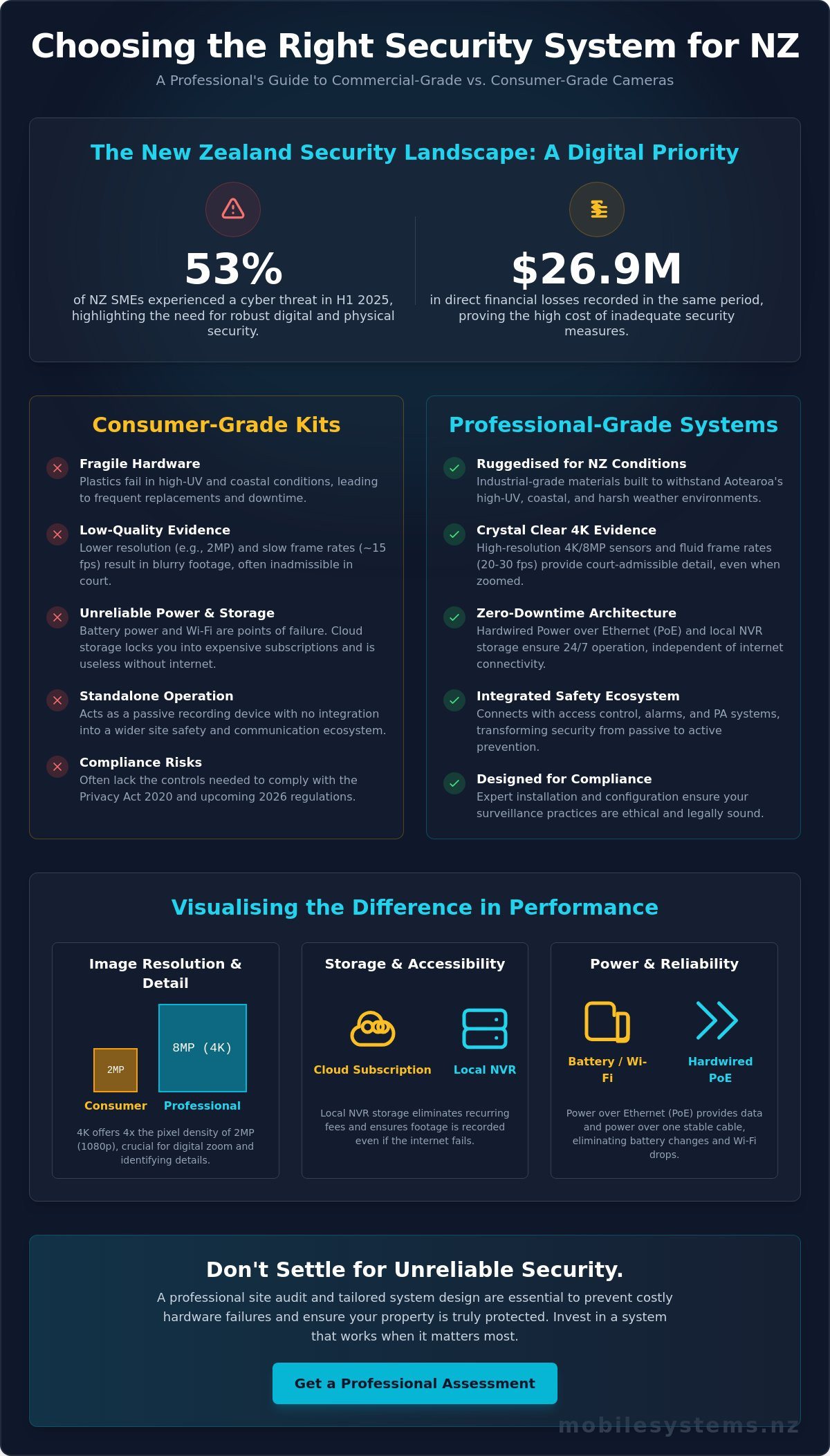
53% of New Zealand small to medium-sized enterprises experienced a cyber threat in the first half of 2025, according to NCSC research. This statistic, alongside the $26.9 million in direct financial losses recorded during the same period, proves that physical security is now a digital priority. When you're researching security cameras nz, it's easy to feel overwhelmed by retail kits that fail in high-UV coastal conditions or lock you into expensive, complex cloud subscriptions.
You likely believe that security should be a silent, reliable partner that provides high-definition evidence without the headache of constant downtime. At Mobile Systems, we act as a trusted expert advisor, treating surveillance as a critical communication system rather than just a standalone camera. This guide provides the professional clarity needed to select and manage a high-performance system tailored specifically for New Zealand's unique industrial and residential environments.
We'll examine the technical requirements for admissible evidence, the impact of recent privacy law changes, and the infrastructure needed for zero-downtime monitoring. By understanding the trade-offs between different storage and power architectures, you'll be equipped to build a system that remains operational when it matters most. A tailored assessment often prevents costly mistakes and ensures your hardware survives the rugged conditions of the Aotearoa landscape.
Key Takeaways
- Learn the technical differences between legacy analogue CCTV and modern IP surveillance to ensure your system integrates with a broader safety ecosystem.
- Identify the specific hardware specifications needed for security cameras nz to withstand high-UV and coastal environments while maintaining 4K clarity.
- Understand why professional-grade sensors and a 24/7 duty cycle are necessary for reliable performance in low-light and high-stakes commercial environments.
- Navigate the legal requirements of the Privacy Act 2020 and new 2026 regulations to ensure your surveillance practices remain compliant and ethical.
- Identify why a professional site audit and structured cable management are essential to preventing system downtime and costly hardware failures.
Understanding Security Camera Systems in New Zealand
Modern surveillance has transitioned from basic recording to complex data management. While the history of CCTV began with analogue feeds and physical tapes, today's systems operate on high-speed digital networks. For business owners researching security cameras nz, this shift represents a move toward greater clarity and remote accessibility.
To better understand the current landscape of surveillance technology and how it applies to modern properties, watch this video:
A professional system functions as a vital part of a commercial safety ecosystem. In 2026, cameras integrate with access control, two-way radios, and public address systems. This connectivity allows a single visual event to trigger a site-wide response, transforming security from a passive recording tool into an active deterrent. At Mobile Systems, we prioritize these integrated solutions to ensure your facility is protected from every angle.
The Shift from CCTV to IP Surveillance
IP surveillance is the industry standard for 2026. Unlike older systems that used coaxial cables, digital systems utilize Cat6 Ethernet and Power over Ethernet (PoE) to transmit data and power through one cable. This transition supports 4K resolution and secure remote access for security cameras nz from any location in the country. Digital units also allow for local data processing, reducing network strain while providing instant alerts for specific events.
Core Components of a Professional System
A reliable system consists of high-durability camera units, a Network Video Recorder (NVR), and a stable power supply. Camera units require precision lenses and industrial sensors capable of managing high-contrast light environments. While consumer gear might wash out in bright sun, professional sensors adjust dynamically to preserve detail. Local storage via an NVR provides immediate access to high-bitrate footage and eliminates the recurring fees often associated with cloud subscriptions. This architecture ensures your footage remains accessible even if your internet connection drops during a storm or network outage.
Key Features for NZ Conditions: Resolution, Storage, and Power
Selecting security cameras nz requires a balance between image clarity and infrastructure capability. While 4K (8-megapixel) resolution is often marketed as the default choice, its primary value lies in the ability to perform digital zooming without losing critical detail. For a standard 4-camera professional system, 4K provides the pixel density required for evidence that is admissible in court, whereas 2-megapixel sensors may struggle with motion blur during high-speed events.
Frame rates also dictate the quality of your evidence. A camera recording at 15 frames per second (fps) might miss the brief moment a face is turned toward the lens. Professional installations in 2026 typically target 20 to 30 fps to ensure fluid motion capture. This high-frequency data requires robust power solutions. While battery-operated units offer convenience, hardwired Power over Ethernet (PoE) remains the gold standard for zero-downtime monitoring in New Zealand's industrial and commercial sectors.
Balancing Resolution and Bandwidth
High-definition footage can significantly impact your local network speed if not managed correctly. Modern systems use H.265 compression, which reduces data file sizes by approximately 50% compared to older standards without sacrificing image quality. This efficiency is vital when deploying multiple 8MP cameras on a single network. We typically recommend 8MP cameras for wide-angle outdoor areas where detail at a distance is crucial, while 2MP or 4MP units are often sufficient for smaller indoor offices or entryways.
Storage Strategies for Business Continuity
Relying solely on cloud subscriptions is a common mistake, especially in rural New Zealand where internet latency can interrupt uploads. A centralized Network Video Recorder (NVR) provides a more reliable architecture by storing footage locally. This ensures that recording continues even if your ISP experiences an outage. Most New Zealand businesses require a 30-day retention period to comply with the Privacy Act 2020, which necessitates high-capacity surveillance-grade hard drives designed for 24/7 write cycles.
- On-device SD cards: Best used as a redundant "fail-safe" if the NVR connection drops.
- Centralized NVRs: Essential for managing multi-camera feeds and long-term data retention.
- Solar-assisted power: A practical solution for remote NZ farms or construction sites where trenching cables is cost-prohibitive.
A tailored assessment often prevents costly mistakes when matching camera resolution to your existing network capacity and storage requirements. Choosing commercial-grade hardware ensures your system survives the high-UV and salt-mist conditions common in our coastal regions.
Commercial-Grade vs. Consumer Security Cameras
Professional security cameras nz are engineered for a 100% duty cycle, meaning they're built to record 24 hours a day without hardware fatigue. Consumer-grade kits are often designed for intermittent event-based use, like checking a front porch. When these units are forced into continuous commercial operation, their internal processors can fail within 18 to 24 months due to thermal stress and component wear.
Sensor quality represents another significant divide. Professional cameras utilize larger image sensors that capture more light, providing clear color images in near-darkness. While budget cameras rely on basic infrared that often washes out facial features at close range, commercial gear uses Wide Dynamic Range (WDR) to balance shadows and highlights. This ensures that high-definition evidence remains usable regardless of the lighting conditions or solar glare.
Why Retail Kits Often Fail Businesses
Retail systems struggle with scalability. Managing 16 or 32 channels across multiple sites using a consumer app is often slow and cumbersome for a business owner. There are also critical security vulnerabilities to consider. Cheap hardware often lacks regular firmware updates, leaving your local network exposed to cyber threats. The total cost of ownership also shifts over time. While the initial price of a retail kit is lower, mandatory cloud subscriptions can exceed the hardware cost over a five-year period.
The Professional Advantage
Modern commercial systems include advanced AI analytics as a standard feature. Instead of simple motion detection that triggers for every passing cat or swaying branch, professional AI identifies specific objects like people and vehicles. This precision reduces false alarms by over 90% and allows for proactive perimeter protection. Partnering with Mobile Systems ensures you have access to local authorized support and valid warranty claims within New Zealand.
Integration is a key benefit for New Zealand industries. Professional surveillance can be linked with other site infrastructure to create a unified safety response. Common integrations include:
- Alerting security personnel via two-way radio systems when a perimeter is breached.
- Triggering public address systems to broadcast automated warnings to intruders.
- Syncing with fleet tracking to document vehicle arrivals and departures.
The physical build of the hardware also matters. While consumer cameras use polycarbonate plastics that become brittle under high UV levels, professional units utilize vandal-proof metal housings with IP67 and IK10 ratings. A tailored assessment often prevents costly mistakes by identifying the specific duty cycle and environmental ratings required for your facility.
Planning Your Installation: Regulations and Environmental Factors
Strategic planning ensures your security cameras nz deliver admissible evidence while surviving our unique environment. Professional placement minimizes blind spots by analyzing field of view and light angles before a single bracket is mounted. This phase also involves establishing a robust data backbone through structured Cat6 cabling, which provides the high bandwidth and power delivery that wireless alternatives cannot sustain.
Audio recording is a critical consideration during the planning phase. Under the Crimes Act 1961, the recording of private conversations is heavily restricted in New Zealand. Most professional installations disable audio by default to avoid legal complications, focusing instead on high-quality visual data that complies with national surveillance standards.
NZ Legal Compliance and Privacy
On May 1, 2026, the new Information Privacy Principle 3A (IPP 3A) came into force, requiring organizations to take reasonable steps to notify individuals if their information is being collected indirectly. For businesses using CCTV, this means clear, visible signage is no longer optional; it's a legal necessity. Legal compliance is as vital as hardware quality. If your system captures images of people in public spaces, you must also be prepared to manage data access requests under the Privacy Act 2020.
Data retention is another key regulatory pillar. While the Privacy Act 2020 requires that footage be deleted once it's no longer needed, a standard 30-day retention period is widely accepted for New Zealand businesses. If you utilize advanced features like facial recognition, you have until August 3, 2026, to ensure your practices comply with the new Biometric Processing Privacy Code.
Environmental Durability in New Zealand
New Zealand's geography presents unique challenges that standard retail hardware often fails to meet. Coastal properties in areas like Mount Maunganui face constant salt spray, which can corrode standard camera housings within months. We recommend security cameras nz with IP66 or IP67 ratings and corrosion-resistant finishes to ensure longevity in these high-salinity zones.
In alpine regions like Central Otago, cameras must operate across extreme temperature swings while resisting the high-UV levels that degrade consumer-grade plastics. Professional housings are UV-stabilized to prevent the casing from becoming brittle or yellowing over time. Effective coverage requires a professional site audit to identify critical entry points and high-value areas. This technical precision, combined with professional installation and servicing, ensures your system remains a reliable asset rather than a maintenance burden.
Why Professional Design Prevents Costly Failures
A professional design ensures that your investment provides the protection you expect. Many businesses purchase high-end hardware only to find it underperforms due to poor placement or inadequate network support. A professional site audit identifies these vulnerabilities before any equipment is purchased, ensuring every camera serves a specific purpose. This technical foundation is what separates a reliable security system from a collection of disconnected gadgets. Similarly, for comprehensive property safety, Methamphetamine Testing Services NZ Limited offers professional screening to ensure your premises are free from chemical contamination.
Professional cable management and mounting are equally critical for long-term performance. In New Zealand's varied climate, exposed or poorly secured cabling leads to signal degradation and hardware failure within the first 12 to 18 months. Using industrial-grade mounting solutions ensures that your security cameras nz remain stable, preventing the vibration and movement that can trigger false AI alerts or compromise the clarity of evidence during high-wind events.
The Value of a Tailored Assessment
A tailored assessment often prevents costly mistakes in hardware selection. While a DIY user might install a wide-angle lens in a narrow corridor, a professional designer selects the exact focal length needed to capture high-definition facial details at specific distances. This precision ensures your footage is useful for police investigations rather than just providing a general overview of an incident.
We also analyze your existing network infrastructure to prevent system crashes. High-bandwidth 4K video can cripple a standard business network if the traffic isn't properly segmented and managed. Our design process includes calculating bitrates and storage requirements to ensure your NVR handles 30 days of continuous recording without data corruption or frame loss. This proactive approach identifies high-risk zones that DIY users often overlook, such as poorly lit blind spots or vulnerable entry points.
Partnering with Mobile Systems Limited
Mobile Systems Limited brings decades of experience working in New Zealand's most challenging environments, from coastal industrial sites to remote alpine facilities. We don't just sell hardware; we provide a complete security partnership. Our full-service capability covers everything from initial system design and supply to professional on-site installation and ongoing maintenance. By choosing our surveillance camera solutions, you gain access to hardware specifically vetted for local conditions.
Ongoing support is vital for system longevity and compliance with the Privacy Act 2020. We provide regular firmware updates to protect against cyber threats and physical inspections to ensure your hardware survives the elements. Whether you need a new system or an upgrade to your existing infrastructure, our team provides the technical expertise required for a reliable, high-performance solution. Contact our team for a professional security consultation today to ensure your property is protected by the best technology and design available in 2026.
Future-Proof Your Property with Professional Surveillance
Choosing the right security cameras nz is a decision that directly impacts your operational continuity and legal standing. We've established that professional-grade hardware is designed to survive New Zealand's high-UV and coastal environments where standard retail kits often fail within 18 months. A system built on industrial standards ensures you have high-definition evidence when it's needed most.
Mobile Systems Limited brings specialized expertise to high-interference industrial environments and remote, rugged areas where connectivity is often a challenge. Our NZ-wide mobile support vehicles provide on-site technical assistance to keep your systems running at peak performance. We understand the nuances of the May 1, 2026, privacy regulations and the technical requirements for 24/7 monitoring in New Zealand's unique conditions.
A tailored approach prevents the common pitfalls of DIY installations and ensures your data remains secure. Contact Mobile Systems for a professional security assessment to discuss a surveillance solution that meets your specific requirements. Investing in a professionally designed system today provides the peace of mind that your business and home are protected by a reliable, compliant, and durable security ecosystem.
Frequently Asked Questions
Do I need a permit to install security cameras on my NZ business premises?
You don't usually need a building permit for standard installations, but you must strictly follow the Privacy Act 2020. On May 1, 2026, the new IPP 3A principle made clear signage mandatory for any business collecting footage of the public. When installing security cameras nz, you must ensure they don't capture private spaces like neighboring bedrooms or bathrooms to avoid legal disputes.
Can security cameras work without an active internet connection?
Yes, professional IP systems can record 24/7 to a local Network Video Recorder (NVR) without an active internet connection. While you'll lose the ability to view live feeds remotely on your smartphone, the core recording and AI analytics functions remain fully operational. This local-first architecture is a reliable fail-safe for rural NZ properties where internet connectivity is frequently interrupted or high-latency.
What is the difference between NVR and DVR systems?
The primary difference is the type of camera and cabling they support. NVR systems process digital data from IP cameras via Cat6 Ethernet cables, providing higher resolution and advanced AI features. DVR systems are designed for older analogue cameras using coaxial cables. In 2026, NVRs are the industry standard because they offer better scalability and superior image quality for commercial sites.
How long do security cameras last in coastal New Zealand environments?
Professional units with IP67 ratings and treated metal housings typically last 5 to 7 years in coastal New Zealand regions. In contrast, consumer-grade plastic cameras often degrade within 24 months due to high UV exposure and salt-mist corrosion. Choosing high-quality security cameras nz designed for marine environments ensures your hardware survives the harsh conditions in places like Mount Maunganui or Napier.
Do professional security cameras require a monthly subscription fee?
Professional systems don't require monthly fees if you choose a local storage model. While many consumer brands force you into cloud subscriptions to view your history, a professional NVR allows you to own your data outright. This approach eliminates recurring costs and ensures your footage remains accessible even if the manufacturer's servers go offline or change their pricing structure.
What resolution is required for legal evidence in New Zealand?
There is no specific legal minimum resolution, but 4K (8-megapixel) is the professional recommendation for identifying faces or license plates at 5 to 10 meters. Lower resolutions like 1080p often become too pixelated when you zoom in on a suspect's features. High-resolution sensors ensure that the evidence you provide to the NZ Police is clear enough to be useful in a prosecution.
Can I integrate my security cameras with my fleet tracking system?
Yes, you can integrate surveillance with fleet tracking to create a unified logistics record. Modern security software allows you to sync camera timestamps with GPS data, documenting exactly when a vehicle arrived or departed your facility. This integration is particularly useful for transport hubs and construction sites where tracking high-value assets and verifying delivery times is a daily operational requirement.
How much storage do I need for 30 days of 4K video recording?
For a 4-camera system recording in 4K resolution at 15 frames per second, you'll need approximately 8TB to 12TB of storage to meet a 30-day retention target. This calculation relies on H.265 compression, which reduces file sizes by 50% compared to older codecs. If your business requires a higher frame rate for smoother evidence, your storage needs will increase significantly.
Related posts

- May 24, 2026
Our expert Starlink review NZ looks at speed, pricing, and reliability for business, farm, and maritime use. See if it's...

- May 23, 2026
Approximately 40% of New Zealand's landmass remains outside the reach of traditional mobile networks. For professional teams operating in remote...

- May 14, 2026
A complete guide to Starlink setting up for NZ businesses. Learn pro tips on site survey, mounting, network integration, and...