
Marine Radio Channels NZ: The Complete Maritime Communication Guide (2026)
If you found yourself in a sudden squall five nautical miles off the Coromandel Coast, would you know exactly which frequency to dial for a local weather update versus a Mayday call? Most boaties understand that a VHF radio is their most vital safety tool, yet understanding the specific marine radio channels nz requires more than just turning a dial.
If you found yourself in a sudden squall five nautical miles off the Coromandel Coast, would you know exactly which frequency to dial for a local weather update versus a Mayday call? Most boaties understand that a VHF radio is their most vital safety tool, yet understanding the specific marine radio channels nz requires more than just turning a dial.
It's common to feel a sense of hesitation when keyed up on the mic, especially with the fear of accidentally interfering with emergency frequencies or missing a regional repeater. You likely recognize that clear communication is the difference between a controlled situation and a genuine maritime crisis.
This guide provides the technical clarity you need to master the New Zealand maritime VHF landscape in 2026. You'll learn the precise protocols for emergency distress calls, how to locate regional repeater networks for your specific area, and the requirements for legal hardware compliance.
We will explore the current channel allocations used by Coastguard New Zealand and commercial operators, ensuring your vessel is equipped for both safety and efficiency on the water.
Key Takeaways
- Understand the critical role of Channel 16 as the international distress frequency and the legal requirement for continuous monitoring to ensure maritime safety.
- Learn how to navigate the extensive network of marine radio channels nz repeaters to maintain reliable long-range communication across New Zealand's rugged coastline.
- Identify the specific working channels used for commercial coordination and port operations to streamline vessel-to-vessel and ship-to-shore communications.
- Access real-time Maritime NZ weather broadcasts on dedicated channels to mitigate operational risks and prevent weather-related accidents at sea.
- Evaluate the technical trade-offs between fixed-mount and handheld VHF units to select the most durable and effective hardware for your commercial maritime requirements.
The Foundation of NZ Maritime Safety: Channel 16 and Distress Protocols
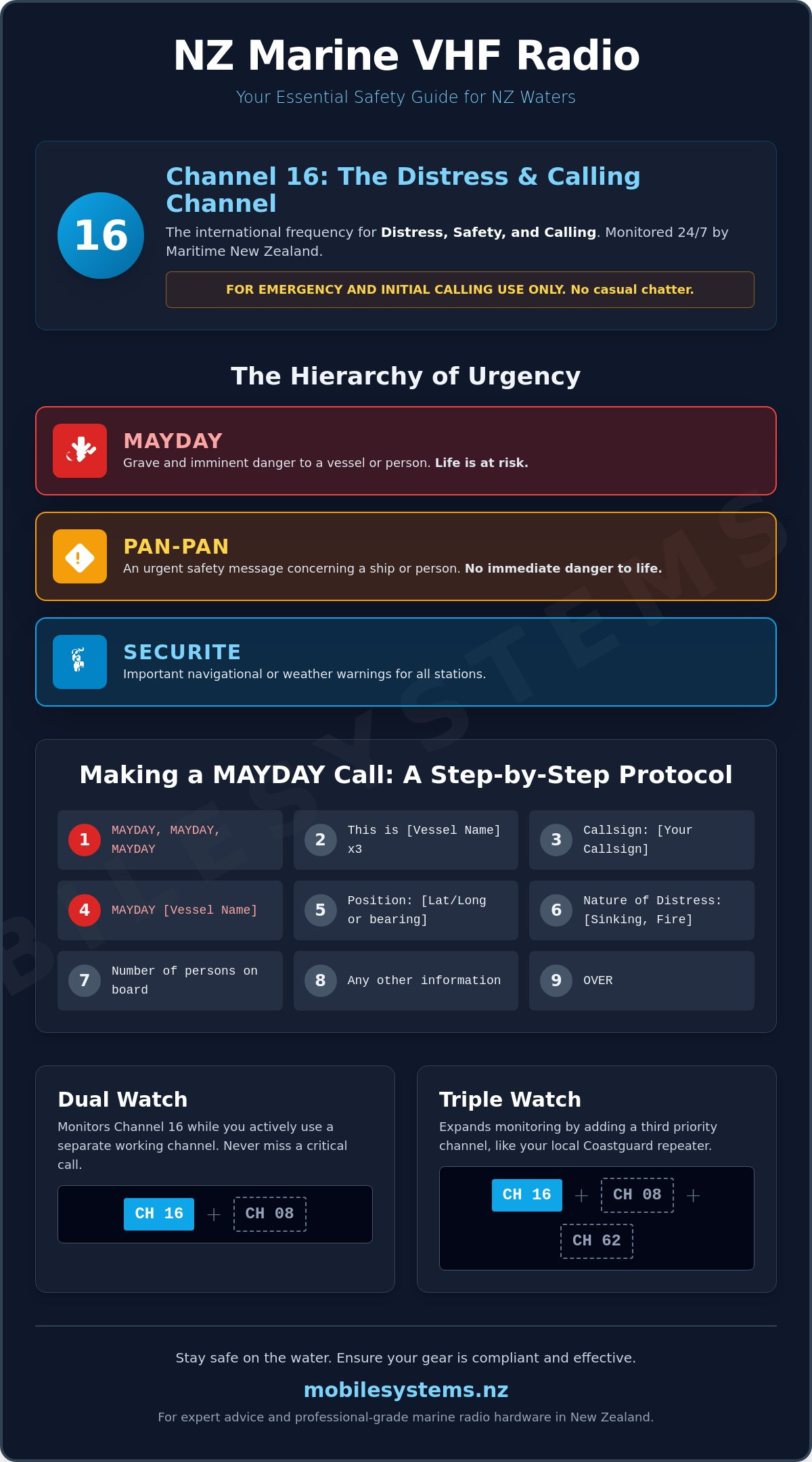
Channel 16 serves as the backbone of the New Zealand maritime safety network. It's the primary international frequency for distress, safety, and calling, monitored 24 hours a day by the Maritime New Zealand Rescue Coordination Centre. Every vessel in New Zealand waters equipped with a Marine VHF Radio is legally required to maintain a continuous watch on this channel while at sea.
This constant vigilance ensures that any vessel in trouble can reach help immediately. Using this channel for casual chatter is strictly prohibited. Misusing distress frequencies can lead to severe penalties, including significant fines under the Maritime Transport Act 1994, because it potentially blocks life-saving communications. Understanding the specific marine radio channels nz protocols is the first step toward responsible seamanship.
To better understand how these frequencies are managed and updated in New Zealand, watch this helpful video:
The International Distress Frequency
Channel 16 operates at 156.8 MHz and is the core of the global maritime safety system. In New Zealand, communications follow a strict hierarchy to prioritise urgency. A "Mayday" call signifies grave and imminent danger to a vessel or person. A "Pan-Pan" call indicates a very urgent message concerning the safety of a ship or person, but where there's no immediate danger to life. Finally, a "Securite" call is used for important navigational or weather warnings.
When you're in a life-threatening situation, use this standard distress template to contact Maritime Radio:
- MAYDAY, MAYDAY, MAYDAY
- This is [Vessel Name, Vessel Name, Vessel Name]
- Callsign: [Your unique NZ callsign]
- MAYDAY [Vessel Name]
- Position: [Latitude/Longitude or bearing and distance from a known landmark]
- Nature of Distress: [e.g., Sinking, Fire, Medical Emergency]
- Number of persons on board: [Total count]
- Any other information: [e.g., Abandoning to life raft]
- OVER
Dual Watch and Triple Watch Monitoring
Dual Watch is a feature that allows your radio to monitor Channel 16 while you're actively using a separate working channel for fishing updates or local port communications. This ensures you don't miss an emergency broadcast while talking to other boaties. Triple Watch expands this by adding a third channel, often the local Coastguard channel, to your monitoring rotation.
High-quality hardware is vital for these functions. Professional-grade radios from Mobile Systems are designed with superior scanning speeds and receiver sensitivity. Cheaper units often struggle to toggle between frequencies fast enough, leading to clipped audio or missed calls. It's a common mistake to scan too many channels during high-stakes operations. Limit your scan to the essential marine radio channels nz to ensure your radio's processor stays focused on the most critical signals.
A tailored assessment of your vessel's communication needs often prevents costly mistakes. Ensuring your antenna height and radio power settings are optimized for New Zealand's rugged coastline is just as important as knowing which channel to use. If you're unsure about your current setup, seeking expert advice is the safest way to ensure you're heard when it matters most.
Navigating the NZ Coast: Understanding Regional Repeater Channels
New Zealand's rugged coastline and deep fjords create significant obstacles for standard line-of-sight VHF transmissions. To overcome these geographical barriers, a vast network of VHF repeaters provides coverage across our coastal waters. These repeaters are high-altitude stations that receive a weak signal and re-broadcast it at higher power. This technology allows a 5-watt handheld radio to communicate over distances that would be impossible with a direct ship-to-ship connection.
How Maritime Radio Repeaters Work in NZ
VHF signals travel in straight lines, which means mountains often block signals in areas like the Marlborough Sounds or the West Coast. Repeaters solve this by using "duplex" operation. Your radio transmits on one frequency and receives on another, with the repeater handling the translation. Most marine radio channels nz users rely on for repeater access are assigned specific numbers like 01, 03, 05, or 63, depending on the local geography. Maritime NZ manages the national distress and safety network, while local organizations maintain regional repeaters to fill coverage gaps. Using these repeaters correctly requires your radio to be in "International" mode rather than "USA" mode to ensure the correct frequency offsets are applied. A tailored assessment of your vessel's typical cruising grounds often prevents costly mistakes in choosing the right antenna setup or mounting height.
Coastguard and Local Community Channels
Local Coastguard units operate specific "working channels" for non-emergency communications. Channels 80, 81, and 82 are frequently used for trip reporting and local weather updates. You should always log a trip with your local Coastguard via VHF before leaving the boat ramp. This provides a digital record of your journey, including your vessel name, number of people on board, and expected return time. Following the advice from Coastguard New Zealand Communications ensures that search and rescue teams have a starting point if you fail to close your trip report. In some remote regions, coastal communities fund their own repeaters. These units might not have 24/7 monitoring, so it's vital to know the specific operating hours for your area. Relying on the wrong channel in a dead zone can lead to total communication failure. If you need to upgrade your equipment to ensure better reach across the marine radio channels nz network, you can browse our range of marine two-way radios
Commercial Coordination: Working Channels and Port Operations
Commercial vessels operating in New Zealand waters rely on a structured frequency plan to maintain safety and operational efficiency. While Channel 16 is the universal calling and distress frequency, it's not the place for routine business. Congestion on safety channels can lead to delayed emergency responses. Understanding the specific marine radio channels nz uses for commercial coordination is a fundamental requirement for every professional skipper.
Working channels are designated for routine communication between vessels or between ship and shore. By moving operational talk to these frequencies, commercial users ensure that the calling and distress channels remain open for their intended purpose. Adhering to professional radio etiquette is mandatory for commercial fleet operators to maintain order on the airwaves.
Port Authorities and Harbour Management
New Zealand's major ports, including the Port of Tauranga and Port Otago, operate under strict traffic management protocols. These authorities typically use channels 12 or 14 for port operations, though 09, 10, and 11 are also common depending on the specific region. You must monitor the correct port frequency when operating within a harbour's limits.
The ship-to-shore protocol requires you to establish contact with "Harbour Control" or the "Duty Pilot" on their designated working channel before entering a controlled zone. This ensures the port authority can manage the movement of large commercial vessels and maintain a safe environment for all users. For those seeking high-performance hardware to manage these critical links, our commercial two-way radio solutions provide the reliability needed for heavy maritime use.
Inter-ship and Fishing Fleet Communication
For routine communication between vessels, channels 06 and 08 are the primary inter-ship frequencies in New Zealand. These allow crews to coordinate movements, discuss weather conditions, or manage operational needs without interference. Using these channels correctly prevents the cluttering of the national marine radio channels nz depends on for coastal safety.
Many commercial fishing fleets also utilize private channels for their daily operations. These frequencies require specific licensing through Radio Spectrum Management (RSM) and offer a level of privacy for fleet coordination. Clear communication isn't just a matter of convenience; it's a core health and safety requirement under the Health and Safety at Work Act 2015. Professional operators must ensure their equipment is correctly programmed and their staff are trained in standard maritime radio procedures.
A tailored assessment of your fleet's communication needs often prevents costly mistakes and ensures compliance with New Zealand's maritime regulations. Maintaining high standards in radio discipline reflects the professionalism of your maritime business and contributes to the overall safety of the coastal community.
Meta Description: Master marine radio channels NZ for weather updates. Learn to use NowCasting, Maritime NZ broadcasts, and DSC technology for safer coastal navigation in 2026.
URL Handle: marine-radio-weather-nz
Operational Intelligence: Weather Channels and Routine Updates
Accessing real-time weather data is the most effective way to prevent maritime accidents in New Zealand. Conditions in the Hauraki Gulf or Cook Strait can change in under 30 minutes, making constant monitoring a requirement rather than a suggestion. Maritime NZ manages a sophisticated network of transmitters to ensure boaties stay informed regardless of their distance from the coast.
Staying updated on current conditions prevents the common mistake of heading out into a deteriorating sea state. While smartphone apps are popular, they rely on cellular towers that often have "dead zones" once you're a few nautical miles offshore. A dedicated VHF unit remains the only 100% reliable method for receiving official safety alerts.
Accessing NowCasting and 24-Hour Weather Services
Maritime NZ broadcasts continuous weather forecasts on specific marine radio channels nz, primarily 20, 21, 22, and 23. These announcements occur on a disciplined schedule, usually every four hours at 0133, 0533, 0933, 1333, 1733, and 2133 hours. These broadcasts include regional outlooks, tide information, and urgent gale or storm warnings.
For immediate, site-specific data, the NowCasting service provides live wind speed, gust velocity, and direction. This data comes from automated coastal stations located at strategic points like Tiritiri Matangi or Bean Rock. To use this service effectively, you should:
- Identify the specific NowCasting channel for your local region before leaving the boat ramp.
- Listen for the automated loop that provides current observations rather than just forecasts.
- Cross-reference NowCasting data with the general Maritime NZ forecast to spot emerging trends.
Digital Selective Calling (DSC) and Modern Safety Tech
Modern VHF systems equipped with Digital Selective Calling (DSC) add an automated layer of safety to your vessel. DSC allows for a "one-button" distress alert that transmits your precise GPS coordinates to the Rescue Coordination Centre NZ. This technology removes the risk of human error during high-stress situations where communicating your position verbally might be difficult.
In 2026, integrating GPS with your VHF is the standard safety recommendation for all New Zealand vessels. For the DSC functions to work, you must have a Maritime Mobile Service Identity (MMSI) number. This is a unique nine-digit code that identifies your boat and contact details. You can register for an MMSI through Radio Spectrum Management, and it's a critical step that many boat owners overlook.
A DSC-equipped radio doesn't just help in emergencies; it also allows for private individual polling between vessels. This means you can "ping" a friend's boat to see their location on your chart plotter without broadcasting to every radio in the area. Ensuring your hardware is correctly configured is the best way to leverage these modern features.
Selecting the right hardware is essential for maintaining these safety links. A tailored assessment of your vessel's setup often prevents costly mistakes in emergency situations. Explore our range of fixed and portable marine radios to ensure your bridge is 2026-compliant.
Choosing the Right Marine Radio Hardware for Commercial NZ Use
Selecting hardware requires a precise balance of transmission power, durability, and environmental resistance. In New Zealand, the maritime environment is often unforgiving. Salt spray and heavy vibration can degrade low-quality equipment within a single season. All marine VHF equipment must be type-approved for use in the maritime band to operate legally on marine radio channels nz.
Mobile Systems specializes in installing robust radio systems for the most demanding marine environments. Whether you operate a commercial fishing vessel or a tourism charter, your hardware must be reliable when conditions deteriorate.
Fixed-Mount vs. Handheld VHF Radios
Fixed-mount units are the standard for primary communication on commercial vessels. These units provide a maximum output of 25W, which is essential for long-range safety. Handheld radios are usually limited to 5W or 6W. While portable, they lack the reach needed for consistent offshore operations.
- Transmission Power: 25W fixed units can reach up to 60 nautical miles depending on antenna height. Handhelds typically reach 5 to 8 nautical miles.
- Waterproofing: NZ coastal conditions demand at least IPX7 protection, meaning the unit can survive 30 minutes in one metre of water. IPX8 is preferred for open-deck work.
- Emergency Features: Modern fixed units include Digital Selective Calling (DSC). This requires integration with a GPS source to send your exact coordinates during a distress alert.
For specific model recommendations tailored to local waters, read our guide on the Best Handheld VHF Radio NZ.
Compliance and Licensing Requirements in New Zealand
Owning the hardware is only one part of the requirement. You must hold a Maritime VHF Operator Certificate to use a VHF radio legally. This certification ensures you understand the protocols for distress calls and general communication on marine radio channels nz.
Every vessel must also have a unique call sign registered through Radio Spectrum Management (RSM). A call sign ensures that search and rescue services can identify your vessel and contact your shore-based emergency representatives immediately. Operating without a registered call sign can lead to significant delays during an emergency response.
Professional installation is the final step in ensuring system reliability. A radio is only as good as its antenna system. We focus on tuning antennas for maximum gain and range. We use specialized equipment to measure the Standing Wave Ratio (SWR), which prevents power loss and protects your radio's internal circuitry from damage.
A tailored assessment often prevents costly mistakes. Choosing the wrong antenna or mount can reduce your effective range by 50% or more. Mobile Systems provides the technical expertise to ensure your commercial vessel remains compliant and connected in all conditions.
Securing Your Maritime Operations for 2026 and Beyond
Effective communication on the water relies on more than just hardware. It requires a deep understanding of the marine radio channels nz network, from the vital distress protocols of Channel 16 to the specific repeater frequencies used across New Zealand's diverse coastal regions.
Maintaining reliable contact ensures safety and operational efficiency for commercial vessels. Choosing high-performance equipment from trusted brands like Tait and Hytera is a critical step in preventing communication blackouts during heavy weather or remote port operations.
Mobile Systems brings over 20 years of New Zealand communication expertise to every project. Our specialist marine installation team ensures your fleet meets all regulatory standards while providing crystal-clear reception in the most demanding environments. We don't just sell radios; we design integrated systems that protect your crew and assets.
A tailored assessment often prevents costly mistakes and ensures your hardware is perfectly matched to your operational needs. Contact Mobile Systems for a professional maritime communication assessment today. We're here to help you navigate the complexities of modern maritime connectivity with confidence.
Frequently Asked Questions
Do I need a license to use a marine VHF radio in New Zealand?
You must hold a Maritime Radio Operator Certificate (MROC) to legally operate a marine VHF radio in New Zealand. While anyone can use the radio in a life-threatening emergency, a license is mandatory for all routine transmissions and trip reports. This certification ensures you understand the correct protocols for specific marine radio channels nz users rely on for safety.
What is the range of a standard marine VHF radio in NZ waters?
A fixed-mount 25-watt VHF radio typically provides a range of 20 to 50 kilometres depending on your antenna height. Handheld 5-watt units are more limited, usually reaching 5 to 10 kilometres. Because VHF signals travel in a "line of sight," range is restricted by the earth's curvature and physical barriers like the high cliffs found in Fiordland or the Hauraki Gulf.
Can I use a land-based CB radio for marine communication?
You can't use a land-based CB radio for maritime safety because they operate on different frequency bands. CB radios use 26 MHz or 477 MHz, while marine VHF equipment operates between 156 MHz and 162 MHz. Using land-based gear at sea is dangerous because you won't be able to communicate with the Coastguard or other vessels during an emergency.
Which channel should I use for general chatting with other boats?
Ship-to-ship "chatter" should take place on channels 6, 8, 72, or 77. You should always establish contact on Channel 16 first, then immediately switch to one of these working channels to keep the hailing frequency clear. This practice ensures that the marine radio channels nz emergency services monitor remain open for those in genuine distress.
How do I log a trip with the Coastguard using my VHF?
Call the Coastguard on Channel 16 to establish contact, then move to their designated local working channel to provide your details. You'll need to state your boat name, call sign, number of people on board (POB), departure point, destination, and estimated time of arrival (ETA). This free service creates a digital trail that can save your life if you don't return as planned.
What should I do if I accidentally transmit a distress signal?
You must broadcast a cancellation message on Channel 16 immediately if you trigger a false alarm. State your boat name and call sign, then clearly explain that the distress alert was an accident and there's no emergency. Don't just turn the radio off; this triggers an expensive search and rescue operation involving police and air support.
What is the difference between International, USA, and Canadian channel settings?
New Zealand vessels must use the "International" setting to ensure the radio transmits and receives on the correct frequency pairs. The USA and Canadian settings use different frequency offsets for duplex channels, which will prevent you from hearing Coastguard repeaters. Using the wrong mode is a common mistake that leads to "one-way" communication where you can't hear replies.
Are there specific channels for the America’s Cup or other major NZ regattas?
Major events like the America's Cup or the Coastal Classic often have dedicated channels assigned for race management and spectator safety. During the 2021 America's Cup, Channel 17 was used for course boundaries and spectator control. You should check the current Notice to Mariners or the event's official website for specific channel assignments before heading out to watch a race.
Related posts

- June 12, 2026
Relying on a cellular signal in the Southern Alps or the dense King Country bush is a calculated risk that...

- June 06, 2026
Did you know that 98.6% of radio licenses in New Zealand are subject to a fee increase starting July 1,...

- May 17, 2026
Read our 2026 NZ guide. DMR vs P25: Which Digital Radio Standard is Right for Your Business? Compare features to...