
Marine Radio Frequencies NZ: A Complete Guide to Marine Communications
Explore marine radio frequencies nz and learn which channels to use, licensing basics, and safety tips for NZ boaters.
If you're a boatie anywhere in New Zealand, getting your head around marine radio frequencies isn't just a nice-to-have—it's absolutely fundamental to staying safe out on the water. The big ones you need to know are VHF Channel 16 (156.800 MHz) for distress calls and hailing, and Channel 70 (156.525 MHz), which is dedicated to automated Digital Selective Calling (DSC) alerts. Knowing how to use these channels properly is the cornerstone of good, safe communication at sea.
Your Essential Quick Reference to NZ Marine Radio Frequencies
When you're in our coastal waters, a Very High Frequency (VHF) marine radio is your most dependable lifeline. It’s a world away from a mobile phone, giving you a direct line to rescue services and other vessels, and it works perfectly fine when you’ve lost all cell reception just a bit offshore. The entire system is built around safety, with organised and disciplined communication at its heart.
Navigating the Airwaves
The whole marine radio system is designed to prevent a free-for-all on the airwaves by assigning specific jobs to different channels. This structure guarantees that emergency calls always get top priority and can be heard without interruption. For example, once you make contact on a calling channel, you must switch over to a working channel to have your chat. This simple rule keeps the main calling channels clear for the next person who might have an urgent situation on their hands.
Knowing the rules is one thing, but having the right gear is just as critical. When you're in the market for a VHF radio, it pays to talk to specialised suppliers. They have the hands-on product knowledge of reliable marine brands like GME, Uniden, Motorola, and Entel and will make sure your radio is programmed correctly for New Zealand waters. That’s a level of expertise you won’t find at a large department store, making them an essential partner for your safety.
Here’s a quick-glance table covering the most vital marine radio frequencies NZ boaties need to commit to memory.
Quick Reference NZ Marine VHF Channels
This table breaks down the key channels, their frequencies, and what you need to know to use them correctly.
| Channel | Frequency (MHz) | Primary Use | Key Notes |
|---|---|---|---|
| 16 | 156.800 | Distress, Urgency, Safety & Hailing | ALWAYS monitor this channel. For emergency use and initial contact only. |
| 70 | 156.525 | Digital Selective Calling (DSC) | Reserved for automated digital distress alerts. Not for voice communication. |
| 13 | 156.650 | Inter-ship Navigation Safety | Used for bridge-to-bridge communication between vessels for safety. |
Think of these channels as your direct lines for safety and coordination on the water. Knowing which one to use, and when, is a non-negotiable skill for every skipper.
A Quick Look Back: How NZ Marine Radio Came To Be
To really get why the rules around marine radio frequencies in NZ are so important today, it pays to understand where they came from. Our maritime radio network wasn't built overnight; it’s the result of over a century of development, all driven by the need for better safety and coordination in our often-unforgiving waters. The story starts way back in the earliest days of wireless tech, long before anyone had heard of a modern VHF marine radio.
The journey kicked off with clunky spark-gap transmitters, a world away from the crisp, digital signals we're used to now. But back then, they were revolutionary, offering the first real way to talk to ships over the horizon without a physical cable. Seeing this progression from the very beginning helps put the structured nature of our VHF marine band into proper context.
From Spark Gaps to a Coordinated Safety Net
The organisation of marine radio in New Zealand really started to take shape in the early 20th century. After the Australasian Telegraph Conference in 1909, the government made the call to set up crucial marine radio coast stations in Auckland, Wellington, and the Chatham Islands.
This was a huge step forward, creating a proper, coordinated safety network. The first station—a hefty 2.5 kilowatt 'spark' transmitter—officially went live from a tower at Wellington's General Post Office on 26 July 1911. If you're keen on the details, you can explore more of this rich communication history on the RSM website.
Over the years, major maritime incidents, both here and overseas, kept reinforcing the need for strict rules. Disasters at sea showed just how chaotic things could get with uncontrolled radio use. This led to international agreements that shaped the very channels we tune into today. This history of learning the hard way is exactly why disciplined channel use, especially on distress frequencies, is non-negotiable. The system is built on tough lessons, all aimed at putting safety first and providing a solid foundation for the channel guides that follow.
Decoding the NZ VHF Marine Channel List
Getting to grips with the different channels on your VHF marine radio is the first step to using it properly and safely. The international system, which we follow here in New Zealand, isn't just a jumble of numbers. It’s a highly structured framework designed to keep critical safety channels clear of boat-to-boat chit-chat.
Think of it as dedicated lanes on a motorway—each one has a specific job. This structure ensures that when a real emergency hits, the lines of communication are open. The system is split into several key groups, and knowing which one to use is a core skill for any skipper.
Distress, Urgency, and Safety Channels
This group is the most important of all and is strictly for situations where a vessel or person is in danger. These are the channels you should always be monitoring but only transmit on when absolutely necessary.
-
Channel 16 (156.800 MHz): This is the international distress, safety, and calling frequency. If you have a VHF radio, you are required to keep a listening watch on this channel. It’s used for Mayday, Pan Pan, and Sécurité calls. You also use it to hail another boat before quickly moving to a working channel.
-
Channel 70 (156.525 MHz): This one is dedicated to Digital Selective Calling (DSC). It’s a digital-only channel, meaning no voice calls. Its sole purpose is to send automated distress alerts and other calls, instantly transmitting your vessel's details without a word spoken.
Port Operations and Ship Movement Channels
These frequencies are vital for navigating safely around busy harbours and commercial ports. They’re how you talk to harbourmasters, pilot boats, and port authorities to coordinate vessel movements and avoid collisions.
- Channels 12, 13, and 14: In New Zealand, these are the main channels for port operations. For instance, if you're coming into Auckland Harbour, you'll need to be listening to the designated port operations channel to get updates on shipping traffic and follow instructions from Harbour Control. Always check your local charts to confirm the right channel for your area.
A common mistake is using these channels for a casual chat. They absolutely must be kept clear for their intended purpose to ensure everyone, from small trailer boats to massive container ships, can move about safely.
Inter-ship Navigation and Working Channels
Once you’ve hailed another boat on Channel 16, you must switch over to a working channel to continue your conversation. This is non-negotiable—it keeps CH 16 free for the next emergency or hailing call.
- Channels 06, 08, 72, and 77: These are your designated "ship-to-ship" or working channels. After hailing your mate's boat on CH 16 ("Vessel Sea Eagle, Vessel Sea Eagle, this is Vessel Albatross on channel one-six, over."), you'd follow up with, "Switch to channel seven-two," to carry on your natter.
On top of this, Coastguard New Zealand has its own set of channels for communicating with its members for things like trip reports and non-urgent assistance.
Using Channel 16 and Channel 70 for Safety
Out of all the marine radio frequencies in NZ, two channels are absolutely critical for your safety on the water: Channel 16 and Channel 70. Getting your head around their distinct roles isn’t just a good idea—it’s non-negotiable for any skipper. Think of them as your lifelines; knowing how to use them properly can be the difference between a close call and a tragedy.
Channel 16 (156.800 MHz) is the international distress, safety, and calling frequency. If you have a VHF radio on board, you are legally required to keep a listening watch on this channel at all times. This is the channel for making those urgent Mayday, Pan Pan, and Sécurité calls. It's also where you'll hail another vessel before you both agree to jump over to a working channel for a chat. Strict radio etiquette is vital here; if you hear a distress call in progress, complete radio silence is mandatory for everyone else.
The Power of Digital Alerts on Channel 70
Channel 70 (156.525 MHz) is a different beast altogether. It’s a digital-only channel dedicated exclusively to Digital Selective Calling (DSC). You can't have a voice conversation on it; its sole job is to send automated digital alerts.
When you hit that red distress button on a DSC-equipped radio, it sends out a rapid digital burst of information on Channel 70. This single message instantly tells rescue services:
- Your vessel's unique Maritime Mobile Service Identity (MMSI) number.
- Your precise GPS coordinates (as long as your radio is hooked up to a GPS).
- The nature of your distress.
This automates the whole alert process, getting critical data to the right people in seconds, even if you’re in no position to make a voice call.
The diagram below shows how marine VHF channels are organised, with distress communications sitting right at the top of the pyramid.
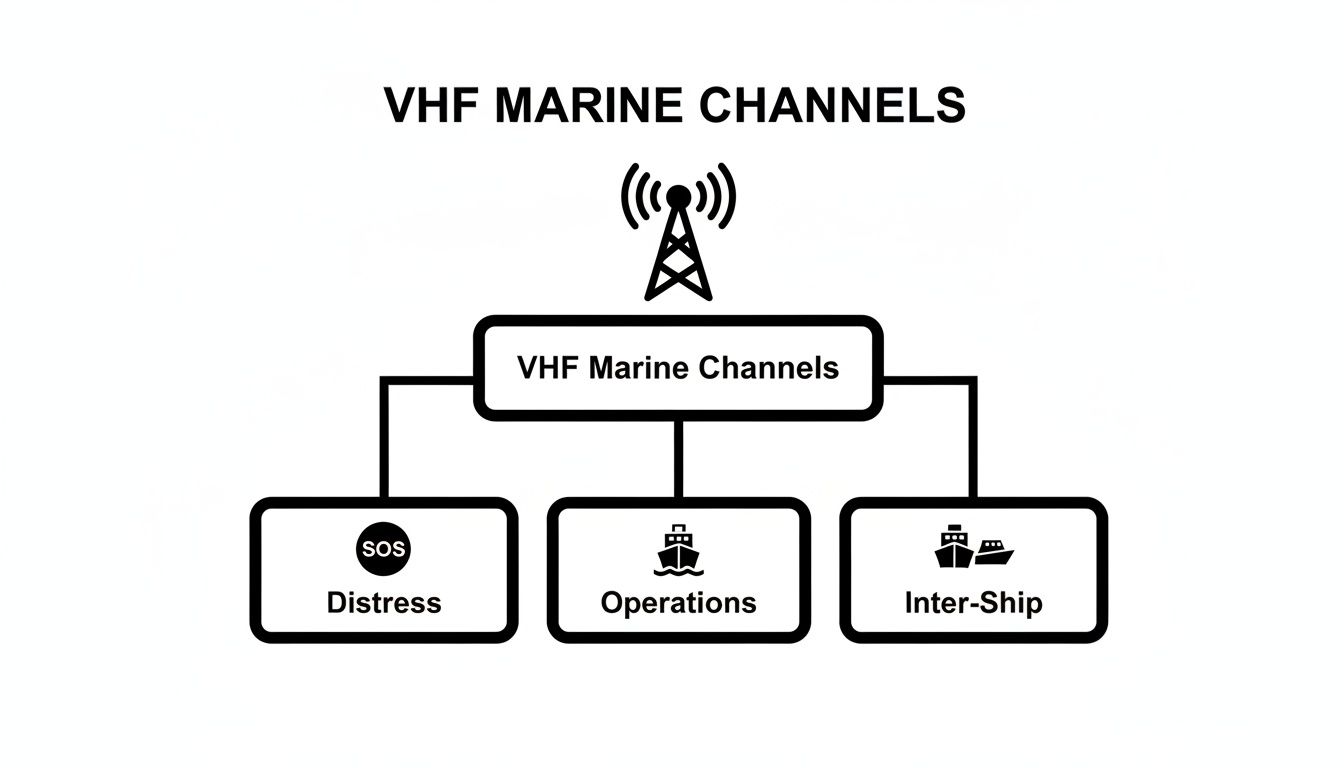
This structure is designed to keep life-saving channels like 16 and 70 clear for their intended purpose, while routine operational and inter-ship chatter happens elsewhere.
Navigating Offshore with MF and HF Frequencies
Once you’re out of sight of land, you’re well beyond the reach of standard coastal VHF. VHF radio is a line-of-sight technology, which means its signal travels in a straight line and gets blocked by the curve of the earth or big headlands. For any boat heading offshore in New Zealand, this is where Medium Frequency (MF) and High Frequency (HF) radios become absolutely vital.
Unlike VHF, MF and HF signals can travel over the horizon. They achieve this by bouncing off the ionosphere, allowing them to cover huge distances. This makes them the go-to tool for any serious long-range communication, keeping you connected to shore when you're hundreds of nautical miles out. For more advanced needs like long-range communication or internet access via satellite internet NZ, specialist solutions from providers like Starlink or Inmarsat are crucial.
Key MF and HF Frequencies for NZ Waters
To use these bands effectively, you need to know the critical calling and distress frequencies. These channels are constantly monitored by services like Maritime Radio (Taupo Maritime Radio), which also broadcast weather forecasts and manage communication schedules for commercial fleets on these same frequencies.
Here are the key international distress and calling frequencies you need programmed in:
- 2182 kHz (MF): This is the main frequency for distress calls, working much like VHF Channel 16 but for medium-range offshore situations.
- 4125 kHz (HF): A crucial calling and distress frequency used for even longer-range communication.
- 6215 kHz (HF): Another primary HF channel for distress, safety, and calling, which offers different propagation characteristics depending on the time of day and atmospheric conditions.
Think of a commercial fishing trawler on a multi-day trip far off the coast of Fiordland. They’d likely use an HF frequency like 6215 kHz to file a routine position report with Maritime Radio. If they ever got into serious trouble well outside of VHF range, these HF channels are their most reliable lifeline to kick off a rescue.
For any blue-water cruiser or commercial operator, mastering these long-range marine radio frequencies in NZ isn’t just good practice—it's a critical safety skill.
Meeting Your NZ Licensing and Legal Requirements
Operating a marine radio in New Zealand isn't a free-for-all; it comes with some serious legal responsibilities designed to keep everyone out on the water safe. Radio Spectrum Management (RSM) is the governing body here, and getting to grips with their rules is a must before you even think about hitting the transmit button.
The legal side of things is built on two key pillars, and you need both sorted to be compliant.
First up is the Maritime Ship Radio Licence, which is tied directly to your vessel. This licence gets your boat and its radio gear officially registered and assigns it a unique call sign, something like ZMW1234. Think of this call sign as your boat's official identity on the airwaves for all voice communications.
The second piece of the puzzle is the Maritime VHF Radio Operator Certificate. This one is for you, the person actually using the radio. It's your proof that you know how to operate the equipment correctly, understand the protocols, and can handle yourself in an emergency. You're required by law to hold this certificate to transmit on any marine VHF frequencies in NZ.
Why Your MMSI Number is Crucial
If your radio is kitted out with Digital Selective Calling (DSC) and Automatic Identification System (AIS)—and most modern units from brands like GME and Hytera are—then you'll also need a Maritime Mobile Service Identity (MMSI) number.
This unique nine-digit number is essentially your vessel’s digital fingerprint. When you apply for your Ship’s Radio Licence, you'll be issued an MMSI. It is absolutely vital that this number is programmed correctly into your radio, as it's what enables those life-saving one-touch DSC distress alerts to work.
Navigating the licensing paperwork and making sure your MMSI is programmed correctly can feel a bit daunting. This is where specialist providers like Mobile Systems come in. We can guide you through the whole process, making sure your gear is fully compliant and correctly set up from day one.
For anyone ready to get their operator's ticket, our step-by-step guide on how to get your VHF operator certificate in NZ has all the info you need to get started.
Choosing the Right Marine Radio and Antenna
Getting your communication setup right is one of the most important safety decisions you'll make for your boat here in New Zealand. The gear you choose can make all the difference out on the water, and it really comes down to the radio itself and the antenna you pair it with. The first big decision is whether to go for a fixed-mount VHF radio or a handheld unit.
Fixed-mount radios are the workhorses. They’re permanently installed, usually at the helm, and wired straight into your vessel's power supply. This allows them to push out the maximum legal power of 25 watts, giving you the best possible range.
On the other hand, you have handheld radios. These are completely self-contained, running on their own batteries and putting out anywhere from 1 to 6 watts. While their range is naturally shorter, their portability is a massive plus. They're a fantastic backup to have on board, and for smaller craft like kayaks or tenders, they're often the primary means of communication.

Sourcing the Right Gear
This isn't the kind of gear you buy from a general electronics store. For something this vital to your safety, you need to talk to specialist suppliers. They have the deep-seated product knowledge of quality, compliant marine brands like GME, Uniden, Hytera, and Motorola that you just won't find anywhere else. They'll also make sure your radio is programmed correctly for New Zealand waters.
Now, a radio is only ever as good as its antenna. A core principle of VHF communication that a lot of people overlook is that antenna height is more important than transmission power when it comes to range. It’s simple physics—mounting your antenna as high as you possibly can lets its signal "see" further over the horizon before it's blocked by the curve of the earth.
You'll also come across ground-dependent and ground-independent antennas. Trusted antenna brands like rfi and Pacific Aerials offer a range of solutions for every type of vessel.
While the comms gear is critical, don't forget about protecting the vessel itself. A high-quality ceramic coating for marine vessels can go a long way in preserving all your on-board equipment from the harsh marine environment. At the end of the day, the physical setup of your communication system is every bit as important as the radio itself.
On-Air Etiquette and Best Practices
Good on-air discipline is what keeps everyone safe and the channels running smoothly. Following the accepted rules for marine radio isn't just about being polite; it ensures those critical marine radio frequencies in NZ are kept clear for emergencies and that everyone can get their message across. It's a skill that directly contributes to a safer maritime environment for all of us.
The most fundamental rule is to listen before you speak. Always take a moment to make sure a channel is free before you hit that transmit button. When you do make a call, the standard procedure is to state the name of the vessel you’re calling three times, then your own vessel's name once. For example: "Sea Eagle, Sea Eagle, Sea Eagle, this is Albatross, over."
Core Communication Protocols
To keep things clear and professional on the air, a few practices are absolutely essential. Think of these less as suggestions and more as the standard operating procedures for maritime comms.
- Use Pro-words: These are standard procedural words that keep transmissions short and unambiguous. "Over" simply means you've finished speaking and are waiting for a reply. "Out" signals the entire conversation is finished. A common mistake is using them together – you never do.
- Phonetic Alphabet: If you need to spell out a vessel name or a word that might be garbled by a weak signal, use the NATO phonetic alphabet (Alpha, Bravo, Charlie, etc.). This cuts right through any potential confusion.
- Keep it Brief: Your transmissions should be as concise as you can make them. There's no room for unnecessary chatter, especially on busy calling channels or operational frequencies where people are trying to work.
- Radio Checks: NEVER use Channel 16 for a radio check. It’s strictly for distress, safety, and calling. Instead, call up Maritime Radio or another boat on a working channel to ask for a quick signal report.
Sticking to these simple but vital rules helps keep the airwaves organised. It guarantees that when a real emergency happens, the lines of communication are open and ready.
Common Questions About Marine Radio in NZ
Getting your head around marine communications can throw up a few questions. We've put together some quick, clear answers to the queries we hear most often from Kiwi boaties, helping you get it right and stay safe out on the water.
Do I Need a Licence to Use a VHF Marine Radio in New Zealand?
Yes, you definitely do. It's a two-part requirement. First, your vessel needs a Maritime Ship Radio Licence. This registers your radio equipment and gives your boat its own unique call sign.
On top of that, whoever is operating the radio must have a Maritime VHF Radio Operator Certificate. This isn't just a piece of paper; it proves you know the correct procedures for everything from a routine call to a full-blown distress situation, which is absolutely critical for safety at sea.
What Is the Real-World Range of a VHF Marine Radio?
The honest answer is: it depends. VHF radio is "line-of-sight," so its range is all about antenna height, not just how much power you're pushing.
- A standard fixed-mount 25W radio on a yacht, with the antenna up on the mast, can usually talk to a shore station 15-20 nautical miles away without much trouble.
- A little handheld radio (pushing 1-6W) has a much smaller footprint. You’re looking at around 3-5 nautical miles, mostly because of its lower power and tiny antenna.
This really drives home the point that a good quality, properly installed antenna is just as crucial as the radio unit itself if you want to maximise how far your signal can reach.
Can I Use a Marine Radio on Land?
Generally, no. It’s illegal to operate a marine VHF radio from land in New Zealand unless you have specific authorisation from Radio Spectrum Management (RSM). The marine radio frequencies in NZ are strictly for vessels at sea.
This rule is in place to keep the channels clear for maritime traffic and prevent interference that could mask a genuine emergency call. While places like marinas or Coastguard bases have special licences to operate as coast stations, these aren't available for the general public to use on shore.
How Do I Get an MMSI Number for My Boat?
Your Maritime Mobile Service Identity (MMSI) number is issued when you apply for your boat's Maritime Ship Radio Licence with RSM. Think of it as your boat's unique phone number for the marine world.
This nine-digit number is vital. You'll need to program it into any modern marine radio to unlock powerful safety features like Digital Selective Calling (DSC) and the Automatic Identification System (AIS).
For no-nonsense advice on picking, licensing, and installing the right comms for your vessel, talk to the specialists at Mobile Systems Limited. We'll make sure your gear is fully compliant and tough enough for New Zealand's challenging marine conditions. Check out our range of marine communication systems at https://mobilesystems.nz.
Related posts

- June 12, 2026
Relying on a cellular signal in the Southern Alps or the dense King Country bush is a calculated risk that...

- June 06, 2026
Did you know that 98.6% of radio licenses in New Zealand are subject to a fee increase starting July 1,...

- May 17, 2026
Read our 2026 NZ guide. DMR vs P25: Which Digital Radio Standard is Right for Your Business? Compare features to...