
UHF vs VHF Radios NZ: The Professional Buyer’s Guide (2026)
Relying on a cellular signal in the Southern Alps or the dense King Country bush is a calculated risk that often results in total communication failure. When your operations move beyond the reach of the nearest tower, the technical choice between uhf vs vhf radios nz becomes the primary factor in your team's safety and operational efficiency.
Relying on a cellular signal in the Southern Alps or the dense King Country bush is a calculated risk that often results in total communication failure. When your operations move beyond the reach of the nearest tower, the technical choice between uhf vs vhf radios nz becomes the primary factor in your team's safety and operational efficiency.
You likely recognize that standard consumer-grade equipment isn't built for the rigors of New Zealand's industrial or alpine environments. We understand the frustration of signal dropouts and the complexity of complying with Radio Spectrum Management (RSM) requirements, particularly with the 2026 license fee adjustments now in effect.
This guide provides a professional framework for selecting the correct frequency and hardware for your specific terrain. We'll examine the physics of signal penetration, clarify current licensing obligations under the latest regulations, and identify the hardware standards required to survive moisture and high-vibration settings.
Key Takeaways
- Evaluate the technical differences of uhf vs vhf radios nz to determine which frequency wavelength suits your specific work environment.
- Navigate the 2026 Radio Spectrum Management (RSM) licensing changes and fee structures to maintain legal compliance for your business.
- Assess the benefits of the industry shift to Digital Mobile Radio (DMR) for superior audio clarity and reduced signal interference.
- Identify hardware specifications, such as IP ratings and military standards, that ensure your equipment survives the rugged conditions of the New Zealand bush.
- Understand how repeaters and simulcast systems extend communication range across vast or topographically challenging commercial sites.
UHF vs VHF: Frequency Selection for NZ Terrain
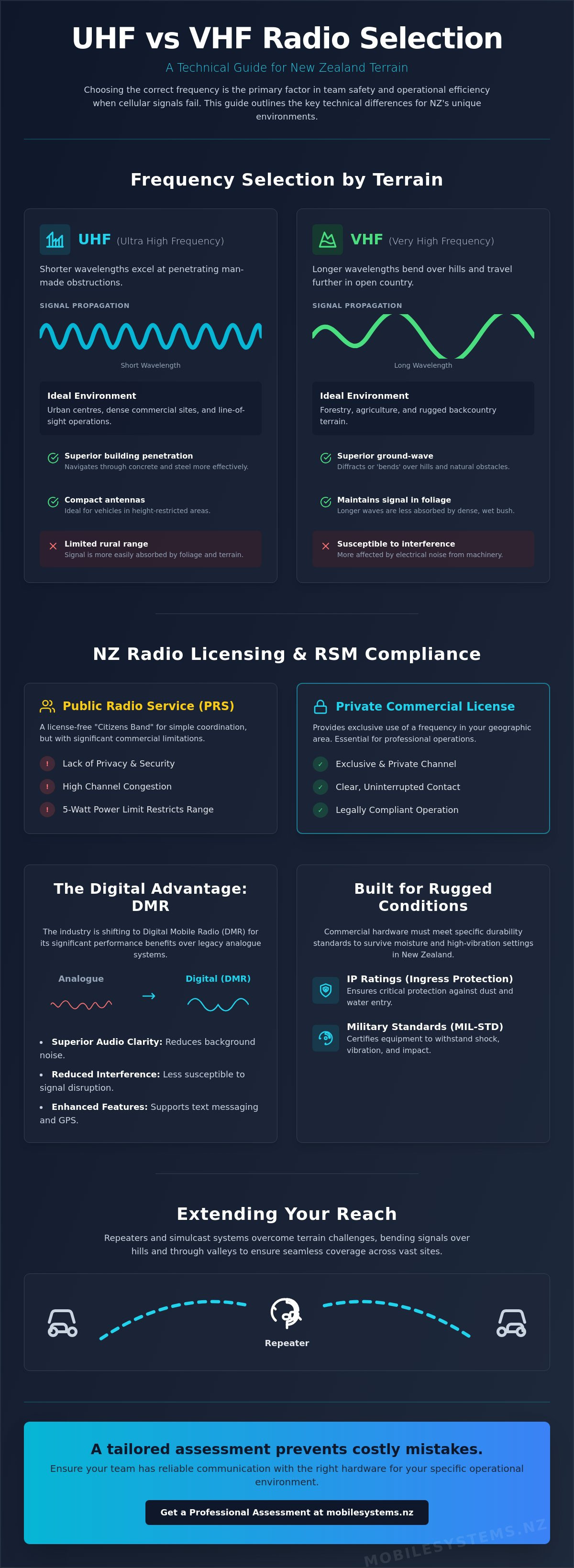
Selecting the right hardware requires a technical understanding of how radio waves interact with the physical environment. The choice between uhf vs vhf radios nz isn't about which technology is superior in a vacuum, but which wavelength matches your specific topography. UHF operates at a higher frequency with shorter wavelengths, while VHF uses longer waves that behave differently when they encounter obstacles like hills or dense foliage.
Terrain dictates the physics of your communication link. In a flat, open paddock, both systems may perform similarly. However, as soon as you introduce the steep ravines of the Kaimai Ranges or the concrete canyons of a CBD, the propagation characteristics diverge. Shorter waves tend to bounce or penetrate, while longer waves tend to bend.
To better understand the fundamental differences in how these frequencies propagate, watch this technical overview:
UHF for Urban and Line-of-Sight Operations
UHF (Ultra High Frequency) signals are highly effective at penetrating man-made obstructions. Because the waves are shorter, they can navigate through smaller openings in buildings and pass through steel structures more effectively than lower frequencies. This makes UHF the standard choice for urban operations in cities like Auckland or Christchurch.
Most commercial users in these environments utilize the 80-channel UHF PRS (Public Radio Service) band for short-range coordination. Additionally, UHF antennas are significantly shorter than their VHF counterparts. This makes them ideal for vehicle-mounted two-way radios in height-restricted areas like underground parking buildings where longer antennas would strike the ceiling.
VHF for Forestry and Rugged Backcountry
For rural sectors like forestry and large-scale agriculture, Very High Frequency (VHF) remains the preferred standard. VHF waves possess superior "ground wave" characteristics, meaning they can diffract or bend over the crest of a hill or around the curve of the earth more effectively than UHF.
In the dense native bush of the South Island, these longer wavelengths maintain signal integrity where UHF would be absorbed or blocked by wet foliage. However, VHF is more susceptible to electrical interference from heavy machinery and power lines. It also requires a longer antenna to operate efficiently, which can be a mounting challenge on smaller utility vehicles. A tailored assessment of your primary work sites often prevents costly mistakes when deciding between uhf vs vhf radios nz systems.
New Zealand Radio Licensing and RSM Compliance
In New Zealand, the radio spectrum is a finite public resource managed by Radio Spectrum Management (RSM). Operating commercial communications requires adherence to strict legal frameworks to prevent interference between users. When evaluating uhf vs vhf radios nz, businesses must decide whether to utilize shared public channels or invest in a dedicated private frequency.
Failure to comply with these regulations can lead to significant operational disruptions. If your equipment interferes with emergency services or licensed commercial networks, you may face equipment seizure and substantial fines under the Radiocommunications Act. Legal operation ensures your team maintains clear, uninterrupted contact without infringing on other spectrum users.
Public Radio Service (PRS) vs Private Licensing
The Public Radio Service (PRS) is the license-free "Citizens Band" of New Zealand. It consists of 80 channels on the UHF band and is restricted to 5-watt maximum power. While PRS is cost-effective for simple coordination, it's often unsuitable for commercial operations due to several factors:
- Lack of Privacy: Any user within range can listen to or interrupt your conversations.
- Congestion: In industrial hubs or popular forestry blocks, channel traffic can make communication nearly impossible.
- Power Limitations: The 5-watt limit restricts range, making it ineffective for large-scale sites or rugged terrain.
A private commercial license provides exclusive use of a specific frequency in your geographic area. This is essential for businesses requiring high-power 25-watt vehicle-mounted units or repeater systems. As of July 1, 2026, the standard annual license fee for most commercial users has increased to $190 NZD, reflecting the value of this protected airwave space.
Compliance for Imported Hardware
Not all radio hardware sold online is legal for use in New Zealand. Equipment must comply with the Radiocommunications Regulations (Radio Standards) Notice 2025. All compliant hardware must carry the Regulatory Compliance Mark (RCM), which signifies the device meets AS/NZS standards for signal stability and power levels.
Many high-power radios imported from overseas are unblocked and can transmit on restricted frequencies used by the New Zealand Police or aviation sectors. Even hardware built for the Australian market may not be legal here, as frequency allocations for certain services differ between the two countries. A tailored assessment often prevents costly mistakes regarding hardware legality and regulatory compliance.
To secure a private frequency, businesses typically engage an Approved Radio Engineer (ARE) or an Approved Radio Certifier (ARC). These professionals calculate the necessary signal parameters and submit the technical data to RSM for license generation. This process ensures your communication system is engineered to work reliably within the legal limits of the New Zealand environment.
Digital vs Analogue: The 2026 Technology Shift
In 2026, the New Zealand commercial sector is rapidly moving toward Digital Mobile Radio (DMR) standards. Unlike traditional analogue systems that transmit a continuous voice wave, digital radios convert audio into data packets. This shift is essential for businesses comparing uhf vs vhf radios nz because digital technology fundamentally changes how signals behave at the edge of their range.
Digital processing eliminates the static and background hiss that often plague weak analogue signals. You either have a clear voice signal or no signal at all, which ensures critical instructions are never misunderstood in high-stakes environments. Additionally, digital systems utilize Time Division Multiple Access (TDMA). This technology allows two simultaneous conversations on a single 12.5 kHz channel, effectively doubling your capacity without requiring additional Radio Spectrum Management (RSM) licensing fees for extra frequencies.
Efficiency also extends to hardware performance. Digital handhelds only transmit half the time during a conversation because of the TDMA pulsing method. This results in battery life improvements where digital devices often last 30% to 50% longer per charge compared to their analogue equivalents. This is a vital consideration for long shifts in remote New Zealand locations where charging opportunities are non-existent.
Clarity and Privacy in Digital Systems
Industrial worksites are inherently loud. Digital radios feature active background noise cancellation, filtering out the roar of heavy machinery or high winds to prioritize the human voice. Privacy is also significantly enhanced. While anyone with a basic scanner can listen to analogue transmissions, digital systems offer encryption levels ranging from basic 40-bit to advanced AES-256. These systems also support integrated data features like GPS tracking and short text messaging, providing a comprehensive operational overview of your fleet.
Migration Strategies for Professional Fleets
Transitioning a full fleet doesn't have to happen overnight. Most modern two-way radio devices are dual-mode, meaning they can communicate with existing analogue units while you phase in newer digital hardware. It's critical to ensure your new units are compatible with your current repeater infrastructure. Proper programming allows for a unified fleet where teams can move between analogue and digital zones seamlessly. A tailored assessment of your current infrastructure often prevents costly mistakes during this technological transition.
Commercial Durability and Hardware Specifications
Beyond selecting the right frequency, the longevity of your communication system depends on hardware engineering. New Zealand's industrial environments, from high-country stations to coastal construction sites, demand equipment that exceeds consumer-grade specifications. When comparing uhf vs vhf radios nz, the internal chassis construction is often the first point of failure in cheaper units. Professional radios utilize a die-cast aluminium chassis that protects internal circuitry from vibration and acts as a heat sink during high-power transmissions.
Audio output power is another critical technical specification. In high-noise environments like sawmills or heavy transport depots, a standard handheld may be inaudible. Professional units typically offer 1 watt of audio output or more, coupled with noise-cancelling microphones. This ensures voice clarity remains high even when background decibel levels are significant. This is a functional requirement that prevents the need for repeated transmissions in loud settings.
Hardware must also meet MIL-STD 810 standards. This US Military Standard involves rigorous testing for environmental stress, including high-impact shock and sustained vibration. For vehicle-mounted units traveling over corrugated forestry roads or rugged farm tracks, these standards are not optional; they're required for operational reliability. Equipment lacking these certifications often suffers from internal component fatigue and premature failure.
IP Ratings for the NZ Environment
Ingress Protection (IP) ratings define how well a radio resists dust and water. For New Zealand forestry and marine operations, IP67 or IP68 ratings are essential. An IP67 rating means the device is dust-tight and can survive immersion in water up to 1 metre for 30 minutes. This level of protection is vital for handheld radios exposed to sudden alpine rain or the corrosive salt air of our coastal regions. Protecting internal circuitry from moisture ingress is the only way to ensure a multi-year service life.
Battery Chemistry and Cold Weather Performance
Battery performance varies significantly based on chemical composition and ambient temperature. Lithium-Ion (Li-Ion) batteries are standard for their high energy density and lack of "memory effect." However, performance can drop in extreme cold. Nickel-Metal Hydride (NiMH) is sometimes preferred for South Island winters due to its stability in sub-zero temperatures. Modern intelligent battery management systems now provide real-time health data, helping fleet managers replace cells before they fail in the field. For more detailed model comparisons, consult our best handheld VHF radio NZ guide.
Selecting equipment that matches your specific environmental stressors is as important as the frequency choice itself. If you're unsure which hardware standard meets your site requirements, contact our technical team for a professional hardware assessment.
Designing an Integrated Fleet Communication System
Purchasing high-quality hardware is only the initial step in establishing a reliable network. Commercial communication failures often stem from "off-the-shelf" solutions that fail to account for the specific topography and infrastructure of a New Zealand worksite. A robust system requires professional engineering to ensure that the technical advantages of uhf vs vhf radios nz are fully realized in the field.
Antenna tuning is a critical component frequently overlooked in DIY installations. Every antenna must be precisely matched to its operating frequency using a Standing Wave Ratio (SWR) meter. If the antenna is not tuned correctly, energy reflects back into the transmitter rather than radiating into the air. This inefficiency reduces range and can eventually destroy the radio's power amplifier through overheating. Professional installation ensures your equipment operates at peak efficiency while protecting your long-term investment.
For operations spanning vast distances or mountainous terrain, a single radio's power is often insufficient. Repeaters placed on high-altitude sites receive weak signals and re-transmit them at higher power, effectively bypassing geographic obstacles. In complex regional networks, simulcast systems synchronize multiple repeaters to provide a seamless coverage footprint. This allows workers to move between valleys without manually switching channels or losing contact with the base.
Engineered Solutions vs Box-Buying
Effective system design begins with a comprehensive site survey. We utilize digital coverage mapping to identify potential "dead zones" caused by terrain or structural interference. This data-driven approach is essential when determining the best configuration for uhf vs vhf radios nz in new developments. Modern systems also integrate specialized safety features to meet New Zealand health and safety obligations, including:
- Man-Down Sensors: Automatically alerts the base if a handheld unit remains at a horizontal angle for a set duration.
- Lone Worker Timers: Requires the user to check in at programmed intervals, triggering an alarm if they fail to respond.
- GPS Integration: Provides real-time coordinates of every unit in the fleet for rapid emergency response.
Next Steps for Your Business Fleet
Your first step toward a more reliable network is a comprehensive audit of your current equipment. Identify units with degraded battery life or those that struggle with signal clarity in known problem areas. Many businesses now find value in hybrid systems that link traditional radio networks with cellular devices, allowing office staff to communicate with field teams via unified gateways.
System design is a technical discipline where a tailored assessment often prevents costly mistakes. For expert guidance on RSM frequency planning or to request a technical assessment of your requirements, contact Mobile Systems. Our team provides the on-site support and mobile servicing necessary to keep remote New Zealand operations connected in all conditions.
Securing Your Operational Communications
Establishing a reliable communication network requires balancing technical requirements with the physical realities of the New Zealand landscape. Success depends on matching your frequency choice to your specific terrain, ensuring full compliance with the latest 2026 RSM licensing regulations, and selecting hardware that meets industrial durability standards. It's clear that the technical choice between uhf vs vhf radios nz is the foundation of a system that provides safety where cellular networks fail.
Mobile Systems Limited has specialized in ruggedized New Zealand fleet solutions since our inception. We provide comprehensive RSM licensing and frequency planning expertise to ensure your operations remain legal and interference-free. Our nationwide fleet of mobile support vehicles provides on-site servicing and installation, ensuring your team stays connected regardless of their location.
A tailored assessment often prevents costly mistakes in frequency selection and hardware procurement. To optimize your fleet connectivity for the demanding conditions of the New Zealand bush and urban centers, request a tailored communication assessment today. We look forward to helping you build a communication framework that supports your business objectives with absolute reliability.
Frequently Asked Questions
Do I need a licence to use a two-way radio for my business in New Zealand?
Yes, most commercial operations require a specific license from Radio Spectrum Management (RSM). While the 80-channel UHF PRS band is available under a General User Radio Licence (GURL) without individual fees, businesses needing higher power or private channels must apply for an individual frequency. As of July 1, 2026, standard license fees for commercial use have increased to $190 NZD per year.
What is the main difference between UHF and VHF for NZ terrain?
The technical difference between uhf vs vhf radios nz lies in signal propagation and wavelength. UHF uses shorter wavelengths that penetrate concrete and steel, making it ideal for urban Auckland or indoor warehouse use. VHF features longer wavelengths that bend over hills and through dense native bush. Consequently, forestry and agricultural sectors typically favor VHF for its superior performance in rugged backcountry.
How far will a 5-watt handheld radio transmit in the NZ bush?
You can generally expect a range of 1 to 3 kilometers in dense New Zealand bush. While a 5-watt radio can reach 10 kilometers or more across open water or from a high ridge, thick vegetation and steep gullies rapidly absorb and block signals. To extend this range in remote areas, businesses often utilize vehicle-mounted repeaters or high-gain antennas to maintain reliable contact.
Can I use Australian-spec UHF radios in New Zealand legally?
No, you shouldn't assume Australian-spec hardware is legal in New Zealand. While both countries share some standards, NZ equipment must comply with the Radiocommunications Regulations (Radio Standards) Notice 2025 and carry the Regulatory Compliance Mark (RCM). Using unapproved high-power radios can result in fines if they interfere with local frequencies or emergency services. Always verify compliance before importing hardware.
What is DMR and why is it recommended for professional fleets in 2026?
Digital Mobile Radio (DMR) is an international standard that replaces traditional analogue signals with digital data packets. It's recommended because it provides superior audio clarity by filtering out background industrial noise and doubles channel capacity using TDMA technology. In 2026, DMR is the professional standard due to its support for integrated GPS tracking and encrypted private communication.
How long does a commercial radio battery typically last on a single charge?
A professional-grade radio battery typically lasts between 10 and 14 hours on a standard duty cycle. This cycle assumes 5% transmit time, 5% receive time, and 90% standby time. Digital radios generally offer 30% to 50% better battery efficiency than analogue models because they don't transmit a continuous wave, making them more reliable for extended work shifts.
Is it worth buying a waterproof IP68 radio for land-based construction?
Yes, an IP68 rating is highly beneficial for land-based construction. While the "8" refers to water immersion, the "6" indicates total protection against dust and grit, which are primary causes of hardware failure on NZ worksites. A ruggedized radio survives being dropped in mud or exposed to heavy rain, significantly reducing the total cost of ownership by preventing premature equipment failure.
Can different brands of two-way radios communicate with each other?
Yes, different brands can communicate if they're programmed to the same frequency and use the same modulation mode. Analogue radios are almost universally compatible across brands. For digital systems, hardware must support the same standard, such as DMR Tier II. Ensuring all devices are correctly programmed for your licensed frequency is essential for seamless fleet integration.
Related posts

- June 06, 2026
Did you know that 98.6% of radio licenses in New Zealand are subject to a fee increase starting July 1,...

- May 17, 2026
Read our 2026 NZ guide. DMR vs P25: Which Digital Radio Standard is Right for Your Business? Compare features to...