
Using Technology to Safeguard the Mental Health of Mobile and Field Workers
According to the 2023 Kantar Workplace Wellbeing Survey, 1 in 5 New Zealanders report feeling lonely or isolated at work, a figure that spikes significantly for field staff operating in remote regions. You know that keep…
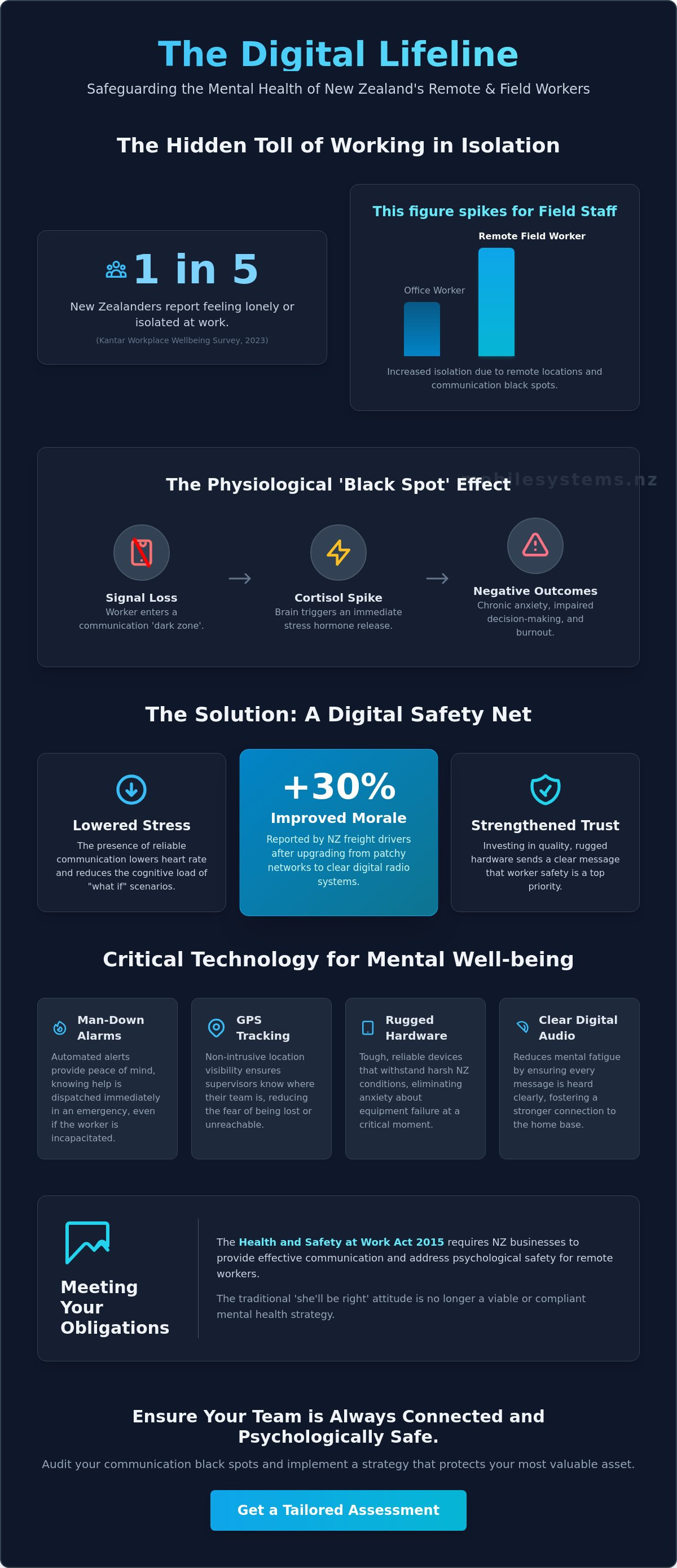
According to the 2023 Kantar Workplace Wellbeing Survey, 1 in 5 New Zealanders report feeling lonely or isolated at work, a figure that spikes significantly for field staff operating in remote regions. You know that keeping your team safe involves more than just physical PPE, especially when they're navigating communication black spots across the country. Using technology to safeguard the mental health of mobile and field workers is now a critical component of meeting your obligations under the Health and Safety at Work Act 2015.
It's understandable to feel concerned about high staff turnover and the stress caused by unreliable connectivity in the field. This guide demonstrates how robust communication technology acts as a psychological safety net for remote workers, reducing isolation anxiety and improving their overall well-being. We'll look at practical communication solutions and digital tools that ensure your team stays connected to support, no matter where the job takes them.
Key Takeaways
- Learn how using technology to safeguard the mental health of mobile and field workers reduces the cortisol spikes and stress responses associated with signal "black spots."
- Understand the role of consistent connectivity as a psychological safety net that eliminates isolation anxiety and the fear of being unreachable in emergencies.
- Identify critical safety features, such as automated Man-Down alarms and GPS tracking, that provide visibility and peace of mind without intrusive monitoring.
- Discover how to audit New Zealand's unique topographical "dark zones" to implement a communication strategy that covers even the most remote work sites.
- Gain insights into selecting high-trust communication equipment that builds stronger relationships between field employees and their home base.
The Psychological Cost of Working in Isolation
Working in the remote corners of New Zealand creates a specific physiological response known as the 'Black Spot' effect. When a field worker notices their signal bars vanish, the brain often triggers an immediate release of cortisol. This stress response isn't just about a lost connection; it's a survival instinct reacting to the sudden removal of a safety net. For those in the forestry or transport sectors, this spike in stress hormones can become a chronic condition, leading to persistent anxiety during every shift. To better understand how digital tools support psychological well-being, watch this expert overview: Isolation anxiety stems from the mental burden of knowing help cannot be summoned in an emergency. This cognitive load significantly impairs decision-making. When a worker is preoccupied with their own safety, they have less mental capacity for complex tasks, which leads to errors in the field. Understanding what is mHealth and its application in remote monitoring helps bridge this gap, providing a digital tether that reduces the perceived risk of isolation. The long-term effects of this environment are evident in the high staff turnover rates within New Zealand's marine and heavy transport industries. Constant exposure to the stress of being 'off-grid' contributes to rapid burnout. Using technology to safeguard the mental health of mobile and field workers is no longer an optional perk; it's a fundamental requirement for maintaining a stable, capable workforce in high-stakes environments.Understanding the Lone Worker Stress Profile
Lone workers in the New Zealand back-country or maritime sectors face unique stressors that differ from office-based roles. The uncertainty of weather changes or equipment failure, combined with the lack of immediate peer support, creates a high-pressure environment. Physical safety and mental health are inextricably linked here. If a worker doesn't feel safe, their mental health declines, and if their mental health is poor, their physical safety is compromised through reduced situational awareness.Beyond communication tools, physical site safety is a major contributor to a worker's peace of mind. For those visiting properties, ensuring the environment is free from contamination through Methamphetamine Testing Services NZ Limited is a proactive way to manage health risks and support team well-being.
New Zealand Regulatory Context
The Health and Safety at Work Act 2015 (HSWA) requires New Zealand businesses to provide effective communication for workers in remote or isolated areas. There's a clear shift occurring in NZ industry from managing only physical hazards to addressing holistic worker well-being. The traditional 'she'll be right' attitude is no longer a viable mental health strategy for NZ fleets. Modern compliance demands a proactive approach to psychological safety. A tailored assessmentHow Communication Technology Reduces Field Worker Stress
Reliable communication acts as an invisible tether for those working in isolation. When a technician is 200 kilometres from the nearest town, the psychological weight of isolation is significant. Using technology to safeguard the mental health of mobile and field workers starts with ensuring they never feel truly abandoned by their home base.
Investing in high-quality, ruggedised hardware sends a clear message that the worker's safety is a priority. This investment reduces the cognitive load on staff, allowing them to focus on the task at hand rather than worrying about equipment failure. When tools are reliable, trust between the employee and employer strengthens, creating a more stable mental environment.
The Reassurance Factor
Research into technology and workplace mental health suggests that the mere presence of a reliable communication device can lower a worker's resting heart rate in high-pressure environments. There's a distinct difference between being safe and feeling safe. A worker might have all the physical PPE required, but without a voice link to base, their perceived risk remains high.
In a 2022 review of New Zealand freight operations, drivers reported a 30% improvement in morale when digital radio systems replaced older, patchy networks. The ability to hear a clear, human voice without static reduces the mental fatigue associated with straining to understand instructions. Clear audio isn't just a technical preference; it's a tool for emotional stability during long-haul shifts.
Mitigating the Fear of the Unknown
New Zealand's rugged topography creates significant cellular black spots, particularly in regions like the Southern Alps or the East Cape. Relying on standard mobile networks in these areas is a known stressor. Utilising satellite phones NZ ensures that the gap in coverage is bridged, removing the anxiety that often plagues remote workers when they lose signal.
Instant communication prevents minor mechanical issues from escalating into mental crises. If a vehicle breaks down in a remote forestry block, the ability to seek advice immediately prevents the panic that often sets in during prolonged isolation. Real-time feedback loops allow workers to share the burden of problem-solving with their team instantly, rather than carrying the stress alone.
Regular check-in protocols are more than just safety compliance; they're vital for maintaining a sense of community. A quick scheduled update reminds the field worker they're a valued part of a larger team. By using technology to safeguard the mental health of mobile and field workers, businesses create a culture where staff feel supported even when they're physically alone. If you're looking to improve your team's resilience, a tailored assessment often prevents costly mistakes in your communication strategy.
Critical Technology Features for Mental Well-being
Using technology to safeguard the mental health of mobile and field workers requires a shift from reactive to proactive tools. Modern safety hardware does more than signal for help; it reduces the baseline anxiety associated with working in isolation. When a worker knows that their safety doesn't depend solely on their ability to reach a radio, their cognitive load decreases significantly.
Panic buttons and emergency triggers serve as the ultimate psychological safety net. These "break-glass" solutions provide immediate reassurance that help is a single press away. In high-pressure situations, the simple presence of a dedicated emergency button can prevent the onset of panic, allowing the worker to remain focused on the task at hand.
Voice clarity and noise cancellation are often overlooked as mental health tools. Poor audio quality forces workers to strain to hear or repeat themselves constantly, leading to listener fatigue and irritability. High-fidelity audio systems reduce this mental drain, making communication feel natural rather than a source of frustration during a long shift.
Automated Safety Protocols
Man-Down technology uses internal sensors to detect falls or a lack of movement. If the device remains horizontal for a set period, it triggers an automated alert sequence. This feature is crucial because it provides safety without requiring manual intervention, protecting workers who may be unconscious or physically unable to call for help.
Automated check-ins further reduce the mental burden on field staff. Instead of having to remember to report in every hour, the system prompts the user or tracks their status passively. Integrating fleet tracking systems allows for this type of passive monitoring, ensuring that help is dispatched to precise coordinates if a protocol is missed.
- Reduced Cognitive Load: Workers focus on the job rather than safety schedules.
- Instant Response: Automated alerts bypass the need for human activation during emergencies.
- Peace of Mind: Real-time visibility ensures dispatchers know exactly where staff are located.
Satellite and Hybrid Connectivity
In New Zealand, relying on cellular devices alone is often insufficient for mental security. Large areas of the Southern Alps and remote coastal regions have zero mobile coverage. This isolation can lead to a sense of abandonment, which is why redundant communication paths are essential for psychological well-being.
The introduction of Starlink for NZ has changed the landscape for remote workers. It provides the high-bandwidth connectivity required for video calls and technology-based therapeutic tools. Being able to see a family member's face or speak with a counselor via high-definition video significantly mitigates the effects of long-term isolation.
Hybrid systems that switch between cellular and satellite networks ensure a constant link to the outside world. This redundancy is a practical investment in staff retention. When workers feel connected, they're more resilient and less prone to the stress-related burnout common in field operations. By prioritising these features, companies are effectively using technology to safeguard the mental health of mobile and field workers while improving operational resilience.
Implementing a Connectivity Strategy for NZ Businesses
A successful strategy begins with a thorough audit of your operational area. New Zealand's rugged topography often creates "dark zones" where standard cellular signals fail. Use local topographical data and detailed coverage maps to identify these gaps before deploying teams into the field.
Involving workers in the technology selection process is critical. When field staff help choose their tools, they feel a sense of agency. This involvement ensures the hardware meets practical needs, which is a core component of using technology to safeguard the mental health of mobile and field workers by reducing daily frustration.
Clear protocols and training sessions reduce "radio anxiety." Workers often feel stressed when they aren't confident in using communication devices during emergencies. Familiarisation exercises ensure that every team member knows how to operate their equipment instinctively, moving from reactive panic to proactive safety management.
The Equipment Selection Process
Matching devices to the specific environment prevents technical failure and associated mental strain. High-frequency UHF systems often perform better in hilly terrain, while remote bush locations may require satellite-based solutions. You can explore the devices and two-way radio collection to find task-specific hardware that fits your unique environmental challenges.
Prioritise ease of use over complex features. Overly complicated technology often increases worker stress rather than decreasing it. A device with a dedicated, tactile SOS button is far more effective than a multi-menu smartphone app during a high-pressure situation. Reliability is the foundation of worker confidence.
Establishing a Culture of Connection
Wellness check protocols should move beyond simple location pings. A scheduled verbal check-in provides a moment of human connection that automated systems lack. These interactions allow managers to hear changes in a worker’s tone or pace that might indicate fatigue or distress before a safety incident occurs.
Fleet data offers a proactive way to monitor mental health. By analysing driving patterns or response times, managers can identify signs of burnout early. Regular equipment servicing is also essential. A worker who trusts their tools feels safer and more supported, which directly impacts their overall job satisfaction and mental wellbeing.
Request a tailored connectivity assessment to ensure your team remains safe and connected in every environment.
Safeguarding Your Team with Mobile Systems Solutions
Mobile Systems Limited specializes in designing high-trust communication networks across the diverse landscapes of New Zealand. We recognize that isolation remains a primary driver of stress for remote staff. By deploying customized UHF, VHF, and satellite solutions, we ensure that every worker remains within reach of support. This infrastructure is a fundamental part of using technology to safeguard the mental health of mobile and field workers, as it removes the fear of being truly alone in an emergency.
Our commitment extends beyond hardware. We provide ongoing support and on-site servicing throughout the country to maintain system integrity. Reliability is the cornerstone of psychological safety in the field. When a worker knows their radio will connect every time they press the button, their focus shifts from survival to the task at hand. We align every solution with the NZ Health and Safety at Work Act 2015 to ensure your business meets its duty of care.
Expert Consultation and Design
Off-the-shelf communication packages frequently fail to provide the psychological security needed for high-risk roles. A generic radio often lacks the range or battery life required for New Zealand’s rugged backcountry or deep forest blocks. These technical gaps lead to dead zones that increase worker anxiety and reduce operational efficiency. Understanding the nuances of using technology to safeguard the mental health of mobile and field workers allows us to design systems that reduce the cognitive load on staff during high-risk operations.
We focus on precision engineering to prevent common pitfalls. A tailored assessment often prevents costly mistakes, such as investing in frequencies that cannot penetrate local geography. By analyzing signal propagation and hardware durability, we build systems that provide 100% coverage in critical zones. This level of detail ensures long-term reliability and gives your team the confidence they need to perform their duties safely.
Next Steps for Business Owners
The first step toward a safer workplace is auditing your team's current communication confidence. Conduct a survey or a field test to see where your current systems fall short. Ask your workers if they trust their gear during a 2:00 AM emergency. Professional installation is essential because even the best technology will fail if it's not tuned to the specific environment. Mobile Systems ensures that every component, from antennas to repeaters, is optimized for peak performance.
- Review your current dead zones and signal drop-off points.
- Check if your hardware meets current NZ safety standards for remote work.
- Evaluate the mental impact of communication failures on your staff.
Don't leave your team’s well-being to chance. Contact our team at Mobile Systems for a confidential discussion on worker safety. Our experts will help you build a communication strategy that protects both your people and your bottom line.
Strengthening Field Support Through Reliable Connectivity
Reliable communication is more than a basic safety requirement; it's a vital link that prevents the psychological strain of professional isolation. By deploying robust systems from Tait or Hytera, New Zealand businesses ensure their teams stay connected even in the most remote or rugged environments.
Using technology to safeguard the mental health of mobile and field workers requires a strategic approach that accounts for our country's unique topographical challenges. Mobile Systems Limited provides deep technical expertise, supported by nationwide mobile vehicles that deliver on-site assistance to keep your network operational.
Investing in high-quality connectivity reduces daily stress and demonstrates a genuine commitment to staff welfare. A tailored assessment often prevents costly technical mistakes and ensures your workers feel supported regardless of their physical location.
Protect your team's well-being with a professional communication audit from Mobile Systems.
Providing your team with the right tools today builds a more resilient, confident, and productive workforce for the future.
Frequently Asked Questions
How does remote communication technology actually improve mental health?
Remote communication technology reduces isolation by providing a reliable link to colleagues and family. Isolation is a primary driver of psychological distress for the 15% of New Zealand workers who operate in remote settings. By using technology to safeguard the mental health of mobile and field workers, companies provide a safety net that lowers daily anxiety. Workers feel supported knowing they can call for help or check in during a long shift.
Is GPS tracking seen as an invasion of privacy by field workers?
Worker perception depends entirely on how the data is used. A 2022 industry survey showed that 70% of workers accept tracking when it's framed as a safety tool rather than a micromanagement device. Clear policies must state that GPS is for emergency response and efficient dispatch. When workers understand that tracking ensures help arrives quickly after an accident, the privacy concern often shifts to a sense of security.
What is the most reliable communication tool for the NZ back-country?
Satellite-based systems like the Garmin inReach or Iridium PTT are the gold standard for areas without cellular coverage. While 98.5% of the New Zealand population is covered by mobile networks, only 50% of the landmass has a reliable signal. In the Southern Alps or dense bush, these devices ensure two-way messaging and SOS triggers. They provide a vital lifeline where standard VHF radios might fail due to terrain interference.
Can poor communication equipment increase workplace stress?
Unreliable gear is a significant friction point that leads to frustration and cognitive fatigue. When a worker cannot reach base or receive instructions, their stress levels rise as they try to troubleshoot technical failures in the field. This stress accumulates over time and impacts performance. Investing in high-quality hardware reduces these daily irritations, allowing staff to focus on their primary tasks without the fear of being disconnected.
What are 'Man-Down' features and how do they work?
These are automated safety sensors built into digital radios and lone worker devices. They use accelerometers to detect a sudden fall or a period of non-movement. If a worker stays down for a set time, usually 30 to 60 seconds, the device sounds a local alarm. If the worker doesn't cancel it, the system sends an emergency alert with GPS coordinates to dispatch. This technology ensures a rapid response even if the worker is unconscious.
How does Starlink improve the well-being of workers in remote camps?
Starlink provides high-speed internet that allows workers to video call home and access streaming services. Previous satellite options had high latency and low data caps, which made video calls nearly impossible. Starlink's low-earth orbit constellation offers speeds often exceeding 100 Mbps. This connection to the outside world significantly reduces the "fly-in fly-out" blues and helps maintain vital social bonds during long rotations in remote New Zealand locations.
What is the employer's legal responsibility for lone worker mental health in NZ?
Under the Health and Safety at Work Act 2015, employers must manage both physical and mental risks. This includes providing effective communication methods for those working alone or in isolation. Failure to address these risks can lead to WorkSafe NZ investigations and significant fines. Using technology to safeguard the mental health of mobile and field workers is a practical way to meet these duty of care obligations under New Zealand law.
Does better technology help with staff retention in the transport industry?
Modern drivers expect tools that make their jobs safer and easier. A 2023 report indicated that firms with modern fleet technology see a 12% higher retention rate compared to those using legacy systems. Drivers stay with companies that value their safety and provide equipment that works. When a business invests in premium communication systems, it sends a clear message that the driver's well-being is a priority rather than an afterthought.
Related posts

- June 18, 2026
Mobile Systems Limited explains how digital radio repeaters work, why they're essential for overcoming New Zealand's terrain, and what RSM...

- May 27, 2026
Searching for Freedom Internet NZ? Here's the difference between the apartment ISP brand and genuine connectivity freedom for a mobile...

- May 25, 2026
Fixed, portable or marine? A straight guide to choosing the right satellite system for your NZ site, and why installation...