
The Ultimate WiFi Booster NZ Guide for Your Business
Struggling with weak WiFi? Our guide to WiFi booster NZ solutions helps businesses in rural, industrial, and marine areas achieve reliable connectivity.
You can't just grab a WiFi booster nz business solution off the shelf and expect it to work. Real commercial solutions are professionally designed systems, built from the ground up to tackle the unique physical and environmental challenges we see across New Zealand workplaces.
For farms, warehouses, and marine operations, standard gear just doesn't cut it. Trying to make it work often leads to frustrating dropouts, lost productivity, and even safety risks. The right approach involves commercial-grade hardware from specialist suppliers like Tait, Hytera, Starlink, Motorola, or Uniden, an expert installation, and a deep understanding of how radio signals actually behave in these demanding environments.
Why Standard WiFi Fails In Demanding NZ Workplaces
Ever wonder why the WiFi signal that’s rock-solid in your office completely vanishes the moment you step into the warehouse or wander down to the far end of the orchard? You're not alone.
Consumer-grade WiFi equipment is designed for the clean, predictable layout of a modern home, not the rugged, complex reality of a Kiwi commercial operation. This gap between expectation and reality is a source of daily frustration for businesses all over the country. Key operational areas end up as connectivity black spots, creating pain points that hit your bottom line hard.
Common Commercial Connectivity Headaches
For many New Zealand businesses, the story is the same, just with different scenery:
- On the Farm: The signal dies halfway to the workshop or implement shed. Suddenly, you can't access vital inventory data or pull up machinery diagnostics on your tablet.
- In the Warehouse: Steel racking and thick concrete walls create signal "dead zones," causing barcode scanners to drop their connection and throwing your whole inventory management system out of whack.
- Across a Construction Site: The connection is strong near the site office but non-existent where the teams are actually working, blocking access to digital plans and critical safety updates.
- On a Marine Vessel: Head below deck or to the stern, and the signal is gone. That means no weather updates, no comms, and no access to crucial operational data.
These aren't just minor annoyances; they're genuine roadblocks to efficiency, safety, and productivity.
It's true that the massive rise in household data use has created huge demand for simple home boosters. With median download speeds in NZ climbing to 214.49 Mbps by early 2024, home networks are feeling the strain. But the tech used to get a signal to a sleepout is worlds away from what's needed to guarantee coverage across a bustling packhouse. Find out more about New Zealand's digital trends.
The core problem is simple: consumer routers are built for open-plan living rooms, not for punching through insulated cool store panels, navigating steel-framed buildings, or covering vast outdoor areas exposed to the elements. They just don't have the power, resilience, or intelligent design required for mission-critical business use.
Decoding Your Options: Boosters, Extenders, And Access Points
When your WiFi signal gives up the ghost at the far end of the workshop, it's tempting to grab the first "booster" you see online. But in the world of commercial connectivity, terms like 'booster', 'extender', and 'access point' get thrown around interchangeably, often leading to wasted money and ongoing frustration.
Getting it right means understanding what these devices actually do. Each one tackles poor coverage differently, with massive trade-offs in performance, reliability, and speed. Choosing the wrong one is like trying to have a clear conversation with a megaphone in a noisy warehouse when what you really needed was a direct, hard-wired phone line.
The diagram below shows just how often standard WiFi setups fail in the exact environments Kiwi businesses operate in.
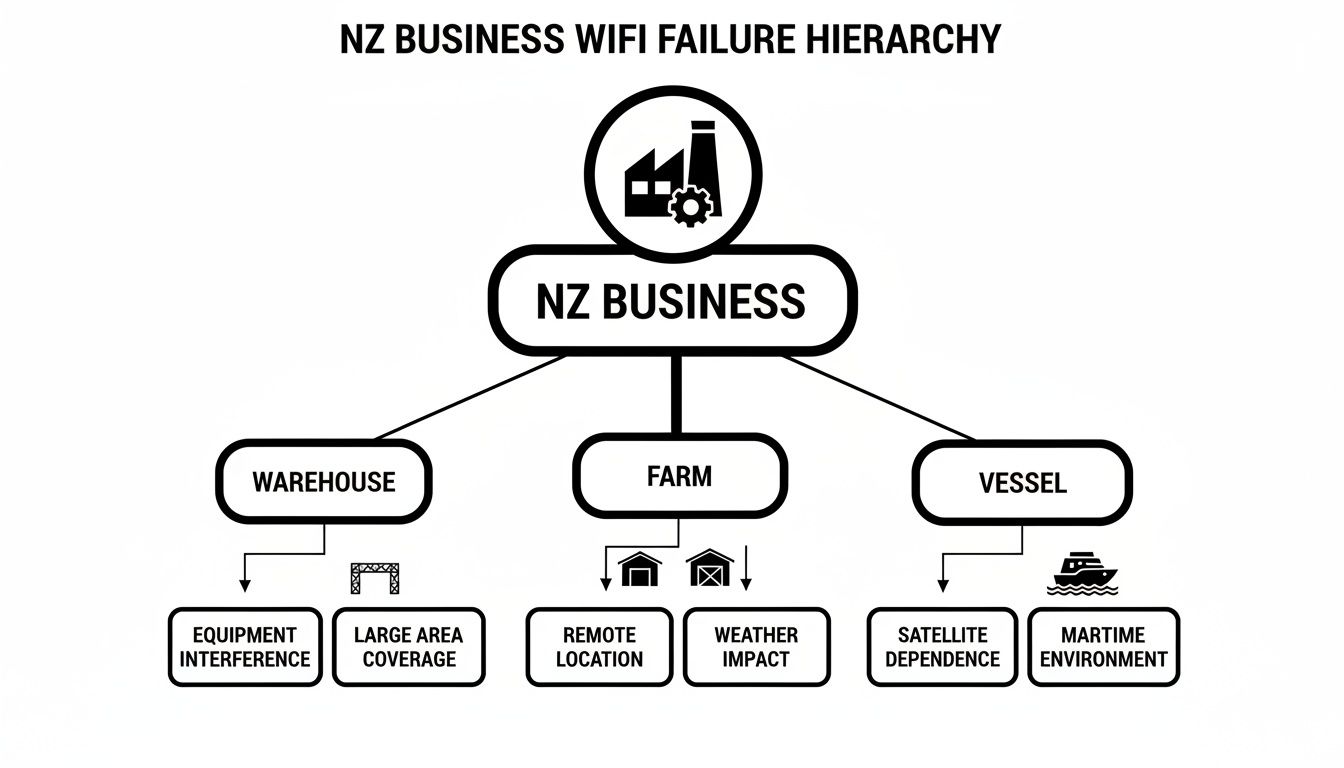
Whether it's a sprawling farm, a steel-clad warehouse, or a vessel out on the water, the physical environment is almost always the number one enemy of a good signal, demanding a properly engineered solution.
WiFi Boosters or Repeaters: The Simplest "Fix"
A WiFi booster, more accurately called a repeater, is the most basic device you'll find. It works by listening for the WiFi signal from your main router and then simply rebroadcasting it, stretching the coverage area a little further.
Think of it like a crew member standing halfway across a noisy factory floor. They hear an instruction from the foreman, then shout it again to the team at the far end. The message might get there, but it's lost some clarity and volume along the way. It’s just an echo.
Because a repeater uses the same channel to both receive and transmit the signal, it effectively cuts your available network speed in half for any device connected to it. This might be fine for checking emails at home, but it’s a productivity killer in a business that relies on fast data for scanners, machinery, or POS systems.
WiFi Extenders: A Small Step Up
A WiFi extender is a close cousin to the repeater. It often uses a different method to connect back to the network, like piggybacking on your building's electrical wiring (these are called Powerline adapters). This can sometimes create a more stable link than a purely wireless repeater, but it's still a middleman solution.
The analogy here is using a cheap walkie-talkie. The signal might be a bit clearer than just shouting, but you’re still sharing the airwaves and dealing with all sorts of interference. Performance is notoriously inconsistent, especially in commercial buildings with "noisy" or complex electrical circuits.
For any New Zealand business needing reliable coverage for critical operations, both repeaters and extenders are a compromise that usually leads to more headaches than results.
Wireless Access Points: The Professional Standard
For any serious commercial or industrial application, a Wireless Access Point (WAP) is the only way to go. Unlike a repeater that just parrots a weakened signal, a WAP connects directly to your main network router with a physical Ethernet cable.
This is the equivalent of running a proper cable from the main sound system to a brand-new, high-fidelity speaker. It doesn’t just repeat the signal; it creates a new, strong, full-speed WiFi hotspot exactly where you need it. Because it’s hard-wired, it delivers the maximum possible speed and stability your internet connection can provide.
This approach lets you strategically place multiple Access Points to build a seamless, powerful network that covers your entire operational area—from the front office to the back of the cool store—without crippling performance.
"In a commercial setting, every drop in network speed is a drop in productivity. A simple repeater might extend your signal range, but it does so at the cost of the performance your business relies on. It’s a band-aid, not a cure."
To help clarify the differences, here’s a quick breakdown of how these technologies stack up in a business environment.
WiFi Booster vs Extender vs Access Point: A Business Comparison
| Technology Type | How It Works | Best For | Performance Impact |
|---|---|---|---|
| WiFi Repeater | Wirelessly captures and re-broadcasts the existing WiFi signal. | Small homes or non-critical office areas with very minor dead spots. | High. Can reduce network speed by 50% or more for connected devices. |
| WiFi Extender | Similar to a repeater, but may use Powerline (electrical wiring) to connect back to the router. | Situations where running an Ethernet cable is impossible, but a slightly more stable link than a repeater is needed. | Medium to High. Performance is heavily dependent on the quality and layout of the building's electrical wiring. |
| Wireless Access Point (WAP) | Connects directly to the router via a physical Ethernet cable to create a new, full-strength WiFi signal. | All commercial, industrial, rural, and marine environments needing reliable, high-speed coverage. | Negligible. Delivers the maximum speed and reliability the network can provide. |
Ultimately, while repeaters and extenders are marketed as easy fixes, they rarely deliver the robust performance that a business needs. Investing in a properly planned network of Wireless Access Points is the only way to guarantee the stable, high-speed connectivity required to keep your operations running smoothly.
For businesses that also struggle with a weak mobile signal to feed their network in the first place, you can learn more about how Cel-Fi boosters create a reliable data backbone for your WiFi system right here.
Choosing The Right WiFi Solution For Your Industry
Trying to solve a business connectivity problem with a generic solution is a recipe for frustration. The WiFi needs of a kiwifruit packhouse in the Bay of Plenty are worlds apart from a logistics depot in Auckland or a fishing vessel out on the water. Choosing the right WiFi booster NZ solution isn’t about just buying a box; it’s about deploying a system that’s actually designed for your operational reality.
A one-size-fits-all approach simply falls flat. It can't account for the unique challenges different industries throw at it—from environmental factors like dust and moisture to structural headaches like steel framing and concrete walls. A setup that works perfectly in a retail store will be completely useless on a sprawling farm.
This is why understanding what your industry uniquely demands is the first and most critical step. Let's break down some common scenarios for key New Zealand sectors to show how a tailored approach delivers the reliable performance your business needs to thrive.
Agriculture and Horticulture
From orchards and vineyards to large-scale dairy and sheep farms, the modern Kiwi agricultural operation is more data-driven than ever. The challenge here is massive: covering vast outdoor areas and linking up multiple buildings like workshops, implement sheds, and packing facilities.
- The Problem: Standard WiFi routers just don't have the range or the toughness for farm life. Signals get swallowed up by the terrain, trees, and metal-clad sheds, creating annoying dead zones right where you need to access weather data, livestock monitoring systems, or machinery diagnostics.
- The Solution: A network of rugged, outdoor-rated Wireless Access Points (WAPs) is the professional standard. These are weatherproof (IP-rated) units built to handle rain, dust, and temperature swings. By strategically placing these WAPs and pairing them with high-gain antennas from brands like rfi or Pacific Aerials, we create a powerful, seamless WiFi umbrella across your entire property, making sure every critical corner is connected.
Transport, Logistics, and Warehousing
Warehouses and distribution centres are notoriously difficult environments for radio signals. You’ve got a tough combination of concrete walls, high steel racking, and constant movement from forklifts and machinery, all of which creates a chaotic battlefield for WiFi.
- The Problem: Signal dropouts are the enemy of efficiency. The moment a barcode scanner loses connection, inventory management grinds to a halt, leading to costly delays and inaccurate stocktakes. Dead zones behind shelving can render entire sections of your facility offline.
- The Solution: A professional site survey is absolutely essential here. We use specialised tools to map out the radio frequency environment and pinpoint the perfect spots for multiple, strategically placed WAPs. This setup ensures seamless roaming, allowing handheld devices to move between coverage zones without ever dropping their connection—a non-negotiable for any modern logistics operation.
Tourism and Hospitality
For hotels, motels, and holiday parks, providing great guest WiFi isn't a luxury anymore—it's a basic expectation. The real challenge is delivering a strong, consistent signal to every room, across multiple floors, and even out to the pool or BBQ area.
- The Problem: That single router tucked away in the reception area is guaranteed to leave guests in the rooms at the far end of the complex with a slow, flaky connection. This quickly leads to poor reviews and unhappy customers.
- The Solution: A managed mesh WiFi system or a network of discreet in-room WAPs is the perfect answer. This approach creates one unified network that covers the entire property, intelligently routing traffic to make sure every guest gets a fast, stable connection, whether they’re in their room or relaxing by the pool.
For many businesses, particularly in rural and remote spots, the challenge isn't just extending WiFi—it's getting a reliable internet signal in the first place. This is where hybrid solutions become critical.
This need for robust signal extension is a measurable reality across the country. While fibre reached about 74% of New Zealand’s fixed broadband connections by early 2024, a big chunk of the country, especially in rural regions, is still dealing with coverage gaps left by the major providers. This often means we need to get creative with local solutions like cellular boosters or satellite-to-WiFi systems to bridge that connectivity divide. You can read more about the NZ telecommunications market here.
From construction sites needing temporary, rugged connectivity to marine vessels requiring a stable signal below deck, every industry plays by its own rules. The key to a successful deployment is partnering with a specialist who understands these nuances inside and out.
Professional Installation For Maximum Performance
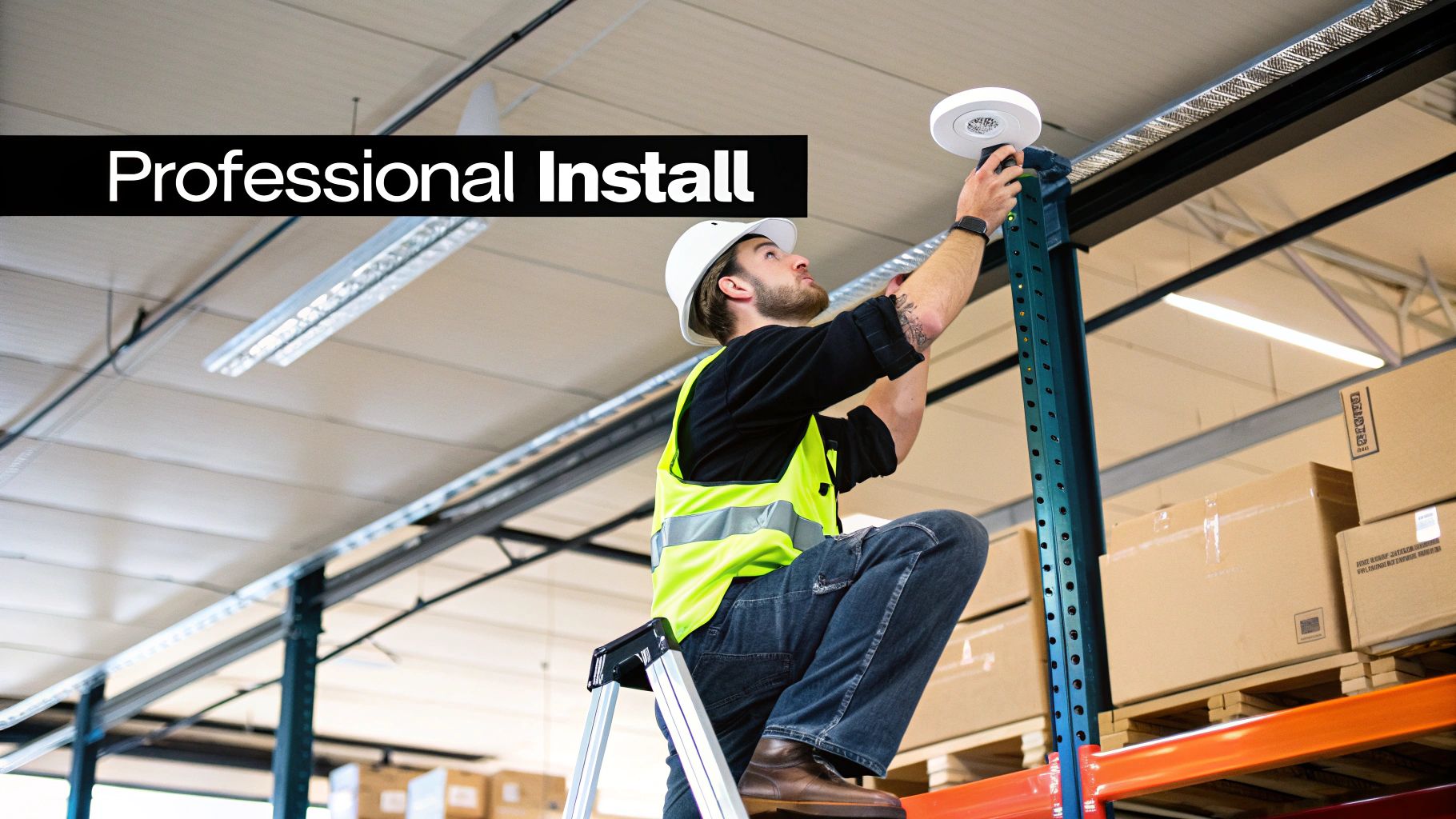
Even the best commercial-grade hardware is only as good as its installation. Plugging in a powerful Wireless Access Point in the wrong spot is like parking a delivery truck in a dead-end alley—it has all the potential in the world but simply can't get the job done. This is where professional installation stops being a luxury and becomes an absolute necessity for any business serious about reliable connectivity.
A DIY setup almost always relies on guesswork, which leads to those persistent dead zones and frustrating performance bottlenecks. A professional deployment, on the other hand, is a scientific process. It’s all about understanding the unique radio frequency (RF) behaviour within your specific environment and engineering a solution that guarantees peak performance from day one.
The Power of a Professional Site Survey
Before we even think about running a single cable, our process kicks off with a crucial first step: a professional site survey. This isn't just a quick walk-through; it's a technical deep dive into your workplace's unique RF landscape.
Using specialised tools and analysers, our technicians map out your entire operational area. We measure existing signal strength, sniff out sources of interference from machinery or neighbouring networks, and pinpoint the physical obstacles that are killing your Wi-Fi signals. This data-driven approach allows us to build a precise "heat map" of your property, showing us exactly where your dead zones are and, more importantly, why they exist.
This survey becomes the blueprint for a successful installation. It takes all the guesswork out of the equation and ensures every piece of hardware is placed for maximum impact and value for your investment.
Strategic Placement Is Everything
The difference between a flawless connection and a constant headache often comes down to just a few metres. Professional installers understand the science behind how signals travel and how different materials get in the way.
Key things we look at include:
- Obstacle Avoidance: We position access points to broadcast around, not through, signal-killing materials like concrete walls, metal shelving, and insulated cool store panels.
- Antenna Orientation: The exact direction and angle of an antenna can dramatically alter the shape and reach of its Wi-Fi signal. We precisely orient each one to focus coverage right where your teams need it.
- Minimising Interference: Big machinery, high-voltage electrical lines, and even microwave ovens can disrupt Wi-Fi. Our site survey identifies these culprits, allowing us to place equipment where their impact is minimal.
A professional installation isn't just about making the signal reach further; it's about delivering a clean, stable, and high-speed signal that your business can depend on, shift after shift.
This meticulous approach doesn’t just apply to Wi-Fi. It’s just as critical for boosting cellular signals. For businesses struggling with poor mobile reception indoors, a professional can strategically place devices like the Cel-Fi GO G41, making sure the repeater captures the strongest possible outdoor signal to rebroadcast inside. You can discover more about how these powerful cellular repeaters work by reading our guide on the Nextivity Cel-Fi GO G41.
Ultimately, investing in a professional wifi booster nz installation is an investment in reliability. It guarantees your hardware performs as intended, eliminating the costly downtime and productivity losses that come from a poorly planned network.
Thinking Beyond WiFi With Cellular And Satellite Solutions
Sometimes, even the most expertly installed WiFi system can’t quite solve your connectivity problems. Why? Because a WiFi booster nz business solution can only extend a signal that already exists. If the internet connection feeding your whole network is weak, unreliable, or just plain absent, all you’re doing is broadcasting a poor signal further.
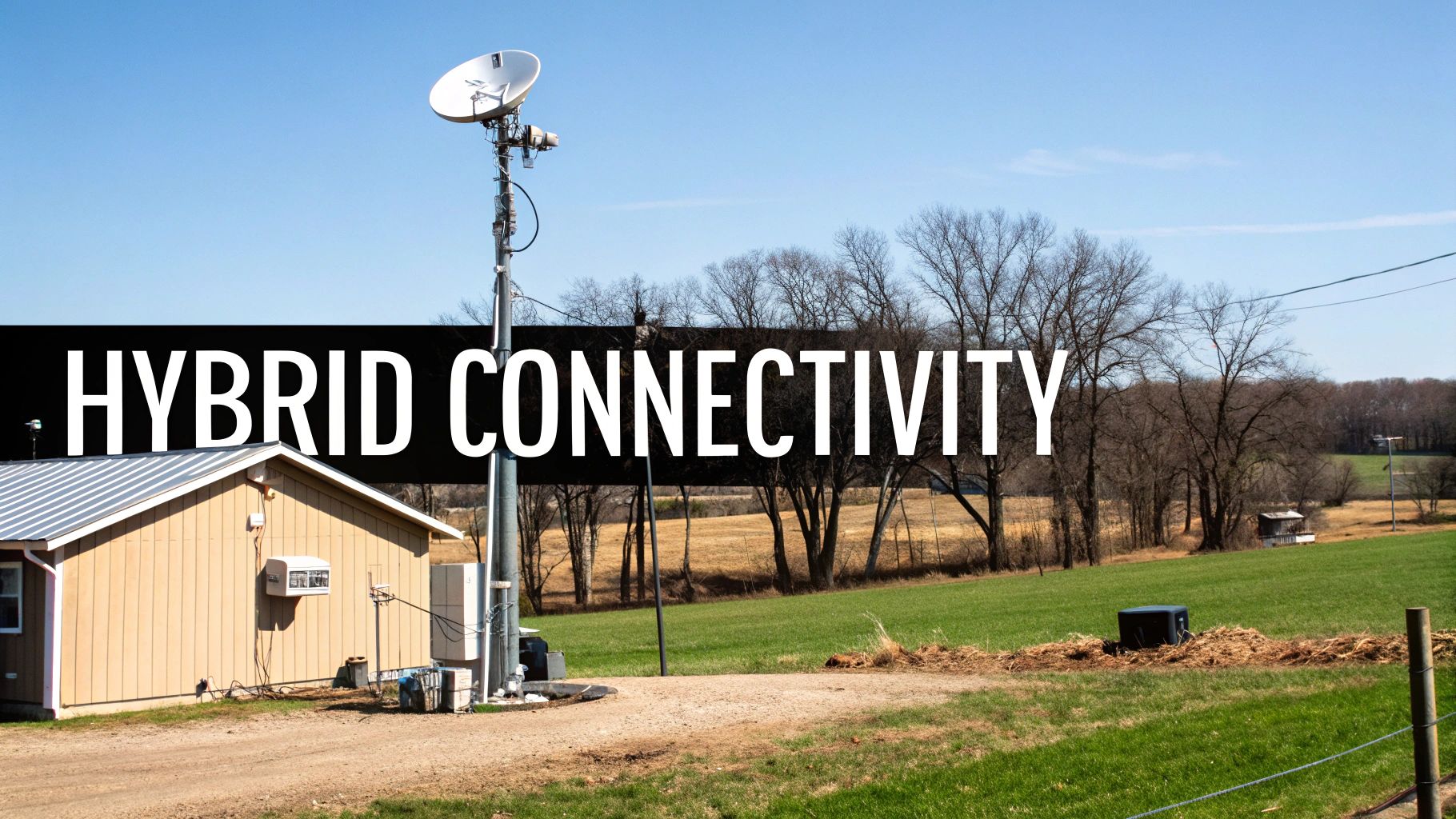
This is a daily reality for plenty of New Zealand businesses, especially those out in rural areas, on remote sites, or in temporary locations. The issue isn't really the WiFi; it's the lack of a stable internet backbone to begin with. To get true operational reliability, we need to think beyond WiFi and fix the source connection first. This is where a hybrid approach, mixing different technologies, becomes mission-critical.
Cellular Boosters: The Key To A Strong Data Foundation
For businesses operating out of large metal sheds, commercial buildings with thick concrete walls, or fleet vehicles, poor mobile reception is a constant headache. When your phone is barely clinging to one bar of 4G or 5G, you have no reliable data connection to power your EFTPOS machine, tablet, or laptop—let alone a building-wide WiFi network.
This is exactly where a cellular booster, or repeater, comes into its own.
- What it does: A Cel-Fi cellular booster from a brand like Nextivity grabs whatever weak mobile signal it can find outside, legally amplifies it, and then rebroadcasts a strong, reliable cellular signal inside your building or vehicle.
- The Outcome: This doesn't create WiFi. Instead, it creates a powerful and stable 4G/5G data connection. Your devices can use this directly, or, more importantly, it can feed a modem/router to generate a rock-solid local WiFi network.
In short, a Cel-Fi GO system fixes the root problem—a poor incoming data signal. It provides a solid foundation you can then build a high-performance WiFi system on, using strategically placed Access Points to spread the love.
Satellite Internet For The Truly Remote
But what if there's no mobile signal to boost in the first place? For forestry crews deep in the bush, marine operations far offshore, or agricultural properties tucked away in New Zealand's most remote valleys, neither standard broadband nor cellular is an option.
In these scenarios, satellite internet is the ultimate answer.
Modern satellite services like Starlink provide high-speed, low-latency internet access virtually anywhere in the country, completely bypassing the limitations of terrestrial infrastructure. This isn't the slow, laggy satellite internet of the past; it's a genuine game-changer for remote operations.
Once the Starlink terminal is installed, it provides a powerful internet source. From there, we can design a robust network of outdoor-rated Wireless Access Points to distribute that high-speed connection across an entire worksite, farm, or vessel. This hybrid system—satellite for the main connection and WAPs for local distribution—delivers seamless, city-grade connectivity to the most isolated corners of New Zealand.
The demand for these integrated solutions is growing fast. With around 6.22 million cellular connections in New Zealand and mobile data consumption constantly on the rise, businesses in logistics, construction, and emergency services are increasingly deploying systems like Cel-Fi to guarantee indoor coverage for their operations. You can discover more insights about the NZ mobile market growth on Advanced Television.
By looking at your entire connectivity picture, we can design a solution that actually works—from the source right through to the end-user. For a deeper dive into how this technology is transforming remote work, check out our guide on satellite internet in New Zealand.
Why Partner With A New Zealand Connectivity Expert?
Picking the right bit of hardware is only one piece of the connectivity puzzle. For any Kiwi business, the real win comes from partnering with a local expert who gets that a solid connection is a critical asset, not just another gadget off the shelf.
Standard, off-the-shelf solutions just can’t cope with our unique environmental conditions or regulatory landscape here in New Zealand.
We don’t just sell boxes. At Mobile Systems, we deliver complete, end-to-end solutions designed to solve your specific operational challenges. This is all about building a robust system you can truly depend on, day in and day out, to keep your business running at full tilt.
A Full-Service Approach to Business Connectivity
Our partnership goes way beyond a simple transaction. We provide a comprehensive service covering every stage of your connectivity journey, making sure you get the performance and reliability your investment deserves.
Our process breaks down like this:
- Professional Consultation and Site Surveys: We start by listening. Our technicians come to you, conducting thorough on-site assessments to understand your unique environment, pinpoint those frustrating signal dead zones, and map out a data-driven plan for flawless coverage.
- Sourcing Compliant, Rugged Hardware: We work with world-class brands like Cel-Fi and Starlink. This means we source hardware that's not only powerful but also fully compliant with New Zealand’s RSM regulations and tough enough for commercial conditions.
- Expert Installation and Commissioning: Our experienced technicians handle the entire installation. From strategically placing access points and antennas to running cabling and configuring the network, we get it tuned for optimal performance from day one.
- Ongoing Local Support and Maintenance: As a 100% NZ-owned company based right here in Mount Maunganui, we’re on the ground when you need us. We provide ongoing local support, troubleshooting, and maintenance to ensure your system continues to operate perfectly.
Partnering with a New Zealand-based specialist means you get more than just technology; you get a team that understands the local challenges you face, from navigating RSM licensing to dealing with our often-unforgiving weather.
Let’s Solve Your Connectivity Problems
Stop battling with unreliable connections and frustrating dropouts. The right wifi booster nz solution is all about expert design, professional installation, and dedicated local support.
A simple, no-obligation chat with one of our communications specialists can put you on the path to a faster, more reliable network. We’re here to provide helpful advice and design a system that solves your problems for good.
Got Questions About Business Wi-Fi?
Here are the answers to some of the most common questions New Zealand businesses ask when they're trying to get their connectivity sorted.
Is It Legal To Use Any Wi-Fi Booster In NZ?
Absolutely not. It is NOT legal to use just any signal booster you find online, especially if it touches the cellular network.
Any device that amplifies cellular signals, like a Cel-Fi unit, has to be approved by our local mobile carriers (Spark, One NZ, 2degrees) and meet the rules set by Radio Spectrum Management (RSM). This is crucial to stop dodgy gear from messing with the mobile network for everyone else.
Using an unapproved or illegally imported booster can land you with some pretty hefty fines. The only safe way forward is to get your hardware from a reputable NZ supplier like Mobile Systems. We guarantee all our equipment, including our Cel-Fi cellular repeaters, is 100% compliant and safe to use.
What’s The Real Difference Between Consumer And Commercial Wi-Fi Gear?
The difference is massive, and it’s about a lot more than just signal strength. Think of it like a ute versus a family car – they both drive, but one is built for work.
- Built Tough: Commercial gear, particularly the outdoor Access Points, is made to survive. It comes with high IP (Ingress Protection) ratings to handle the dust, moisture, and temperature swings common on NZ farms, construction sites, and marine environments.
- Handles the Load: A business-grade Wireless Access Point (WAP) is designed to manage dozens, sometimes hundreds, of simultaneous connections without breaking a sweat. This is non-negotiable for a warehouse full of scanners or a tourism spot packed with guests all trying to get online.
- Serious Security & Management: Professional systems give you advanced security to protect your business data and allow for remote management. This means we can monitor the network, spot problems, and often fix them without needing to send a technician out—something you can’t achieve with consumer-grade products.
Can A Wi-Fi Booster Fix My Slow Satellite Or Rural Internet?
This is a common misconception. A Wi-Fi booster or Access Point simply takes the internet connection you already have and spreads it over a wider area. It can't magically make a slow connection faster.
If your main internet source (like old rural broadband or a patchy satellite service) is the bottleneck, a booster will just give you a bigger area of slow, frustrating Wi-Fi.
The real fix is to tackle the problem at the source. This might mean upgrading your internet plan or, for those truly off-the-grid sites, looking at a high-performance solution like Starlink. Once you have a fast, solid internet connection coming into the property, then a professionally installed system of Wireless Access Points can do its job and deliver that speed everywhere you need it.
Do I Need An Electrician To Install A Wireless Access Point?
For a proper, reliable, and safe installation, yes. Most professional Wireless Access Points are powered using Power over Ethernet (PoE). This involves running a single Ethernet cable from your network switch right to where the WAP is mounted—usually high up on a ceiling or wall for the best coverage.
Getting a qualified technician or registered electrician to do this work is the only way to go. They’ll make sure the job is done safely, meets all NZ building codes, and that the cable is run properly to avoid any signal interference or damage down the line.
Ready to stop wrestling with bad Wi-Fi and get a professional solution that just works? The team at Mobile Systems Limited has the on-the-ground experience to design and install a system that fits your business like a glove.
Get a customised quote from a New Zealand connectivity expert today.
Related posts

- May 27, 2026
Discover Freedom Internet NZ solutions. Explore reliable connectivity like Starlink for your NZ business or remote teams.

- May 25, 2026
Find your ideal satellite dish NZ solution for business. Our 2026 guide covers types, installation, and choosing the right system...

- May 20, 2026
Unlock the power of 5G wireless broadband NZ for your business. Our guide covers coverage, FWA vs mobile, equipment, and...