
How to Justify Fleet Tracking Costs: A Data-Driven Guide for NZ Managers
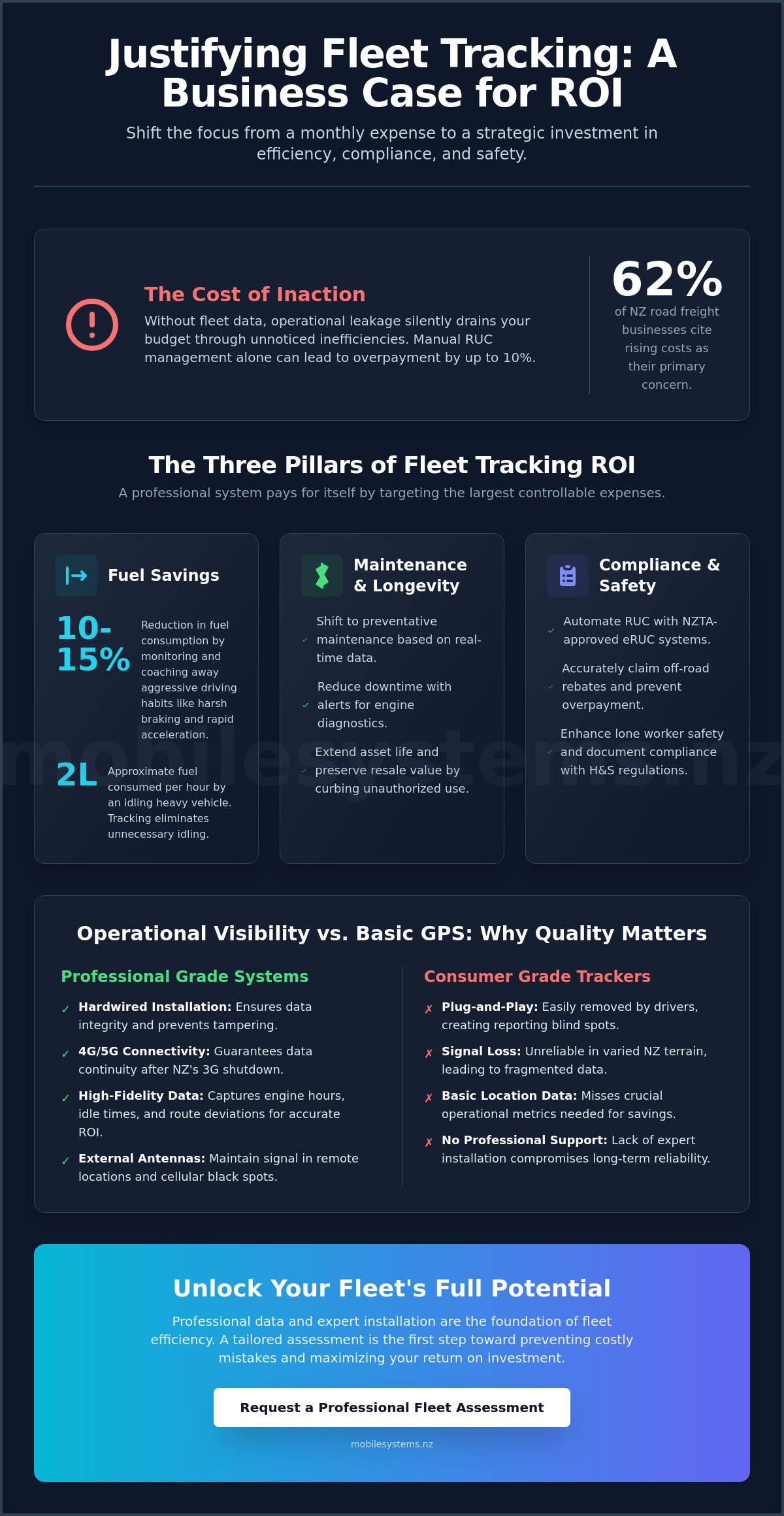
Manual management of Road User Charges (RUC) causes some New Zealand businesses to overpay by up to 10% due to administrative errors and missed off-road credits. If you're facing high fuel prices and operational leakage.
Manual management of Road User Charges (RUC) causes some New Zealand businesses to overpay by up to 10% due to administrative errors and missed off-road credits. If you're facing high fuel prices and operational leakage, you must understand how to justify fleet tracking cost to boss by demonstrating its immediate impact on the company's bottom line.
It's common to feel that senior management views GPS hardware as a surveillance expense rather than a strategic asset. You likely recognize that real-time data is the only way to improve productivity, but translating those technical benefits into a compelling financial argument requires a structured, data-led approach.
This guide provides a professional roadmap to prove how fleet tracking pays for itself through ROI, automated compliance, and enhanced safety. You'll learn how to build a business case that leverages NZTA-approved eRUC transitions and the February 2026 Health and Safety at Work Act amendments to secure executive approval.
Key Takeaways
- Learn how to justify fleet tracking cost to boss by shifting the focus from a monthly expense to a strategy for identifying and recovering operational leakage.
- Identify the three primary ROI pillars—fuel, maintenance, and insurance—that allow a high-quality tracking system to pay for itself.
- Discover how to navigate driver privacy concerns by positioning fleet tracking as a proactive safety tool for lone workers in remote New Zealand locations.
- Explore the financial benefits of automated eRUC systems, including the recovery of off-road rebates for vehicles operating in specialized sectors.
- Understand why professional installation is the foundation of data integrity and long-term fleet uptime in demanding local environments.
Building the Financial Case: ROI Beyond the Monthly Subscription
Justifying new technology requires moving the focus away from subscription fees. A professional vehicle tracking system isn't an overhead; it's a tool for recovering operational leakage. This leakage occurs through inefficient routing, unauthorized vehicle use, and excessive engine idling that often goes unnoticed in daily operations.
When explaining how to justify fleet tracking cost to boss, present a "Cost of Doing Nothing" analysis. Without visibility, small, daily inefficiencies compound into thousands of dollars in lost revenue. According to a 2025 survey of the New Zealand road freight industry by Microlise, 62% of respondents cited business costs and economic pressures as their primary concern. Fleet tracking addresses these pressures by providing the data needed to eliminate waste.
To better understand the financial impact of tracking technology, watch this helpful video:
Fuel Savings and Idling Reduction
Fuel represents one of the largest controllable expenses for any New Zealand fleet. Industry data suggests that heavy vehicle idling can consume approximately 2 litres of fuel per hour. By monitoring these events, managers can implement coaching that reduces idling time significantly. A tailored assessment often reveals exactly where fuel is being wasted across your specific routes.
Monitoring aggressive driving behaviors like harsh braking and rapid acceleration can reduce fuel consumption by 10-15%. Optimized routing ensures that drivers take the most efficient paths, reducing daily mileage and overall fuel spend. This data allows you to show exactly how much capital is being saved each month, making it easier to prove the system's value.
Maintenance and Asset Longevity
Preventative maintenance is more cost-effective than reactive repairs. Fleet tracking systems provide real-time engine diagnostics and service alerts based on actual mileage rather than estimates. This prevents catastrophic engine failures and extends the total life of the vehicle fleet. Accurate data ensures that vehicles are only serviced when necessary, reducing downtime.
Reducing "private use" mileage also slows down vehicle depreciation. By ensuring assets are only used for business purposes, you preserve their resale value and lower maintenance frequency. These long-term savings are essential when considering how to justify fleet tracking cost to boss. Professional data integrity ensures these reports are accurate enough for executive review and financial planning.
Operational Visibility vs. Basic GPS: Why Quality Matters
Operational visibility differs significantly from simple location tracking. While basic GPS answers the question of where a vehicle is, professional fleet tracking reveals how a business is performing. This distinction is vital when considering how to justify fleet tracking cost to boss. High-quality systems provide granular data on engine hours, idle times, and route deviations that basic consumer units miss.
Cheap, plug-and-play trackers often result in fragmented data. These devices frequently lose signal in New Zealand's varied terrain, leading to gaps in reporting that render ROI calculations inaccurate. Following the New Zealand 3G network shutdown, ensuring 4G or 5G compatibility is mandatory for data continuity. A guide from the U.S. Department of Energy highlights that telematics can reduce maintenance costs and improve safety through this high-fidelity data.
The Limitations of Consumer-Grade Trackers
Remote New Zealand environments present unique connectivity challenges. Consumer-grade devices lack the external antennas required to maintain a connection in cellular 'black spots'. This leads to data lag, which compromises the accuracy of customer ETAs and real-time safety monitoring.
Hardwired GPS trackers are essential to prevent data tampering. Plug-and-play models are easily removed by drivers, creating blind spots in your safety and compliance records. Professional installation ensures the hardware remains secure and provides a consistent stream of information for legal audits and RUC claims.
Turning Data into Actionable Insights
Integrated dashboards allow directors to see the big picture without sifting through spreadsheets. By analyzing historical data, managers can identify underutilised assets. If a vehicle sits idle for 40% of the week, it may be better deployed elsewhere or removed from the fleet entirely to save on insurance and registration costs.
There is also significant synergy between tracking and two-way radio systems. Combining location data with instant voice communication allows dispatchers to redirect the closest vehicle to a new job immediately. This reduces 'dead mileage' and improves customer response times. If you are unsure which hardware configuration fits your fleet, a tailored assessment often prevents costly mistakes.
Navigating the 'Big Brother' Objection: Culture and Safety
Driver pushback often stems from a fear of micromanagement. However, framing the technology as a safety initiative changes the narrative. It's a vital component when you need to know how to justify fleet tracking cost to boss, as it directly addresses legal liability and employee welfare.
In New Zealand, the Health and Safety at Work Act 2015 requires businesses to manage risks for mobile workers. An amendment in February 2026 increased the focus on "critical risks" for staff on the road. GPS tracking fulfills this duty by providing real-time location data, ensuring that help can be dispatched immediately if a vehicle stops unexpectedly or an impact is detected.
Data from a U.S. government guide to fleet telematics shows that monitoring driver behavior can lead to a significant reduction in collision rates. In a local context, this reduces the administrative burden of insurance claims and protects the company's reputation. This reduction in risk is a tangible financial benefit that supports the initial investment.
Tracking also protects drivers from false accusations. If a member of the public complains about a driver's behavior, GPS records provide objective proof of speed and location. This exonerates staff who are following company policy and prevents unnecessary disciplinary action. Objective data creates a culture of fairness where performance is measured by facts rather than anecdotes.
Meeting NZ Health and Safety Obligations
Ensuring the safety of remote staff is a non-negotiable legal requirement under current NZ legislation. Modern systems include impact sensors that trigger automatic alerts during an accident. This immediate response capability is a core part of a proactive risk management strategy.
Professional in-vehicle monitoring supports a safer work culture by identifying high-risk habits like harsh braking or excessive speeding before they result in an incident. These insights allow for targeted training, which is far more effective than generic safety briefings. A tailored safety assessment often prevents costly accidents before they occur.
Implementing a Fair Driver Policy
Transparency is the key to successful technology adoption. Before the system goes live, managers should clearly communicate which data is being collected and why. Distinguishing between "work time" and "private time" through privacy toggles ensures that staff feel respected during their off-hours.
Shift the focus from punishment to performance by using scorecard data. Businesses can create incentive programs that reward the safest and most efficient drivers. This gamification encourages positive behavior and turns the fleet tracking system into a tool for professional development rather than just a compliance checkbox. High-performing drivers often become the strongest advocates for the system once they see their efforts recognized.
New Zealand Specific Benefits: eRUC and Compliance
Manual management of Road User Charges (RUC) often results in administrative waste. Research suggests that manual tracking leads to overpayment by up to 10% due to errors and missed off-road credits. When considering how to justify fleet tracking cost to boss, the automation of RUC offers a clear and immediate financial return.
New Zealand is currently transitioning to a fully electronic, distance-based RUC system. With the new system planned to be operational in 2027, early adoption of eRUC technology prepares your business for upcoming legislative changes. Approximately 23% of New Zealand's 5.9 million registered vehicles operate under RUC, contributing over $2 billion annually to road funding.
Electronic systems eliminate the need for manual paperwork and physical labels. For industries like forestry or construction, tracking software automatically calculates off-road RUC rebates. This ensures the business only pays for kilometers traveled on public roads, recovering capital that would otherwise be lost.
Automating the RUC Process
Automated RUC management reduces the risk of costly fines. NZTA-approved digital screens display up-to-date charges and alert managers before a license expires. This "buy as you go" model improves company cash flow by removing the need for large, upfront bulk RUC purchases.
Accuracy is critical for legal compliance. Professional installation of GPS hardware ensures that odometer readings match the tracking data exactly. This prevents discrepancies during NZTA audits and ensures your business case for fleet tracking is built on verified figures.
Simplified Tax and Audit Reporting
Fringe Benefit Tax (FBT) reporting is a significant administrative burden for New Zealand fleet managers. A professional tracking system provides the IRD with bulletproof records that distinguish between business and private use. This transparency is a key factor when demonstrating how to justify fleet tracking cost to boss, as it simplifies end-of-month reporting and reduces the time spent on manual logbooks.
Digital records also streamline transport regulation compliance. Automated logbooks ensure that driver work hours are recorded accurately, reducing the likelihood of fatigue-related incidents or regulatory breaches. Leveraging Mobile Systems' expertise ensures your hardware is installed to meet these strict local standards.
If your current manual processes are creating administrative bottlenecks, contact our team for a compliance audit to identify potential savings.
The Mobile Systems Difference: Expert Installation and Support
Data integrity starts at the mounting point. While many providers focus exclusively on software, the reliability of your reporting depends entirely on the hardware's physical connection to the vehicle. In New Zealand's rugged terrain, vibration and environmental exposure can cause consumer-grade units to fail. Professional installation ensures that your system provides the continuous data stream necessary for legal audits and financial forecasting.
Mobile Systems Limited provides a comprehensive approach by integrating tracking with cellular devices and vehicle-mounted two-way radios. This creates a total connectivity solution where location data and voice communication work in tandem. This integration is a primary factor when considering how to justify fleet tracking cost to boss, as it consolidates multiple communication needs into a single, professionally managed infrastructure.
Our nationwide support vehicles ensure that fleet uptime remains a priority. If hardware requires servicing, local technicians are available to minimize vehicle downtime. This local presence is a significant advantage over software-only providers who lack the physical resources to maintain hardware in remote regions. A tailored assessment often prevents the purchase of unnecessary features, ensuring you only invest in technology that adds direct value to your operations.
Reliability in Remote Environments
Connectivity remains a challenge in many parts of New Zealand where standard cellular networks struggle. We utilize high-gain antennas and, where necessary, cellular boosters to maintain data continuity in "black spots." Secure mounting and robust hardware are essential to prevent data tampering and ensure the longevity of the equipment in commercial use.
Our design philosophy focuses on clarity over cleverness. We prioritize functional communication and reliable data over complex, unused features. By ensuring the hardware is fit for purpose and professionally installed, we eliminate the common mistakes that lead to data loss and fragmented reporting. This technical reliability provides the foundation for a high-trust business case.
Your Next Steps for Executive Approval
Securing approval for fleet tracking requires a clear summary of the benefits. When making your final pitch, focus on the intersection of safety, compliance, and ROI. A professional system isn't just a cost; it's a competitive advantage that reduces operational leakage and fulfills your duty of care under the Health and Safety at Work Act.
We recommend starting with a professional site audit to identify the specific needs of your fleet. This assessment provides the concrete data required to prove that the system will pay for itself through recovered costs and improved efficiency. Contact our team for a tailored fleet assessment to begin building your data-driven business case.
Maximising Fleet Efficiency and Compliance
Implementing a professional tracking system marks a strategic shift from simply monitoring vehicle locations to actively managing operational performance. By automating eRUC and improving fuel efficiency, this technology directly addresses the 62% of New Zealand operators who cited economic pressures as a primary concern in 2025.
When you prepare how to justify fleet tracking cost to boss, focus on the long-term reliability of the data. Mobile Systems Limited ensures this through professional installation and expertise in ruggedised hardware and antennas. This technical foundation is essential for meeting the 2026 Health and Safety at Work Act amendments and ensuring accurate tax reporting.
Our nationwide NZ support network provides the physical resources needed to maintain fleet uptime in any environment. Moving beyond manual paperwork protects both your bottom line and your team's safety. A clear, data-led business case demonstrates that tracking isn't a surveillance cost but a necessary productivity tool.
Request a tailored fleet tracking assessment from our NZ experts to secure a competitive advantage for your business.
Frequently Asked Questions
Is fleet tracking worth it for a small fleet of 5 vehicles?
Yes, tracking is beneficial for fleets of any size. For a five-vehicle operation, each asset represents a significant portion of your total capacity. Improved scheduling and the elimination of unauthorized use ensure that every vehicle is generating maximum revenue, which is vital for maintaining smaller margins.
How much can a business save on fuel with GPS tracking?
Businesses often see a 10% to 25% reduction in fuel consumption according to data from the U.S. Department of Energy. These savings result from eliminating excessive idling and monitoring aggressive driving habits like harsh acceleration. This tangible data is a core part of how to justify fleet tracking cost to boss.
Will my drivers quit if I install tracking systems?
Drivers generally accept tracking when it's introduced as a tool for safety and exoneration. Most staff value the protection provided by GPS records during accident investigations or disputes with the public. Transparency regarding privacy and the use of data for rewards rather than punishment helps maintain driver morale.
How does eRUC work with fleet tracking in New Zealand?
eRUC systems integrate with GPS hardware to record distance traveled in real-time. This data is sent to NZTA-approved providers to automate license purchases and off-road credit claims. It eliminates manual paperwork and ensures vehicles are always compliant with New Zealand road funding regulations without administrative delays.
What happens to tracking data if the vehicle is in a cellular black spot?
If a vehicle enters a cellular black spot, the tracker stores all data in its internal memory. Once the vehicle moves back into a coverage area, the device automatically transmits the stored logs to the server. This ensures that your records remain complete even when operating in remote New Zealand regions.
Can fleet tracking help lower my insurance premiums in NZ?
Many New Zealand insurers offer premium discounts for fleets equipped with professional tracking. These systems reduce the risk of permanent loss due to theft and encourage safer driving behaviors. You should consult with your insurance provider to determine the specific savings available for your commercial policy.
What is the difference between hardwired and plug-in trackers?
Hardwired trackers are professionally installed and connected directly to the vehicle's power and diagnostic systems. They are tamper-resistant and provide more accurate engine data. Plug-in trackers are portable but can be easily removed, which compromises the integrity of your compliance and safety records.
How long does it take to see a return on investment for fleet tracking?
Most fleets see a full return on investment within three to six months of installation. Savings are typically realized through reduced fuel spend, lower administrative costs, and recovered RUC credits for off-road travel. This rapid payback period is a strong argument when considering how to justify fleet tracking cost to boss.
Related posts

- June 03, 2026
Mobile coverage on New Zealand farmland averages just 57% as of September 2025. This figure hasn't improved since 2022, leaving...

- June 02, 2026
Research indicates that 52% of all construction rework is caused by communication breakdowns, costing the industry billions annually. On a...

- June 01, 2026
Cellular connectivity is a convenience, yet it remains a single point of failure for many New Zealand businesses. With the...