
Resilient Communication Systems for Natural Disasters: A 2026 NZ Business Guide
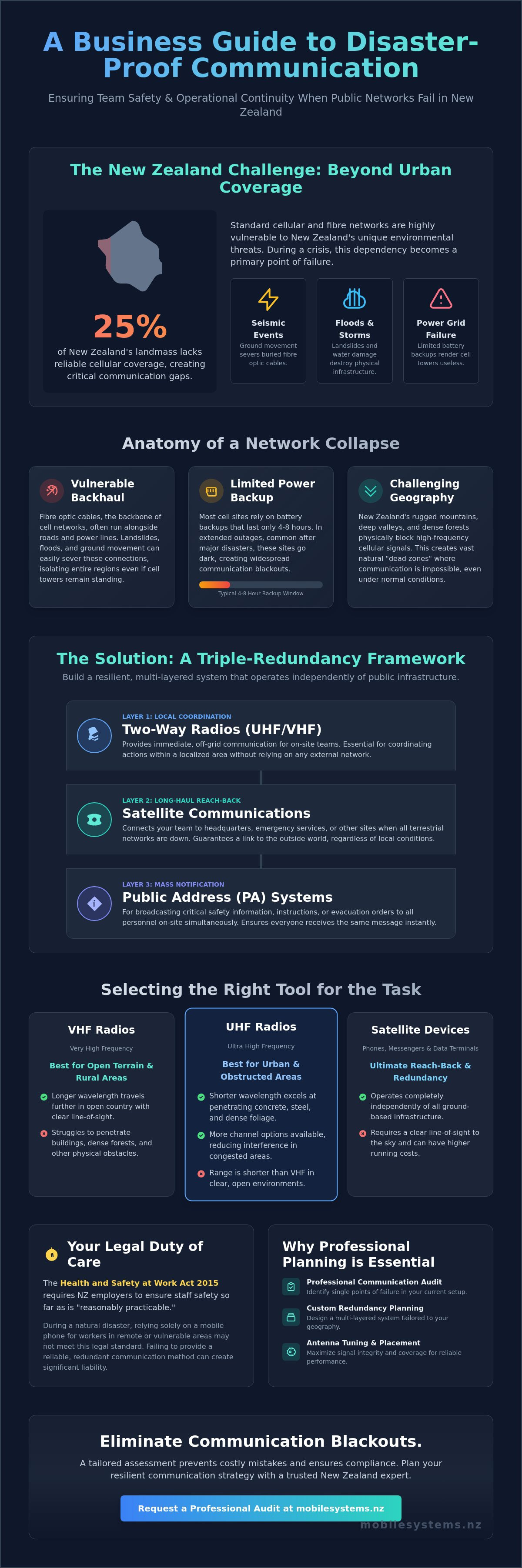
Approximately 25% of New Zealand's landmass lacks reliable cellular coverage. This statistic becomes a critical liability when extreme weather events disable public infrastructure, making a dedicated communication system for natural disasters a necessity for any local business.
Approximately 25% of New Zealand's landmass lacks reliable cellular coverage. This statistic becomes a critical liability when extreme weather events disable public infrastructure, making a dedicated communication system for natural disasters a necessity for any local business.
Relying on standard mobile networks often leads to total isolation during a crisis. You likely recognize that when the power grid fails, your operational continuity depends on equipment that functions independently. This vulnerability puts your organization at risk of non-compliance with the Health and Safety at Work Act 2015.
We will show you how to build a triple-redundant framework using off-grid technology to ensure your team remains connected in the most severe conditions. This guide provides a clear roadmap to building a multi-layered infrastructure that ensures team safety regardless of the environment.
This article clarifies the technical differences between UHF, VHF, and satellite systems. We provide the practical knowledge needed to choose the right hardware for your specific geographic challenges and operational requirements.
Key Takeaways
- Identify why standard cellular and fiber networks are prone to failure during New Zealand seismic events and floods.
- Learn to implement a multi-layered communication system for natural disasters by integrating localized two-way radios with long-haul satellite technology.
- Evaluate the performance trade-offs between handheld and vehicle-mounted hardware to ensure reliable coverage across varied terrain.
- Discover how to conduct a professional communication audit and apply redundancy planning to eliminate single points of failure.
- Understand the technical necessity of professional antenna tuning and placement for maintaining signal integrity in high-stakes environments.
Why Standard Public Networks Fail During NZ Natural Disasters
Public telecommunications networks are designed for high-capacity daily use rather than extreme resilience. Many New Zealand businesses operate under a "cellular illusion," assuming that 5G and 4G coverage will remain stable during a crisis. These networks are highly centralized and rely on a complex chain of physical infrastructure that is often the first to fail during seismic or weather events.
To better understand the limitations of standard networks and the need for alternatives, watch this helpful video:
The vulnerability of terrestrial backhaul is a primary cause of network collapse. Fibre optic cables, which connect cell towers to the core network, are frequently buried along road corridors or hung on power poles. Landslides, floods, and ground movement can easily sever these links. When a backhaul cable is cut, the cell tower becomes an isolated island, unable to transmit data even if the tower itself has power.
Power dependency further complicates the situation for any business relying on a standard communication system for natural disasters. Most commercial cell sites have limited battery backup, typically providing only 4 to 8 hours of operation after a grid failure. In a significant disaster, power outages often last for days. Without a dedicated emergency communication system that operates independently, your business loses all ability to coordinate teams.
The Impact of New Zealand’s Geography on Signal Propagation
New Zealand’s rugged terrain creates significant "dead zones" where cellular signals cannot penetrate. Steep mountain ranges and deep valleys act as physical barriers to the high-frequency signals used by public networks. Dense forestry also contributes to signal attenuation, absorbing energy and reducing the effective range of standard mobile devices.
Lessons from Cyclone Gabrielle and the Kaikōura earthquake confirm that physical isolation happens rapidly. When roads are blocked and terrestrial lines are cut, businesses without off-grid two-way radios face total communication blackouts. These events highlight the critical need for systems that don't rely on vulnerable, ground-based infrastructure.
Legal Obligations for NZ Employers
The Health and Safety at Work Act 2015 requires employers to ensure the safety of their staff so far as is "reasonably practicable." In the context of a natural disaster, this includes providing a reliable communication system for natural disasters. If your team operates in remote areas, relying solely on a mobile phone may not meet this legal threshold during a crisis.
A "reasonably practicable" approach involves assessing the risks of isolation and implementing redundancy. Failing to provide a fail-safe communication method for isolated workers can lead to significant liability. A tailored assessment from an expert partner can help you identify these gaps before a crisis occurs. For a detailed review of your current capabilities, reach out through our contact page.
Core Components of a Resilient Disaster Communication System
A truly resilient communication system for natural disasters doesn't rely on a single piece of hardware. It functions as a multi-layered infrastructure designed to maintain connectivity when primary networks fail. By integrating different technologies, your business creates a "fail-safe" environment that ensures team safety and operational continuity.
The first layer involves localized two-way radios for immediate, site-specific coordination. The second layer utilizes satellite communications for long-haul reach-back to headquarters or emergency services. Finally, a third layer incorporates Public Address (PA) and warning systems to provide site-wide alerts to all personnel simultaneously.
For organizations operating across wide geographic areas, "Simulcast" technology is essential. This allows multiple repeaters to operate on the same frequency throughout a region. It eliminates the need for users to manually switch channels as they move, which is critical for maintaining focus during high-stress disaster scenarios.
Professional Two-Way Radio Networks
Digital Mobile Radio (DMR) has largely superseded older analogue systems for commercial disaster use. DMR provides superior audio clarity by filtering out background noise, which is vital in stormy or chaotic conditions. These systems also support basic data transmissions, such as GPS location and text messaging, providing more context than voice alone.
While handheld radios offer portability, vehicle-mounted units are the backbone of a resilient system. They feature higher power output and external antennas, significantly increasing range and signal penetration. Repeaters are often installed at high points to extend this range across New Zealand's rugged terrain, ensuring that "dead zones" don't compromise safety.
Satellite Integration for Total Independence
Satellite technology provides the ultimate redundancy because it bypasses all terrestrial infrastructure. For New Zealand's latitudes, the Iridium constellation is often preferred because its Low Earth Orbit (LEO) satellites provide consistent coverage even in deep valleys. Inmarsat remains a strong choice for fixed-mount terminals in emergency operations centres where a stable, geostationary link is required.
Satellite PTT (Push-to-Talk) has emerged as a powerful hybrid solution. It allows users to communicate with the same "one-to-many" simplicity of a radio but with global reach. This ensures that even if a team is hundreds of kilometres from the nearest repeater, they can still provide status updates to the National Emergency Management Agency or company HQ.
Building these layers correctly requires technical precision to avoid frequency interference and hardware mismatching. A tailored assessment of your site often prevents costly mistakes in hardware selection.
Technology Comparison: Selecting the Right Tool for the Task
Selecting the correct hardware for a communication system for natural disasters requires a clear understanding of environmental constraints. Many businesses mistakenly rely on consumer-grade devices that fail under the stress of heat, moisture, or heavy impact. Professional systems are built to industrial standards, ensuring they remain operational when conditions deteriorate and public networks become unusable.
Strategic planning helps strengthen emergency communications by aligning technical capabilities with specific geographic needs. For example, while Starlink offers high-speed data for business continuity, it remains a terrestrial-dependent system that requires clear sky views and consistent power. It should complement, not replace, dedicated radio or satellite voice links that function with lower power requirements.
System Comparison Matrix
The following table outlines the performance characteristics of common professional technologies used in New Zealand to maintain a robust communication system for natural disasters.
| Technology | Power Needs | Range (LOS) | Monthly Costs | Ease of Use |
|---|---|---|---|---|
| UHF Radio | Low | 5-15km | Licensing only | High |
| VHF Radio | Low | 10-20km | Licensing only | High |
| Satellite Phone | Medium | Global | High Subscription | Medium |
| Cellular Booster | Medium | Network Dep. | None | High |
VHF is often preferred for New Zealand marine or forestry environments because its longer wavelengths navigate around large obstacles and terrain features more effectively than UHF.
Matching Technology to NZ Industries
Different sectors face unique environmental risks that dictate hardware choice. Selecting the right tool ensures that your safety protocols remain effective during a crisis.
- Forestry and Agriculture: These industries require high-power vehicle-mounted VHF radios to penetrate dense bush. A handheld satellite phone serves as a critical secondary layer for remote workers operating outside vehicle range.
- Transport and Logistics: Fleet-wide UHF systems integrated with GPS tracking allow dispatchers to monitor vehicle locations even when cellular data is unavailable.
- Construction and Civil Engineering: On-site DMR networks provide clear voice coordination, while integrated PA systems ensure immediate evacuation alerts can be broadcast across noisy work zones.
A vehicle-mounted radio typically provides 25 watts of power compared to the 5 watts found in handheld units. This fivefold increase in power, combined with an external antenna, often makes the difference between a successful transmission and total silence. If you are unsure which configuration suits your terrain, a tailored assessment can identify the specific technical requirements for your fleet.
Designing and Implementing Your Emergency Comms Plan
A robust communication system for natural disasters is only as effective as the plan governing its use. While high-quality hardware provides the capability to connect, operational protocols ensure that connection happens when it is needed most. Businesses must move beyond simply owning equipment to establishing a structured framework for emergency coordination.
The audit phase is the foundation of this framework. It involves mapping known dead zones across your operational area and identifying critical communication paths between remote teams and headquarters. Understanding where signals naturally drop allows you to position repeaters or schedule satellite check-ins strategically to maintain a continuous safety net.
Redundancy planning should follow the "Rule of Three" for emergency contact. This strategy ensures that if one layer fails, two others remain available. A typical resilient configuration includes:
- Primary: Localised two-way radio for immediate team coordination.
- Secondary: Satellite phones or messengers for long-haul reach-back.
- Tertiary: Cellular boosters to leverage any remaining public network fragments.
Licensing and Regulatory Compliance
Operating a professional radio network in New Zealand requires adherence to Radio Spectrum Management (RSM) requirements. As of July 1, 2026, the standard annual license fee for commercial radio frequencies is $190.00. This fee ensures your organisation has a dedicated, interference-free channel, which is vital during disasters when unlicensed frequencies become congested.
Securing a commercial radio licence prevents your critical transmissions from being stepped on by other users. Professional frequency management provides the legal and technical protection needed for high-stakes environments. We assist organisations in navigating these RSM applications to ensure full compliance with New Zealand's radio regulations.
Operational Protocols for Disasters
Training staff for high-pressure radio use is essential for maintaining order during a crisis. Establishing "Comms Windows" is a practical way to preserve battery life; for example, teams might only broadcast for five minutes at the top of every hour. This discipline ensures that handheld units remain functional over several days of power outages.
Standardised emergency call signs and "Mayday" procedures prevent confusion when multiple parties are on the same frequency. Integrating fleet tracking systems into your disaster recovery plan further enhances safety by providing real-time location data alongside voice updates. This dual approach allows dispatchers to see exactly where a team is located even if voice signals are weak.
Regular maintenance cycles are the final step in implementation. Batteries should be tested and firmware updated to ensure all devices are ready for 2026 standards. Request a full system audit through our contact page to ensure your protocols and hardware meet current safety requirements.
Professional Installation: Why Local Expertise Matters
A DIY approach to a communication system for natural disasters often introduces invisible failure points. In high-stakes environments, technical errors in hardware configuration or wiring can lead to system collapse at the exact moment connectivity is required. Professional installation ensures that every component, from power supplies to connectors, meets industrial standards for reliability.
Antenna placement and tuning are the most critical factors in radio performance. Simply mounting an antenna doesn't guarantee a signal; it requires precise calibration to the specific frequency in use. Incorrectly tuned antennas cause signal reflection, which can damage the radio's internal components and significantly reduce the transmission range across New Zealand's challenging terrain.
Mobile Systems Limited brings over 20 years of field-tested experience to every project. Our technicians understand the specific environmental stressors found in New Zealand, from salt spray in coastal regions to extreme vibration in heavy machinery. We provide ongoing support and mobile servicing to ensure your equipment remains operational even in the most remote locations.
Custom System Design for NZ Conditions
We tailor hardware selections to match the unique topography of your operational site. Standard "out of the box" solutions rarely account for the signal shadowing caused by New Zealand's steep valleys. Our designs focus on ruggedised, IP-rated hardware that withstands the heavy rain and dust common in local industries.
- Ruggedisation: We utilise IP67 and IP68 rated handheld radios and vehicle units to prevent water ingress.
- Topography Mapping: Installations are informed by signal propagation studies to ensure maximum coverage in deep bush or alpine areas.
- Proven Performance: Our deployments in remote forestry blocks have successfully maintained links where cellular networks have never reached.
Next Steps for Business Resilience
Moving from a fragile, cellular-only model to a robust, multi-layered system requires a methodical approach. A professional site survey and signal audit identify where your current protocols will fail during a disaster. This data-driven assessment allows you to invest in the specific technology, such as cellular boosters or satellite terminals, that fits your risk profile.
A tailored assessment often prevents costly mistakes, such as purchasing low-power handhelds for tasks that require high-gain antennas. Transitioning to a resilient framework ensures your business meets its safety obligations while maintaining a clear line of command during a crisis.
Don't wait for a seismic event or severe weather to test your limitations. Contact the team at Mobile Systems to begin your resilience audit and secure your team's safety for 2026 and beyond.
Securing Your Operational Continuity for 2026 and Beyond
Establishing a resilient communication system for natural disasters is a fundamental requirement for business continuity in New Zealand. Relying on a single network layer creates a dangerous point of failure. A multi-layered strategy that combines off-grid two-way radios with satellite redundancy provides the only reliable safeguard against the inevitable collapse of public infrastructure during a crisis.
Mobile Systems Limited serves as a Tait Communications authorised dealer, providing access to mission-critical hardware designed for high-stakes environments. We maintain a fleet of mobile service vehicles to provide on-site support across New Zealand, ensuring your antennas are tuned and your firmware is current. Our expertise covers everything from ruggedised VHF/UHF networks to comprehensive Satellite Phone NZ solutions.
Proactive planning today ensures your team stays safe and connected when the next major weather or seismic event occurs. It's better to verify your redundancy now than to discover a gap during an emergency. Consult with our expert engineers to design your disaster-ready communication system. We look forward to helping you build a more resilient future.
Frequently Asked Questions
What is the best communication system for natural disasters in New Zealand?
The most effective communication system for natural disasters is a hybrid architecture that incorporates localized DMR radios and satellite backup. This approach ensures that if terrestrial networks fail, you still have two independent methods of contact. Relying on a single device type often leads to total isolation when environmental conditions or infrastructure status changes unexpectedly.
Do satellite phones work during a cyclone or heavy cloud cover?
Professional satellite phones operating on the L-band frequency, such as Iridium, generally function well during cyclones and heavy cloud cover. While extreme rain fade can occasionally degrade signal quality, these systems are significantly more resilient than high-frequency consumer satellite internet. Maintaining a clear line of sight to the sky remains the primary requirement for a stable connection during a storm.
How far can a professional two-way radio transmit in NZ bush?
Transmission range in dense New Zealand bush typically spans 2 to 5 kilometres for handheld units and up to 20 kilometres for vehicle-mounted systems. These distances depend heavily on the specific topography and the density of the canopy. Using a vehicle-mounted radio with an external antenna provides the best chance of penetrating thick forestry and navigating rugged terrain features.
Is Starlink reliable enough to be my primary emergency communication system?
Starlink is a powerful tool for restoring business data but shouldn't serve as a primary safety communication system for natural disasters. The terminals require significant power and a completely unobstructed view of the sky, which is often impossible during storm events or in bush environments. It also lacks the "push-to-talk" immediacy required for rapid, life-safety coordination among team members.
What is the difference between UHF and VHF for emergency use?
The primary difference lies in how the radio waves interact with the environment. VHF (Very High Frequency) features longer wavelengths that "bend" around hills and foliage, making it the standard for New Zealand forestry and rural operations. UHF (Ultra High Frequency) uses shorter waves that excel at penetrating concrete and steel, which is preferable for urban or industrial settings.
How long do the batteries last on professional handheld radios?
Most professional handheld radios provide 12 to 18 hours of operation based on a standard duty cycle. Digital Mobile Radio (DMR) technology is more energy-efficient than older analogue systems, often extending battery life by up to 40%. For extended disasters, keeping spare high-capacity batteries or vehicle-based chargers is a critical part of maintaining your communication system for natural disasters.
Can I use my existing cellular phones as part of a disaster comms system?
Standard mobile phones can only function in a disaster if you've installed a cellular booster and the local cell tower remains operational. While boosters can pull in weak signals from distant towers, they can't create a connection if the network backhaul is severed. They should be viewed as a convenience layer rather than a fail-safe emergency tool for critical coordination.
Do I need a licence to operate a commercial radio system in NZ?
Yes, commercial radio operation in New Zealand requires a licence managed by Radio Spectrum Management (RSM). As of July 1, 2026, the standard annual fee for a commercial frequency licence is $190.00. This licence protects your organisation from signal interference and ensures your emergency transmissions remain clear, legal, and compliant with New Zealand's radio regulations.
Related posts

- June 03, 2026
Mobile coverage on New Zealand farmland averages just 57% as of September 2025. This figure hasn't improved since 2022, leaving...

- June 02, 2026
Research indicates that 52% of all construction rework is caused by communication breakdowns, costing the industry billions annually. On a...

- June 01, 2026
Cellular connectivity is a convenience, yet it remains a single point of failure for many New Zealand businesses. With the...