
Warehouse Communication Systems: The 2026 NZ Operational Guide
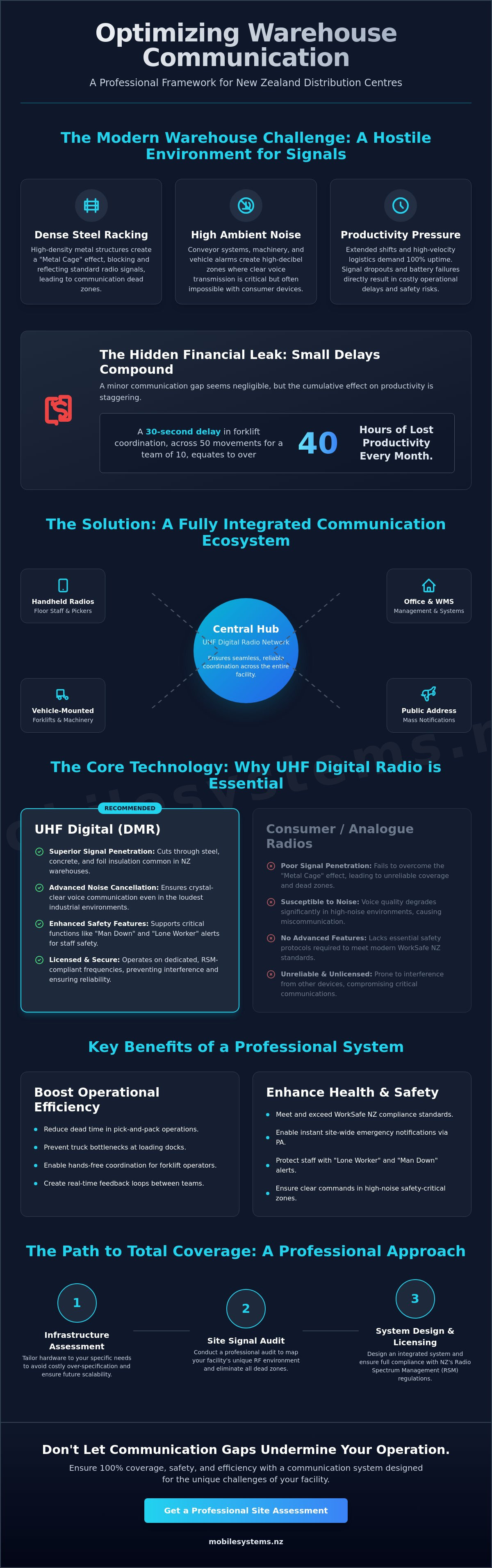
Effective warehouse communication systems function as a critical infrastructure component for New Zealand distribution centres, where dense steel racking and high ambient noise often disrupt standard signals.
Effective warehouse communication systems function as a critical infrastructure component for New Zealand distribution centres, where dense steel racking and high ambient noise often disrupt standard signals. Reliable coordination requires a strategic ecosystem that integrates handheld units, vehicle-mounted radios, and public address systems to ensure seamless operations across the entire facility.
Operational delays and safety risks frequently arise from signal dropouts or battery failure during extended shifts. Maintaining constant contact between office staff, floor teams, and forklift operators is necessary to meet productivity targets and ensure compliance with local health and safety protocols. You understand that even a minor communication gap can lead to significant logistical bottlenecks.
This guide provides a professional framework for designing and optimizing communication infrastructure specifically for the New Zealand market. We'll examine specific hardware requirements, the 2026 Radio Spectrum Management (RSM) licensing updates, and practical methods for achieving total site coverage to prevent costly operational errors.
Key Takeaways
- Learn how integrated warehouse communication systems reduce operational delays by connecting floor staff, forklift drivers, and management across high-density environments.
- Understand why UHF digital radio technology provides the superior signal penetration and noise cancellation required for modern steel-racked facilities.
- Discover how to integrate public address systems with handheld radios to streamline site-wide mass notifications and emergency evacuations.
- Identify the steps for conducting a professional site signal audit to eliminate dead zones and ensure compliant radio licensing under New Zealand regulations.
- Explore the benefits of a tailored infrastructure assessment to avoid costly hardware over-specification while ensuring long-term system scalability.
The Critical Role of Integrated Communication in Modern Warehousing
A professional warehouse communication system is more than just a set of handheld devices. It's a multi-layered infrastructure that integrates two-way radios, public address systems, and signal enhancement hardware. In a modern logistics environment, these components work together to ensure that information flows as fast as the physical goods.
Operational silence creates hidden financial leaks. For example, a 30-second delay in forklift coordination might seem negligible, but when multiplied across 50 movements per day for a team of 10, it equates to over 40 hours of lost productivity every month. These inefficiencies often stem from poor signal penetration in high-density racking areas where standard consumer devices fail.
To better understand how these systems integrate with broader logistics technology, watch this helpful video:
Modern New Zealand facilities have moved beyond basic analogue walkie-talkies to sophisticated Digital Mobile Radio (DMR) networks. These systems often interface with a warehouse management system (WMS) to provide a cohesive operational picture. This integration allows for automated alerts and clearer voice transmissions, even in the most challenging structural environments.
Operational Efficiency and the Bottom Line
Real-time feedback loops reduce dead time in pick-and-pack operations. When a picker encounters a stock discrepancy, instant radio contact with the inventory team prevents the entire workflow from stalling. Similarly, streamlining inwards goods and dispatch coordination through dedicated channels prevents truck bottlenecks at the loading docks.
Using vehicle-mounted radios allows forklift operators to stay focused on their surroundings while receiving instructions hands-free. This reduces the need for drivers to stop or dismount to check mobile phones, which is both a safety hazard and a productivity drain. Effective warehouse communication systems ensure that every team member remains connected without compromising their primary task.
Health, Safety, and Emergency Management
Meeting WorkSafe NZ standards requires robust emergency notification protocols. Integrated public address systems allow for site-wide mass notifications that standard radios might miss. This is particularly vital during emergency evacuations where every second of response time is critical for personnel safety.
In high-rack environments, DMR features such as "Man Down" and "Lone Worker" alerts provide an essential safety net for staff working in isolated aisles. These digital systems also utilize advanced noise cancellation to ensure audio remains intelligible in high-decibel zones near conveyor systems or heavy machinery. A tailored assessment often prevents costly mistakes in safety coverage by identifying these high-noise areas early in the design phase.
Core Technologies: UHF, Digital Radio, and Signal Penetration
Most professional warehouse communication systems rely on UHF (Ultra High Frequency) because of its ability to navigate complex indoor environments. Unlike lower frequencies, UHF waves are shorter and can pass through or around the dense obstructions common in logistics centres. This frequency band is the global standard for indoor industrial applications due to its superior penetration through internal walls and pallet racking.
Modern New Zealand warehouses present a unique challenge known as the "Metal Cage" effect. The combination of steel-clad walls and foil-backed insulation creates a highly reflective environment that attenuates radio signals. This construction acts as a Faraday cage, trapping or blocking signals and leading to persistent dead zones. Standard consumer-grade equipment often fails to overcome these structural barriers, resulting in inconsistent coverage in the heart of the facility.
Transitioning to Digital Mobile Radio (DMR) provides a distinct advantage over legacy analogue systems. Digital technology processes audio as data, which offers several functional benefits for warehouse operations:
- Noise Cancellation: Digital filters eliminate background hum from machinery and conveyor belts, ensuring voice clarity.
- Battery Longevity: Digital transmitters pulse rather than staying constantly active, extending battery life by up to 40%.
- Increased Capacity: Digital systems allow for multiple talk groups on a single frequency, reducing channel congestion.
UHF vs. VHF: Choosing the Right Frequency
UHF is preferred for indoor work because its waves are small enough to navigate between steel racking. In contrast, VHF (Very High Frequency) waves are longer and better suited for outdoor yard operations or transport depots where line-of-sight distance is the priority. Selecting the correct frequency is a technical requirement for performance and a legal one, as all commercial operations must comply with NZ radio licensing regulations to avoid interference with emergency services or neighbouring businesses.
Overcoming Signal Obstructions
Achieving 100% facility coverage for warehouse communication systems usually requires the strategic placement of repeaters. These devices receive a weak signal and re-broadcast it at a higher power to reach shielded areas. For massive distribution centres, a Distributed Antenna System (DAS) may be necessary to ensure consistent signal strength across several thousand square metres of floor space.
While radios handle operational traffic, office staff and visiting drivers often require reliable mobile signals. Installing cellular boosters ensures that smartphones function correctly inside the steel-clad environment. A tailored signal assessment often prevents the frustration of persistent dead zones in critical work areas by identifying structural weaknesses before hardware is installed.
Beyond Handhelds: Public Address and Mass Notification
A robust warehouse communication system extends beyond individual voice units to include site-wide broadcast capabilities. Public Address (PA) and mass notification systems are essential for managing large-scale facilities where handheld devices might not reach every staff member simultaneously. These systems provide the necessary reach for safety alerts, general announcements, and operational instructions that affect the entire workforce.
Unlike traditional standalone setups, modern configurations allow for seamless integration between radio networks and audio broadcasting hardware. This allows authorized personnel to make facility-wide announcements using their existing handheld or vehicle-mounted radios. This level of integration is a key component in optimizing warehouse operations, as it eliminates the delay of finding a fixed microphone during time-sensitive situations.
Zoned paging further refines this capability by allowing messages to be directed only to relevant areas. A supervisor can issue instructions to the loading dock without disturbing pickers in the racking zones. This targeted approach prevents "alarm fatigue," where staff begin to ignore announcements because they are frequently irrelevant to their specific tasks.
Ambient noise compensation technology ensures that these messages are always heard. Sensors throughout the facility monitor background noise levels from machinery and vehicles. The system then dynamically adjusts the speaker output in real time. If a heavy forklift passes a speaker, the volume increases; when the floor is quiet, the volume lowers to a comfortable level.
Fixed vs. Portable PA Solutions
Permanent installations typically utilize high-clarity horn speakers mounted at height to provide consistent coverage across the floor. These fixed systems are ideal for standard distribution centres with predictable layouts. Conversely, portable PA systems offer the flexibility required for outdoor yards, temporary storage sites, or assembly points. For a deeper understanding of the technical requirements, refer to our resource on Public Address Meaning.
Audibility in Industrial Environments
Ensuring a message is heard requires careful calculation of Sound Pressure Levels (SPL) to overcome ambient machinery noise. However, speech intelligibility is more important than raw volume. If the acoustics of a steel-clad building cause excessive echo, the message will become garbled regardless of how loud it is. Professional warehouse communication systems often incorporate visual indicators, such as synchronized strobe lights, to provide an additional layer of safety in high-decibel areas or for hearing-impaired employees.
Designing for the NZ Environment: Racking, Dead Zones, and Licensing
Designing effective warehouse communication systems requires a systematic framework to ensure long-term reliability. A haphazard approach to hardware acquisition often leads to signal interference or non-compliance with local regulations. Every facility has unique structural challenges that must be addressed during the planning phase.
The design process follows five essential steps:
- Site Signal Audit: Identifying structural dead zones caused by high-density racking and foil insulation.
- Channel Architecture: Defining distinct user groups such as logistics, security, and management to prevent cross-talk.
- Licensing Strategy: Securing legal frequencies through Radio Spectrum Management (RSM).
- Hardware Specification: Selecting devices based on environmental stressors like dust and moisture.
- Scalability Planning: Ensuring the infrastructure can support additional units during seasonal volume surges.
Navigating NZ Radio Licensing
Commercial operators in New Zealand must navigate specific regulatory requirements. While some low-power devices operate under a General User Radio Licence (GURL), professional warehouse communication systems usually require an individual licence to ensure interference-free operation. As of July 1, 2026, the standard annual fee for an individual radio licence is $190.00.
If your facility requires repeaters to maintain coverage, the fees increase to $800.00 for up to five units. Mobile Systems Limited acts as a liaison with Approved Radio Engineers (ARE) to identify clear frequencies and manage the certification process within the Register of Radio Frequencies (RRF). It's critical to avoid importing overseas equipment using MURS or FRS bands, as these are prohibited in New Zealand and can interfere with safety services.
Hardware Durability and Ingress Protection
Industrial environments are inherently harsh on electronics. Consumer-grade radios typically fail due to fine dust ingress or moisture from temperature fluctuations in large distribution centres. Professional hardware is rated by Ingress Protection (IP) standards. An IP67 rating, for instance, indicates the device is dust-tight and can withstand immersion in water up to one metre for 30 minutes.
Battery management is equally vital for maintaining workflow. Implementing multi-unit chargers and conducting regular shift-life testing ensures that devices don't fail during 12-hour operational windows. If you're unsure which hardware suits your specific floor plan, request a professional site assessment to prevent costly equipment mismatches and ensure total site coverage.
The Mobile Systems Approach: Professional Design and Support
Mobile Systems Limited provides a comprehensive framework for developing warehouse communication systems that align with specific operational workflows. We avoid a one-size-fits-all hardware approach, focusing instead on technical precision and site-specific signal requirements. Our methodology ensures that every component serves a functional purpose within your logistics ecosystem.
A tailored assessment prevents the common mistake of over-specifying hardware. By calculating exactly how many repeaters or two-way radios are needed for your racking density, we ensure maximum coverage without unnecessary capital expenditure. This data-driven design process identifies the most efficient path for signal propagation before any equipment is permanently installed.
Based in Mount Maunganui, our team provides nationwide service through a fleet of mobile servicing vehicles equipped with specialized diagnostic tools. This capability ensures that technical system optimisations and hardware repairs are conducted on-site, minimizing operational downtime. We support facilities across New Zealand, providing the local expertise required for our unique industrial builds and terrain.
In a recent integration for a major New Zealand logistics hub, we unified fragmented communication layers into a single digital network. This transition allowed for direct radio-to-PA broadcasting and automated safety alerts, which significantly improved coordination between the dispatch office and the floor team. This unified approach replaced unreliable legacy devices with a single, resilient communication layer.
Consultative System Design
Our process begins with a detailed site walk-through to map signal strength and identify interference risks from existing machinery or structural steel. Once the design is finalized, we handle the final commissioning and provide structured training. Educating staff on radio etiquette and the use of emergency features ensures the technology is used to its full potential from day one.
We also specialize in hybrid configurations for businesses managing tight upgrade cycles. You don't always need to replace your entire fleet at once. We can integrate new DMR technology to function seamlessly with your legacy analogue gear. This allows for a phased and cost-effective upgrade path that maintains operational continuity while gradually improving signal clarity and battery life.
Next Steps for Your Facility
Identifying immediate gaps in your communication flow is the first step toward improving site safety and productivity. Whether you're experiencing persistent dead zones in high-rack aisles or battery failures during 12-hour shifts, these issues indicate a need for infrastructure modernization. Addressing these gaps early prevents small delays from compounding into significant annual losses.
Requesting a site audit allows you to future-proof your warehouse against seasonal expansion and technological shifts. A professional evaluation provides a clear roadmap for equipment investment and regulatory compliance. Contact the Mobile Systems team for a professional assessment of your current communication requirements.
Future-Proofing Your Logistics Infrastructure
Modern logistics centers require more than basic radios; they need a resilient ecosystem that overcomes structural interference and meets New Zealand's specific regulatory standards. Transitioning to integrated warehouse communication systems ensures your facility remains productive, safe, and fully compliant with RSM licensing requirements. A well-designed network eliminates the hidden costs of operational delays while providing a robust safety net for your workforce.
Mobile Systems Limited brings over 20 years of NZ industrial communication expertise to every project. We specialize in complex frequency coordination and provide ongoing maintenance via our dedicated on-site mobile support vehicles for nationwide service. Our team understands the technical challenges of steel-clad environments and provides the practical solutions needed to maintain 100% site coverage.
Request a professional warehouse communication audit to identify signal gaps and optimize your team's coordination. Taking this proactive step ensures your communication infrastructure scales alongside your business growth and remains reliable under pressure.
Frequently Asked Questions
Do I need a licence for warehouse radios in New Zealand?
Yes, most professional warehouse communication systems require an individual radio licence from Radio Spectrum Management (RSM). As of July 2026, the standard annual fee for this licence is $190.00. Obtaining a private frequency through an Approved Radio Engineer ensures your operations remain interference-free and legally compliant.
Can my PA system be linked to my two-way radios?
Yes, you can integrate public address systems with your radio network using a specialized interface. This allows authorized staff to trigger site-wide announcements or emergency alerts directly from their handheld units. This integration centralizes control and improves response times during critical incidents or facility-wide evacuations.
How do I stop dead zones in my high-rack warehouse?
Eliminating dead zones requires a combination of strategic repeater placement and, in larger facilities, a Distributed Antenna System (DAS). A professional site signal audit identifies where steel racking or foil insulation blocks signals. These technical assessments allow for a targeted infrastructure design that ensures total facility coverage.
What is the difference between UHF and VHF for warehouse use?
UHF is the industry standard for indoor use because its shorter waves navigate around steel racking and internal walls more effectively. VHF is better suited for outdoor yards or large transport depots where line-of-sight distance is the priority. Most warehouse communication systems utilize UHF to maintain signal integrity inside complex metal structures.
How long do professional warehouse radio batteries last?
Modern digital radios typically provide 12 to 14 hours of operational life on a single charge. Digital technology improves battery longevity by up to 40% compared to legacy analogue systems because the transmitter pulses rather than staying constantly active. Using multi-unit smart chargers helps maintain battery health over multiple shifts.
Are digital radios better than analogue for noisy environments?
Digital radios are superior for high-noise areas because they incorporate advanced noise-cancellation software. These systems filter out the background hum of conveyors and heavy machinery, transmitting only clear voice audio. This ensures instructions are understood the first time, which reduces operational errors in high-decibel processing zones.
Can we use our mobile phones instead of a radio system?
Mobile phones are generally unsuitable for primary warehouse coordination due to their fragility and the signal attenuation caused by steel-clad buildings. Radios provide instant one-to-many communication and dedicated safety features like "Man Down" alerts. Consumer mobile devices also lack the physical durability and battery life required for industrial environments.
What happens to our communication system during a power outage?
If your system includes repeaters, they should be connected to an Uninterruptible Power Supply (UPS) to maintain coverage during outages. Handheld radios will continue to function in "simplex" or peer-to-peer mode without a repeater. However, the effective range will be significantly reduced across the facility without the repeater's amplification.
Related posts

- May 27, 2026
Did you know that a single communication failure in a remote work zone could expose your business to fines of...

- May 23, 2026
Need to go beyond 100m? Our guide to the ethernet cable extender explains types, distance limits, and NZ use cases...

- May 22, 2026
Can't fix a phone on site? Learn essential troubleshooting for NZ field teams, when to seek professional repair, and how...