
Why UHF radios matter on New Zealand farms
For many New Zealand farms, UHF radios are as critical as the tractor keys or the gate dog. They keep teams connected across paddocks, hills, and back roads where mobile coverage is patchy or non‑existent. Choosing the wrong radio can mean missed calls at the yards, confusion during stock moves, or silence in an emergency.
For many New Zealand farms, UHF radios are as critical as the tractor keys or the gate dog. They keep teams connected across paddocks, hills, and back roads where mobile coverage is patchy or non‑existent. Choosing the wrong radio can mean missed calls at the yards, confusion during stock moves, or silence in an emergency.
This guide explains how to choose a UHF radio for farming, with a focus on New Zealand rules, terrain, and work patterns. You will learn which features actually affect range, clarity, and reliability, what to look for in vehicle and handheld radios, and how to plan channels for family, staff, contractors, and emergency use.
If you want deeper technical detail on local frequencies, you can also refer to dedicated resources such as Uhf Radio Nz and Uhf Radio Repeater Channels while you work through this guide.
Key Takeaway: The “right” UHF farm radio is not just about maximum range. It is about matching power, antenna, channels, and durability to your land, vehicles, and daily jobs.
Core decisions: vehicle, handheld, or both
Before you get into technical details, decide where and how the radio will be used. Most farms end up with a mix of vehicle and handheld radios that work as a system.
Vehicle‑mounted radios for tractors, utes, and trucks
Vehicle or fixed‑mount UHF radios suit:
- Tractors and harvesters working across large blocks
- Utes and farm trucks doing regular runs between sheds, yards, and distant paddocks
- Transport operators moving stock or feed in and out of the farm
Typical benefits:
- Higher transmit power compared to basic handhelds
- Ability to run a quality external antenna in the best location on the vehicle
- Permanent power from the vehicle electrical system
- Larger, easier‑to‑use controls and displays
In hill country or large flats, a good in‑vehicle unit with the right antenna often becomes the backbone of farm communications. For brand selection and feature comparisons, resources like Choose Gme Uhf Cb Radio are useful, especially if you standardise across a fleet.
Handheld radios for stock work and on‑foot jobs
Handheld UHF radios suit:
- Stock work on foot or on bikes
- Yard work where vehicles may be parked away from the action
- Staff who move between vehicles and sheds
- Portable use for emergency kits and volunteer response
Key considerations:
- Size and weight for all‑day carry
- Battery life for full working days
- Audio volume in noisy environments, such as near machinery or in high wind
- Rugged casing for drops, mud, and rain
On many farms, handhelds talk to a higher‑powered vehicle radio which then reaches the rest of the property.
Pro Tip: Plan radio roles first. Decide which units will be “backbone radios” in key vehicles, and which will be portable “edge radios” used by people on foot or on bikes. Then choose models that complement each other.
Understanding range and terrain on New Zealand farms
Manufacturers often advertise “up to 20 km range” or more. In real farming conditions, especially in New Zealand, that figure is rarely accurate.
What actually affects UHF range
Range is driven by:
- Line of sight: UHF is essentially line‑of‑sight. Hills, ridges, and bush can block or weaken the signal.
- Antenna height and quality: A high‑mounted vehicle antenna almost always outperforms a handheld at hip height.
- Transmit power: Higher wattage can help, although it does not overcome bad antenna placement or severe terrain.
- Interference and noise: Nearby radios, buildings, and machinery can add noise or reflections, reducing practical range.
In flat dairy country, two good vehicle radios with high antennas might talk clearly across 15 km or more. In steep hill country, a few kilometres between valleys can already be challenging.
Using repeater channels for extended coverage
Repeater stations receive and re‑broadcast on a different frequency pair. When you can “see” the repeater, you can often talk to other radios that cannot see you directly.
Benefits for farming:
- Extends coverage into valleys or around hills
- Helps link outlying blocks or neighbouring farms
- Useful for emergency and multi‑agency coordination
To understand which repeater channels are available, how they are allocated, and how to program them correctly, refer to Uhf Radio Repeater Channels.
Key Takeaway: Terrain beats marketing claims. For reliable farm comms, focus on antenna height and smart use of repeaters instead of chasing unrealistic “maximum range” numbers.
Key technical features that matter on farms
Once you know where radios will be used, compare technical features that make a practical difference in day‑to‑day farm work.
Power output and legal limits
In New Zealand, UHF CB and related services operate under specific power and frequency rules. Practical guidance:
- Choose radios that comply with New Zealand standards and channel plans.
- More power is helpful, but only when paired with a good antenna system.
- For most farms, legal UHF CB‑class radios are sufficient for coordination and safety.
Radios sourced from overseas marketplaces may not be legal or compatible with local channels, which can cause interference issues and compromise emergency communications.
Channel capacity and channel management
Modern UHF radios offer many channels. For farming, plan how you will use them:
Common channel uses:
- A primary “farm operations” channel
- A separate “yards or shed” channel to avoid cross‑talk with distant paddocks
- A “quiet” family or house channel
- Designated emergency or monitoring channels
- Shared channels for contractors, transport, or neighbours
Look for radios that support:
- Clear channel labelling or naming on the screen
- Scan functions to monitor several channels
- Priority channel settings, for example always listening to the main emergency or farm channel
CTCSS / DCS and privacy tones
CTCSS or DCS codes allow you to avoid hearing other users on the same channel. They do not provide encryption, but they help keep communications clean and focused.
On busy rural corridors or when working near neighbouring farms, this can greatly reduce unwanted chatter. Make sure all radios in your fleet use the same code plan, and record it in a farm communications sheet.
Audio clarity and noise management
On bikes, in tractors, or near PTOs and pumps, audio performance matters more than many realise.
Look for:
- High audio output power in watts
- Good speaker quality
- Noise‑canceling microphones for vehicle sets
- Optional external speakers for loud cabs
Ask suppliers if you can test radio volume with tractor engines running, or read user reviews from farming and civil users rather than generic hobby reviews.
Durability, weather resistance, and power options
Farming is hard on equipment. Radios must survive dust, mud, vibration, and rain.
Ruggedness and IP ratings
For handhelds, check:
- IP rating: For example, IP67 means dust‑tight and submersible for short periods. This is valuable for wet stock work and sudden downpours.
- Drop resistance: Many radios are tested for repeated drops from around 1 to 1.5 metres.
- Robust belt clips and seals on battery and accessory ports.
For vehicle sets, consider:
- Shock and vibration resistance for tractors, side‑by‑sides, and rough tracks
- A microphone that can survive daily handling with gloves and wet hands
- A mounting bracket that does not work loose over corrugations
Important: A slightly higher cost for a properly sealed, rugged radio usually pays for itself by avoiding replacements after the first wet winter or busy calving season.
Battery type, run time, and charging
Battery performance directly affects productivity and safety.
For handhelds:
- Look for at least 8 to 12 hours of real‑world use at standard duty cycles.
- Prefer radios with removable lithium‑ion packs, not just built‑in batteries.
- Assess charging options, such as drop‑in chargers in the shed, 12 V vehicle chargers, or USB‑C for flexibility.
On large properties, consider spare battery packs in the main vehicles. For multi‑shift operations, like transport or big cropping programmes, a proper charging bay in the workshop is worth the investment.
Power integration in vehicles
Vehicle radios can be:
- Hard‑wired to the vehicle battery
- Plugged into accessory sockets in lighter‑duty use
- Integrated into fleet wiring looms for trucks and service vehicles
Ensure the installation uses proper fusing, cable protection, and mounting so that vibration and dust do not cause intermittent power issues.
Antennas, installation, and practical field setup
A good radio with a poor antenna or bad installation will still perform poorly. Antenna choices can easily double or halve real‑world range.
Choosing the right antenna for your terrain
For farm and fleet vehicles, the main antenna options are:
| Antenna Type | Typical Gain | Best For | Trade‑offs |
|---|---|---|---|
| 3 dBi low‑gain whip | Low | Hilly terrain, mixed country | Less range on flat land, better in valleys |
| 6 dBi medium‑gain whip | Medium | General farm use, rolling farmland | Good compromise of range and coverage |
| 9 dBi high‑gain collinear | High | Flat country, long straight roads | Poor in steep hills and close‑in work |
In hill country, a lower gain antenna often works better because it spreads signal more vertically, helping cover ridges and valleys around you instead of just far across the flats.
Mounting locations on vehicles
Common options:
- Bullbar or front guard mounts
- Roof or roof‑rack mounts
- Brackets on mirror arms for trucks and larger machines
Key points:
- Higher is usually better, within reason
- Avoid mounting directly beside heavy steel structures that can shadow the signal
- Use quality coaxial cable and weather‑proof connectors
If you use multiple radios, GPS, or other antennas on one vehicle, plan layout to minimise interference and physical damage from branches and gateways.
[IMAGE: Illustration of a ute, tractor, and quad bike showing recommended UHF antenna mounting positions in a farm setting]
Programming, labelling, and training
Once radios are installed:
- Program channel names that make sense to your team, such as “YARDS,” “HILL BLOCK,” or “TRUCKS.”
- Print a simple channel guide and keep it in vehicles and the smoko room.
- Train new staff on radio etiquette, emergency phrases, and which channels to use for what.
Pro Tip: Treat your radio system like a piece of safety equipment. Clear rules about which channel to use during mustering, spraying, or shifting stock reduce confusion when something goes wrong.
Matching features to different rural and allied sectors
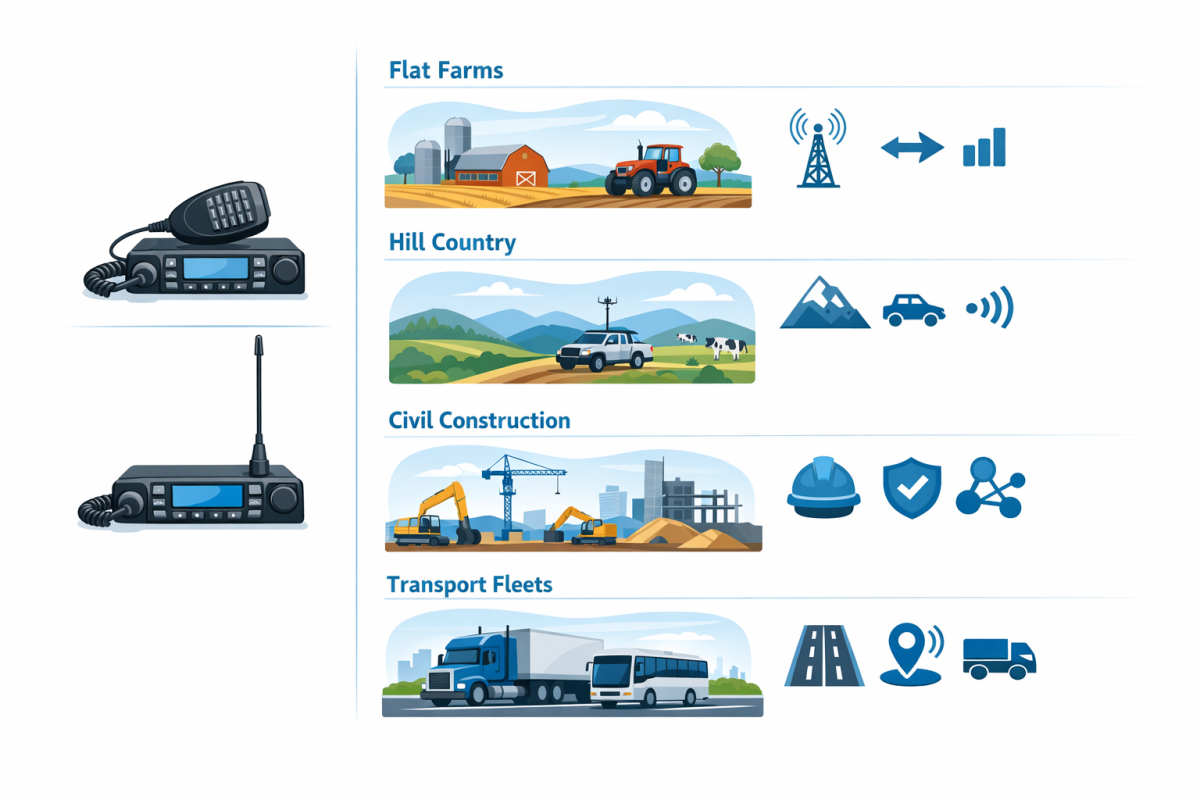
Although this guide focuses on farming, the same decision logic applies to other rural New Zealand operations and supporting sectors.
Agriculture, cropping, and mixed farms
Priorities:
- Mix of vehicle and handheld radios
- Medium‑gain antennas for rolling land
- Long battery life for all‑day seasonal work
- Simple, clearly labelled channel plans for permanent and seasonal staff
Civil construction and infrastructure
Priorities:
- High durability ratings for dust and shock
- Integration with existing site communications and safety protocols
- Clear audio around heavy plant and in high‑noise environments
- Potential need to interoperate with subcontractors and traffic management
Transport, logistics fleets, and school or tour buses
Priorities:
- Reliable vehicle sets with external speakers and easy‑reach microphones
- Effective antennas for highway and rural route coverage
- Possible use of repeater networks and shared channels along key routes
- Consistent installation standards across the fleet
Emergency services, marine, security, and OH&S
Emergency and volunteer rescue, marine and offshore, and security operations may use additional, service‑specific bands and equipment. However, UHF CB‑type radios often support:
- On‑site coordination at incidents or events
- Backup communication when primary systems fail
- Interoperability with farms, civil contractors, and transport operators working at the same location
In all these cases, ruggedness, clear audio, predictable battery life, and well‑planned channel structures matter just as much as in day‑to‑day farming.
Key takeaways for choosing a farm UHF radio
- Decide on your mix of vehicle and handheld radios based on how your team actually works.
- Remember that terrain, antenna height, and antenna type dominate real‑world range.
- Use New Zealand‑compliant radios and channel plans, and consider nearby repeater coverage.
- Prioritise ruggedness, IP rating, audio clarity, and battery life for harsh rural conditions.
- Plan and label channels for different tasks: operations, yards, family, contractors, and emergency.
- Train staff on consistent usage and keep a simple communications plan where everyone can see it.
Related posts

- June 16, 2026
Mobile Systems Limited's 2026 buyer's guide to satellite phones covers Iridium vs Inmarsat vs Starlink Direct to Cell, dedicated handsets,...

- June 15, 2026
Mobile Systems Limited's 2026 guide for NZ businesses covers VHF vs UHF frequency selection, Digital Mobile Radio, IP67 durability ratings,...

- June 14, 2026
A portable PA system is a critical safety and communication tool, not just a luxury for public events. When you're...