
Maintaining Communication Equipment: The Professional Guide for NZ Fleets
Could a single corroded antenna connection result in a NZ$3 million fine? For New Zealand fleet operators working in forestry, marine, or remote transport, maintaining communication equipment is more than a technical choice.
Could a single corroded antenna connection result in a NZ$3 million fine? For New Zealand fleet operators working in forestry, marine, or remote transport, maintaining communication equipment is more than a technical chore; it's a legal and operational necessity. You understand that equipment failure in a cellular black spot isn't just a frustration. It's a significant safety risk that can lead to severe penalties under the Health and Safety at Work Act 2015.
Neglected hardware often leads to high replacement costs and avoidable downtime that eats into your margins. This guide provides a professional framework for ensuring your commercial radio and satellite systems remain operational in the country's most demanding environments. You'll learn how to implement preventative strategies that align with current New Zealand standards and technical requirements.
We'll examine specific maintenance protocols for vehicle-mounted radios and handheld units, the impact of the 2026 telecommunications regulatory changes, and how to maximise the lifespan of your critical communication assets.
Key Takeaways
- Recognise the safety implications of equipment failure under the Health and Safety at Work Act 2015 for remote New Zealand operations.
- Identify how environmental stressors such as dust, heat, and vibration impact the duty cycle of vehicle-mounted radio units.
- Adopt a preventative strategy for maintaining communication equipment to reduce the high costs associated with reactive 'run-to-fail' approaches.
- Establish structured daily and weekly inspection routines to identify physical degradation before it results in operational downtime.
- Utilise professional diagnostic tools and on-site servicing to ensure communication assets remain compliant and functional in harsh environments.
The Critical Role of Maintaining Communication Equipment in NZ Industry
Reliable connectivity is the backbone of New Zealand's primary industries. Whether you're managing a log-hauling fleet or a maritime operation, the ability to coordinate movements and report hazards is essential. Professional communication systems are designed for high duty cycles, but they require a structured approach to care to remain functional in high-vibration and high-dust environments.
Failure in a remote cellular black spot often results in a total cessation of work. Without a functional radio link, safety protocols often dictate that operations must stop until contact is restored. This makes Two-way radio technology a critical infrastructure component rather than just a secondary tool.
To better understand the principles of managing these assets effectively, watch this helpful video:
Communication as a Safety Critical Asset
In the New Zealand forestry and maritime sectors, communication systems are classified as safety-critical assets. This classification means their failure directly increases the risk of injury or death. Under the Health and Safety at Work Act 2015, PCBUs have a legal obligation to provide a reliable means of communication for workers in isolated or remote areas.
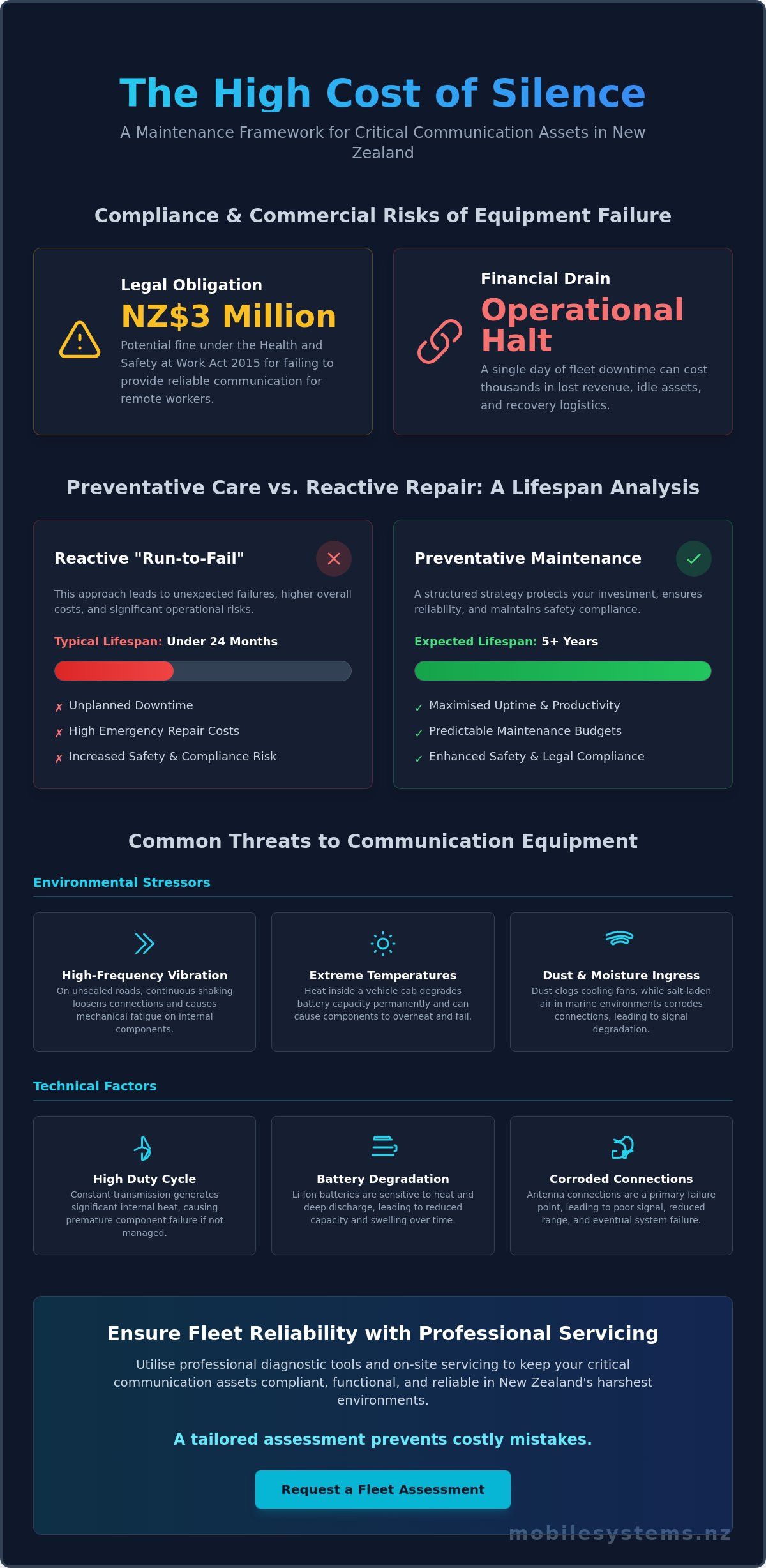
Regularly maintaining communication equipment prevents "lost contact" emergencies where a worker is unable to call for help during a medical event or mechanical failure. It's the difference between a minor delay and a major health and safety investigation that could result in fines of up to NZ$3 million.
Financial Impact of Neglect vs. Prevention
Neglecting hardware leads to a "run-to-fail" cycle that's significantly more expensive than scheduled servicing. When a radio fails on-site, you lose the cost of the hardware, the labour for the repair, and the productivity of the vehicle sitting idle. A single day of fleet downtime can cost a business thousands in lost revenue.
A well-maintained UHF radio can serve a fleet for over five years, whereas neglected units often fail within 24 months due to moisture ingress or vibration damage. Prioritising the process of maintaining communication equipment is a core business function that protects your bottom line and ensures compliance with New Zealand standards.
Technical Fundamentals: Why Radio and Satellite Systems Fail
Technical failure in communication systems is rarely the result of a single event. It's usually a cumulative process driven by environmental stress and electronic fatigue. For New Zealand operators, maintaining communication equipment requires an understanding of the 'Duty Cycle'. This term defines the ratio of time a radio spends transmitting versus receiving or idling. High-use fleet radios generate significant internal heat during transmission; if the hardware isn't rated for the specific duty cycle of your operation, internal components will degrade prematurely.
Environmental factors in New Zealand, such as high-frequency vibration on unsealed forestry roads or salt-laden air in maritime environments, accelerate mechanical fatigue. Dust ingress can clog cooling fans or settle on circuit boards, causing thermal throttling or short circuits. Modern vehicle-mounted units are ruggedized, but they aren't invincible. Consistent exposure to these elements without intervention leads to a predictable decline in signal clarity and range.
Battery Health and Duty Cycles
Most modern handheld radios and satellite phones utilize Lithium-Ion (Li-Ion) chemistry because of its high energy density. While superior to older Nickel-Metal Hydride (NiMH) cells, Li-Ion batteries are sensitive to extreme temperatures and "deep discharge" cycles. Leaving a radio in a hot vehicle cab in the summer can permanently reduce its capacity.
You should monitor your fleet for signs of battery swelling or a significant drop in operational runtime. If a unit that previously lasted a full 12-hour shift now requires charging by mid-afternoon, the cell is likely reaching the end of its functional life. Replacing batteries before they fail entirely ensures your team isn't left without a lifeline in the field.
Antenna and Cable Integrity (VSWR)
The antenna system is the most frequent point of failure in NZ fleets. Voltage Standing Wave Ratio (VSWR) measures how efficiently power is transmitted from the radio to the antenna. A high VSWR indicates that energy is being reflected back into the radio rather than being broadcast. This reflected power generates intense heat that can "blow" the radio's power amplifier, resulting in a costly repair.
Moisture ingress is the primary enemy of coaxial cables. Salt spray or heavy rain can seep into connectors, causing corrosion that disrupts the signal. Following OSHA best practices for hardware inspection can help identify these issues early. A technical audit of your current fleet often identifies these hidden risks before they cause hardware failure.
Firmware and Digital System Updates
Modern communication is increasingly software-defined. Digital Mobile Radio (DMR) and P25 systems rely on complex firmware to manage network handovers, encryption, and noise-cancellation algorithms. Manufacturers frequently release patches to fix software bugs that can cause intermittent audio drops or "freezing" of the user interface.
Regularly updating firmware is just as important as physical cleaning. These updates ensure your hardware remains compatible with evolving network standards and maintains the integrity of your secure channels. Skipping these updates can leave your system vulnerable to interference or operational glitches that are difficult to diagnose in the field.
Preventative vs. Reactive Maintenance: A Commercial Analysis
Choosing a maintenance strategy is a financial decision that directly impacts fleet uptime and safety compliance. Reactive maintenance, often described as the 'run to fail' approach, is common in high-pressure New Zealand industries like seasonal harvesting or transport. In this model, maintaining communication equipment only occurs after a total system failure. While this avoids upfront costs, it ignores the reality that electronic components rarely fail at convenient times or in accessible locations.
Preventative maintenance involves scheduled technical audits and performance testing to identify degradation before it leads to a breakdown. By shifting to this proactive model, fleet managers can extend the lifespan of their assets and ensure they remain compliant with New Zealand's health and safety regulations. Predictive maintenance takes this further by using data from fleet tracking systems to identify high-use units that may require service sooner than the rest of the fleet.
The True Cost of Reactive Repair
The sticker price of a repair is only a fraction of the total cost in a reactive model. When a radio fails in a remote site like the Urewera ranges or a deep-sea fishing vessel, the logistics of getting a replacement unit to the worker are significant. You face emergency repair premiums, expedited shipping costs, and the loss of productivity while the vehicle sits idle.
Equipment failure often has a ripple effect on project timelines. If a lead vehicle's radio fails, the entire convoy may need to stop for safety reasons. Fixing it when it breaks is almost always the most expensive strategy because you lose control over the timing and the cost of the intervention. A single hour of fleet downtime can quickly exceed the cost of a full year's preventative service plan.
Implementing a Preventative Framework
Transitioning to a preventative model starts with scheduling bi-annual technical check-ups for all two-way radio systems. These audits should include testing antenna VSWR, battery capacity, and firmware versions. Maintaining an accurate equipment asset register is essential; you can't manage what you don't track. This register should record the age, service history, and physical condition of every handheld and vehicle-mounted unit in your fleet.
- Establish a clear process for staff to report minor issues, such as intermittent audio or loose knobs.
- Conduct physical inspections every six months to check for cable wear and moisture ingress.
- Use usage data to rotate handheld units, ensuring even wear across the entire fleet.
Training your team to value their gear is the final step. When operators understand that their radio is a safety lifeline, they're more likely to report small faults before they become terminal. A tailored assessment often prevents costly mistakes and ensures your communication net remains tight when it's needed most.
A Comprehensive Checklist for Maintaining Communication Equipment
Effective routines for maintaining communication equipment rely on a tiered approach that separates user-level inspections from professional technical audits. In New Zealand's high-impact sectors, hardware is frequently exposed to conditions that exceed standard operating parameters. A structured checklist ensures that minor physical wear doesn't escalate into a total system failure during a critical operation.
Implementing these checks creates a culture of equipment accountability within your fleet. When operators are responsible for the first line of defence, they're more likely to identify the subtle signs of hardware fatigue that automated systems might miss. This proactive stance is essential for meeting the safety requirements of the Health and Safety at Work Act 2015.
Daily and Weekly User Inspections
Daily checks should focus on the physical integrity of the unit. Operators must inspect antennas for cracks or permanent bends, as these often indicate internal copper fatigue. Check all knobs and buttons for tactile responsiveness and ensure battery contacts are free from dirt or oxidation. If you notice a "crackle" or significant audio distortion during test calls, the unit should be flagged for immediate review.
Weekly cleaning protocols are vital in ruggedized environments. Use a damp, lint-free cloth to remove mud and grit from the radio housing. For battery contacts, use an approved non-abrasive solution or a specialized contact cleaner. Avoid using consumer-grade detergents or harsh chemicals, as these can degrade the waterproof seals and gaskets that protect the internal circuitry.
Quarterly Technical Audits
Quarterly audits move beyond visual inspections to verify the electronic performance of the system. This includes bench testing the transmitter power and receiver sensitivity to ensure they meet the manufacturer's original specifications. For fleets utilizing emergency gear, you must verify satellite phone connectivity and SIM card status to prevent "service expired" errors in the field.
Technical staff should also recalibrate antennas using a VSWR meter. Over time, vibration can loosen connectors or shift the antenna's mounting position, which reduces signal propagation. Regular recalibration ensures your fleet maintains the maximum possible range, which is critical when working in the deep valleys or dense bush common in New Zealand's backcountry.
NZ Environmental Considerations
The New Zealand landscape presents unique challenges for maintaining communication equipment. Salt spray is a primary concern for marine communication systems and coastal transport fleets. Salt is highly corrosive and can penetrate even IP-rated housings over time. Applying a thin layer of dielectric grease to external connectors can provide an additional barrier against moisture and salt ingress.
In construction and quarrying, dust management is the priority. Fine particulates can clog speaker grilles and heat sinks, leading to overheating during long transmissions. For heavy transport, the focus shifts to vibration. Constant jarring on unsealed roads can stress internal solder joints. If your fleet operates in these conditions, booking a professional system health check can identify internal mechanical fatigue before a failure occurs.
Professional Support: Maximising System Lifespan with Mobile Systems
Professional support is the final pillar of a robust communication strategy. While daily and weekly checks identify external damage, the internal health of a radio requires specialized diagnostic tools. Mobile Systems provides the technical expertise and infrastructure needed for maintaining communication equipment at a commercial standard, ensuring your fleet remains operational across the diverse terrain of New Zealand.
On-site servicing is a core component of this support. Mobile support vehicles are equipped to perform repairs and installations directly at your depot or site, which significantly reduces the downtime associated with shipping units to a service centre. This nationwide capability ensures that whether you're in Northland or Southland, your critical infrastructure is supported by technicians who understand local environmental challenges.
Expert Bench Testing and Calibration
Consumer electronics shops are typically unequipped to handle the complexities of commercial-grade radios. Professional servicing requires high-precision service monitors that can measure frequency error, modulation, and receiver sensitivity to within minute tolerances. This level of precision is necessary to maintain compliance with Radio Spectrum Management (RSM) regulations and to prevent interference with other spectrum users.
Calibration ensures that your equipment is transmitting on the correct frequency and at the authorized power levels. Over time, internal oscillators can drift due to temperature fluctuations and mechanical shock. Regular bench testing identifies these drifts, allowing technicians to re-align the hardware to its factory specifications. This process extends the functional life of the asset and guarantees clear audio in high-stress environments.
Getting Started with a Maintenance Plan
The transition from a reactive "break-fix" cycle to a managed service partnership starts with a comprehensive fleet audit. This assessment identifies the current condition of your hardware and highlights immediate risks such as degraded antennas or end-of-life batteries. A tailored assessment often prevents costly mistakes by identifying systemic issues before they cause widespread failure.
Booking a fleet-wide communication audit allows you to budget for maintenance rather than facing unpredictable emergency repair costs. This strategic approach transforms your communication gear from a depreciating hardware expense into a reliable safety asset. It ensures that your investment in vehicle-mounted radios and satellite phones delivers the maximum possible ROI.
For professional advice on implementing a service schedule or to discuss your specific fleet requirements, contact the Mobile Systems team. Our technicians provide the practical insights needed to keep your team connected in New Zealand's harshest environments.
Securing Your Fleet's Future Connectivity
Reliable connectivity in New Zealand's remote sectors is a baseline requirement for safety and operational success. Prioritising the process of maintaining communication equipment ensures your fleet remains compliant with the Health and Safety at Work Act 2015 while protecting your capital investment. Moving away from a reactive model eliminates the high costs of emergency downtime and the safety risks associated with equipment failure in isolated environments.
Mobile Systems provides the technical depth required to sustain these critical systems. As authorized service agents for Tait and Hytera, we offer specialized mobile support vehicles for on-site servicing and expert knowledge of NZ Radio Spectrum Management (RSM) compliance. This professional oversight guarantees that your hardware performs to its original specifications regardless of environmental stressors.
It's a strategic move to address technical degradation before it results in a total system failure. You can contact Mobile Systems to schedule a communication equipment audit to identify hidden risks before they impact your operations. Investing in technical resilience today ensures your team remains connected and secure in the field.
Frequently Asked Questions
How often should I have my two-way radios professionally serviced?
You should schedule professional servicing for your two-way radios at least once every 12 months. For fleets operating in high-stress New Zealand environments like forestry or marine sites, bi-annual checks are recommended. Regular audits help in maintaining communication equipment by identifying internal component wear that isn't visible during daily user inspections.
Can I clean my communication equipment with standard household chemicals?
No, you shouldn't use standard household chemicals or glass cleaners on professional radios. These substances can degrade the rubber gaskets and seals that provide IP-rated water and dust resistance. Use a soft, damp cloth with a mild dish soap solution or specialized non-abrasive contact cleaners specifically designed for professional electronic hardware.
What are the first signs that a radio antenna is failing?
The first signs of antenna failure include visible cracks in the outer casing, permanent bends, or a noticeable increase in audio static. If you experience a sudden drop in signal range or intermittent transmission, the internal copper element may be fractured. Antennas are the most frequent point of failure in NZ fleets and should be inspected daily.
How long do professional radio batteries typically last before needing replacement?
Professional Lithium-Ion batteries generally provide peak performance for 18 to 24 months, or approximately 300 to 500 charge cycles. You'll notice a need for replacement when the unit no longer holds a charge for a full work shift. Extreme temperatures in New Zealand vehicle cabs can accelerate this chemical degradation significantly.
Is it necessary to update firmware on older analog radio systems?
While digital DMR or P25 systems require frequent patching for network compatibility, analog units should still be checked during annual technical audits. Firmware updates for analog radios often address power management efficiency or known hardware bugs. Ensuring your firmware is up to date prevents intermittent software glitches that can mimic hardware failure.
What should I do if my satellite phone hasn't been used for several months?
You should perform a test call in an open-sky environment and verify your SIM card's active status. Satellite airtime plans can expire if left unmonitored, which renders the device useless during an emergency. Charge the battery fully and check for any firmware updates to ensure the device can still hand over between satellites effectively.
Why is my radio range shorter than it used to be?
Reduced range is typically caused by high VSWR (Voltage Standing Wave Ratio) resulting from antenna damage or moisture ingress in the coaxial cable. Over time, salt spray or dust can corrode connectors, which increases signal loss. A technical bench test can identify whether the issue lies in the radio's power amplifier or the external antenna system.
Does Mobile Systems offer on-site maintenance for large vehicle fleets?
Yes, we provide on-site maintenance across New Zealand using specialized mobile support vehicles. This service allows our technicians to perform technical audits and repairs at your depot, which minimizes vehicle downtime. We can service vehicle-mounted radios, antennas, and GPS trackers without requiring you to remove the hardware from your fleet.
Related posts

- May 28, 2026
NZ police scanner frequencies are changing. Learn why & discover reliable communication solutions for NZ businesses in 2026. Authoritative guide.

- May 21, 2026
Most common two-way radio faults aren't caused by internal electronic failure but by physical degradation and environmental stress. In remote...