
Common Two-Way Radio Faults: A Professional Troubleshooting Guide
Most common two-way radio faults aren't caused by internal electronic failure but by physical degradation and environmental stress. In remote New Zealand locations, a sudden loss of communication isn't just a nuisance; i…
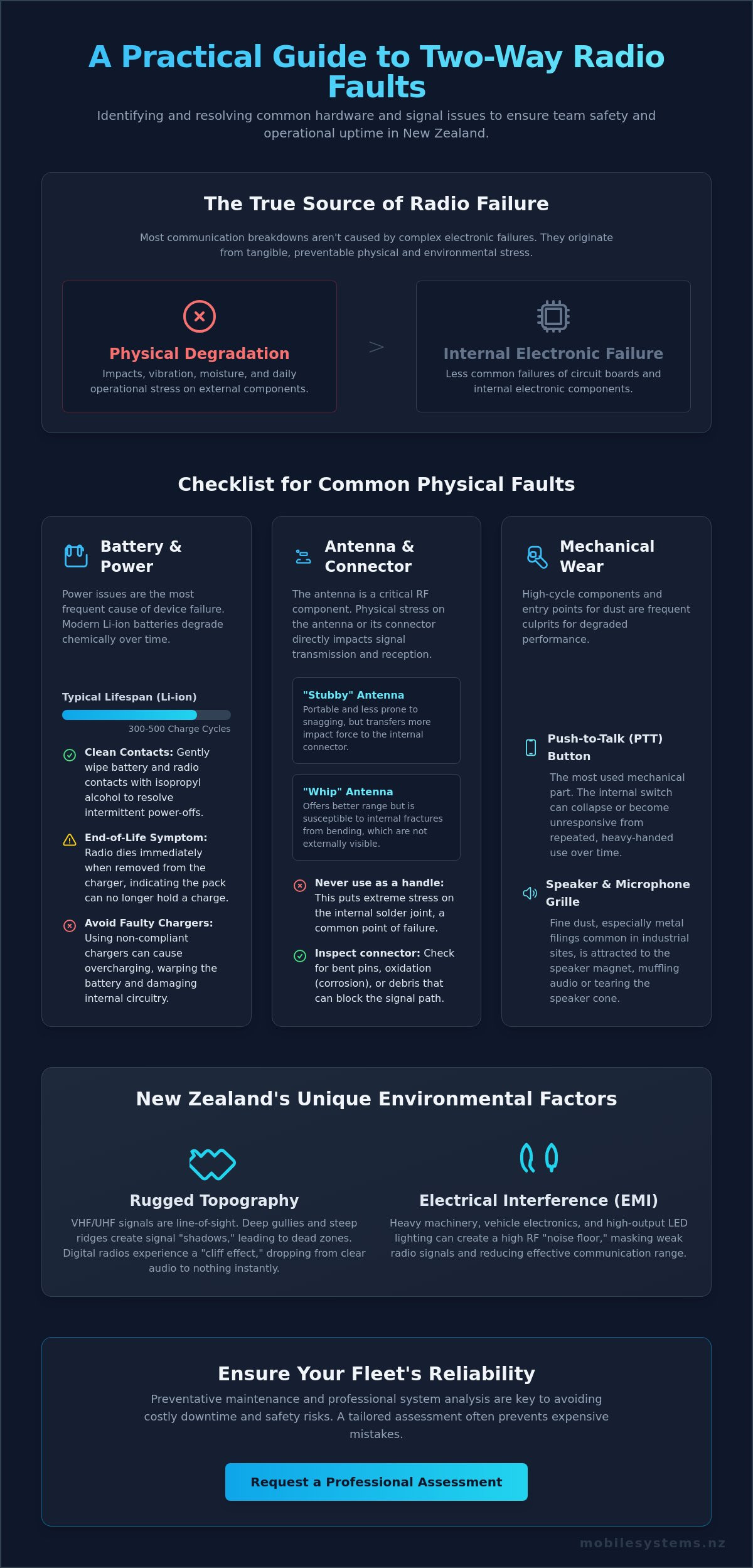
Most common two-way radio faults aren't caused by internal electronic failure but by physical degradation and environmental stress. In remote New Zealand locations, a sudden loss of communication isn't just a nuisance; it's a significant safety risk that halts productivity and compromises team security.
You likely rely on your handheld or vehicle-mounted radios to keep your team safe and efficient. It's frustrating when intermittent signals or poor audio quality disrupt your operations, especially when you're working in challenging terrain where cellular coverage is non-existent.
This guide will help you quickly identify whether the issue lies with the individual device or the wider system. We'll examine the most frequent hardware failures and explain how to establish a preventative maintenance routine to extend the life of your equipment.
By understanding the mechanics behind these failures, you can troubleshoot common two way radio faults effectively and keep your team connected. A tailored assessment often prevents costly mistakes and ensures your communication infrastructure remains reliable and compliant with local standards.
Key Takeaways
- Learn how to identify battery aging and antenna connector wear that often lead to sudden device failure in high-use vehicle fleets.
- Understand why New Zealand's unique topography and local electrical interference create specific signal challenges for VHF and UHF users.
- Master a systematic workflow to isolate common two way radio faults, distinguishing between individual device issues and broader system installation errors.
- Discover the technical impact of High Voltage Standing Wave Ratio (VSWR) and how professional installation prevents long-term hardware damage.
- Gain a framework for calculating the total cost of ownership to decide when to repair legacy equipment or transition to modern digital systems.
Common Physical Faults in Handheld and Mobile Radios
Physical damage remains the leading cause of communication breakdown in commercial environments. While modern handheld radios are built to high ingress protection (IP) standards, daily operational stress eventually compromises the hardware. Understanding two-way radio technology helps operators realize that even minor exterior wear can signal a critical internal failure.
Common two way radio faults often manifest as intermittent performance before a total failure occurs. In New Zealand's forestry and construction sectors, equipment is frequently exposed to vibration and impact, which accelerates mechanical fatigue in internal components. Identifying these physical issues early prevents total communication loss during critical tasks.
To better understand these physical challenges and their solutions, watch this helpful video:
Battery and Power Supply Failures
Most fleet managers encounter the "memory effect" in older nickel-cadmium packs, where the battery remembers a shorter life cycle if not fully discharged. Modern lithium-ion packs avoid this but suffer from chemical aging. After approximately 300 to 500 charge cycles, internal resistance increases, leading to rapid voltage drops during transmission.
You can often resolve intermittent power-offs by cleaning the battery contacts with a lint-free cloth and isopropyl alcohol. If the radio works in the charger but dies immediately when removed, the pack has likely reached its end-of-life. Using non-compliant or faulty chargers can also lead to overcharging, which permanently warps the battery casing and damages the radio's internal power regulation circuitry.
Antenna and Connector Integrity
The choice between "stubby" and "whip" antennas involves a trade-off between portability and durability. Stubby antennas are less likely to snag on clothing, but their rigid nature can transfer more force to the internal connector during an impact. Conversely, whip antennas offer better range but are prone to internal fractures that aren't visible through the rubber housing.
- Avoid using the antenna as a handle; this places terminal stress on the internal circuit board.
- Inspect the connector pin for bends, oxidation, or debris that blocks the signal path.
- Check for "perished" or cracked rubber which allows moisture to enter the RF path.
The Push-to-Talk (PTT) button is the most cycled mechanical part on any radio. Over time, the tactile switch underneath can collapse or become unresponsive due to heavy-handed use. In industrial sites across New Zealand, metal filings and fine dust often migrate into the speaker grille. Because the speaker contains a magnet, it attracts these particles, eventually muffling the audio or tearing the speaker cone entirely. Regular cleaning and a protective carry case can mitigate these common two way radio faults.
Signal, Range, and Audio Quality Issues
Signal degradation often stems from environmental factors rather than hardware failure. In industrial New Zealand settings, heavy machinery and high-output LED lighting systems can generate significant electromagnetic interference. This noise floor masks incoming signals, leading to what many operators mistake for common two way radio faults within the device itself.
New Zealand’s rugged geography presents a unique challenge for VHF and UHF systems. Because these frequencies rely on line-of-sight propagation, deep gullies and steep ridges frequently "kill" the signal. While analog systems might provide a weak, static-filled message in these areas, digital DMR radios experience the "cliff effect." They either provide crystal-clear audio or drop out entirely, often producing a "robotic" sound before the link fails.
Interpreting Poor Reception and Static
Hardware desensitisation occurs when a nearby transmitter or electrical source overloads the radio's receiver, making it less sensitive to distant signals. In NZ coastal regions, salt-air corrosion on antenna connectors significantly reduces gain, which mimics a loss of transmit power. Understanding FCC guidelines on radio services provides a useful baseline for how different frequencies behave and the regulatory limits that affect your range.
Squelch settings act as a gatekeeper for your audio. If the squelch is set too low, the radio will constantly hiss with atmospheric noise. If it's set too high, it may filter out legitimate but weak signals from team members working in remote valleys. Balancing these settings is essential for maintaining a reliable connection without constant background irritation.
Audio Distortion and Background Noise
Blown speakers are a frequent result of operating radios at maximum volume in noisy environments like forestry or heavy transport. Over time, the internal diaphragm loses its elasticity or tears, resulting in a buzzy, distorted output. Using noise-cancelling microphones is a practical solution for these high-noise sectors, as they use dual-microphone technology to phase out ambient sounds.
Microphone gain settings also play a critical role in transmission clarity. Clipping is the distortion that happens when the input signal level is too high for the circuit to handle, causing the peaks of the audio wave to be cut off. This makes the message sound harsh and unreadable to the receiver. If your team consistently reports poor clarity, a professional system assessment can determine if the issue is a simple configuration error or a need for hardware upgrades.
System-Level Faults and Installation Errors
While individual unit failure is common, many persistent issues arise from poor installation or system-level configuration errors. These common two way radio faults often stay hidden until a team member attempts to communicate from a distance or during a high-stakes operational period. Identifying these faults requires looking beyond the handheld device to the entire communication infrastructure.
One of the most critical technical failures in mobile setups is High Voltage Standing Wave Ratio (VSWR). This occurs when the antenna system isn't properly matched to the radio's frequency. Instead of radiating into the air, the power reflects back into the transmitter. This generates excessive heat and eventually destroys the radio's power amplifier, leading to a permanent hardware failure.
Vehicle-Mounted Radio Specifics
Successful integration into a vehicle fleet requires more than just a power connection. Professional installation ensures that vehicle two-way radios are mounted in positions that allow for adequate heat dissipation. Without proper airflow, the unit's internal thermal protection will trigger, reducing transmit power or shutting down the device entirely to prevent a fire risk.
- Engine Whine: Poor grounding to the vehicle chassis often introduces alternator noise into the audio path, creating a high-pitched whine that makes transmissions unreadable.
- Cable Routing: Running antenna cables parallel to high-current vehicle wiring can induce interference and significantly degrade signal quality.
- Voltage Fluctuations: Radios in 24V heavy machinery require high-quality voltage reducers to prevent surges that can fry internal components during engine startup.
Programming and Configuration Conflicts
Even perfectly installed hardware will fail if the software configuration is inconsistent across the fleet. Mismatched Continuous Tone-Coded Squelch System (CTCSS) or Digital Coded Squelch (DCS) tones are frequent culprits. If one unit is programmed with a specific tone and another is not, the receiver's squelch won't open. This results in a "silent" failure where the user believes they're transmitting, but the rest of the team hears nothing.
Frequency drift is another factor, particularly in older analog equipment. Over years of use, internal oscillators can drift slightly off the assigned frequency, leading to distorted audio or total loss of connection. Modern digital fleets must operate on 12.5 kHz narrowband channels to meet industry standards. If a fleet has a mix of narrowband and wideband settings, audio levels will be wildly inconsistent, making it difficult for operators to hear instructions clearly.
Ensuring all devices share the same firmware version is also vital for fleet health. In digital systems, firmware mismatches can cause specific features like GPS tracking or emergency calling to fail intermittently. A professional technical audit can synchronize your fleet's programming and eliminate these avoidable system-level faults.
Professional Troubleshooting and Maintenance Workflow
Effective troubleshooting requires a methodical approach to eliminate variables one by one. Guesswork often leads to unnecessary hardware replacement or prolonged downtime. By following a structured workflow, you can isolate common two way radio faults and determine if the issue is a simple accessory failure or a complex system error.
One of the most efficient diagnostic tools is the "Golden Radio" test. This involves using a known-good unit from your fleet to swap components with the faulty device. If the fault follows the battery, you've identified the source. If the "Golden Radio" fails when connected to a specific vehicle's antenna, the issue lies within that vehicle's cabling or installation rather than the handheld unit.
A 5-Step Diagnostic Process
Following a consistent process ensures no potential failure point is overlooked. This systematic isolation helps maintain fleet reliability in demanding New Zealand industries like forestry and civil construction.
- Step 1: Power and battery verification. Test the battery under load. A pack might show full voltage on a meter but fail when the radio draws current during a transmission.
- Step 2: External accessory isolation. Remote speaker microphones and earpieces are high-wear items. Disconnect all accessories to see if the radio's internal speaker and PTT button function correctly.
- Step 3: Antenna and cable continuity. For vehicle units, inspect the coaxial cable for kinks or moisture ingress. Use a multimeter to check for shorts between the center pin and the connector shield.
- Step 4: Programming and alignment. Verify that the radio hasn't been accidentally switched to an incorrect zone or that the frequency hasn't drifted due to aging internal oscillators.
- Step 5: Environmental review. Assess if new structures or heavy machinery in the immediate area are creating temporary signal blocks or electrical interference.
Preventative Maintenance for NZ Fleets
Establishing a six-monthly health check is vital for commercial operations. New Zealand's salt air and high-vibration environments accelerate the degradation of internal seals and connectors. Maintaining a detailed log of serial numbers and battery commissioning dates allows you to retire aging hardware before it fails during a critical task.
Professional equipment servicing extends the operational life of your hardware by identifying minor issues like perished gaskets or slightly out-of-spec transmitters. If your basic diagnostic steps don't resolve the problem, the device likely requires bench testing using specialized RF service monitors. A tailored technical assessment from Mobile Systems Limited ensures your communication infrastructure remains robust and compliant.
When to Repair vs. Replace Your Radio Fleet
Deciding whether to fix a unit or overhaul the entire fleet depends on the nature of the failure. While some common two way radio faults are easily rectified with a new battery or antenna, persistent issues often point to end-of-life hardware. Business owners must weigh the immediate cost of repair against the long-term reliability of a modern communication system.
Legacy analog systems often carry a higher Total Cost of Ownership than many realize. As components age, frequency drift becomes more frequent and receiver sensitivity drops. If you're constantly sending units for bench testing, the cumulative downtime and service fees quickly exceed the price of a new digital handset. It's often more economical to transition to a platform that offers better diagnostics and stability.
If you're considering new equipment, learn more about We sell, rent, and hire out two-way radios, body cameras, and accessories, including Motorola two-way radios, Hytera two-way radios, ICOM two-way radios, body cameras, and a wide range of radio accessories.
Safety remains the most critical factor in this decision. In remote New Zealand environments, an unreliable radio isn't just a technical glitch; it's a significant liability. Modern DMR or P25 digital systems offer enhanced range, clearer audio, and emergency features that older analog units simply can't provide. These features ensure that your team remains connected when it matters most.
Evaluating Repair Viability
The "50% rule" is a standard industry benchmark used by fleet managers. If a repair quote exceeds half the cost of a new replacement, investing in the newer model is generally the more prudent choice. This calculation should also account for the age of the remaining fleet to ensure consistency across your operations.
- Parts Availability: Sourcing components for discontinued Tait or Motorola models becomes increasingly difficult and expensive as manufacturers shift focus to digital-only support.
- Housing Integrity: Once the physical housing is cracked or the seals perish, the radio's ingress protection is compromised. Repairing internal electronics without replacing the shell is futile in damp or dusty NZ conditions.
- Functional Obsolescence: If your current hardware can't support GPS tracking or lone-worker features required by modern health and safety standards, repair is no longer a viable strategy.
The Mobile Systems Advantage
Mobile Systems Limited provides comprehensive support to help you navigate these transitions without the guesswork. We offer on-site technical assistance across New Zealand to minimize your operational downtime. Our team understands that every environment is different, from high-density urban sites to rugged backcountry stations.
Our team specializes in customized system design. We don't just sell hardware; we analyze your specific location to eliminate "dead spots" and ensure your common two way radio faults are solved at the infrastructure level. This holistic approach prevents you from buying new radios to solve what is actually a repeater or antenna site problem.
A tailored assessment often prevents costly mistakes in fleet management and ensures you invest in the right technology for your specific needs. Contact us today to evaluate your current setup and determine the most cost-effective path forward for your business.
Ensuring Long-Term Fleet Reliability
Maintaining a commercial radio fleet involves more than just reactive repairs. Most common two way radio faults are the result of physical environmental stress or poor installation rather than inherent electronic failure. It's vital to implement a structured maintenance routine and follow the 50% repair rule to ensure your team remains safe and productive.
Mobile Systems Limited understands the unique challenges of operating in New Zealand's rugged landscapes. We provide NZ-wide mobile support and serve as an authorized service center for industry leaders like Tait and Hytera. Our technicians have the specialized tools required to identify complex system-level issues that basic troubleshooting might miss.
A tailored technical assessment is the most effective way to prevent communication downtime and ensure regulatory compliance. To secure your infrastructure, book a professional fleet health check with Mobile Systems today. Investing in reliability now ensures your business stays connected and efficient when it matters most.
Frequently Asked Questions
Why is my two-way radio making a constant beeping sound?
A constant beeping sound typically indicates a low battery, an unprogrammed channel, or a transmit time-out timer (TOT) alert. If the beep occurs during transmission, the radio is likely warning you that you've exceeded the pre-set continuous talk time. Check the battery voltage first, as insufficient power is the most frequent cause of this audible alert.
Can I fix a broken two-way radio antenna with tape?
You cannot fix a broken antenna with tape because the adhesive doesn't restore the electrical continuity of the internal radiating element. Even if the antenna looks physically straight, a fracture in the copper core will cause high VSWR, which can destroy the radio's power amplifier. Replacing the antenna is the only way to prevent permanent hardware damage.
Why can I hear other people but they cannot hear me?
This issue usually suggests a failure in your radio's transmitter circuit or a faulty Push-to-Talk (PTT) switch. Another possibility is a mismatch in CTCSS or DCS tones; your radio is receiving their open signal, but your signal is being filtered out by their squelch settings. This is one of the common two way radio faults that requires a professional bench test to isolate.
How long should a professional two-way radio battery last?
A professional-grade lithium-ion battery typically lasts between 18 and 24 months, or approximately 300 to 500 charge cycles. After this period, chemical aging increases internal resistance, causing the battery to lose its ability to hold a charge under the heavy load of transmission. Tracking the commissioning date on each battery pack helps you manage timely replacements across your fleet.
Why does my radio range decrease in wet or rainy weather?
Radio range decreases in wet weather because water droplets absorb and scatter radio frequency (RF) energy, particularly at higher frequencies. Additionally, moisture ingress into antenna connectors or cables can increase signal loss and change the antenna's impedance. In New Zealand's high-humidity environments, ensuring all external connectors are properly sealed is essential for maintaining range.
Is it worth repairing an old analog radio or should I switch to digital?
Repair is generally viable if the cost is less than 50% of a new unit and parts are still available. However, switching to digital is often the better long-term investment for New Zealand businesses due to superior noise cancellation and increased signal range. Digital systems also provide integrated safety features, such as GPS and lone-worker alerts, which analog hardware doesn't support.
What causes the static or "white noise" on my radio channel?
Static or "white noise" is usually caused by a squelch setting that's too low, allowing background atmospheric noise to pass through the speaker. It can also result from environmental interference from nearby electrical equipment or LED lighting. If the static persists across all locations, the radio's receiver may have desensitized due to internal component wear or a failing antenna.
How do I know if my radio is DMR or analog?
You can identify the technology by checking the model number or observing the audio behavior. Analog radios produce a constant background hiss when the squelch is open, whereas Digital Mobile Radio (DMR) units are silent until a voice signal is detected. DMR signals also sound distinctively robotic when at the edge of their range, unlike the fading static heard on analog systems.
Related posts

- June 27, 2026
Searching "commercial radio suppliers NZ" turns up broadcasting licences before real hardware. Here's how to cut through that, and what's...

- June 17, 2026
Did you know that fines for an expired Road User Charges (RUC) license in New Zealand can exceed $1,000 per...

- June 07, 2026
A single wiring error in a modern vehicle's digital bus system can lead to repair costs of up to NZ$4,500....