
Understanding Fleet Management Reports: A Guide for NZ Businesses
Did you know that fines for an expired Road User Charges (RUC) license in New Zealand can exceed $1,000 per occurrence? For many local business owners, the challenge isn't a lack of data, but the difficulty of understand…
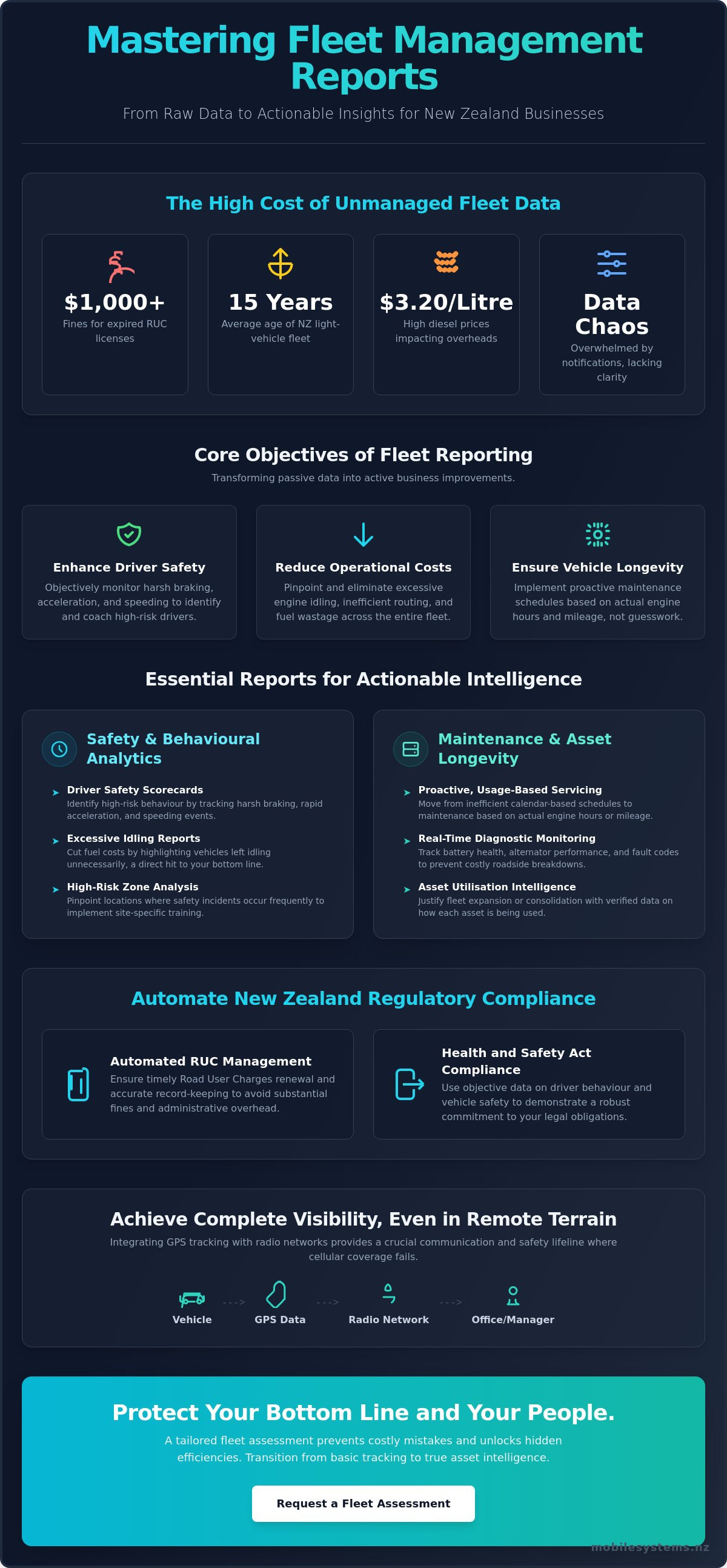
Did you know that fines for an expired Road User Charges (RUC) license in New Zealand can exceed $1,000 per occurrence? For many local business owners, the challenge isn't a lack of data, but the difficulty of understanding fleet management reports amidst a constant stream of telematics notifications.
It's common to feel overwhelmed by information while struggling to justify the cost of tracking systems to company directors. Managing RUC and health and safety requirements manually is no longer sustainable as the average age of the NZ light-vehicle fleet reaches 15 years, necessitating more proactive maintenance oversight.
You'll learn how to interpret complex data sets to improve driver safety and significantly reduce fuel and maintenance overheads. We'll provide a clear framework for reviewing your reports and show you how to automate compliance for New Zealand's specific regulatory environment.
This article covers the transition from basic data collection to diagnostic interpretation. We'll examine practical ways to use your fleet data to make informed decisions that protect your bottom line and your people.
Key Takeaways
- Learn to transition from simple vehicle tracking to a comprehensive asset intelligence system that informs strategic business decisions.
- Discover how monitoring driver behavior and harsh braking can directly lower maintenance costs and improve operational safety.
- Automate Road User Charges (RUC) and meet Health and Safety at Work Act requirements to ensure full regulatory compliance in New Zealand.
- Gain a clear framework for understanding fleet management reports to distinguish between isolated incidents and systemic fleet issues.
- Understand why integrating fleet tracking systems with radio networks is essential for maintaining visibility in remote New Zealand terrain.
What are Fleet Management Reports and Why Do They Matter?
Fleet management reporting is the systematic collection and analysis of telematics data. While basic GPS tracking shows where a vehicle is, reporting explains how that vehicle is being utilized. Fleet management encompasses vehicle financing, maintenance, and driver oversight to ensure operational efficiency across the entire organization.
For New Zealand businesses in the transport and construction sectors, this data is vital. It moves the conversation from simple vehicle tracking to comprehensive asset intelligence. Automated systems bridge the gap between field operations and office management, providing a single source of truth for decision makers who need to verify site arrivals or job durations.
To better understand this concept, watch this helpful video:
The Core Objectives of Fleet Reporting
The primary goal of understanding fleet management reports is to transform passive data into active improvements. These objectives help businesses stay competitive in an environment where diesel prices remain around $3.20 per litre. Key focus areas include:
- Enhancing driver safety through objective monitoring of harsh braking, rapid acceleration, and speeding.
- Reducing operational overheads by identifying excessive engine idling and fuel wastage across the fleet.
- Ensuring vehicle longevity by using proactive maintenance scheduling based on actual engine hours rather than guesses.
From Data Points to Actionable Intelligence
Raw GPS coordinates are of limited use in isolation. Reporting platforms process these points into trip summaries that show start times, durations, and routes taken. This transformation allows managers to identify patterns that aren't visible in real-time tracking, such as inefficient routing that increases wear and tear.
Historical data is essential for identifying long-term operational trends. By reviewing performance over several months, businesses can see if safety initiatives are actually working or if fuel consumption is trending upward. This data-driven approach supports high-trust business decisions, allowing directors to justify investments in new GPS trackers or fleet expansion based on verified utilization rates.
Essential Fleet Report Types for Operational Success
Effective fleet oversight requires filtering out noise to focus on high-impact data. While many telematics platforms offer dozens of automated outputs, understanding fleet management reports involves prioritizing those that directly affect safety, costs, and New Zealand regulatory compliance.
Safety and Behavioural Analytics
A Safety Scorecard provides an objective measurement of driver performance. By monitoring events like harsh braking, rapid acceleration, and speeding, businesses can identify high-risk drivers before an accident occurs. Consistent improvement in these scores often helps when negotiating insurance premiums or demonstrating a commitment to the Health and Safety at Work Act.
Monitoring excessive idling is another critical function. With diesel prices averaging $3.20 per litre as of May 2026, every minute a truck sits idling unnecessarily represents a direct hit to your bottom line. Reporting on high-risk zones where safety incidents frequently occur allows managers to implement site-specific training or route adjustments.
Maintenance and Asset Longevity
Traditional maintenance schedules based on calendar dates are often inefficient. Some vehicles may be over-serviced, while others working double shifts are neglected. Modern fleet tracking systems allow for servicing based on actual engine hours or mileage.
- Tracking battery health and alternator performance prevents unexpected breakdowns in remote areas.
- Monitoring fault codes in real-time allows for predictive repairs, often preventing a minor issue from becoming a major engine failure.
- Extending tracking to non-vehicle assets like trailers or generators ensures these supporting pieces of equipment are also maintained correctly.
Activity and Utilisation Summaries
Geofencing reports are essential for accurate client billing in the construction and service sectors. These reports verify exactly how much time a vehicle spent on a specific site, providing an audit trail that resolves invoice disputes quickly. For tax purposes, trip logs consolidate private versus professional use, ensuring FBT compliance without manual paperwork.
Understanding fleet management reports related to asset activity helps identify ghost assets that cost money without generating revenue. These are vehicles or pieces of equipment that are rarely used but still incur registration, insurance, and interest costs. A utilization report highlights these underused assets, allowing you to sell them or redeploy them to higher-demand areas. If you're unsure which reports provide the most value, a tailored assessment often prevents costly mistakes.
Interpreting Data: Moving from Logs to Actionable Insights
Data collection is only the first step in optimizing a mobile workforce. Interpreting Data effectively requires a shift from reactive monitoring to proactive diagnostics. Businesses often struggle with understanding fleet management reports because they treat every alert with equal weight, leading to information overload.
A single harsh braking incident might be a defensive maneuver to avoid a collision. However, if a vehicle shows consistent harsh braking events every Tuesday on a specific suburban route, it indicates a systemic issue. This could be due to unrealistic scheduling or a driver who needs specific training. Distinguishing between these one-off events and recurring patterns is essential for fair driver management.
Cross-referencing fuel reports with trip logs is a high-impact diagnostic tool. If a fuel card transaction occurs for 80 litres but the GPS log shows the vehicle wasn't at the service station at that time, you've identified potential theft. Similarly, discrepancies between fuel consumed and distance travelled often point to mechanical leakages or poor driving habits that waste resources.
Heat maps provide a visual representation of fleet activity that lists cannot match. They highlight where vehicles spend excessive time idling or where high-stress maneuvers occur most frequently. Optimising routing based on these visual trends reduces unnecessary wear on tires and brakes, extending the lifecycle of your GPS trackers and the vehicles they monitor.
Identifying Diagnostic Patterns
Harsh driving patterns directly correlate with maintenance frequency. A vehicle consistently driven at high speeds or with rapid acceleration will require brake replacements sooner than the fleet average. Red flag patterns include:
- Irregular vehicle usage outside of standard business hours, indicating potential unauthorized private use and FBT implications.
- Excessive stop-time data at specific locations, revealing bottlenecks in delivery or service routes.
- Repeated fault codes that precede major mechanical failures, allowing for predictive repairs.
Setting Realistic Performance Benchmarks
Effective coaching relies on achievable goals. Use fleet-wide averages as a baseline for understanding fleet management reports and setting driver benchmarks. Implementing a "Three-Strike" rule provides a clear framework; the first strike is an informal reminder, the second a formal review, and the third a mandatory training session.
A weekly review cycle is more effective than a monthly one because it keeps feedback immediate and relevant. Sharing these findings with the team fosters transparency. When drivers understand that data is used for fair coaching rather than punishment, they're more likely to support safety initiatives and operational goals.
New Zealand Regulatory Compliance and Reporting
New Zealand businesses face significant administrative burdens from Road User Charges (RUC) and tax obligations. Understanding fleet management reports allows managers to automate these tasks, reducing the risk of human error and expensive fines. Fines for an expired RUC license can exceed $1,000, making real-time monitoring a financial necessity for any commercial operator. For organizations looking to streamline their broader IT infrastructure and technical partnerships, you can check out SpaceCenter Systems.
The regulatory landscape is becoming increasingly digital. By November 1, 2026, the Vehicle Standards Compliance Amendment Rule will introduce changes to Warrant of Fitness (WoF) and Certificate of Fitness (CoF) requirements, including checks for certain Advanced Driver Assistance Systems (ADAS). Maintaining accurate digital records of vehicle health and maintenance is essential for passing these expanded inspections.
Road User Charges (RUC) Management
Transitioning to electronic distance recorders (eRUC) removes the need for manual label changes. These systems provide a digital audit trail for Waka Kotahi, ensuring that your fleet always operates within legal requirements. As of June 2026, the RUC rate for light EVs is $76 per 1,000 km, while a heavy vehicle with two axles between 6,001kg and 9,000kg pays $167 per 1,000 km.
- Reports provide an immutable record of distance travelled for NZTA compliance audits.
- Auto-purchasing of RUC licenses based on real-time odometer data prevents vehicle downtime.
- Electronic systems eliminate the risk of lost paper labels or accidental over-purchasing.
Health and Safety Compliance in NZ
Under the Health and Safety at Work Act (HSWA), directors must demonstrate due diligence regarding worker protection. Reports on driver fatigue, work-time, and rest periods provide the documented proof required to meet these legal standards. Monitoring these metrics helps prevent accidents caused by exhaustion and ensures your business meets its primary duty of care.
For staff operating in remote NZ locations with limited cellular coverage, lone worker alerts are critical. Integrating fleet tracking systems with emergency notification features ensures an immediate response if an incident occurs. This level of oversight is a key component of a modern health and safety strategy.
Fringe Benefit Tax (FBT) reporting is also simplified by clearly distinguishing between private and professional vehicle use. These reports provide a clear audit trail for the IRD, reducing the time spent on manual logbooks. Additionally, accurate GPS data enables businesses to claim fuel excise duty rebates for kilometres driven off-road on farms or construction sites. For assistance with implementing a compliant system, a professional consultation with Mobile Systems often prevents costly mistakes.
Integrating Communication and Tracking for a Complete View
GPS data provides the 'what' and 'where', but in rugged New Zealand terrain, it often fails to provide the 'why'. Relying solely on cellular-based tracking can lead to gaps in visibility when vehicles enter reception black spots. This lack of context makes understanding fleet management reports difficult when data points seem inconsistent or incomplete.
Synergizing fleet tracking systems with UHF/VHF radio networks creates a robust operational framework. This integration ensures that quantitative data from your tracking platform is backed by real-time qualitative context from the field. It allows managers to verify report findings through direct communication, ensuring a more accurate interpretation of driver performance.
Professional installation is the foundation of data reliability. If antennas or GPS units are improperly mounted, the resulting data can be intermittent or inaccurate. High-quality installation ensures that sensors capture every event correctly, providing the high-trust data needed for long-term analysis and regulatory compliance.
Communication as a Data Context Tool
Voice communication acts as a vital diagnostic tool for fleet managers. For example, a report might show a sudden, unexplained route deviation or a prolonged stop. A quick radio call can clarify that the driver encountered a road closure or an unplanned site hazard, preventing an unnecessary disciplinary follow-up based on raw data alone.
In many remote NZ locations, cellular tracking lags or drops out entirely. Using vehicle-mounted two-way radios allows for constant coordination regardless of mobile network availability. This ensures that the office remains informed even when the digital map hasn't updated due to signal limitations.
This immediate feedback loop is essential for understanding fleet management reports during complex projects. When a data anomaly appears, such as an engine fault code or a geofence breach, real-time voice communication allows the driver to provide immediate clarification before the issue escalates into a costly maintenance event or safety violation.
Choosing a Strategic Fleet Partner
Selecting a single provider for both tracking hardware and communication systems simplifies maintenance and support. Having a local NZ partner based in Mount Maunganui ensures that technical assistance is available when hardware requires calibration or repair. This local presence is vital for ensuring that your reporting systems remain accurate and operational year-round.
A tailored assessment often prevents costly mistakes when selecting reporting tools. By evaluating both your data needs and your communication requirements simultaneously, you ensure that your fleet management system is greater than the sum of its parts. Professional guidance from Mobile Systems helps align these technologies with your specific operational environment.
Transforming Fleet Data into Operational Excellence
Mastering the art of understanding fleet management reports is no longer optional for New Zealand businesses aiming to control rising operational costs. By shifting focus from simple vehicle tracking to comprehensive diagnostic interpretation, you can proactively address driver safety and reduce maintenance overheads. This data-driven approach ensures your fleet remains an asset rather than a liability.
Success in the local landscape requires more than just software. It demands reliable hardware and expert installation that withstands New Zealand's unique geography. Mobile Systems provides NZ-based technical support and specialized expertise in both GPS tracking and UHF/VHF radio systems. We're specialists in remote area connectivity solutions that ensure your data remains accurate even in cellular black spots.
A proactive approach to fleet intelligence prevents costly regulatory fines and improves worker safety under the HSWA. You've already invested in the technology; now it's time to maximize its value through better data interpretation. Contact our team for a tailored fleet assessment to ensure your systems are fully optimized for your specific operational needs.
Taking control of your fleet data today builds a safer, more profitable business for tomorrow. We look forward to helping you navigate these technical requirements with confidence.
Frequently Asked Questions
How often should I review my fleet management reports?
You should review high-impact safety alerts, such as harsh braking or speeding, on a weekly basis to ensure immediate coaching. Monthly reviews are more appropriate for identifying long-term trends in fuel efficiency, vehicle utilization, and maintenance costs. This dual approach ensures you're managing both day-to-day risks and strategic operational goals effectively.
Can fleet reports help reduce my insurance premiums in New Zealand?
Yes, many New Zealand insurers view telematics data as evidence of a proactive safety culture. By providing objective reports that demonstrate a consistent reduction in high-risk driving behaviors, you can often negotiate lower premiums. Insurers value the "safety scorecard" as a verified indicator of a lower risk profile compared to fleets without monitoring.
What is the most important metric to track for a small NZ fleet?
Driver behavior is the most critical metric for smaller operators because it directly influences fuel consumption, tire wear, and maintenance frequency. Understanding fleet management reports that highlight speeding and idling allows small business owners to tackle the largest variable costs first. This focus provides the fastest return on investment for tracking hardware.
Do fleet reports work in areas with poor cellular coverage?
Most modern GPS trackers store data internally when they lose cellular signal and upload the backlog once the vehicle returns to a coverage area. For fleets operating in extremely remote NZ terrain, integrating tracking with satellite or radio systems ensures real-time visibility. This redundancy prevents data gaps that could lead to inaccurate compliance reporting.
How do I explain the introduction of driver behaviour reporting to my staff?
Frame the introduction as a safety and support initiative rather than a surveillance tool. Explain that the data helps the company meet its "due diligence" requirements under the Health and Safety at Work Act. Emphasize that objective reporting protects drivers by providing an accurate record of events in the case of an incident involving a third party.
Are electronic RUC reports accepted by NZTA for audits?
Yes, electronic Road User Charges (eRUC) reports from approved providers are fully accepted by Waka Kotahi for compliance audits. These digital systems provide a more accurate and tamper-proof record of distance traveled than traditional hubodometers. Using eRUC significantly simplifies the audit process and reduces the risk of fines for expired licenses.
Can I integrate my existing two-way radio system with new fleet tracking software?
Integration is often possible and provides significant operational advantages. Professional installation by communication specialists allows your radio network to provide real-time context for your tracking data. This synergy ensures that if a report shows a vehicle is off-route, you can use your radio system to immediately clarify the situation with the driver.
What is the difference between a trip log and a utilisation report?
A trip log provides a detailed record of every journey, including start and end times, locations, and distances for FBT and billing purposes. A utilization report analyzes how much time an asset is actually working versus sitting idle. Understanding fleet management reports of both types is essential for identifying underused "ghost assets" that are costing the business money.
Related posts

- June 27, 2026
Searching "commercial radio suppliers NZ" turns up broadcasting licences before real hardware. Here's how to cut through that, and what's...

- June 07, 2026
A single wiring error in a modern vehicle's digital bus system can lead to repair costs of up to NZ$4,500....