
Man Down Alert Systems NZ: A Professional Guide to Lone Worker Safety
If a lone worker falls in a remote corner of the King Country where cellular bars disappear, does your current man down alert system nz actually provide a lifeline? You likely recognize that meeting the strict requiremen…
If a lone worker falls in a remote corner of the King Country where cellular bars disappear, does your current man down alert system nz actually provide a lifeline? You likely recognize that meeting the strict requirements of the Health and Safety at Work Act 2015 is about more than avoiding NZ$3 million in potential corporate fines; it's about the moral obligation to protect your team in high-risk environments.
It's frustrating when safety technology causes more headaches than it solves, especially when false alarms disrupt operations or equipment fails in rural blackspots. You need a solution that works where your team actually works, not just where the signal is strongest. Reliability in the field is the difference between a minor incident and a workplace tragedy.
This professional guide will teach you how to evaluate, implement, and maintain a safety system that ensures legislative compliance and genuine worker protection. We'll explore how to bridge the gap between policy and practice, ensuring your emergency response times are minimized and your lone workers are never truly alone.
Key Takeaways
- Understand how automated G-force sensors and accelerometers detect falls or immobility to provide immediate protection for lone workers in high-risk roles.
- Learn to select the most reliable man down alert system nz providers offer by evaluating radio, cellular, and satellite pathways for remote New Zealand worksites.
- Identify critical hardware specifications, including IP67 ratings and extended battery life, necessary to ensure equipment reliability in harsh local environments.
- Discover how local pre-alerts and customized response protocols minimize false alarms while ensuring emergency contacts receive accurate, actionable data.
- Gain insights into conducting site-specific communication audits to ensure your safety implementation meets New Zealand legislative compliance and operational requirements.
Understanding Man Down Alert Technology in New Zealand
A man down alert system nz is a specialized safety solution designed to protect personnel working in isolation or high-risk environments. Unlike standard communication tools, these systems rely on automated sensors to detect physical distress. If a worker suffers a fall or becomes immobile due to a medical event, the device triggers an emergency protocol without requiring human intervention.
Modern safety hardware utilizes sophisticated components like tri-axial accelerometers and G-force sensors. These sensors monitor the device's orientation and sudden changes in velocity. By analyzing movement patterns, the technology can distinguish between a person tripping and a piece of equipment being set down on a desk. This precision is vital for reducing false alarms while ensuring genuine emergencies receive an immediate response.
Manual SOS buttons serve a purpose, but they're insufficient for many lone worker scenarios. If a worker is knocked unconscious or suffers a sudden cardiac event, they cannot physically press a button. Automatic detection fills this critical gap. It ensures that help is summoned even when the user is completely incapacitated.
The Legal Necessity for Lone Worker Protection
Under the Health and Safety at Work Act (HSWA) 2015, New Zealand businesses must take all "reasonably practicable" steps to ensure worker safety. For remote or isolated staff, this includes providing a reliable means of communication and emergency assistance. Failure to provide adequate monitoring tools can lead to significant legal exposure for a PCBU (Person Conducting a Business or Undertaking).
Liability under NZ law extends to directors and managers, who must exercise due diligence to ensure the organization meets its safety duties. Automated alerts mitigate the risk of delayed emergency discovery, which is often a focal point in WorkSafe New Zealand investigations. Implementing a robust man down alert system nz demonstrates a proactive commitment to managing the specific risks associated with lone work.
Automatic Detection vs. Manual Alarms
The science of impact detection involves complex algorithms that calculate the force and angle of a fall. High-quality devices are calibrated to recognize the specific G-force signature of a human body hitting the ground. This prevents the system from triggering every time a worker jumps off a tailgate or drops their device on a soft surface.
- Non-movement timers: These detect medical events like heart attacks or seizures by monitoring for a total lack of activity over a set period.
- Pre-alert phase: Before an alarm is sent to emergency contacts, the device will vibrate or beep. This allows the user to cancel a false trigger if they've simply been sitting still for too long.
- Angle detection: Sensors can identify when a device remains at a horizontal angle for an extended time, suggesting the wearer is lying down.
Choosing the right hardware requires an understanding of your specific operational environment. A tailored assessment from Mobile Systems Limited often prevents costly mistakes and ensures your team has the most reliable protection available.
How Man Down Systems Work: From Sensor to Response
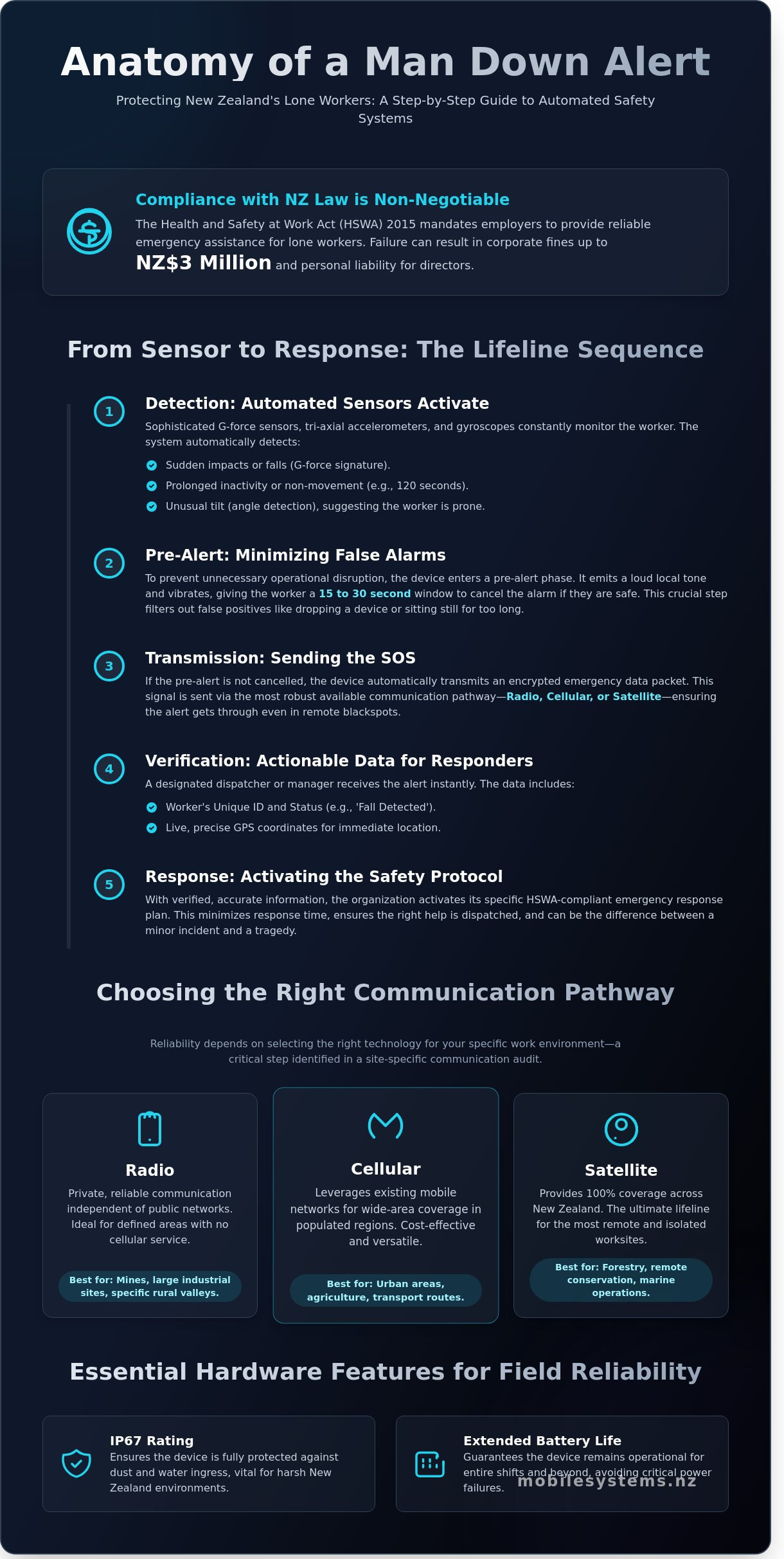
A man down alert system nz functions through a sophisticated chain of events designed to minimize response times during an emergency. It begins with high-sensitivity accelerometers and gyroscopes built into the hardware. These sensors detect specific G-force signatures associated with a fall or the complete lack of movement over a set period, such as 120 seconds.
Once a potential incident is detected, the device enters a pre-alert phase. It emits a loud local tone and vibrates, giving the worker a window of 15 to 30 seconds to cancel the alarm if it's a false positive. If the worker doesn't intervene, the device automatically transmits an emergency signal via the most robust available network.
The process follows a strict protocol to ensure worker safety:
- Detection: Sensors identify a sudden impact, tilt angle change, or prolonged inactivity.
- Warning: A local alert sounds to allow for manual cancellation and reduce false alarms.
- Transmission: The device sends an encrypted data packet containing the user's ID and status.
- Verification: A dispatcher or manager receives the alert with live GPS coordinates.
- Response: The organization activates its specific Health and Safety at Work Act (HSWA) 2015 compliant emergency plan.
The Critical Role of GPS and Location Data
Location accuracy is the most vital component of any man down alert system nz. In the New Zealand high country or dense bush, devices often utilize Global Navigation Satellite Systems (GNSS) to provide sub-five-meter accuracy. Satellite signals are essential for outdoor workers where cellular towers are sparse.
Indoor environments require different technical approaches, such as Bluetooth beacons or Wi-Fi positioning, because satellite signals struggle to penetrate concrete and steel. During a low-bandwidth emergency, location data is compressed into small packets. This ensures coordinates reach the monitoring station even when cellular signal is weak. For teams working in remote areas like the West Coast or Central Otago, this technical reliability is essential for a successful rescue.
Managing the Alert Chain
Choosing how to handle incoming alerts depends on your specific risk profile. Self-managed systems route alerts directly to supervisors or team leads via SMS or email. This is often cost-effective for low-risk roles but relies on the supervisor being constantly available and within range of a signal.
Monitored services provide 24/7 professional response through dedicated centres. These operators follow strict escalation paths and can contact emergency services directly if the worker is unresponsive. While this involves monthly subscription fees, it ensures no alert goes unanswered. A tailored assessment helps determine which monitoring level fits your operational needs and budget without overcomplicating your workflow.
Radio vs. Cellular vs. Satellite: Choosing the Right Pathway
Selecting a man down alert system nz requires a realistic assessment of your team's geographic footprint. New Zealand's topography, from dense urban centers to deep alpine valleys, means a one-size-fits-all approach often leads to dangerous coverage gaps. You've got to match the communication pathway to the specific blackspots your workers encounter daily.
Reliability isn't just about the device features; it's about the infrastructure supporting the signal. A high-tech sensor is useless if the alert can't reach a dispatcher because of terrain interference or network failure. Professional safety planning starts with mapping where your people work and identifying the most resilient pathway for those locations.
Cellular Systems: Best for Urban and Fringe Areas
4G and 5G lone worker pendants are the standard for metropolitan roles. Community health workers and retail staff benefit from the low hardware weight and simple interfaces. These devices are generally the most cost-effective for businesses operating within reliable signal zones.
There's a significant risk to consider: network congestion. During regional emergencies, such as the 2023 North Island weather events, cellular networks can become overwhelmed or fail entirely. If your safety plan relies solely on public towers, your team might be left without a lifeline when they're most vulnerable. These systems work best when backed by a secondary communication protocol.
Radio-Integrated Systems: The Industrial Standard
For construction sites, large warehouses, and local government fleets, Digital Mobile Radio (DMR) remains the professional choice. These systems integrate man down features directly into the handset. When a tilt or no-motion sensor triggers, the alert travels over a private UHF or VHF network rather than a public one.
- Zero ongoing data fees: Radio-based alerts don't require monthly SIM card subscriptions or data plans.
- Instant communication: Handsets provide immediate one-to-many voice calls during a crisis.
- Private infrastructure: These systems operate independently of public cellular networks for guaranteed uptime.
This private coverage ensures that your safety protocols remain functional even if public networks go down. It's a robust solution for sites where workers are concentrated within a specific 10 to 50-kilometer radius. Many industrial leaders prefer this because it places the control of the safety network entirely in the hands of the business.
Satellite Solutions for Remote NZ
Forestry teams and remote agricultural workers often operate in the 25 percent of New Zealand's landmass that lacks any cellular reception. In these isolated environments, Iridium-linked devices are the only viable option for 100 percent coverage. These units link directly to a constellation of low-earth-orbit satellites to transmit location data and alerts.
Integrating satellite messaging with automated SOS protocols ensures that a fall in a remote gully is reported instantly to a 24/7 monitoring center. For a deeper look at specific hardware specifications, refer to the Satellite Phones NZ guide to understand which platform suits your remote risk profile. A tailored assessment often prevents costly mistakes when choosing between these three pathways.
Critical Features for Reliability and Compliance
Selecting a man down alert system nz requires looking beyond basic functionality. Hardware must withstand the rigours of New Zealand's diverse industrial environments. If a device fails because of a dead battery or a sudden downpour, the safety net disappears entirely. Battery life is the most common failure point in lone worker protection. A device must comfortably exceed a standard 12-hour shift to account for overtime or long travel times. If a worker in the Waikato forestry sector is delayed, the safety link shouldn't fail before they return to base. IP ratings define how well hardware survives the elements. We recommend IP67 or higher for NZ conditions. This ensures the device survives a heavy downpour on a West Coast farm or a fall into a shallow stream. Dust ingress protection is equally vital for construction sites where fine particles can ruin internal circuitry. TILT and no-motion sensors require precision. Sensors must distinguish between a worker crouching to fix a fence and a genuine fall. User-configurable settings allow teams to adjust sensitivity based on specific tasks. This customisation prevents the system from becoming a nuisance during active duties. Two-way voice communication provides a critical link during an emergency. High-quality systems allow a dispatcher to talk directly to the fallen worker. This provides reassurance and allows for accurate triage before emergency services are dispatched. It's the difference between sending a first aid kit and an ambulance.False Alarm Mitigation Strategies
Constant false alarms cause staff to turn devices off or ignore alerts. Effective systems include a pre-alarm countdown. This gives the wearer 15 to 30 seconds to cancel the alert via a button press if they simply dropped the unit or moved suddenly. Audible chirps and haptic vibrations provide immediate feedback to the wearer. They'll know exactly when a sequence has started without needing to look at the device. Staff training remains the most effective tool. When workers understand how the sensors trigger, they're 40% less likely to cause accidental activations.Durability and Form Factor
The physical design should match the daily environment of the worker. Pendants work well for office-based lone workers, but field staff often require ruggedized handheld radios with integrated man-down features. These units offer better grip and larger buttons for use with gloves. For fuel depots or chemical plants, Intrinsically Safe (IS) hardware is mandatory. These devices are engineered to prevent any spark that could ignite volatile vapours. Using non-IS gear in these zones is a significant breach of NZ safety standards and puts the entire site at risk. A tailored assessment often prevents costly mistakes when choosing hardware. Contact Mobile Systems for a professional review of your lone worker safety requirements.Implementing a Man Down Solution with Mobile Systems
Implementing a man down alert system nz requires more than just purchasing hardware. It starts with a site-specific communication audit. In New Zealand, complex topography means 70% of rural work sites encounter "black spots" where standard cellular signals fail. Mobile Systems analyzes your specific terrain and local infrastructure to ensure 100% coverage before any equipment is deployed.
Alert protocols must be customized to your organizational structure. A generic alarm is ineffective if no one is assigned to respond. We configure your system to define who gets called, the order of escalation, and the method of delivery, whether it's voice, SMS, or data. This ensures a rescue response is initiated within 120 seconds of a triggered incident.
Integration with existing fleet tracking systems adds a layer of operational intelligence. When a man down alarm triggers, dispatchers see the worker's exact coordinates alongside their vehicle's status. This unified view reduces confusion during high-stress emergencies and speeds up the arrival of help.
Mission-critical safety hardware requires ongoing support. We provide scheduled maintenance and firmware updates to ensure your devices comply with the Health and Safety at Work Act 2015. Regular testing prevents hardware failure when it's needed most, keeping your team safe and your business compliant.
Tailored System Design
Mobile Systems bridges the gap between sophisticated hardware and your existing infrastructure. For example, a forestry crew in the Bay of Plenty utilized integrated Tait radio alerts to solve the problem of zero cellular coverage. By linking their GPS trackers to a private radio network, they achieved instant notifications across 5,000 hectares of dense bush. This tailored approach ensures visibility where consumer-grade devices typically fail.
Your Next Steps for Workplace Safety
Effective lone worker protection begins with a thorough risk assessment of specific roles. Identify where workers are most isolated and what environmental hazards they face daily. Once risks are mapped, book a technical consultation to test signal coverage at your actual work sites. Testing in real-world conditions is the only way to guarantee reliability. Contact the Mobile Systems team for a tailored safety assessment to build a robust protection plan for your staff.
Meta Description: Learn how to implement a man down alert system in NZ. Mobile Systems provides tailored lone worker safety solutions, site audits, and integrated GPS tracking.
URL Handle: man-down-alert-nz-implementation
URL Handle: man-down-alert-nz-implementation
Securing Your Workforce With Reliable Communication Technology
Effective lone worker protection requires more than a standalone device. It demands a robust network that functions where your team actually operates. Choosing the right pathway between cellular, satellite, or radio depends on your specific New Zealand terrain and local coverage requirements.
Implementing a professional man down alert system nz ensures your business meets Health and Safety at Work Act 2015 obligations while providing staff with a genuine lifeline. Reliability comes from selecting hardware with precision tilt and non-movement sensors that integrate seamlessly into your emergency response protocols.
Mobile Systems Limited has specialized in remote area communication since 1998. As an authorized Tait and Hytera partner, we maintain a nationwide fleet of mobile support vehicles to provide on-site technical assistance. A tailored assessment prevents costly coverage gaps and ensures your safety infrastructure remains compliant.
Request a professional safety communication audit for your NZ worksite
Taking the first step toward a managed safety solution protects your most valuable assets and provides lasting peace of mind for your entire organization.
Frequently Asked Questions
What is the difference between a fall detector and a man down alarm?
A fall detector uses high-G sensors to identify a sudden impact, while a man down alarm monitors the device's orientation or lack of movement. If a worker collapses without a heavy impact, the man down sensor triggers after the unit remains horizontal for a set period, usually 30 to 60 seconds. Both features are often combined in a high-quality man down alert system nz to cover different accident scenarios.
This dual-sensor approach ensures that both high-impact falls and medical events like fainting or heart attacks are captured. While a fall detector might miss a slow collapse, the man down timer will catch it once the tilt threshold is exceeded. This redundancy is critical for lone workers in high-risk environments.
Do man down alert systems work in areas with no mobile phone coverage?
Yes, specialized systems operate using satellite networks like Iridium or through private digital radio infrastructure. In New Zealand, approximately 25 percent of the landmass lacks reliable cellular reception, making satellite-linked devices essential for forestry and high-country farming. These units bypass the mobile network to transmit GPS coordinates directly to emergency dispatchers or site managers.
Using a satellite-based man down alert system nz provides a consistent safety net where standard smartphones fail. These devices are built for the rugged terrain of the Southern Alps or the remote bush of the North Island. They ensure that a distress signal reaches help regardless of local infrastructure limitations.
How much does a professional man down alert system cost in NZ?
The total investment typically consists of an initial hardware purchase and an ongoing monthly service fee for monitoring and connectivity. While costs depend on the specific technology used, such as cellular versus satellite, businesses should budget for the device itself and recurring data costs. Professional systems are designed to meet New Zealand's rigorous safety standards rather than competing on price alone.
A tailored assessment often prevents costly mistakes by ensuring the hardware matches the specific environment of the worker. Choosing the wrong network can lead to expensive equipment replacements later. It's better to invest in a system that offers 100 percent coverage from the start.
Can I integrate man down alerts into my existing two-way radio fleet?
Most modern digital two-way radios can be programmed with man down and lone worker functions. This integration allows your existing communication hardware to double as a safety device, sending an emergency ID to the base station if a radio tilts past a certain angle. It's a cost-effective way to enhance safety without requiring staff to carry multiple pieces of equipment.
Mobile Systems Limited can configure these settings on compatible DMR or P25 radios to ensure they meet your site's safety protocols. This setup is particularly effective for large industrial sites or ports where radio coverage is already established. It simplifies the user experience by keeping all tools on one belt clip.
What happens if a worker accidentally triggers the man down alarm?
Accidental activations are managed through a pre-alarm warning period that gives the user time to cancel the alert. When the device detects a potential incident, it emits a loud local beep or vibration for 15 to 30 seconds. If the worker is fine, they simply press a button or return the device to an upright position to stop the emergency signal from being sent.
This "amber alert" phase is vital for preventing false alarms and "alarm fatigue" among monitoring teams. Only if the worker fails to respond to the local warning does the system escalate the alert to the emergency contact list. This process ensures that every live alarm is treated with the highest priority.
Are man down devices waterproof enough for NZ outdoor work?
Professional-grade devices carry an IP67 or IP68 rating, meaning they're fully protected against dust and can withstand immersion in water. This level of durability is necessary for New Zealand's unpredictable weather and demanding industries like civil construction or agriculture. A device with an IP67 rating can typically survive being submerged in one meter of water for up to 30 minutes.
When selecting hardware, we recommend checking the specific Ingress Protection (IP) rating to ensure it matches your work conditions. For workers in extreme environments, like those wading through streams or working in heavy rain, an IP68 rating provides the highest level of confidence. These units are built to survive drops on concrete and extreme temperature shifts.
Is a man down system a legal requirement in New Zealand?
The Health and Safety at Work Act 2015 doesn't explicitly name "man down systems," but it requires PCBUs to manage risks for lone workers. Section 30 of the Act mandates that businesses eliminate or minimize risks to health and safety so far as is reasonably practicable. Implementing a man down alert system nz is a recognized method for meeting these legal obligations.
Failure to provide a reliable means of communication for a lone worker can lead to significant penalties under the HSW Act. A professional system provides the documented "effective means of communication" that WorkSafe NZ looks for during site audits. It demonstrates that the business has taken proactive steps to protect its most vulnerable staff.
Related posts

- April 12, 2026
A consumer-grade camera system is often a liability disguised as a bargain for New Zealand enterprises. While DIY kits promise...

- April 10, 2026
What if the solution to worker isolation in New Zealand's remote forests lies in a comprehensive communication strategy? Reliable communication...