
Security Cameras for NZ Businesses: The 2026 Professional Buying Guide
A consumer-grade camera system is often a liability disguised as a bargain for New Zealand enterprises. While DIY kits promise easy setup, they frequently fail to provide actionable evidence during a 2:00 AM rainstorm.
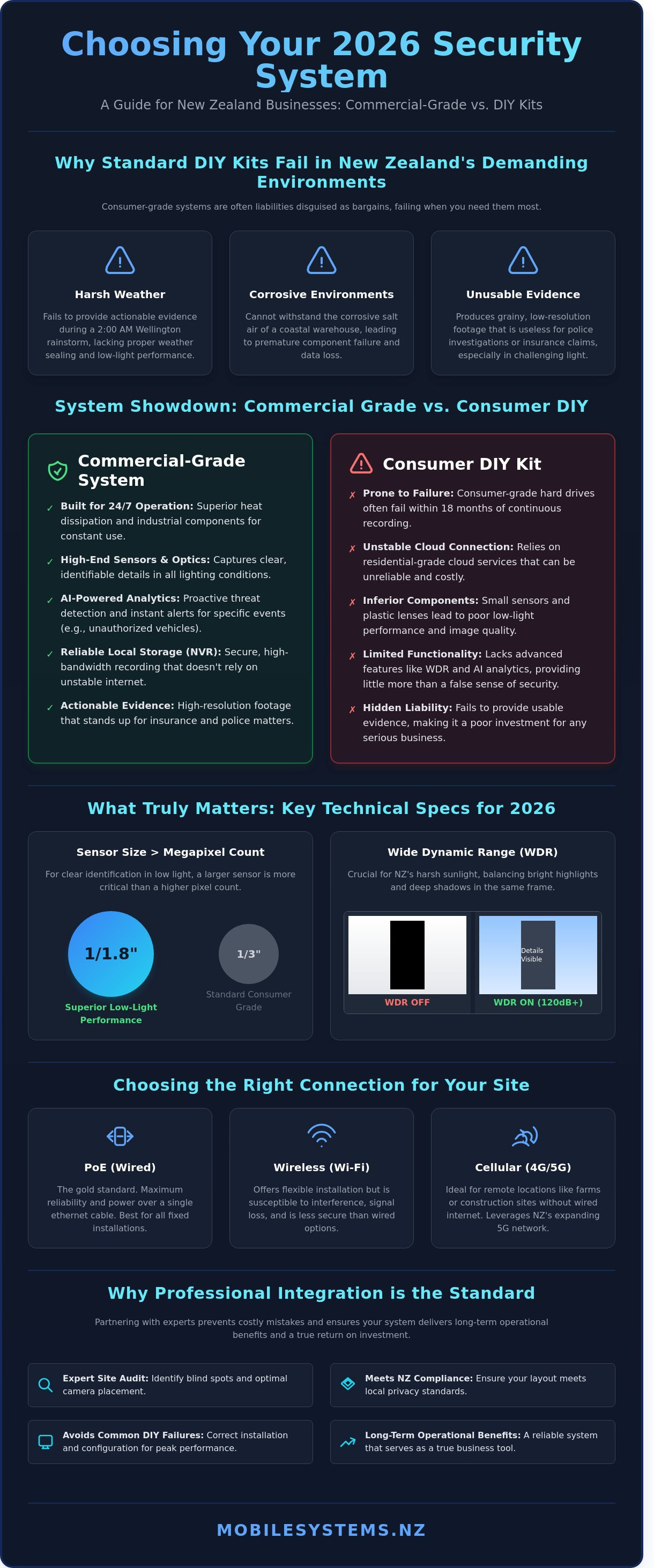
A consumer-grade camera system is often a liability disguised as a bargain for New Zealand enterprises. While DIY kits promise easy setup, they frequently fail to provide actionable evidence during a 2:00 AM rainstorm in Wellington or withstand the corrosive salt air of a coastal warehouse. Investing in professional security cameras requires looking beyond the box price to ensure your system actually performs when a critical incident occurs.
You likely know that grainy, black-and-white footage isn't helpful for insurance claims or police investigations. With New Zealand retail crime reports increasing 20% in recent periods, you need a system that offers clarity, reliability, and the ability to manage multiple sites without constant technical glitches. This 2026 guide gives you the technical specifications and local insights needed to build a robust surveillance network tailored for New Zealand's demanding conditions and strict privacy laws.
We'll break down the essential hardware requirements for the coming year, explain how to integrate your cameras with existing communication tools, and show you how to ensure your data storage remains secure and compliant. A tailored assessment often prevents costly mistakes before you commit to a long-term installation.
Key Takeaways
- Understand the critical differences between consumer-grade retail kits and commercial hardware designed for New Zealand’s unique business environments.
- Learn why sensor size is more important than megapixel count when selecting high-performance security cameras to ensure clear identification in low-light conditions.
- Evaluate the reliability of PoE, wireless, and cellular-linked infrastructure to determine the best connectivity model for your specific site or remote location.
- Discover how to conduct a professional site security audit to identify blind spots and ensure your surveillance layout meets local compliance standards.
- Identify the common failure points of DIY installations and the long-term operational benefits of partnering with professional systems integrators.
Navigating the Security Camera Landscape in New Zealand (2026)
New Zealand business owners face a sophisticated threat landscape that requires more than basic hardware. In 2026, the distinction between commercial-grade Closed-circuit television (CCTV) and consumer-grade retail kits is wider than ever. While big-box retail kits offer a "set and forget" appeal, they often fail under the rigorous demands of a professional environment. Commercial security cameras are designed for 24/7 operation, featuring superior heat dissipation and high-end sensors that outperform home-office alternatives. Retail systems typically rely on unstable cloud connections and consumer-grade hard drives that wear out within 18 months of constant writing. Choosing professional hardware ensures your evidence is available when a critical incident occurs at your site. To better understand the technical differences in modern hardware, watch this helpful video:
The 2026 market has shifted toward AI-driven analytics and edge storage. Instead of sending every minute of footage to a central server, modern cameras process data locally. This reduces bandwidth strain on NZ business networks and allows for instant alerts when specific triggers, like unauthorized vehicle entry, are detected.
The Evolution of Surveillance Technology
Surveillance has transitioned from simple recording to proactive threat detection. Modern systems don't just record a theft; they identify suspicious behavior patterns before a crime is committed. This shift is supported by the expansion of 5G across New Zealand, which provides the low-latency connection required for high-resolution remote monitoring in real-time. While many buyers focus on 4K or 8K resolution, it's only one part of the equation. Low-light performance, dynamic range, and frame rates are equally vital for capturing identifiable faces or license plates in the varied weather conditions found in regions like Canterbury or Southland.
Surveillance as a Business Tool
Modern security cameras serve as multi-functional business tools. Beyond asset protection, they provide operational oversight by monitoring health and safety compliance and workflow bottlenecks. For logistics and transport firms, integration with fleet tracking systems can provide comprehensive oversight of vehicles and goods.
Key Technical Specifications for Commercial Surveillance
Commercial hardware choices determine whether footage serves as usable evidence or a liability. High-performance components ensure that systems capture critical details regardless of environmental challenges. Investing in professional-grade hardware reduces the total cost of ownership by extending the equipment's lifespan beyond the typical 24-month failure rate of consumer products.
Resolution and Low-Light Performance
4K (8MP) resolution is the current benchmark for evidence-grade footage. It provides 3840 x 2160 pixels, allowing for clear identification of faces and license plates at greater distances. However, pixel count is secondary to sensor size. A larger 1/1.8-inch sensor captures more light than a standard 1/3-inch sensor, which is vital for clear imaging during New Zealand’s long winter nights.
Wide Dynamic Range (WDR) is another essential feature for local conditions. NZ’s high UV levels and harsh sunlight often create deep shadows and bright highlights in the same frame. A camera with 120dB WDR or higher balances these extremes, ensuring that a person entering a bright doorway isn't rendered as a dark silhouette. For large industrial sites, optical clarity remains superior to digital zoom, as it maintains pixel density when magnifying distant objects.
Storage Solutions: Local vs. Cloud
Network Video Recorders (NVRs) provide reliable, high-bandwidth recording without the monthly subscription fees associated with cloud-only systems. This local approach is often necessary for NZ businesses in areas where fiber or 4G connectivity is inconsistent. Local storage allows for 24/7 high-bitrate recording that won't saturate the site's internet connection.
- Redundancy: Professional NVRs use RAID configurations to protect data if a hard drive fails.
- Edge Storage: Many systems include SD card slots in the camera itself to record during network outages.
- Hybrid Models: Combining local NVRs with off-site cloud backups ensures footage exists even if the physical recorder is stolen or damaged.
A tailored assessment often prevents costly mistakes in storage architecture. Business owners can browse commercial-grade security cameras to understand the hardware options available for various storage configurations.
Industrial Build Quality and IP Ratings
Environmental protection is a primary concern for New Zealand infrastructure. IP66 and IP67 ratings define how well a camera resists dust and water. An IP67 rating means the unit is completely dust-tight and can withstand immersion in water up to one meter deep. This level of protection is standard for external installations in high-rainfall regions like Westland or Auckland.
Coastal sites, such as those in Mount Maunganui or Napier, require specific salt-air corrosion resistance. Standard metal housings can pit and degrade within 18 months in salt-heavy environments. Additionally, high-risk public areas require IK10 vandal-proof ratings. This ensures the housing can withstand a 20-joule impact, which is equivalent to a 5kg weight dropped from 40cm, protecting the internal security cameras from deliberate damage.
Wired vs. Wireless vs. Cellular: Selecting the Right Infrastructure
Choosing the right backbone for your surveillance system is as critical as the camera resolution itself. Most New Zealand commercial properties rely on three primary connection types: hardwired, wireless, or cellular. Each has specific trade-offs regarding reliability, installation speed, and long-term maintenance.
Infrastructure determines the total uptime of your security cameras. For businesses operating in large industrial sheds in areas like Penrose or Hornby, the physical environment often dictates the technology. Corrugated iron and steel framing act as Faraday cages, which frequently block or degrade Wi-Fi signals. This makes wireless systems unreliable for critical entry points or high-value inventory zones.
Power supply stability is another vital factor. A system is only as good as its weakest link; if a local power point trips, a standalone wireless camera without a backup fails instantly. Professional installations prioritize centralized power management to ensure the system remains active during localized electrical faults or deliberate tampering.
The Reliability of Power over Ethernet (PoE)
PoE systems remain the gold standard for business-critical security. This technology uses a single Cat6 cable to carry both high-speed data and electrical power to the device. It simplifies installation by removing the need for a registered electrician to install new 230V power outlets at every camera location.
- Centralized Power: Connecting all cables to a central PoE switch allows you to use a single Uninterruptible Power Supply (UPS). This keeps the entire network running during a power outage.
- Data Integrity: Wired connections aren't affected by radio frequency interference or thick concrete walls, ensuring a consistent frame rate for evidence.
- Simplified Maintenance: Technical staff can reboot cameras remotely by cycling power at the switch level, reducing the need for ladder work or site visits.
Cellular and Solar for Remote NZ Sites
Fixed-line internet isn't always an option for New Zealand's primary industries. Forestry operations, rural substations, and civil construction projects require high-definition monitoring in areas where traditional infrastructure is non-existent. Integrating cellular devices allows these sites to transmit real-time alerts over 4G or 5G networks.
Solar-powered security cameras provide autonomy for these remote locations. However, placement in New Zealand requires careful planning due to our southern latitudes. To ensure the batteries charge sufficiently during the shorter days of June and July, solar panels should be installed facing North at an angle between 30 and 45 degrees.
A tailored assessment often prevents costly mistakes in these environments. Using industrial-grade cellular routers ensures the connection remains stable even in fringe coverage areas. This approach provides a level of site visibility that was previously impossible for seasonal or mobile work sites across the country.
Planning Your Security Layout: From Site Assessment to Compliance
A successful installation begins with a thorough site audit. You can't simply mount security cameras and hope for the best. A professional assessment identifies high-value targets like cash handling areas or server rooms while accounting for environmental factors like glare and shadows.
Follow these steps to conduct an effective audit:
- Identify all entry and exit points, including loading docks and staff entrances.
- Map out high-traffic zones where inventory is stored or processed.
- Evaluate existing lighting levels to determine if infrared or low-light sensors are required.
- Check for physical obstructions like shelving or trees that create blind spots.
Managing user permissions is equally critical. Modern systems allow you to restrict access based on roles. For example, a floor manager might see live feeds, while only the business owner can export archived footage. This minimizes the risk of internal data breaches.
New Zealand Privacy Act and Compliance
Operating security cameras in New Zealand requires strict adherence to the Privacy Act 2020. You must display clear signage at every entrance to notify visitors and staff that recording is in progress. This isn't just a courtesy; it's a legal requirement to ensure transparency.
Businesses must balance security needs with employee privacy rights. Cameras shouldn't be placed in areas where people have a high expectation of privacy, such as staff break rooms or changing areas. Data retention policies should also be defined. Most NZ businesses find that 30 days of footage meets local regulatory standards without overstepping privacy boundaries.
Strategic Camera Placement
Focus your primary coverage on vehicle and pedestrian traffic at the perimeter. Capturing clear license plates or facial features at the gate provides the best evidence for police reports. Internal coverage should complement this by tracking movement through hallways and storage bays.
For large perimeters, PTZ (Pan-Tilt-Zoom) cameras offer significant advantages. A single PTZ unit can cover the same area as four fixed cameras by patrolling a set path. This reduces hardware costs while maintaining high-resolution oversight of expansive areas like car lots or construction sites.
A tailored assessment often prevents costly mistakes and ensures your system meets New Zealand's specific legal standards. For expert guidance on your layout, contact the Mobile Systems team today.
Why Professional Integration is the Standard for NZ Businesses
NZ businesses often find that consumer-grade hardware fails to meet the rigors of commercial use. While a DIY kit might seem like a budget-friendly option, these systems often lack the durability required for 24/7 operation in New Zealand's varied climate. Common failure points include insufficient storage capacity for high-definition evidence and poor infrared performance that leaves yards vulnerable at night.
Professional integration ensures your security cameras aren't just isolated gadgets. They become part of a cohesive strategy that addresses specific site risks. A professional installer evaluates network bandwidth to prevent your surveillance from slowing down office operations. They also ensure compliance with the NZ Privacy Act 2020, which is a critical legal consideration for any business recording public or staff areas.
A professionally designed system closes the gap between basic surveillance and total site awareness. Instead of just recording an incident for later review, integrated systems provide real-time data that can improve operational efficiency. This proactive approach helps business owners monitor health and safety compliance and manage site access without being physically present.
The Mobile Systems Advantage
Mobile Systems brings decades of experience to the design of surveillance systems for rugged New Zealand industries. We understand that a warehouse in Auckland has different needs than a remote forestry block in the central North Island. Our expertise lies in creating interconnected environments. This includes the seamless integration of surveillance with two-way radio systems, allowing for automated voice alerts when a perimeter is breached.
We maintain a fleet of specialized mobile service vehicles to provide on-site technical support. This means you don't have to wait for a remote technician or ship hardware back for repairs. Our team arrives on-site to calibrate sensors, clean lenses, and update firmware, ensuring your system remains operational when it matters most. We focus on providing hardware that survives the dust, vibration, and moisture common in NZ industrial settings.
Taking the Next Step
Choosing the wrong hardware can lead to costly mistakes, often requiring a complete system replacement within two years. A tailored assessment prevents this by matching the technology to your property's unique topography and lighting. We analyze everything from mounting heights to focal lengths to ensure every security cameras installation provides clear, actionable data. This precision prevents the "dead zones" that criminals often exploit.
The design process starts with a conversation about your operational goals. Whether you need to reduce shrinkage in a retail space or monitor health and safety on a construction site, we build the system around your requirements. To secure your premises with a professional, integrated solution, contact the expert team today for a comprehensive consultation.
Securing Your Business Assets for 2026 and Beyond
Selecting the right security cameras for a New Zealand commercial site requires balancing high-definition technical specifications with robust infrastructure. Whether your operation needs wired reliability or cellular flexibility for remote industrial sites, your hardware must comply with the Privacy Act 2020 to protect both your assets and your team's privacy.
Effective surveillance isn't just about buying hardware; it's about professional integration. Mobile Systems Limited provides nationwide mobile servicing and industrial-grade expertise to ensure your system remains operational in the harshest Kiwi environments. Industrial-grade hardware ensures longevity in coastal or high-dust environments common across New Zealand. We specialize in ruggedized communication and understand the specific safety regulations that NZ business owners must navigate to stay compliant.
A well-planned security layout prevents expensive retrofitting costs and provides long-term peace of mind. A tailored assessment often prevents costly mistakes. We're ready to help you design a system that scales with your business needs. Professional installation ensures your investment is protected from the start.
View our range of professional surveillance cameras
Frequently Asked Questions
Do I need a permit to install security cameras on my NZ business premises?
You don't need a building permit to install security cameras on your private business premises in New Zealand. However, your system must comply with the Privacy Act 2020. This legislation requires you to display clear signage notifying staff and customers they're being recorded.
If your cameras capture public spaces like footpaths or neighboring properties, you must ensure the recording is necessary for security. Businesses that fail to provide adequate notice or misuse footage can face complaints through the Office of the Privacy Commissioner.
Can I view my security camera footage on my phone while away from the site?
You can view live and recorded footage from your security cameras on a smartphone or tablet using dedicated manufacturer apps. Modern IP systems connect to your local network, allowing encrypted remote access from any location with a stable internet connection.
Mobile Systems Limited configures these secure gateways to ensure your data remains private while providing 24/7 visibility of your site. This remote capability allows you to verify alarms in real time, potentially saving costs on unnecessary security guard call-outs.
What happens to my security cameras if the power or internet goes out?
If the power fails, your cameras will stop functioning unless you've installed an Uninterruptible Power Supply (UPS). A standard 1500VA UPS can often provide 30 to 60 minutes of backup power for a small camera system. This keeps the recording active during short outages or intentional tampering.
If only the internet connection fails, your security cameras will continue to record to the local Network Video Recorder (NVR). You won't be able to view the live feed on your phone during the outage, but the footage will be safely stored on the hard drive for later review.
How long should a business keep security camera footage in New Zealand?
New Zealand law doesn't specify a fixed number of days, but the Privacy Act 2020 states you shouldn't keep footage longer than necessary for its intended purpose. Most New Zealand businesses adopt a 30 day retention cycle. This timeframe provides enough room to identify and export footage of an incident before the system overwrites the data.
For high-risk environments like jewelry stores or pharmacies, extending storage to 60 or 90 days is common. Mobile Systems Limited can calculate the hard drive capacity required to meet your specific retention needs based on your camera resolution and frame rates.
Is there a difference between CCTV and modern IP security cameras?
The main difference lies in how video is transmitted and the resulting image quality. Traditional CCTV uses analog signals sent over coaxial cables, which often limits resolution to 720p or lower. Modern IP security cameras convert video into digital data packets sent over an Ethernet network.
IP systems offer 4K resolution and advanced analytics like facial recognition or heat mapping. They're also easier to scale, as you can add cameras to your existing network infrastructure without running individual cables back to a central recorder for every single device.
How often do commercial security cameras require professional servicing?
Commercial security cameras should receive professional servicing at least once every 12 months. In high-dust environments or coastal areas, a 6 month service interval is recommended to prevent salt buildup. Regular maintenance involves cleaning lenses, checking cable integrity, and updating firmware to patch security vulnerabilities.
A proactive service schedule reduces the risk of system failure during a critical security event. It's common for unmaintained cameras to suffer from 20 percent degraded image quality per year due to environmental buildup on the glass housing.
Can security cameras be integrated with my existing fleet management system?
You can integrate high-end security cameras with existing fleet management systems to create a unified oversight platform. Mobile Systems Limited specializes in bridging these technologies, allowing business owners to monitor both fixed assets and mobile units from a single interface.
This integration provides a complete picture of operational security and helps streamline incident investigations. For example, you can sync warehouse footage with GPS data to verify exactly when a vehicle arrived and what was loaded onto it, reducing transit-related losses.
Which security camera brands are best suited for New Zealand’s coastal climate?
Brands like Hikvision and Dahua offer specialized anti-corrosion series specifically designed for New Zealand's salty coastal air. You should look for cameras with an IP67 or IP68 weatherproofing rating and IK10 vandal resistance. These ratings ensure the internal components stay dry in heavy rain.
Using 316-grade stainless steel housings or specialized polymer coatings prevents salt spray from degrading the hardware. Standard aluminum cameras can show signs of significant corrosion in as little as 24 months when installed within 500 meters of the high-tide mark.
Related posts

- May 30, 2026
Could your business withstand a $3 million fine for a health and safety oversight? Under the Health and Safety at...

- May 28, 2026
In 2024, New Zealand recorded 70 work-related fatalities, a statistic that underscores the critical importance of protecting staff in isolated...

- May 25, 2026
In a 2025 survey of the New Zealand road freight industry, 62% of respondents cited rising business costs and economic...