
Achieving Peace of Mind for Remote Worker Safety in NZ (2026)
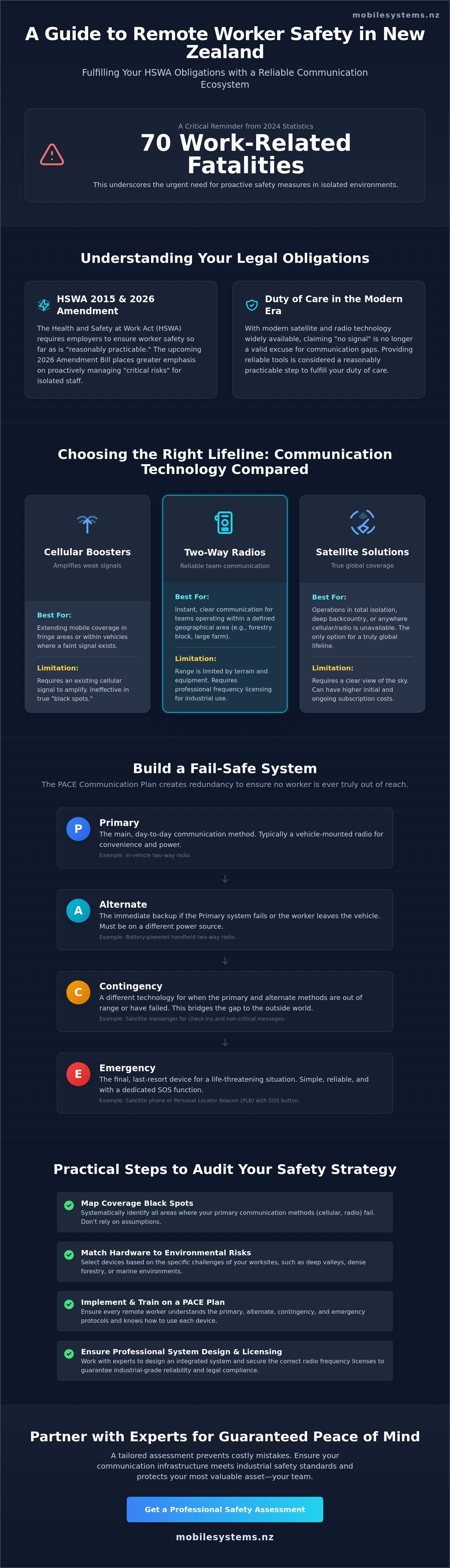
In 2024, New Zealand recorded 70 work-related fatalities, a statistic that underscores the critical importance of protecting staff in isolated environments. For business owners, achieving genuine peace of mind for remote worker safety involves more than just meeting basic compliance.
In 2024, New Zealand recorded 70 work-related fatalities, a statistic that underscores the critical importance of protecting staff in isolated environments. For business owners, achieving genuine peace of mind for remote worker safety involves more than just meeting basic compliance. It requires a proactive approach to managing the "critical risks" highlighted in the February 2026 Health and Safety at Work Amendment Bill.
You likely recognize that New Zealand's diverse terrain makes reliable communication difficult, and the fear of a missed emergency signal is a significant professional burden. We'll show you how to build a fail-safe communication ecosystem that protects your team and fulfills your legal obligations under the HSWA 2015.
This article explores the specific roles of satellite messengers, handheld radios, and vehicle-mounted systems in creating a dependable lifeline. We provide a clear framework for selecting the right technology to reduce organizational anxiety and ensure every worker remains connected, regardless of their location.
Key Takeaways
- Understand how the Health and Safety at Work Amendment Bill 2026 shifts legal requirements toward proactive management of critical risks for isolated staff.
- Learn to evaluate the technical differences between cellular boosters and satellite phones to ensure reliable connectivity across diverse New Zealand terrains.
- Discover how a "PACE" communication plan provides genuine peace of mind for remote worker safety by establishing primary, alternate, contingency, and emergency protocols.
- Identify practical steps for auditing your current safety strategy, including mapping coverage black spots and matching hardware to specific environmental risks.
- Recognize the importance of professional system design and frequency licensing to ensure your communication infrastructure meets industrial safety standards.
What Does Peace of Mind for Remote Worker Safety Actually Mean?
In a professional context, peace of mind isn't a vague feeling of comfort. It's the technical certainty that a two-way communication link exists between a worker and their base, regardless of the environment. In New Zealand, the dangers of working alone are amplified by rugged topography and vast areas without cellular reception. Relying on "hope" that a staff member stays within range isn't a safety strategy; it's a significant operational risk. Achieving true peace of mind for remote worker safety requires moving past assumptions and implementing systems that function where consumer devices fail.
To better understand the practical application of these safety concepts, watch this helpful video:
The cost of a communication failure extends far beyond the immediate physical danger to an employee. A single missed emergency signal can lead to severe legal penalties, long-term damage to business reputation, and a total collapse of staff morale. When a worker enters a "black spot" without a secondary communication method, the employer has effectively lost their ability to fulfill their duty of care.
The Legal Framework: HSWA 2015 and Your Obligations
The Health and Safety at Work Act 2015 (HSWA) requires every PCBU to ensure the safety of workers so far as is "reasonably practicable." With the introduction of the Health and Safety at Work Amendment Bill in February 2026, regulators have placed even greater emphasis on managing critical risks for isolated staff. In the current technological landscape, claiming "no signal" is no longer an acceptable excuse for a lack of communication. If satellite or radio technology is available to bridge a coverage gap, implementing it's often considered a reasonably practicable step. Employers must provide reliable tools, such as two-way radios or satellite messengers, to maintain a constant safety link.
The Psychological Impact on Management and Staff
Robust communication systems don't just protect the person in the field; they protect the mental well-being of the entire team. Operations managers and dispatchers carry significant stress when they can't verify a lone worker's status. Knowing that a worker has a reliable lifeline, such as a satellite phone with a dedicated SOS button, reduces administrative anxiety and allows for more efficient fleet management. For the staff member, the presence of high-quality hardware provides the confidence to focus on their task without the underlying fear of isolation. True peace of mind for remote worker safety is the technical elimination of communication black holes.
Comparing Communication Technologies for True Reliability
Selecting the right hardware is essential for meeting your legal obligations for remote worker safety. New Zealand's topography often creates dead zones where standard consumer mobile phones are useless. To achieve true peace of mind for remote worker safety, you must match the technology to the specific environmental challenges of your work site.
Cellular boosters are an effective solution for fringe-area operations. These devices, typically vehicle-mounted, amplify weak signals to maintain a stable data and voice link. While they extend the reach of standard networks, they still rely on terrestrial towers. For teams operating in total isolation, such as deep backcountry or steep valleys, satellite or radio systems become mandatory.
Satellite Solutions: When Cellular Fails
Satellite technology provides the only truly global coverage. Professional systems using the Iridium network offer a significant advantage over cheaper alternatives because they utilize a constellation of 66 cross-linked satellites. This ensures a connection even in deep ravines where a single-satellite system might fail. With New Zealand having the highest number of satellite connections per person in the OECD, the move toward this technology is a proven trend for rural safety.
For peace of mind for remote worker safety, two-way messaging is far superior to one-way emergency beacons. It allows a worker to receive confirmation that help is on the way, which is vital for managing psychological stress during a crisis. Professional handheld satellite phones typically include integrated SOS buttons and GPS tracking to facilitate a rapid recovery.
Two-Way Radio Systems: The Backbone of Industrial Safety
In sectors like forestry and civil engineering, two-way radios remain the gold standard for team coordination. The primary benefit is the push-to-talk function, which allows for instantaneous communication without the latency common in satellite networks. This immediacy is critical when coordinating heavy machinery or responding to sudden site hazards where every second matters.
Modern Digital Mobile Radio (DMR) systems include advanced safety features like Man Down and Lone Worker alerts. These triggers automatically notify the dispatcher if a handset remains horizontal for a set period or if the user fails to acknowledge a periodic check-in. These features turn a standard communication tool into an automated safety monitor. A tailored assessment often prevents costly mistakes when balancing your operational budget against these technical requirements.
Building Redundancy into Your Remote Safety Infrastructure
A single device represents a single point of failure. If a handheld radio battery dies or a satellite phone is left in a vehicle cabin during an accident, the safety chain breaks instantly. Professional system design relies on the PACE protocol to establish multiple layers of communication. This methodology ensures that if the primary method fails, a secondary or tertiary option is immediately available to the worker.
Integrating a PACE plan (Primary, Alternate, Contingency, and Emergency) into your operations is a critical component of risk management. This structured approach to remote worker safety and business insurance requirements transforms a fragile setup into a resilient ecosystem. By layering different technologies, you ensure that environmental factors like heavy canopy or terrain shadows don't result in a total communication blackout.
Vehicle-Mounted vs. Handheld Redundancy
Vehicles equipped with high-gain antennas and mounted two-way radios act as powerful communication hubs. These systems provide significantly better range and signal penetration than portable units. However, workers are often most vulnerable when they step away from the vehicle to perform tasks. A handheld backup is not optional; it's a necessity for maintaining a continuous lifeline when the worker is on foot.
Adding fleet tracking systems further strengthens this safety net. These systems provide automated location data to dispatchers, ensuring that the last known position of a vehicle is always recorded. This data is invaluable during a search and rescue operation, particularly in New Zealand's dense backcountry where visual spotting from the air is difficult. Mobile Systems prioritizes these multi-layered installations to ensure no worker is left without a way to signal for help.
Automated Welfare Checks and Monitoring
Manual check-in procedures are often the first thing to fail during a busy shift. Moving toward automated welfare checks, such as "dead-man" timers or lone worker prompts on digital radios, removes the risk of human error. If a worker fails to acknowledge a periodic signal, an alarm is automatically raised at the base station or monitoring centre. This level of automation provides genuine peace of mind for remote worker safety by removing the burden of constant manual reporting.
Redundancy in monitoring is just as important as redundancy in hardware. Professional 24/7 monitoring centres can filter out technical noise and low-battery alerts, ensuring that real emergencies receive an immediate response. When you combine high-gain vehicle systems, handheld backups, and automated monitoring, you turn a possible emergency signal into a guaranteed one. Regular equipment servicing and battery health audits ensure these systems remain operational when they are needed most.
How to Audit Your Current Remote Safety Strategy
A theoretical safety plan often fails when confronted with New Zealand's geographic realities. Auditing your strategy is the only way to verify that the redundancy layers discussed previously will function during a crisis. This process moves beyond basic compliance to provide genuine peace of mind for remote worker safety by identifying hidden vulnerabilities in your communication chain.
To conduct a thorough audit, follow these five essential steps:
- Step 1: Map your "black spots" using real-world field data rather than relying solely on theoretical coverage maps.
- Step 2: Match your hardware to specific environmental risks, ensuring devices can penetrate heavy bush or operate in sub-zero alpine conditions.
- Step 3: Test emergency protocols under simulated failure conditions, such as assuming the primary satellite link is unavailable.
- Step 4: Review staff training records and equipment adoption rates to ensure gear isn't just present but is being used correctly.
- Step 5: Partner with a technical expert to perform a professional signal strength survey and frequency coordination.
Identifying Communication Black Spots
Dead zones aren't static. In New Zealand, seasonal changes significantly impact signal reliability. Heavy snow loads in the Southern Alps or dense spring foliage in the central North Island can degrade signal penetration for both radio and satellite systems. Mapping these areas requires more than a mobile phone; it involves logging successful and failed connection points during routine field operations.
A professional RF (Radio Frequency) site survey provides a scientific basis for your safety plan. These surveys identify how terrain shadows and atmospheric conditions affect your specific frequency. Relying on consumer-grade coverage maps often leads to a false sense of security, which is a common mistake that increases organizational risk. A professional signal strength assessment identifies these gaps before they become critical failures.
Staff Training: The Human Element of Safety
The most advanced handheld radios are useless if a staff member can't operate them under duress. Every team member must know how to trigger an SOS signal on every device in the fleet. This includes understanding radio etiquette to keep channels clear for emergency traffic and knowing how to troubleshoot basic antenna connections in the field.
Resistance to "being tracked" is a common hurdle in safety gear adoption. You can overcome this by framing GPS trackers and fleet monitoring as a safety lifeline rather than a surveillance tool. When staff understand that these systems are there to facilitate a rapid rescue, adoption rates increase, which directly contributes to peace of mind for remote worker safety across the entire organization.
Strategic Safety Partnerships with Mobile Systems Limited
Achieving peace of mind for remote worker safety requires more than just purchasing hardware. It demands a partnership with a provider that understands New Zealand's unique industrial and geographic challenges. Mobile Systems Limited brings decades of experience in the NZ backcountry to every project, ensuring your communication infrastructure is built for the specific terrain your team faces every day.
Local expertise is vital when managing technical requirements like frequency licensing and radio network design. We don't just supply equipment; we provide a comprehensive service from initial system design to professional installation. A tailored assessment prevents costly mistakes in safety procurement by ensuring you don't over-invest in unnecessary features or under-equip for critical risks. Our focus remains on functional communication that meets the high bar set by the HSWA 2015.
Custom Design and Installation Expertise
Off-the-shelf communication solutions often fail in the Southern Alps or the dense bush of the central North Island. These environments require high-gain antennas and robust vehicle-mounted two-way radios that are tuned for peak performance. Our mobile support vehicles allow us to provide on-site servicing and installation, ensuring your fleet remains operational regardless of your location.
Whether you're operating in forestry, civil engineering, or rural services, our team designs systems that account for signal shadows and topography. We understand how to integrate cellular boosters with satellite backups to create the redundancy layers discussed in previous sections. You can contact us for a site-specific safety audit to identify exactly where your current infrastructure needs reinforcement.
Ongoing Support and System Maintenance
Safety gear is only reliable if it's maintained correctly. Regular firmware updates for handheld satellite devices and routine hardware checks for handheld radios are essential for long-term reliability. We're committed to keeping your team connected as technology evolves. Our technicians provide the technical support necessary to ensure your fleet tracking systems and GPS units are always communicating with your monitoring hub.
Choosing a local partner means you have access to technical expertise when you need it most. We focus on procedural clarity to ensure your staff have a dependable lifeline in any emergency. To secure true peace of mind for remote worker safety, we recommend you consult with an expert to review your communication ecosystem and ensure your legal obligations are fully met.
Securing Your Remote Operations for the Future
Securing remote operations in New Zealand requires a technical shift from relying on isolated devices to implementing integrated communication networks. You've seen how the PACE protocol and automated welfare checks move your safety strategy beyond simple compliance with the 2026 Health and Safety at Work amendments. Proactive risk management is the only way to bridge the gap between theoretical coverage and real-world reliability.
Effective safety management depends on hardware that survives the Southern Alps and the technical expertise to maintain it. As authorized Tait and Iridium partners, we specialize in the seamless integration of UHF/VHF radio and satellite technology. Our NZ-wide mobile support vehicles ensure your fleet receives professional on-site servicing regardless of your operational location. This hands-on approach ensures your equipment stays functional in the most demanding environments.
Achieving true peace of mind for remote worker safety involves a commitment to regular technical audits and professional signal surveys. A proactive review of your current communication ecosystem prevents critical failures before they occur. We invite you to request a tailored remote worker safety assessment from our experts to ensure your team remains protected in every environment. Taking this step today builds a resilient foundation for your organization's future.
Frequently Asked Questions
Is a satellite phone better than a UHF radio for remote safety?
Neither technology is universally superior as they serve different technical roles. Satellite phones provide global coverage for total isolation, while UHF radios offer instantaneous communication and zero airtime costs for on-site team coordination. Choosing the right tool depends on your specific operational range and the terrain of your work site.
Does the Health and Safety at Work Act require me to have GPS tracking?
The HSWA 2015 doesn't explicitly mandate GPS tracking, but it requires employers to provide a "reasonably practicable" system for managing risks. Given the 2026 regulatory focus on critical risks, providing location-aware devices is often the most effective way to meet your duty of care. GPS tracking ensures a rapid response if a worker is unable to call for help manually.
What happens if my remote worker enters a cellular black spot?
If your worker enters a cellular black spot without a secondary communication device, you've lost your ability to monitor their welfare. To maintain peace of mind for remote worker safety, you must implement a PACE plan that includes satellite or radio backups. These systems ensure that communication remains active even when terrestrial mobile networks fail.
How often should I service my remote communication equipment?
You should perform a full technical audit of your communication hardware at least once every 12 months. This service includes battery health assessments, antenna signal checks, and firmware updates for satellite devices. Annual maintenance ensures that emergency triggers like "Man Down" alerts function correctly when they're needed most.
Can I use a standard mobile phone app for lone worker safety?
Standard apps are often insufficient for professional use in New Zealand because they rely entirely on cellular coverage. While they work well in urban settings, they fail in the coverage gaps common in our backcountry. For true reliability, hardware-based solutions like satellite messengers or digital radios are superior because they don't depend on consumer mobile networks.
What is the most cost-effective way to protect a small remote team?
The most cost-effective approach usually involves a hybrid system of UHF radios for local team communication and a single satellite messenger for emergency reach-back. This setup minimizes monthly subscription fees while providing a reliable emergency lifeline. A tailored assessment helps you balance initial hardware costs against long-term operational expenses.
Do I need a license for professional two-way radios in New Zealand?
Yes, most professional UHF and VHF radios require a license from Radio Spectrum Management (RSM). While some "citizen band" (CB) frequencies are free to use, they're often crowded and unsuitable for critical industrial safety. We assist clients with frequency coordination and licensing to ensure their private channels remain clear of interference.
How can I ensure my staff actually carry their safety devices?
Improving adoption rates requires integrating safety gear into daily workflows rather than treating it as an extra burden. Providing lightweight, wearable handhelds and training staff on how these tools provide peace of mind for remote worker safety helps frame the technology as a personal benefit. When workers understand the device is their primary lifeline, adoption increases significantly.
Related posts

- June 19, 2026
Fall detection, no-motion sensors, and GPS - here's exactly how a man down alarm knows something's wrong, and how the...

- May 30, 2026
Could your business withstand a $3 million fine for a health and safety oversight? Under the Health and Safety at...