
Duty of Care for Remote Workers in NZ: A 2026 Employer’s Guide
Could your business withstand a $3 million fine for a health and safety oversight? Under the Health and Safety at Work Act 2015, your duty of care for remote workers nz is just as stringent as it is for those in a physical office.
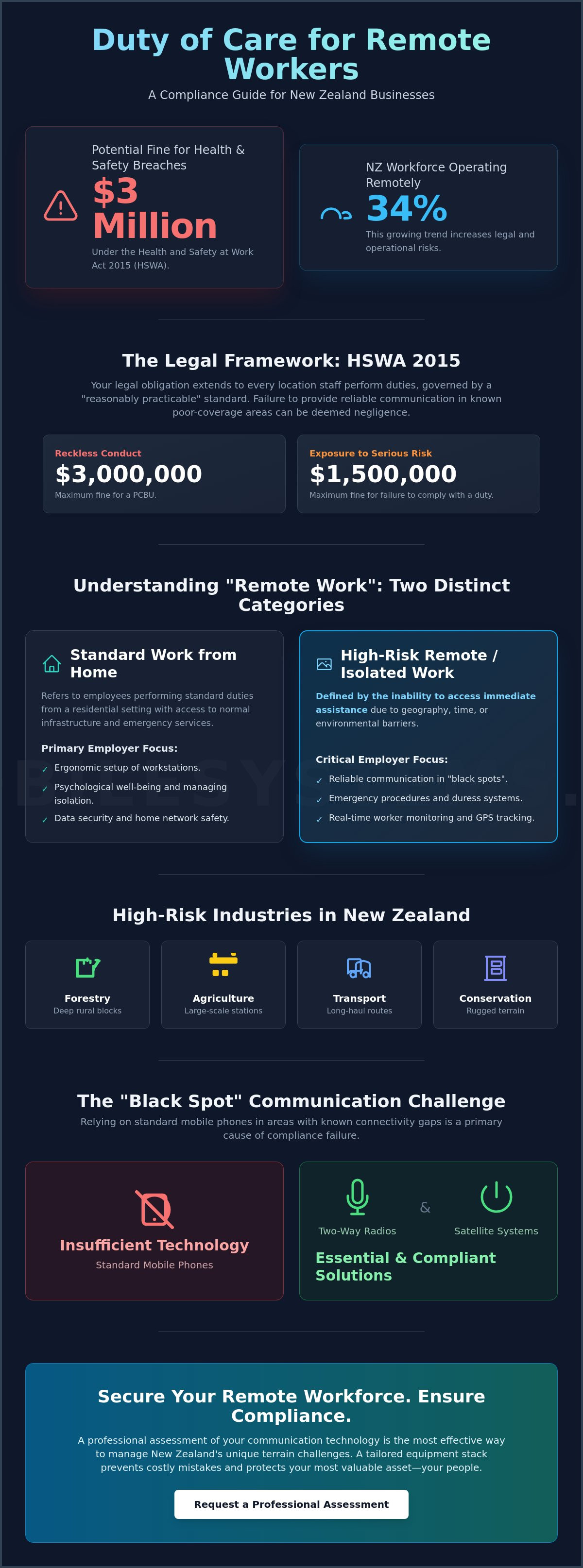
Could your business withstand a $3 million fine for a health and safety oversight? Under the Health and Safety at Work Act 2015, your duty of care for remote workers nz is just as stringent as it is for those in a physical office. With 34% of New Zealanders working remotely as of June 2025, the legal and operational risks of non-compliance are significant.
It's often difficult to maintain oversight when team members operate in cellular "black spots" or private residences. Many business owners feel the pressure of WorkSafe penalties while struggling to define exactly where their responsibility ends in a remote or isolated setting.
This 2026 guide provides a clear framework for meeting your legal obligations under current New Zealand legislation. We'll outline a practical equipment list for remote safety and explain how robust monitoring systems reduce liability. You'll gain the technical knowledge required to keep your isolated staff safe and your business compliant.
Key Takeaways
- Identify the specific legal requirements under the Health and Safety at Work Act 2015 to ensure your business remains compliant.
- Distinguish between standard home-based work and the high-risk environmental factors found in remote or isolated field operations.
- Evaluate the technical differences between UHF/VHF radios and satellite systems to fulfill your duty of care for remote workers nz.
- Learn how to integrate fleet tracking and GPS systems into a structured monitoring policy for real-time employee safety.
- Discover why professional installation and custom-designed communication stacks are essential for managing New Zealand's unique terrain challenges.
Defining Duty of Care for Remote Workers in New Zealand
In New Zealand, the legal concept of 'duty of care' is codified within the Health and Safety at Work Act 2015 (HSWA). This legislation dictates that a Person Conducting a Business or Undertaking (PCBU) must ensure the health and safety of its workers so far as is reasonably practicable. This obligation doesn't end at the office door; it extends to every location where your staff perform their duties.
Fulfilling your duty of care for remote workers nz requires a comprehensive understanding of how your team operates in the field. WorkSafe New Zealand actively enforces these standards, and the consequences of non-compliance are severe. For a PCBU, reckless conduct can lead to fines of up to $3 million, while failures that expose individuals to serious risk can result in penalties of $1.5 million.
To better understand this concept, watch this helpful video:
The Health and Safety at Work Act 2015 (HSWA) Framework
The "reasonably practicable" standard is the benchmark for remote worker protection. It requires employers to weigh the likelihood of a hazard against the cost and effectiveness of available safeguards. In a remote context, this often centers on the ability to communicate during an emergency.
A common failure for many PCBUs is assuming that a standard mobile phone is sufficient for all environments. If a worker is sent into an area with known connectivity gaps, relying on cellular service may be deemed a failure to provide a safe system of work. Legal precedents suggest that if a reliable communication tool exists, such as a satellite phone or a vehicle-mounted radio, the employer is expected to provide it.
Effective management also involves addressing mental health and isolation. Since 34% of employed New Zealanders did at least some work from home in 2025, the scope of the duty of care for remote workers nz has expanded to include psychological well-being and ergonomic safety in residential settings.
What Qualifies as 'Remote or Isolated' Work?
It's vital to distinguish between a "work from home" employee and one performing "remote or isolated work." Isolation is defined by the inability to access immediate assistance from emergency services or colleagues. This can be due to geographical distance, the time of day, or environmental barriers.
Several New Zealand industries are naturally high-risk under these definitions:
- Forestry and silviculture operations in deep rural blocks.
- Agricultural and farming activities on large-scale stations.
- Transport and logistics drivers on long-haul routes.
- Conservation workers in national parks and rugged terrain.
The "Black Spot" challenge is a primary concern for these sectors. When cellular networks fail, the employer's ability to monitor safety is severed. In these instances, implementing two-way radio systems or satellite-based tracking becomes a functional necessity rather than an optional upgrade. A tailored assessment often prevents costly mistakes in hardware selection.
Identifying Risks and Compliance Obligations for NZ Employers
Managing your duty of care for remote workers nz requires moving beyond generic office checklists. While home-based staff face ergonomic challenges, field-based remote workers encounter high-stakes environmental hazards. A May 2026 report revealed a concerning drop in workplace safety perception, with only 63.4% of workers agreeing that safety is taken seriously. This 4.7% decrease from 2025 highlights a growing gap between corporate policy and field reality.
Compliance isn't just about identifying hazards; it's about documenting the mitigation. Employers remain liable for the maintenance of safety equipment and the adequacy of staff training. If a worker can't operate their emergency device during a crisis, the PCBU may be found negligent. This is why the EMA on Duty of Care Complexities emphasizes that responsibilities don't stop at the point of purchase. You must maintain a verifiable audit trail of safety checks and regular check-ins.
Physical vs. Environmental Risk Factors
New Zealand's terrain is notoriously volatile. For workers in forestry, transport, or conservation, the "Lone Worker" scenario is a primary risk. A standard mobile phone often fails to meet compliance standards in these environments due to cellular "black spots." When a worker lacks a distress signal or reliable two-way communication, the risk of a minor injury becoming a fatality increases significantly.
Terrain and weather volatility require hardware that can withstand extreme conditions. Relying on consumer-grade electronics is a common mistake that leaves businesses exposed to WorkSafe penalties. Implementing GPS tracking solutions ensures that even if a worker is incapacitated, their location is visible to the operations center. A tailored assessment often prevents costly mistakes when selecting these critical tools.
Mental Health and Wellbeing Obligations
The duty of care also covers psychological health. Long-term isolation can lead to fatigue and reduced situational awareness. The 2025 survey of public servants found that while many enjoy the flexibility of remote work, the lack of social connection remains a risk factor. Only 38.1% of workers in 2026 believe their health and well-being are taken seriously by their employers, a 6.2% drop from the previous year.
To satisfy WorkSafe guidelines, check-in protocols must be proactive rather than reactive. This means establishing scheduled intervals for communication via radio or satellite. These interactions serve two purposes: they verify physical safety and maintain a professional connection to the wider team. Consistent monitoring reduces the likelihood of employee absence, which rose to 6.7 days per worker in 2024. Clear, reliable communication infrastructure is the foundation of these wellbeing strategies.
Critical Communication Tools for Remote Safety Compliance
Fulfilling your duty of care for remote workers nz requires infrastructure that functions where public cellular networks fail. In many New Zealand field operations, the primary risk is the inability to coordinate during an emergency. Relying solely on mobile phones is a common compliance error. When coverage drops, your safety check-in policy effectively ceases to exist, leaving the PCBU liable for any subsequent incidents.
Selecting the correct hardware depends on your team's specific environment. UHF and VHF radio systems provide the gold standard for site-specific coordination, offering instant, one-to-many communication without the latency of a cellular call. For staff operating in true off-grid locations, satellite technology ensures a signal is always available, regardless of terrain or distance from the nearest tower.
Cellular boosters offer a middle ground for mobile teams. These devices extend the reach of existing networks, allowing workers to maintain contact in fringe areas where signal strength would otherwise be insufficient for reliable voice or data transmission. A tailored assessment often prevents costly mistakes when choosing between these technologies.
Two-Way Radios for Team Coordination
Professional-grade handheld radios are essential for instant communication in construction, forestry, and logistics. Unlike mobile phones, these units allow for group-wide alerts, ensuring every team member is informed of a hazard simultaneously. This capability is critical for meeting the "reasonably practicable" safety standards required by WorkSafe NZ.
Brands like Tait and Hytera provide ruggedized systems designed for New Zealand's harsh conditions. These units are built to withstand moisture, dust, and physical impact, ensuring they remain operational when they are needed most. For a deeper technical analysis of these options, refer to The Ultimate Guide to Two-Way Radio Systems. Using specialized equipment demonstrates a proactive approach to worker safety.
Satellite Solutions for High-Risk Isolation
When workers venture beyond the reach of terrestrial networks, satellite phones become a non-negotiable requirement. Systems utilizing the Iridium or Inmarsat constellations provide global coverage, allowing for voice calls and text messaging from any location in New Zealand. This technology is the ultimate fail-safe for remote duty of care.
Modern satellite devices often include dedicated emergency SOS features. These buttons connect the user directly to international rescue coordination centers, providing precise GPS coordinates even if the worker is incapacitated. This level of monitoring is vital for high-risk isolation scenarios where immediate assistance is not otherwise available. Integrating these tools into your safety stack reduces liability and provides peace of mind for both employers and staff.
Implementing a Robust Remote Worker Monitoring System
A monitoring system serves as the operational link between safety hardware and fulfilling your duty of care for remote workers nz. It transforms passive equipment into an active safety net by establishing clear procedural loops. Without a structured monitoring plan, the presence of safety tools alone may not satisfy WorkSafe requirements in the event of an audit or incident.
Automated features like "Man-Down" alerts provide a critical fail-safe for high-risk field operations. These sensors detect impacts or prolonged inactivity, triggering an emergency signal even if the worker is unable to manually call for help. This technology is essential for New Zealand's forestry and agricultural sectors, where remote accidents often involve physical trauma or medical events that cause incapacitation.
Training staff on equipment use is a fundamental duty that businesses often overlook. Sophisticated monitoring tools only provide value if the user can operate them effectively under high-stress conditions. Regular drills and system tests ensure that both the field worker and the office team are prepared for a rapid response. A tailored safety assessment often prevents costly mistakes during the rollout of these monitoring protocols.
GPS Fleet Tracking as a Safety Tool
Modern fleet tracking systems allow for real-time location awareness that is central to worker safety. In New Zealand's vast rural landscapes, knowing the exact coordinates of a vehicle allows for a targeted emergency response. This data reduces search times significantly when every minute counts for medical outcomes.
Geofencing software can alert supervisors the moment a worker enters a high-risk zone or leaves a designated safe area. While balancing staff privacy is important, the legal mandate for monitoring in hazardous environments is clear. Transparent communication regarding the use of portable GPS communications helps staff understand that these tools are focused strictly on safety and compliance during work hours.
Establishing Mandatory Check-in Protocols
Reliable check-in protocols are defined by the specific risk profile of the task. A worker in a remote conservation block may require contact every hour, while a driver on a regional highway might check in every four hours. These intervals must be documented in your health and safety manual and strictly enforced to remain compliant with the Health and Safety at Work Act 2015.
A robust protocol must include a clear escalation plan for missed check-ins. If a worker fails to respond at the scheduled time, the system should trigger a tiered response from initial contact attempts to the dispatch of emergency services. This structured approach provides a verifiable audit trail, demonstrating that the business is taking all reasonably practicable steps to monitor its remote workforce.
Professional Assessment: Securing Your Remote Workforce
Off-the-shelf solutions often fail because they aren't engineered for the specific topography of the New Zealand backcountry. A device that works on a city street might be useless in a deep gully or dense bush. Meeting your duty of care for remote workers nz requires infrastructure that's purpose-built for the geographic gaps your team operates in.
Mobile Systems provides a comprehensive approach that moves beyond simple hardware sales. By offering nationwide support and professional installation, we ensure that every component of your communication stack is optimized for reliability. A tailored assessment often prevents costly mistakes, ensuring your safety investment provides genuine protection in the field.
Moving from a compliance-heavy mindset to a culture of genuine safety involves integrating technology that workers can trust. When equipment is reliable and easy to use, staff are more likely to engage with safety protocols and report hazards proactively. This cultural shift reduces liability for the PCBU while significantly improving the confidence of isolated team members.
Custom Communication System Design
A custom system accounts for specific frequency requirements and the unique terrain of your operational area. Whether your business requires vehicle-mounted units for long-haul routes or ruggedized handhelds for forestry, the hardware must be matched to the environmental stress. Professional installation ensures that antennas and mounting systems are configured for maximum signal propagation.
For detailed examples of industry-specific integrations, you can explore our resources on custom radio system design and installation. These case studies demonstrate the value of matching technical specifications to real-world demands in the New Zealand outdoors.
Next Steps for NZ Business Owners
The first step in securing your workforce is a thorough gap analysis of your current equipment. Many businesses find that consumer-grade tools don't provide the coverage or durability required for high-risk isolation. A technical review identifies these vulnerabilities before they lead to a WorkSafe investigation or a serious safety incident.
Scheduling a consultation allows for a professional review of your monitoring and communication needs. You can contact Mobile Systems to arrange a tailored safety assessment for your business. Our team provides the expertise needed to ensure your duty of care for remote workers nz is met with the highest industry standards.
Strengthening Your Remote Safety Infrastructure
Fulfilling your duty of care for remote workers nz requires a transition from passive compliance to active infrastructure management. Relying on standard mobile networks in isolated areas creates significant legal and physical risks that standard office policies don't address. By integrating specialized UHF, VHF, or satellite communication tools with mandatory check-in protocols, you ensure your team remains protected in New Zealand's most rugged environments.
Mobile Systems provides the technical expertise to bridge these connectivity gaps. We are specialist installers for the country's toughest industries and maintain a fleet of nationwide mobile support vehicles to keep your systems operational. Our deep expertise in UHF, VHF, and satellite integration allows us to design communication stacks that withstand local environmental volatility.
A tailored assessment often prevents costly mistakes and ensures your business meets its 2026 legal obligations under the Health and Safety at Work Act 2015. Book a professional remote safety assessment with Mobile Systems to secure your field operations and protect your most valuable assets. Taking these proactive steps today builds a safer, more resilient workforce for the future.
Frequently Asked Questions
Is a mobile phone sufficient for duty of care in remote NZ areas?
No, a mobile phone is often insufficient if the worker operates in areas with known cellular "black spots." Under the Health and Safety at Work Act 2015, you must provide a reliable means of communication. In rugged or isolated terrain, this typically requires supplementing cellular devices with vehicle-mounted UHF/VHF radios or satellite phones to ensure constant connectivity.
What does 'reasonably practicable' mean under the Health and Safety at Work Act?
This standard requires you to do what is sensibly possible to manage risks, balancing the likelihood of an incident against the cost and availability of safeguards. In a remote context, if a tool like a satellite phone can prevent a life-threatening delay in emergency response, its implementation is generally considered reasonably practicable regardless of the equipment cost.
Am I responsible for a remote worker's home office safety?
Yes, your legal obligations extend to any location where an employee performs work, including their home. You must take steps to manage risks related to workstation ergonomics, electrical safety, and mental well-being. Most New Zealand employers utilize detailed self-assessment checklists and regular virtual check-ins to verify that residential environments meet these safety standards.
How often should remote workers be required to check in?
Check-in intervals are determined by the specific risk level of the task being performed. High-risk activities in isolated environments, such as forestry or solo field research, may require hourly contact. Lower-risk roles might only require notifications at the start and end of each shift. These intervals must be clearly defined in your company safety policy.
Can GPS tracking be used to satisfy health and safety requirements?
Yes, GPS tracking is an effective tool for fulfilling your duty of care for remote workers nz. It provides precise location data that is vital for emergency recovery operations. When combined with automated "Man-Down" sensors, it allows the office to detect accidents immediately, even if the worker is unconscious or unable to manually trigger a distress signal.
What are the penalties for failing to protect remote workers in NZ?
Penalties for non-compliance are severe and categorized into three tiers. A PCBU entity can be fined up to $3 million for reckless conduct or $1.5 million for failures that expose individuals to a risk of serious injury. For individuals, fines can reach $600,000, and the most serious offenses may result in a prison term of up to five years.
Do I need to provide specialized communication equipment for staff in vehicles?
Yes, if those staff members travel through areas with unreliable cellular coverage. Providing vehicle-mounted radios or cellular boosters is a functional requirement for maintaining your duty of care for remote workers nz during transit. This equipment ensures that drivers can coordinate with base operations and call for assistance during vehicle breakdowns or medical emergencies in rural areas.
What happens if a remote worker refuses to use tracking or safety equipment?
Health and safety is a shared responsibility, and workers have a legal obligation to follow reasonable safety instructions. If an employee refuses to use provided safety tools, you should address this through your formal disciplinary process. You must document that you have provided the necessary equipment, training, and clear policies regarding their mandatory use in the field.
Related posts

- June 19, 2026
Fall detection, no-motion sensors, and GPS - here's exactly how a man down alarm knows something's wrong, and how the...

- June 09, 2026
Mobile Systems Limited's 2026 guide to fleet tracking value for NZ businesses covers total cost of ownership, hardware reliability, and...