
A Skipper's Guide to Marine Band Radio in New Zealand
Stay safe at sea with our complete guide to marine band radio in NZ. Learn about VHF channels, DSC, licensing, and choosing the best radio for your vessel.
Welcome to our definitive guide on marine band radio in New Zealand. If you're out on the water—whether you're casting lines in the Bay of Plenty, sailing the Coromandel, or battling the Cook Strait—reliable communication is your single most critical safety tool. This guide is here to demystify Very High Frequency (VHF) marine radio, the undisputed lifeline for Kiwi boaties.
Your Lifeline at Sea: Understanding Marine Band Radio
We'll break down the core technology, explain the crucial differences between fixed-mount and handheld radios, and unpack the safety features that genuinely save lives. Most importantly, we'll navigate New Zealand's specific channels and licensing rules, making sure you're operating both legally and effectively.
Our goal is simple: to give you the confidence to pick, install, and use the best VHF marine radio NZ conditions demand. Think of this as your first step towards becoming a safer, more competent skipper.
Why VHF Radio is Non-Negotiable
In an age of smartphones and satellite gadgets, it’s fair to ask why a traditional radio is still so essential.
The answer lies in its unique, irreplaceable advantage out on the water. A mobile phone is only as good as the nearest cell tower, and that network disappears surprisingly quickly once you leave the coast. A VHF radio, on the other hand, is completely independent.
It gives you a direct line to other boats, marinas, and—most critically—rescue services like Coastguard New Zealand. When you make a call, everyone tuned to that channel in your vicinity hears you. This "one-to-many" broadcast is the system's greatest strength. A distress call isn't just a private message; it's a flare gun for the airwaves, alerting a whole network of potential helpers at once.
Built for the Harshest Environments
Then there’s the question of durability. Marine VHF radios, whether they’re from trusted names like GME, Uniden, Entel, or Motorola, are engineered from the ground up to survive the brutal maritime environment.
They’re designed to be waterproof, to resist the corrosive bite of salt spray, and to handle the constant shudder and vibration of a vessel underway. It's a level of resilience that a standard mobile phone or even a tough walkie talkie NZ adventurers use on land simply can't touch.
For any skipper, that kind of reliability is everything.
When the weather turns and you're miles from shore, you need gear you can bet your life on. Your marine radio isn't just a gadget; it's a core piece of safety equipment, right up there with your lifejacket and EPIRB. It's the tool that connects you to help when everything else has failed.
How a Marine VHF Radio Really Works
So, what exactly is a marine band radio, and why is it the one piece of kit you absolutely can’t do without on New Zealand waters?
At its core, it’s a purpose-built, two-way radio system, rugged enough to handle salt, spray, and whatever else the sea throws at it. It operates on a specific set of frequencies—the Very High Frequency (VHF) marine band—which sits in the 156 to 162 MHz range, agreed upon internationally.
The real magic of a VHF radio, and what sets it apart from your mobile phone, is that it isn't a private device. This is its single greatest strength. When you hit that transmit button, you're not just calling one person; your signal goes out to every other boat or coast station within range listening on that same channel.
This 'one-to-many' broadcast is what turns it into a lifeline. A distress call isn't a quiet plea for help to a single contact; it’s a powerful alert to a whole network of potential rescuers, from the fishing boat just around the headland to official rescue services. This public broadcast function is the bedrock of maritime safety.
Understanding Line-of-Sight Communication
VHF radios work on a simple but critical principle: line-of-sight.
Think of it like drawing a dead straight line from your boat’s antenna to another antenna. If there’s nothing in the way—no islands, no headlands, not even the curve of the Earth—you can talk. If something big gets in the way, the signal is blocked.
This is exactly why antenna height is king. The higher you can get your antenna, the further your radio 'horizon' extends, and the greater your communication range becomes.
- Typical Fixed-Mount Range: A standard 25-watt fixed radio with a well-mounted antenna will give you a reliable range of 20-30 nautical miles (about 37-55 kilometres).
- Typical Handheld Range: That portable 5-watt radio, like the rugged walkie talkie NZ boaties often carry for backup, has a much shorter reach, usually around 3-5 nautical miles (5-9 kilometres).
Even in an age of satellite phone technology, this direct, reliable connection is still the gold standard for at-sea communication. Why? Because it instantly connects you with the people who can help you the fastest: those nearby.
New Zealand's Maritime Radio Legacy
The system we depend on today is woven into New Zealand's history. The government saw the need for marine radio coast stations way back in 1909. The first one, a powerful 2.5-kilowatt 'spark' transmitter, crackled to life in Wellington on 26 July 1911.
The Titanic disaster in 1912, a tragedy made worse by failed radio communications, spurred New Zealand to enforce strict regulations. By the 1940s, VHF technology had taken over for short-range maritime use. Today, managed by Radio Spectrum Management (RSM), the 156-162 MHz bands are non-negotiable for vessels everywhere from the Bay of Plenty to the Cook Strait.
In fact, over 90% of NZ's commercial fishing fleet relies on these licensed channels for their safety. This long history underscores why specialist providers focus on expertly programmed radios from trusted brands like Motorola, Tait, and Hytera. It's all about keeping Kiwi mariners safe and compliant, helping them avoid massive fines that can reach up to $500,000 for unlicensed use. You can discover more about the history of NZ radio communications and its regulations on the Maritime NZ website.
Choosing Between Fixed and Handheld VHF Radios
One of the first big decisions any skipper has to make is picking the right kind of marine band radio for their boat. It really boils down to two options: a permanently installed fixed-mount radio or a portable handheld unit. Getting your head around the key differences is crucial for staying safe and legal out on the water.
A fixed-mount radio is the undisputed workhorse of marine communications. It's professionally installed on your vessel, wired straight into the 12-volt power supply, and hooked up to a big, externally mounted antenna. This powerful setup gives you the maximum legal transmission power of 25 watts, which means you get the best possible range. For any boat heading more than a few kilometres offshore, it's simply non-negotiable.
On the other hand, a handheld VHF radio is a completely self-contained, battery-powered unit. Think of it like a tough, waterproof walkie talkie NZ adventurers would be familiar with. Its portability is its greatest strength, making it perfect for taking in the tender, grabbing as a backup in an emergency, or for smaller craft like kayaks and dinghies that stick close to the coast.
Power and Range: The Critical Differences
The biggest difference between these two radio types is their power output, which has a massive impact on how far you can communicate. Fixed-mount units are the clear winners with their 25-watt capability, while handhelds are limited to a much lower output, usually somewhere between 1 and 6 watts.
This power gap creates a huge difference in real-world performance.
- Fixed-Mount Radios: You can count on a reliable range of 20-30 nautical miles, making them essential for reaching shore stations and other boats when you're far from land.
- Handheld Radios: These typically give you a range of only 3-5 nautical miles, which is fine for short-range chats in a harbour or close to the coastline.
Because of this, a handheld radio should never be your main communication device if you're venturing into open water. It’s an excellent backup or secondary tool, but it just doesn't have the muscle to be a true lifeline when you’re a long way from shore. For a deeper dive into the specifics, you can explore more about VHF marine radios in our detailed guide.
Comparing Key Features
Picking the best option comes down to your boat and how you use it. For most serious boaties, the answer is often "both." A reliable fixed-mount radio from a trusted brand like GME or Entel acts as the primary system, while a handheld from a brand like Uniden offers that invaluable portability and redundancy.
This decision tree helps clarify when to use your VHF for emergency versus non-emergency situations.
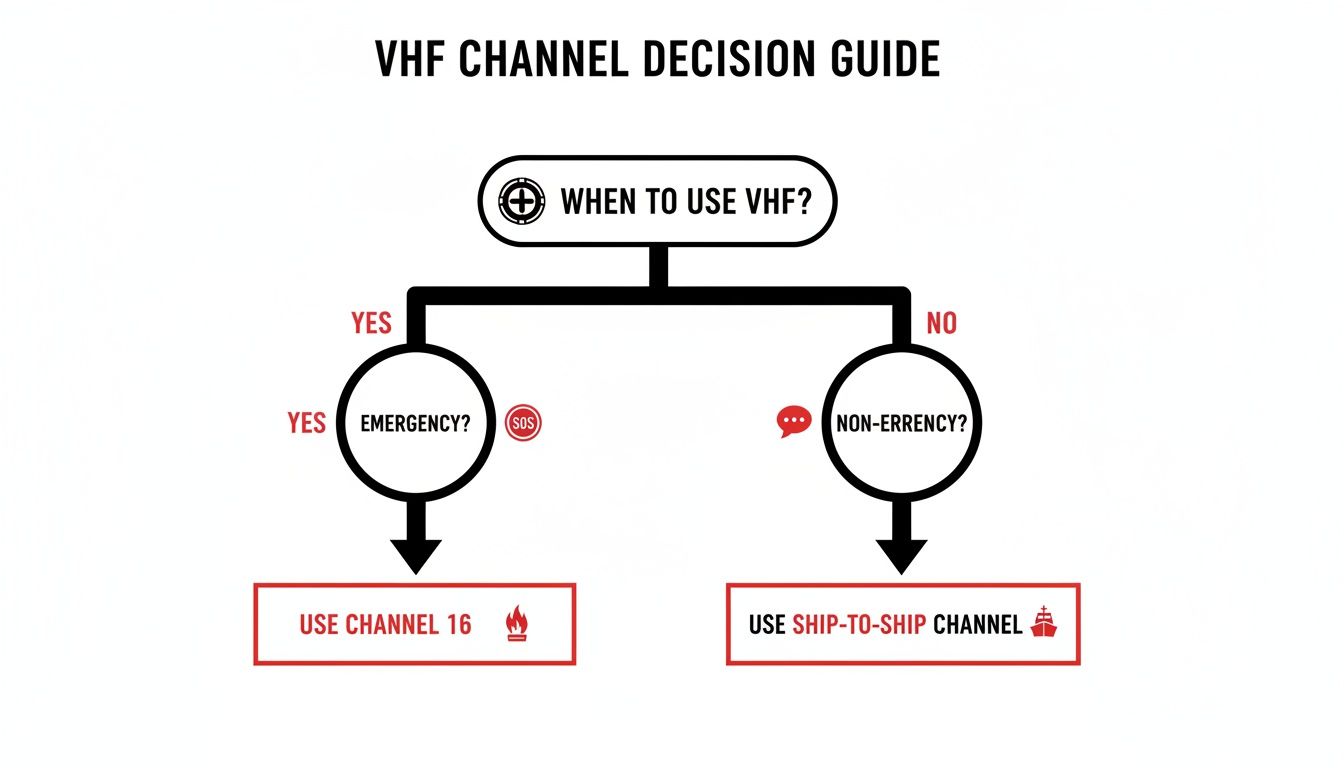
As the flowchart shows, your first thought should always be the nature of your call. This guides you to the right channel and, most importantly, helps keep the emergency lines clear for those who truly need them.
Expert Insight: Always prioritise a fixed-mount installation for your primary radio. The superior range and reliable power source are indispensable safety features that a handheld radio simply cannot replicate.
To help you weigh it all up, let's break down the pros and cons of each in a simple comparison table.
Comparing Fixed-Mount and Handheld Marine VHF Radios
This table breaks down the key differences between fixed-mount and handheld VHF radios to help you decide which is best for your maritime needs.
| Feature | Fixed-Mount VHF Radio | Handheld VHF Radio |
|---|---|---|
| Power Output | High (Up to 25 watts) | Low (1-6 watts) |
| Typical Range | 20-30 nautical miles | 3-5 nautical miles |
| Power Source | Vessel's 12V battery | Rechargeable battery pack |
| Antenna | Large, high-gain external antenna | Small, integrated antenna |
| Best For | All vessels venturing offshore; primary communication system. | Tenders, kayaks, dinghies; emergency backup on larger boats. |
| Key Advantage | Maximum range and reliability. | Portability and use away from the main vessel. |
| Key Limitation | Fixed to one location. | Limited range and battery life. |
Ultimately, choosing the right marine band radio is all about matching the tech to your specific needs on the water. This is why it pays to chat with communication specialists, rather than relying on suppliers with limited product knowledge. You’ll get expert advice and gear that’s perfectly suited for New Zealand’s challenging maritime conditions.
Using NZ Marine Channels with Proper Radio Etiquette
Jumping on a marine band radio in New Zealand isn't like making a casual phone call. It’s about plugging into a highly organised, life-saving network. Knowing the right channels and following the proper rules of the airwaves is a non-negotiable for any skipper—it keeps everyone safe and makes sure help can get through when it’s needed most.
The absolute heart of this system is VHF Channel 16. This is the international channel for distress, safety, and calling. Maritime Radio monitors it 24/7, and it must be kept clear for emergencies. Using it for a bit of a chinwag isn't just bad form; it's dangerous. You could be blocking a genuine distress call without even knowing it.
Navigating Key New Zealand Channels
Beyond the crucial role of Channel 16, New Zealand has a whole set of VHF channels NZ boaties must know, each with a specific job. The mark of a good operator is knowing exactly which channel to use for which conversation. Using the wrong one just clogs up the works and creates unnecessary confusion on the water.
Here’s a quick rundown of some of the channels you'll use most often:
- Ship-to-Ship Channels (e.g., Channels 06, 08, 72, 77): These are your daily drivers for chatting with other boats. Need to line up a rendezvous with your mate's boat or compare notes on where the fish are biting? Make your first call on Channel 16, then agree to jump over to one of these working channels to free up the emergency frequency.
- Marina and Yacht Club Channels (e.g., Channels 62, 63, 64): Most local marinas, boat ramps, and yacht clubs have their own channels for handling logistics, like sorting out a berth for the night or getting clearance to launch.
- Continuous Weather Broadcasts: Maritime New Zealand broadcasts non-stop weather updates on designated channels. Tuning in is a vital part of planning your trip and keeping an eye on any nasty changes heading your way.
For a complete list that you can keep handy on board, it's well worth checking out our guide on Marine VHF Channels in NZ.
The Language of the Sea: Distress Calls
Knowing the channels is one thing, but knowing how to talk—especially when things go sideways—is another. The maritime world uses three very specific prowords (procedure words) for urgent situations. Their meanings are set in stone and aren't up for interpretation.
Crucial Insight: Misusing distress calls can trigger a massive and expensive search and rescue operation. These terms are reserved for genuine emergencies ONLY. Kicking one off for no reason is a serious offence.
Getting these right could save a life—maybe even your own.
- Mayday: This is the big one. It means "grave and imminent danger" to a vessel or a person, and it demands immediate help. You only use this call when there's a direct threat to life, like a fire on board, you're sinking, or someone has a critical medical emergency.
- Pan-Pan: This call is for urgent situations that aren't life-threatening—at least not yet. Think engine failure in a busy shipping lane, losing your mast, or a medical issue that isn't critical but needs attention. It's a heads-up to other boats that you're in a bit of a pickle.
- Sécurité: Pronounced "say-cure-i-tay," this is a safety broadcast. You'll hear it used to warn other vessels about things like a big log floating in the channel, a lost shipping container, or important weather warnings.
Mastering Proper Radio Etiquette
Good radio etiquette keeps the airwaves clear for those who really need them. The golden rule is to always listen before you transmit to make sure you're not cutting someone off.
When you're making a call, state the name of the boat you're trying to reach three times, then say your boat's name and callsign once. For example: "Blue Fin, Blue Fin, Blue Fin, this is Sea Eagle, ZM1234, over."
Once they reply, you immediately suggest moving the conversation elsewhere: "Blue Fin, switch to channel 72, over." This simple process keeps Channel 16 open and ready for action. And remember, using a VHF radio NZ boaties use without the right operator's certificate and a station licence (your callsign) is illegal. Radio Spectrum Management (RSM) enforces this strictly. Following the rules isn’t just about staying legal; it’s about making the water safer for every single one of us.
Unlocking Critical Safety Features Like DSC and MMSI
Your modern marine radio is so much more than just a way to chat with other boats. It's a highly sophisticated safety device, and the single biggest leap forward in its technology is something called Digital Selective Calling (DSC).
Think of DSC as turning your standard marine band radio into a one-touch emergency beacon. Instead of fumbling with the mic to make a distress call that might get lost in static, a DSC-equipped radio lets you send an automated digital alert with the press of a single red button. It's not a voice call; it’s a concentrated burst of data that instantly notifies rescue services and other DSC-capable vessels that you're in trouble.
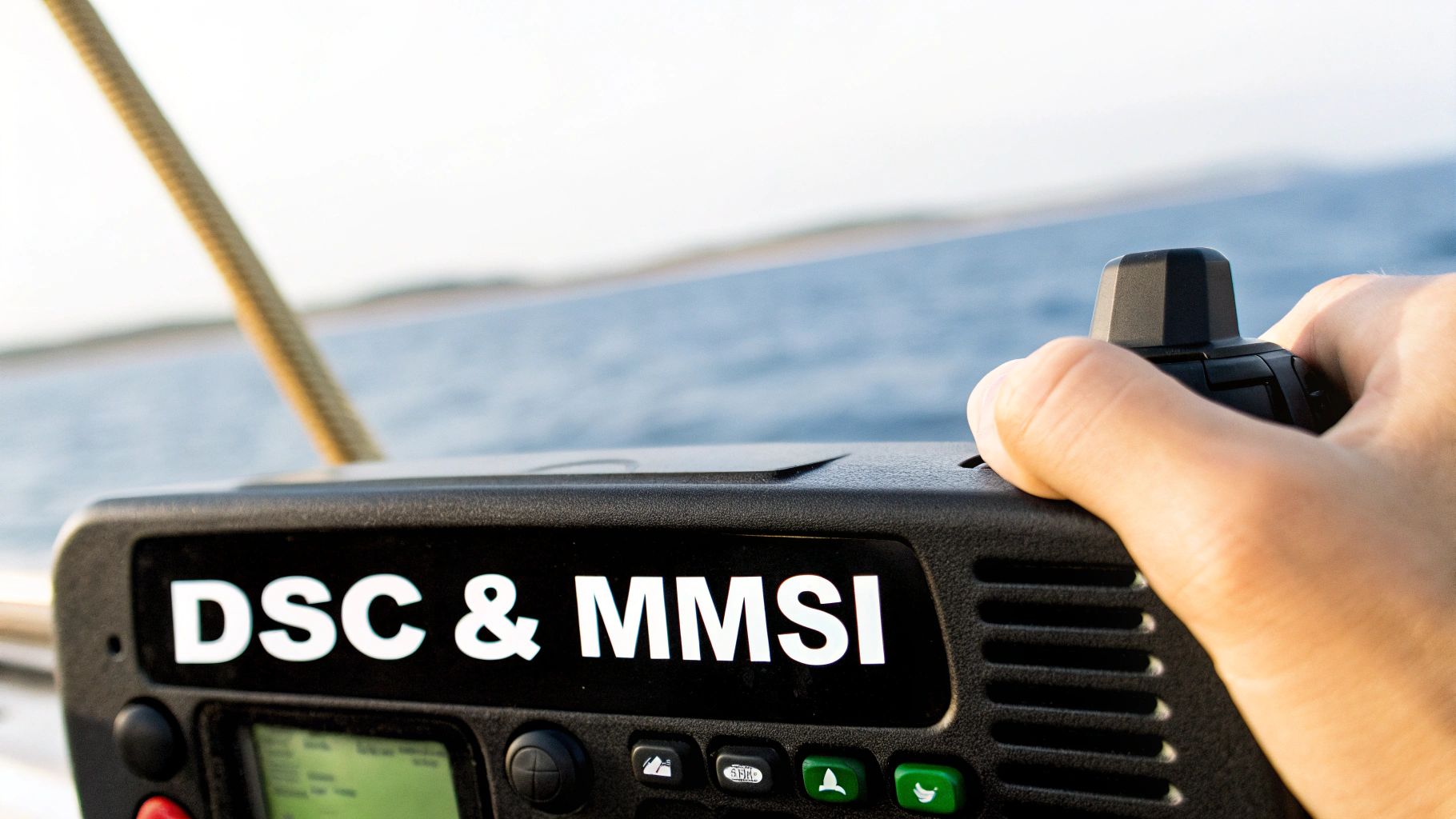
This digital signal is tied to your boat's unique Maritime Mobile Service Identity (MMSI) number – a nine-digit code that’s basically a phone number for your vessel. Even better, if you’ve connected your radio to a GPS, that DSC alert automatically includes your exact coordinates. This takes the "search" right out of search and rescue.
The Role of MMSI in New Zealand
An MMSI is the key that unlocks all this potential. Without one programmed into your radio, that big red distress button is just for show. Getting an MMSI in New Zealand is a straightforward process, handled by authorised radio examiners or the specialist suppliers you buy your gear from.
Once you have your number, it has to be programmed into your radio. This is usually a one-time deal, so getting it right is crucial. Punch in the wrong number, and you could inadvertently send rescuers scrambling to help the wrong boat.
Critical Safety Note: Your MMSI is linked to the vessel, not you. If you sell your boat, you must make sure the MMSI is either transferred to the new owner or cancelled so they can apply for a fresh one.
The whole system – DSC and MMSI working together – is a core part of the Global Maritime Distress and Safety System (GMDSS). This is the international standard for safety procedures and communications at sea, and it’s arguably one of the most important safety advancements in modern maritime history.
Other Essential Safety Features to Consider
Beyond the life-saving potential of DSC, top-tier marine radios from brands like GME, Motorola, Tait, Icom, Entel, and Hytera often come packed with other game-changing features. When you're looking for the best handheld vhf marine radio NZ conditions demand, these are the things you should be keeping an eye out for.
- Integrated GPS: A radio with its own built-in GPS is a huge plus. It means your position is always logged and ready to be sent in a distress call, even if your main chartplotter or GPS unit goes down.
- AIS Receiver: An Automatic Identification System (AIS) receiver lets your radio "see" other large commercial vessels around you. It displays their name, course, and speed right on your screen, which is invaluable for avoiding collisions in busy shipping lanes or foggy conditions.
- Dual Watch/Tri-Watch: This handy function lets your radio keep an ear on Channel 16 (the main distress and calling channel) while you're tuned to another channel, like the weather forecast or a ship-to-ship frequency. You never miss a critical call.
Putting your money into a radio with these features is a direct investment in your safety. While any basic VHF radio NZ boaties use will let you make voice calls, a modern unit with DSC gives you a digital safety net that is simply priceless when things go wrong. This is exactly why a chat with a communications expert is so important—they can point you towards the right radio for your boat and your style of boating, making sure you’re prepared for whatever the sea throws at you.
Installing and Maintaining Your Radio System
Getting reliable, crystal-clear performance from your marine VHF radio isn’t just about buying a good unit. It's really about how you set it up and look after it. Honestly, the installation and ongoing maintenance are just as critical as the radio itself, directly impacting your range and reliability when you need it most.
When it comes to any fixed-mount radio, the antenna is the unsung hero of the whole system. Its placement is everything.
The golden rule? Mount it as high as you practically can and well clear of any metal obstructions. That one step is the single most effective thing you can do to maximise your line-of-sight range and ensure your signal gets out cleanly.
Choosing The Right Hardware
The quality of your components makes a world of difference out on the water. Choosing a high-quality antenna from specialist brands like Pacific Aerials or RFI is a smart investment. These are built tough to withstand the harsh marine environment and will always outperform generic alternatives.
Don't forget the cabling—it's just as important. Always use proper marine-grade coaxial cable and connectors. This type of wiring is specifically designed to resist corrosion from salt and moisture, which is a major cause of signal loss and eventual system failure.
A Simple Maintenance Checklist
A few regular checks are all it takes to keep your radio system in peak condition. Spending a few minutes on this now can save you from a major headache later.
Here's a basic checklist to run through every so often:
- Check Connections: Make sure all cable connections at the back of the radio and at the base of the antenna are tight and free of corrosion. Any white, chalky residue is a dead giveaway that moisture is getting in.
- Inspect the Antenna: Give your antenna a quick visual once-over. Look for any cracks in the fibreglass, a wobbly base, or signs of physical damage that could compromise it.
- Test Your Power Supply: Confirm the radio is getting a stable power supply from your boat's battery. Loose power wires are a surprisingly common—and easily fixed—problem.
- Perform a Radio Check: Before each trip, do a quick, non-emergency radio check with a local marina or another boat on a working channel. It's the best way to confirm you are transmitting and receiving clearly.
Why Professional Expertise Matters
While some of these tasks are straightforward enough, getting the best possible performance often comes down to professional expertise. It is ALWAYS better to talk to a dedicated communications provider who offers specialist product knowledge.
A specialist will not only supply high-quality radios from trusted brands like GME, Uniden, and Tait but also provide expert installation. This ensures your system is compliant with NZ regulations, perfectly reliable, and optimised for New Zealand's tough maritime conditions.
While it's written for land vehicles, understanding the general principles of tracking down electrical faults can be really helpful for any system, including your radio. You can find a practical guide on troubleshooting RV electrical issues that covers some useful diagnostic concepts.
At the end of the day, a properly installed and maintained radio is more than just a convenience—it's your lifeline.
Your Top Questions About Marine Band Radio
Let's tackle some of the most common questions skippers have about using a marine band radio in New Zealand. Getting these fundamentals right is key to staying safe and legal out on the water.
Do I Really Need a Licence to Use a VHF Radio in NZ?
Yes, you certainly do. It’s not just a suggestion; it’s a legal requirement. To operate a VHF marine radio in New Zealand, you need two things: a Maritime VHF Radio Operator Certificate for you, and a unique Call Sign for your boat.
Think of the operator's certificate as your driver's licence for the airwaves—it proves you know the rules of the road. The call sign is like your boat's number plate, a unique ID registered with Radio Spectrum Management (RSM). Skipping these steps isn't worth the risk and can result in hefty fines.
What’s the Real-World Range I Can Expect?
Because VHF radio waves travel in a straight line, their range is essentially "line-of-sight." The actual distance you get depends heavily on your antenna height, the radio's power, and the conditions on the day.
- A fixed-mount 25-watt radio with a decent antenna mounted high up will reliably give you 20-30 nautical miles (that’s about 37-55 km).
- A handheld 5-watt radio is much more limited, usually giving you around 3-5 nautical miles (5-9 km) – perfect for tender-to-boat comms but not for offshore work.
Getting your antenna as high as possible is the single best thing you can do to squeeze every last bit of range out of your radio.
Can I Use My Marine Radio on Land?
Simply put, no. A marine VHF radio is licensed specifically for use on the water, for 'ship-to-shore' or 'ship-to-ship' communication. It’s not meant for chatting from your bach or worksite.
While you'll hear authorised coast stations like marinas or Coastguard on certain channels, it's illegal for the general public to transmit on marine frequencies from land. If you need land-based comms, a UHF radio or CB radio NZ models are the correct and legal tools for the job. And remember, proper wiring is critical for any electronics on board; understanding the essentials of good marine electrical installations will save you a world of headaches down the line.
For expert advice on choosing, installing, or servicing the right communication system for your vessel, trust the specialists at Mobile Systems. We provide end-to-end solutions to keep you safe and connected on New Zealand waters. https://mobilesystems.nz
Related posts

- June 11, 2026
New Zealand's workplace fatality rate is 1.7 times higher than Australia's, a stark figure that highlights the urgent need for...

- June 10, 2026
Did you know that approximately 15% of New Zealanders work in isolated conditions, with many operating entirely outside of reliable...

- May 30, 2026
Could your business withstand a $3 million fine for a health and safety oversight? Under the Health and Safety at...