
Two-Way Radios for Industrial Health & Safety in New Zealand (2025 Guide)
Explore Two-Way Radios for Industrial Health & Safety in New Zealand to improve on-site safety, reliable comms, and rapid incident response.
In New Zealand's toughest industries, from a forestry block deep in the Kaimais to a high-rise construction site in central Auckland, clear and constant communication isn't just a "nice-to-have"—it's a LEGAL and MORAL necessity. Professional two-way radios are a core piece of Personal Protective Equipment (PPE), every bit as important as a hard hat or high-vis vest for meeting your duties under the Health and Safety at Work Act 2015. They deliver an instant, reliable connection that cuts through challenges like patchy mobile coverage and deafening machinery, making sure every single worker is safe and accounted for.
This guide is designed for New Zealand businesses looking to choose the right communication devices to enhance their workplace safety. We will focus exclusively on professional-grade products and services, like those available from specialist providers such as Mobile Systems Limited, who offer the expertise and support needed for critical safety applications.
Why Radios Are Essential for NZ Industrial Safety
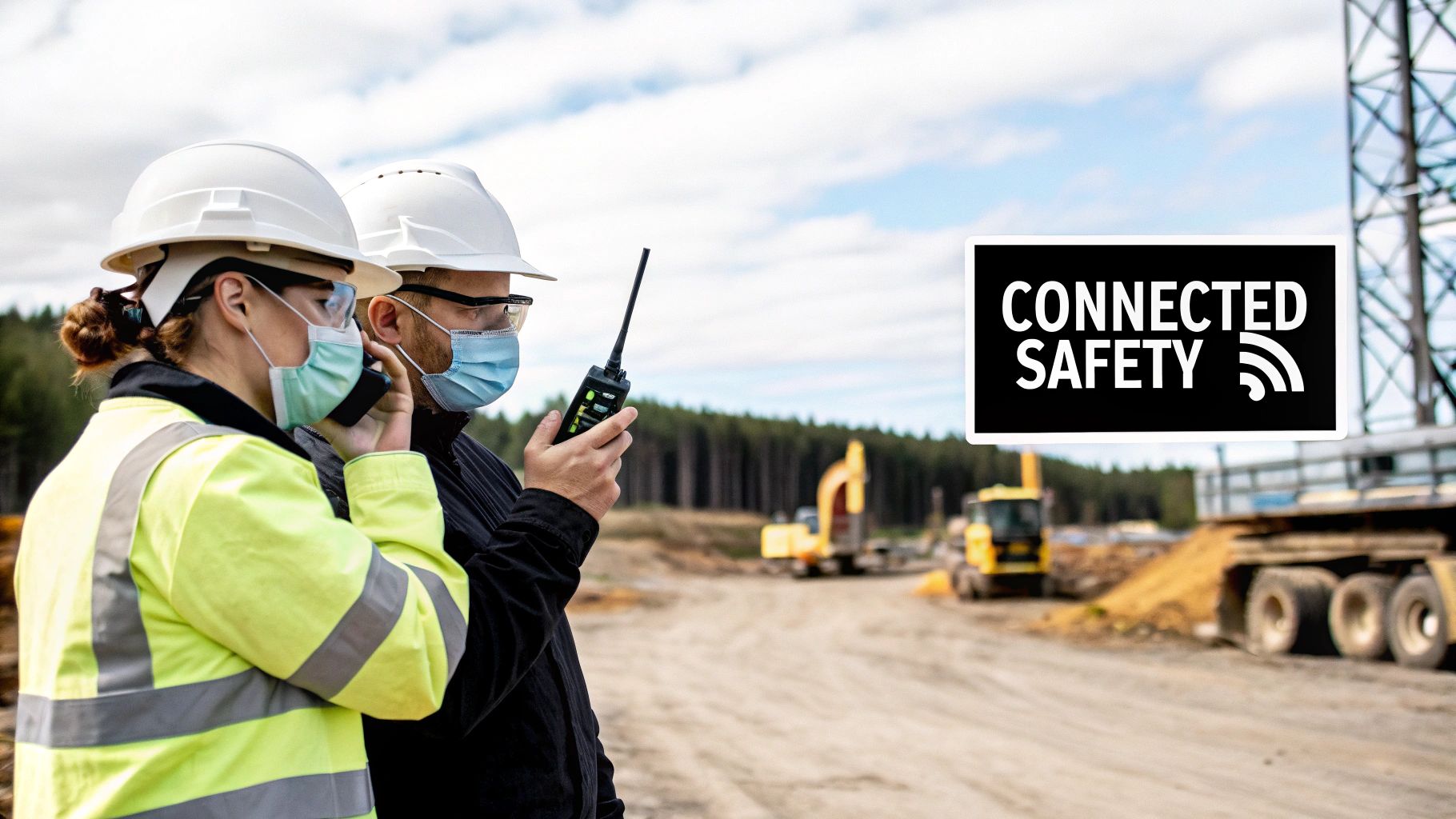
On any Kiwi worksite where there's an element of risk, the ability to talk to someone right now can be the difference between a near-miss and a tragedy. Mobile phones are notoriously unreliable in the very places industrial work happens. Think remote rural areas, steel-and-concrete buildings, or sites cluttered with equipment that causes signal interference. This communication gap is a direct threat to your team's safety.
Two-way radios are the solution. They operate on their own dedicated radio networks, providing a robust line of communication that is ALWAYS ON and instantly available.
There's no dialling.
No waiting for a connection.
Just push the button and talk. This immediate connection is absolutely vital for coordinating heavy machinery, warning a colleague about a sudden hazard, or calling for first aid without a second's delay.
A Critical Investment in Compliance and Resilience
Bringing a professional radio system into your operation isn't just about buying a few gadgets; it's a serious investment in your site's resilience, your team's wellbeing, and your legal compliance. WorkSafe NZ puts huge emphasis on proactive risk management, and rock-solid communication is the foundation of any good safety plan.
The sheer number of radios out there proves their value. It's estimated that between 20,000 to 30,000 two-way radio units are in active use across New Zealand businesses, especially in crucial sectors like construction, forestry, and roading. This isn't a niche tool; it's a fundamental part of keeping operations running smoothly and, most importantly, safely.
Think of a professional radio system as your team's invisible safety net. It ensures that no matter the conditions—be it the roar of a processing plant or the isolation of a high-country farm—every team member stays connected and accounted for.
Overcoming Common Worksite Challenges
Professional walkie-talkies are purpose-built to handle the tough conditions that would destroy a standard mobile phone. They are engineered to solve specific industrial problems.
- Loud Environments: Forget shouting over the noise. Advanced noise-cancelling microphones and powerful speakers punch through the din of diggers and generators, ensuring messages are heard clearly the first time.
- Rugged Conditions: These radios are built tough. Many are IP67-rated, which means they're completely dust-tight and can be submerged in water. They’re designed to survive drops onto concrete, constant vibration, and whatever the New Zealand weather throws at them.
- Coverage Gaps: With a well-designed radio system, you can create a seamless communication bubble across your entire worksite, warehouse, or farm, getting rid of the frustrating dead spots you get with cellular networks.
Key Radio Features And Their Safety Impact
To make it clearer, here's a quick summary of how specific radio features directly boost safety on a typical Kiwi worksite.
| Feature | Primary Safety Benefit | Ideal NZ Industry |
|---|---|---|
| Instant Push-to-Talk (PTT) | Immediate hazard warnings and emergency calls, eliminating connection delays. | Construction, Forestry, Manufacturing |
| Noise-Cancelling Audio | Clear communication over loud machinery, preventing misunderstandings. | Factories, Roadworks, Airports |
| IP67/68 Ruggedisation | Reliable operation in wet, dusty, or rough conditions, ensuring the radio works when needed. | Agriculture, Marine, Mining |
| Lone Worker & Man-Down | Automatic alerts sent if a worker is unresponsive or has a fall, enabling a rapid response. | Security, Utilities, Remote Fieldwork |
| GPS Tracking | Pinpoint a worker's exact location during an emergency, speeding up assistance. | Large-scale Infrastructure, Transport & Logistics |
| Emergency Button | A one-press button to send a priority distress signal to all other radios and dispatch. | All high-risk environments |
Ultimately, having the right gear means your team is better prepared for anything.
While two-way radios are the backbone of immediate, on-site communication, they are part of a bigger safety picture. Modern technology offers more layers of protection; for instance, some companies are now exploring augmented reality safety programs in the workplace to improve training and hazard identification. By integrating the right tools, businesses build a truly resilient safety culture.
To dive deeper into your obligations and how radio solutions fit in, you can learn more about the role of two-way radio solutions in NZ health and safety. In the rest of this guide, we’ll get into the specifics of choosing the right system for your unique needs.
Navigating NZ Radio Licensing And Regulations
Getting your head around New Zealand's radio regulations isn't just a box-ticking exercise. It's a critical part of building a communication system that's reliable, legal, and genuinely safe. When you get this right, you can be confident your critical messages will always get through, which is a massive part of meeting your duties under WorkSafe NZ.
The entire radio spectrum here is managed by a government body called Radio Spectrum Management (RSM). Their job is to keep the airwaves organised and free of interference. This is absolutely vital for emergency services and industrial sites where a missed message could have serious consequences.
Public UHF CB vs Private Licensed Channels
When you're looking at a radio system, one of the first big decisions is whether to use public channels or get your own private, licensed one. It's a bit like this:
A public UHF CB (Citizen Band) channel is like a crowded public park. Anyone can show up, conversations get jumbled, and you have zero control over who else is making noise. It’s chaotic, unpredictable, and totally unsuitable for professional safety comms.
A private licensed channel, however, is your own secure worksite. You get exclusive access, you control the conversation, and you can guarantee your messages will be heard loud and clear. For any serious industrial operation, a licensed channel is simply non-negotiable.
The Critical Importance of a Licensed Frequency
Securing a proper radio licence through a professional provider like Mobile Systems is the only way to guarantee the integrity of your workplace communications. Think of it as an investment in reliability and a core pillar of your health and safety strategy.
Here’s why it matters so much:
- Guaranteed Clarity: A licensed channel is reserved just for your organisation in a specific area. This completely wipes out interference from others, making sure every single instruction, warning, and emergency call is heard perfectly.
- Enhanced Privacy and Security: Anyone with a basic scanner can eavesdrop on public channels. A private digital (DMR) channel, which needs a licence, can be encrypted. This keeps your sensitive operational chat private and secure.
- Legal Compliance: Using commercial-grade, high-powered radios without the right RSM licence is illegal and can lead to some hefty fines. Proper licensing means you’re fully compliant with NZ law.
- Prioritised Communication: In a real crisis, you can't afford for your emergency call to be drowned out by casual chatter. A private channel ensures your team’s safety messages always get priority.
For a deeper dive into how frequencies work, check out our comprehensive guide to UHF radio in NZ.
How to Secure Your Radio Licence
The RSM licensing process can look a bit daunting, but that’s what an expert partner is for. At Mobile Systems, we handle the whole thing for you. We start by understanding your operation—how many staff you have, the size of your site, and the kind of work you do.
With that information, we apply to RSM for the right private channel licence on your behalf. This ensures you get the exact radio frequencies you need, whether it’s a single channel for a small construction site or a multi-channel network for a sprawling logistics operation. By managing this process, we make sure your communication system is not only powerful and reliable, but 100% legal from day one.
Critical Safety Features Your Industrial Radios Must Have
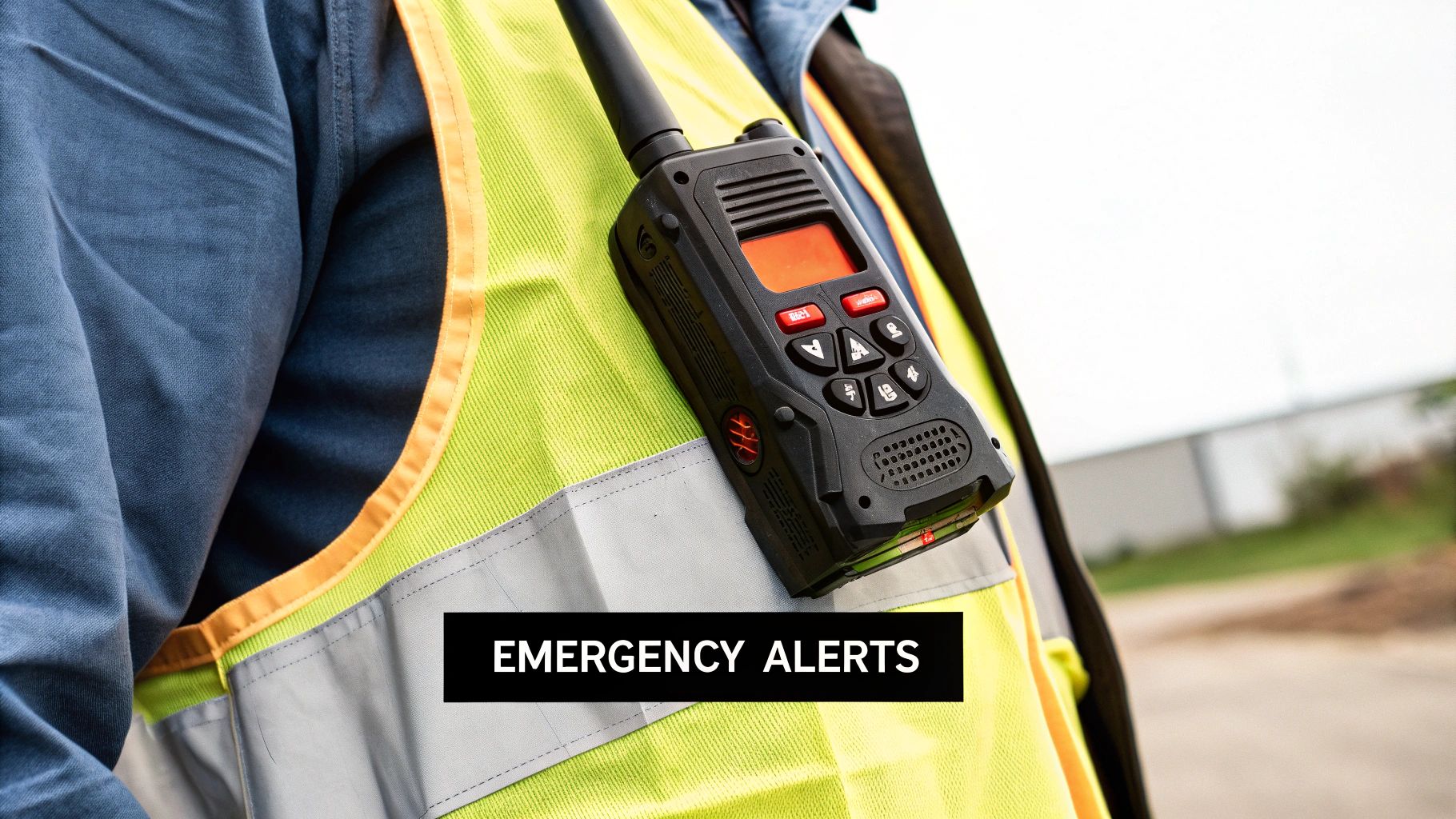
Today's professional digital radios are much more than just a button for talking. They’re intelligent tools built to actively protect your people on the ground. When you go beyond basic voice calls, you unlock a whole suite of life-saving features that create a responsive safety net around every single worker—a key part of your duties under New Zealand's Health and Safety at Work Act.
These functions transform a radio from a simple communication device into a proactive piece of safety equipment, providing a lifeline when it's needed most.
The Dedicated Emergency Button
One of the most essential features on any modern industrial radio is the Emergency Button. It's usually bright orange and easy to find, and for good reason—it's not just another function key.
Pressing it sends an instant, high-priority distress signal across your entire network. This alert cuts through all other non-urgent chatter, making sure the call for help is heard immediately by supervisors and the rest of the team. This single press means no time is wasted trying to explain what's wrong in the heat of the moment; it triggers your emergency response protocol straight away.
Think of a machine operator on a noisy construction site. They can signal an equipment failure or an injury instantly, bypassing all the usual operational chatter without any delay.
Lone Worker Monitoring
So many industrial jobs in New Zealand involve people working by themselves, often in isolated corners of a worksite. The Lone Worker feature is designed specifically for them.
It works like an automated digital check-in. The radio is set up to prompt the user with a tone at regular intervals—say, every 30 minutes. All the worker has to do is press a button to confirm they're okay.
If they don't respond within a set time, the radio automatically triggers an emergency alarm, letting the team know there might be a problem. This is absolutely vital for roles like:
- Security guards doing their rounds at night.
- Technicians carrying out maintenance in a massive factory.
- Farm workers checking on stock in a remote back paddock.
Man Down and Motion Detection
The Man Down feature takes safety monitoring a step further. It uses a built-in accelerometer to detect unusual movement or, more importantly, a lack of it. It can be set up to send an alarm in a few key scenarios:
- Unusual Tilt: If the radio stays tilted past a certain angle for too long (suggesting a fall), it sends an alert.
- No Motion: If the radio is completely still for an unusual amount of time, it signals that the worker might be unconscious or unable to move.
Imagine a forestry worker who slips on a steep, remote hillside. They might not be able to reach their radio to call for help. The Man Down feature would automatically send an alert, transmitting their GPS location and allowing help to be sent immediately to their precise spot.
These automated monitoring features are your digital first responders. They don't wait for a worker to call for help; they proactively signal a potential crisis, turning reactive emergency response into a preventative safety measure.
GPS Tracking for Pinpoint Location
In an emergency, knowing where your worker is can be just as crucial as knowing they need help. Modern radios with integrated GPS tracking provide real-time location data, viewable on a central dispatch screen.
This is invaluable for huge worksites like ports, sprawling farms, or major infrastructure projects. When an alarm is triggered—manually or automatically by Lone Worker or Man Down—the radio instantly sends its exact coordinates. This gets rid of dangerous guesswork and dramatically cuts down response times, guiding first aiders or emergency services directly to the person who needs them.
Intrinsically Safe for Hazardous Environments
For any industry working with flammable gases, dust, or chemicals, the communication device itself can be an ignition risk. This is where Intrinsically Safe (IS) radios aren't just a nice-to-have; they're a legal and safety requirement.
These radios are specifically engineered to prevent any internal sparks or heat from igniting a hazardous atmosphere. To get a full understanding of this critical specification, you can learn more about what an Intrinsically Safe radio is in our detailed guide.
Choosing The Right Radio For Your Industry
Picking the right two-way radio isn't a one-size-fits-all job. The perfect communication tool for a noisy Auckland construction site is worlds away from what a logistics company needs to connect its nationwide fleet. The real secret is matching the technology to the unique risks and day-to-day challenges of your Kiwi workplace.
This means you’ve got to look past the basic specs and focus on gear that’s purpose-built to solve a specific problem. That way, you know your investment is directly making your team’s environment safer and more efficient. Let’s jump into some of the best industrial-grade radios available from Mobile Systems and see where they really shine.
For Noisy and Demanding Environments: Construction and Manufacturing
In industries like construction, manufacturing, and roadworks, your biggest enemy is noise. The constant roar of heavy machinery, grinders, and plant equipment can completely swallow up a standard radio transmission, leading to missed instructions and dangerous mistakes. You need a device built to cut through that chaos.
The Hytera HP602 is an absolute standout here. It's built with some seriously clever AI-based noise cancellation that actively filters out all that background racket, making sure every word comes through crisp and clear.
Its rugged design is another massive plus. With an IP67 rating, the HP602 is completely sealed against dust and can even handle being dropped in water. It's tough enough for the mud, rain, and rough handling that comes with a typical Kiwi worksite. This thing is built to survive.
For Nationwide Coverage: Logistics and Transport
When your business operates across the country, from Invercargill right up to Cape Reinga, traditional radios with their limited range just won't cut it. You need a communication solution that can connect your entire team, no matter how far apart they are.
This is where Push-to-Talk over Cellular (PoC) radios really come into their own. The Motorola TLK110 is a perfect example, using New Zealand's widespread cellular networks to deliver instant, nationwide communication. If your driver has mobile coverage, they're connected. Simple as that.
The TLK110 gives you the best of both worlds: the one-touch simplicity of a two-way radio with the almost limitless reach of the mobile network. It’s a powerful, modern solution for any business with a team on the move.
For Durability in Extreme Conditions: Forestry and Agriculture
When your workplace is the great outdoors, your gear has to be bulletproof. Industries like forestry, farming, and civil engineering need radios that can take a beating from extreme weather, constant vibration, and the odd drop onto hard ground.
For these jobs, you need proven reliability from world-class brands available at Mobile Systems.
- Tait Radios: A true New Zealand icon, Tait radios are famous globally for their incredible toughness and flawless performance in harsh environments. There's a good reason they're the first choice for emergency services and heavy industry. Models like the Tait TP9355 are renowned for their mission-critical reliability.
- Icom Radios: Icom, especially models like the Icom F2000SD, deliver outstanding durability and fantastic audio quality. They are built to military standards for resilience, so you can be confident they won’t let you down when it matters most.
These brands are the gold standard in rugged engineering, giving you a communication lifeline you can truly count on, even in the most challenging spots.
For In-Vehicle Fleet Communication
For a lot of businesses, the vehicle is the command centre. Whether you're managing a fleet of delivery trucks or coordinating a convoy of 4WDs on a remote farm track, a powerful vehicle-mounted radio is an absolute must.
The GME XRS Series is designed specifically for this. These units pack more power and range than any handheld, and they connect to a high-gain external antenna for the best possible coverage across New Zealand’s hilly terrain. They’re the perfect hub for keeping your entire fleet connected, coordinated, and safe on the road.
Think of it this way: the right radio is a tool designed to solve a problem. Once you identify your main challenge—whether it’s noise, distance, or durability—you can find a device that will actively improve your safety and efficiency.
Industrial Radio Model Comparison
It can be tough to decide which features matter most. This table breaks down our recommended models to help you match the right radio to the right job, ensuring you get a tool that’s perfectly suited for the demands of your industry.
| Model | Key Feature | Best For | Durability (IP Rating) |
|---|---|---|---|
| Hytera HP602 | AI-Powered Noise Cancellation | Construction, Manufacturing, Noisy Sites | IP67 |
| Motorola TLK110 | Nationwide Cellular Coverage (PoC) | Transport, Logistics, Nationwide Fleets | IP67 |
| Icom F2000SD | Military-Standard Ruggedness & Clear Audio | Forestry, Agriculture, Extreme Conditions | IP67 |
| GME XRS Series | High-Power Vehicle Mount & Superior Range | Fleet Management, Convoy Coordination, 4WD | N/A (Vehicle Unit) |
| Tait Radios | Legendary Toughness & Mission-Critical Reliability | Emergency Services, Heavy Industry, Utilities | Varies (High) |
Nailing the model selection is the first and most critical step in building a communication system that genuinely enhances your health and safety protocols. Each of these options offers a rock-solid solution, purpose-built for the unique challenges faced by New Zealand’s industries.
Maximising Safety With The Right Accessories
A professional radio handset is the core of your communication system, but it’s the accessories that really make it work for your specific job. The right add-ons can transform a good radio into a purpose-built safety tool, perfectly suited to the unique demands of your New Zealand worksite. This is how you go from just having communication to having effective communication when it really counts.
This quick decision tree helps show how different worksite challenges point to specific gear.
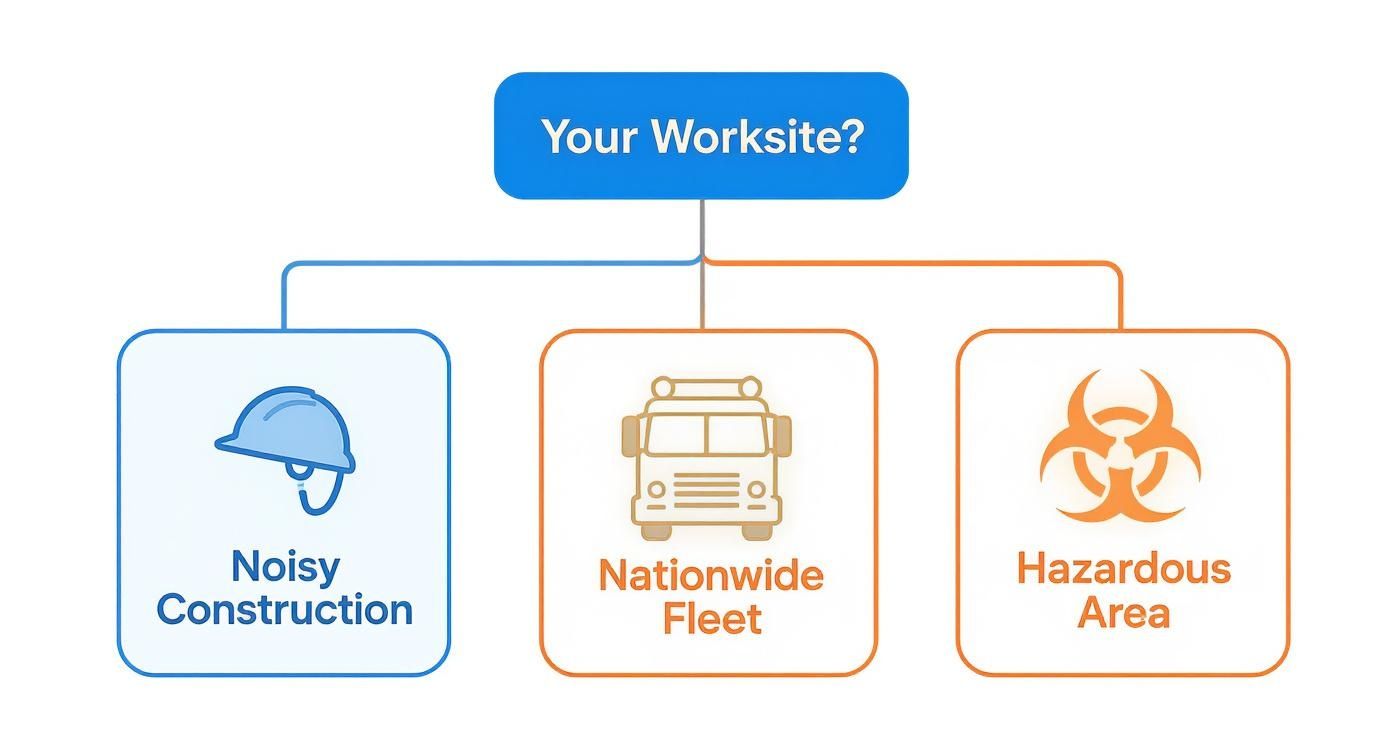
As you can see, figuring out your main operational hurdle—whether it's noise, distance, or hazardous conditions—is the first step towards choosing the right ecosystem of technology.
Upgrading Your Signal With High-Performance Antennas
New Zealand’s rugged, hilly terrain is a natural enemy of radio waves. The standard "rubber ducky" antenna that comes with a handheld is a decent all-rounder, but it will often struggle to push a signal over hills or through dense bush.
This is where a quality, vehicle-mounted antenna becomes absolutely essential. When you pair a unit like a GME or Tait mobile radio with a properly installed high-gain whip antenna, you can dramatically boost your transmission range. It’s what keeps your team connected across vast farms, sprawling construction sites, or winding rural roads where clear communication is non-negotiable for safety.
Hearing Protection and Clear Communication in High-Noise Areas
On sites like factories, processing plants, or roadworks, noise isn't just an annoyance—it's a serious health and safety risk. A standard radio can force workers to pull off their hearing protection just to take a call, completely defeating the purpose of their PPE.
This is where smart headsets become a critical safety investment. They solve two problems at once: protecting a worker’s hearing from damaging industrial noise while delivering crystal-clear audio directly to their ear.
Specialist gear like Sensear smart headsets are a leading solution here. They use clever technology that suppresses dangerous background noise while enhancing speech, allowing for a normal conversation without ever compromising a worker's safety. For any business serious about its hearing conservation programme, this is a vital piece of kit.
Ensuring Constant Readiness With Smart Power Management
A radio with a dead battery is just a plastic brick in an emergency. If you're managing a fleet of radios, you’re also managing a fleet of batteries, and doing it properly is the key to being operationally ready.
A multi-unit battery charger is a simple but crucial piece of infrastructure for any team. These charging bays keep all your handsets charged, organised, and ready to grab at the start of every shift. This simple step eliminates the risk of a worker heading out with a low-power radio, giving you peace of mind that their communication lifeline will last the entire day.
Hands-Free Operation for Maximum Safety and Efficiency
So many industrial jobs require both hands to be free, whether you're climbing a ladder, operating machinery, or carrying equipment. A worker fumbling with a radio isn't just inefficient; it's a real safety hazard.
This is where rugged carrying solutions come in. A remote speaker microphone clipped to a lapel brings the conversation closer, while a purpose-built chest rig like the Cactus harness keeps the radio secure and accessible without getting in the way. These simple additions let workers communicate on the move, keeping their hands—and their focus—on the task at hand.
Partnering For A Complete Safety Solution
Putting an industrial-grade radio system in place is about much more than just buying the hardware. It’s about building a complete safety ecosystem. Choosing the right purpose-built radio, getting your head around NZ regulations, and picking the critical safety features are the foundations. But tying it all together? That takes specialist expertise.
At Mobile Systems Limited, we step in as your dedicated safety partner. We make sure every piece of your communication network is professionally managed, giving you absolute peace of mind.
Expert Installation and Programming
Our job doesn't end when you buy the radio. We provide professional installation for vehicle-mounted units and fixed base stations, ensuring everything works perfectly and integrates smoothly with your other assets.
Our technicians also handle custom programming. We’ll configure your radios to create efficient, private talk groups so your teams can communicate clearly without chatter or interference from other users. Getting this setup right is vital for a reliable comms network that’s truly fit for your worksite.
A properly installed and programmed radio system is the difference between simply having equipment and having a true safety solution. We handle the technical details so you can focus on running your operation.
Flexible Hire and Lease Options
We get it—every project has its own budget and timeline. That’s why we offer flexible radio hire and lease options to suit your needs.
Whether you need a few extra handsets for a short-term construction job or prefer to lease a full system to manage capital spend, we have a solution that works.
A truly comprehensive safety solution also means combining different measures, including clear visual warnings. Beyond robust radio communication, exploring effective workplace safety signs is another key step in protecting your crew.
Our goal is simple: to provide a complete, professionally managed system that keeps your team safe, connected, and fully compliant.
Your Questions Answered
When you're sorting out communications for your worksite, a few questions always pop up. Here are the straight-up answers to some of the most common queries we get from Kiwi businesses looking to get their health and safety comms right.
Do We Really Need a Licensed Radio Channel?
For any serious commercial or industrial operation in New Zealand, the answer is a definite yes. While public UHF CB channels exist, they're often clogged with chatter and totally unreliable – the last thing you want in an emergency.
A private licence from Radio Spectrum Management (RSM) gives you a clear, secure channel free from interference. Think of it as your own private highway for communication, which is absolutely fundamental for a solid workplace safety plan.
What Does IP67 Actually Mean?
An IP rating tells you how tough a piece of gear is against the elements. It’s simple once you break it down.
The first number (6) means the radio is completely sealed against dust. The second number (7) means you can drop it in a metre of water for up to 30 minutes, and it’ll come out working. For any Kiwi worksite where mud, dust, and a bit of rain are just part of the job, an IP67 rating is non-negotiable for a reliable handheld radio.
How Far Will My Radios Actually Reach?
That’s the million-dollar question, and the honest answer is: it depends. The transmission range is a mix of the radio's power, the type of antenna you're using, and—most importantly—the terrain you're in. Out in the open Canterbury Plains, you could get several kilometres. In the middle of Auckland's CBD or the rolling hills of the Waikato, that range will shrink dramatically.
This is exactly why a one-size-fits-all approach doesn't work. For vehicles covering a large area or a sprawling site, we can install a high-gain whip antenna to seriously boost your signal, making sure your communication network has no dead spots.
Are Digital Radios Really Better Than the Old Analogue Ones?
Without a doubt. Modern Digital Mobile Radio (DMR) technology has left the old analogue systems in the dust. The difference is night and day.
- Crystal Clear Audio: Digital tech is smart enough to filter out background noise, so even on a loud site, your voice comes through sharp and clear.
- Stronger Signal to the Edge: Analogue signals get weaker and fuzzier the further you go. Digital signals stay perfectly clear right up to the very edge of their range, then drop off. No more guessing what was said.
- Proper Privacy: Digital signals can be encrypted, which stops anyone from casually listening in on your operations.
- Smarter Safety Features: This is the big one. Life-saving functions like Man Down, Lone Worker alerts, and real-time GPS tracking are only possible with digital radios.
Moving to a digital system isn't just an upgrade; it’s a crucial step in future-proofing your team’s safety.
Getting your comms system designed properly from the start is critical. At Mobile Systems Limited, we handle the whole process—from sorting your RSM licence and programming the gear to installation and ongoing support. We make sure your team stays connected and safe, no matter what.
Explore our complete range of industrial communication solutions at mobilesystems.nz
Related posts

- June 19, 2026
Fall detection, no-motion sensors, and GPS - here's exactly how a man down alarm knows something's wrong, and how the...

- June 13, 2026
In 2024, New Zealand recorded 70 work-related fatalities and more than 209,000 injury claims. These statistics underscore the heavy responsibility...

- June 11, 2026
New Zealand's workplace fatality rate is 1.7 times higher than Australia's, a stark figure that highlights the urgent need for...