
How to Reduce Fleet Fuel Costs in NZ: A Professional Management Guide
A single medium sized delivery truck can burn through NZ$2,500 of diesel every year just by idling on New Zealand job sites. If you're looking for ways to reduce fleet fuel costs nz, identifying these hidden inefficienciues.
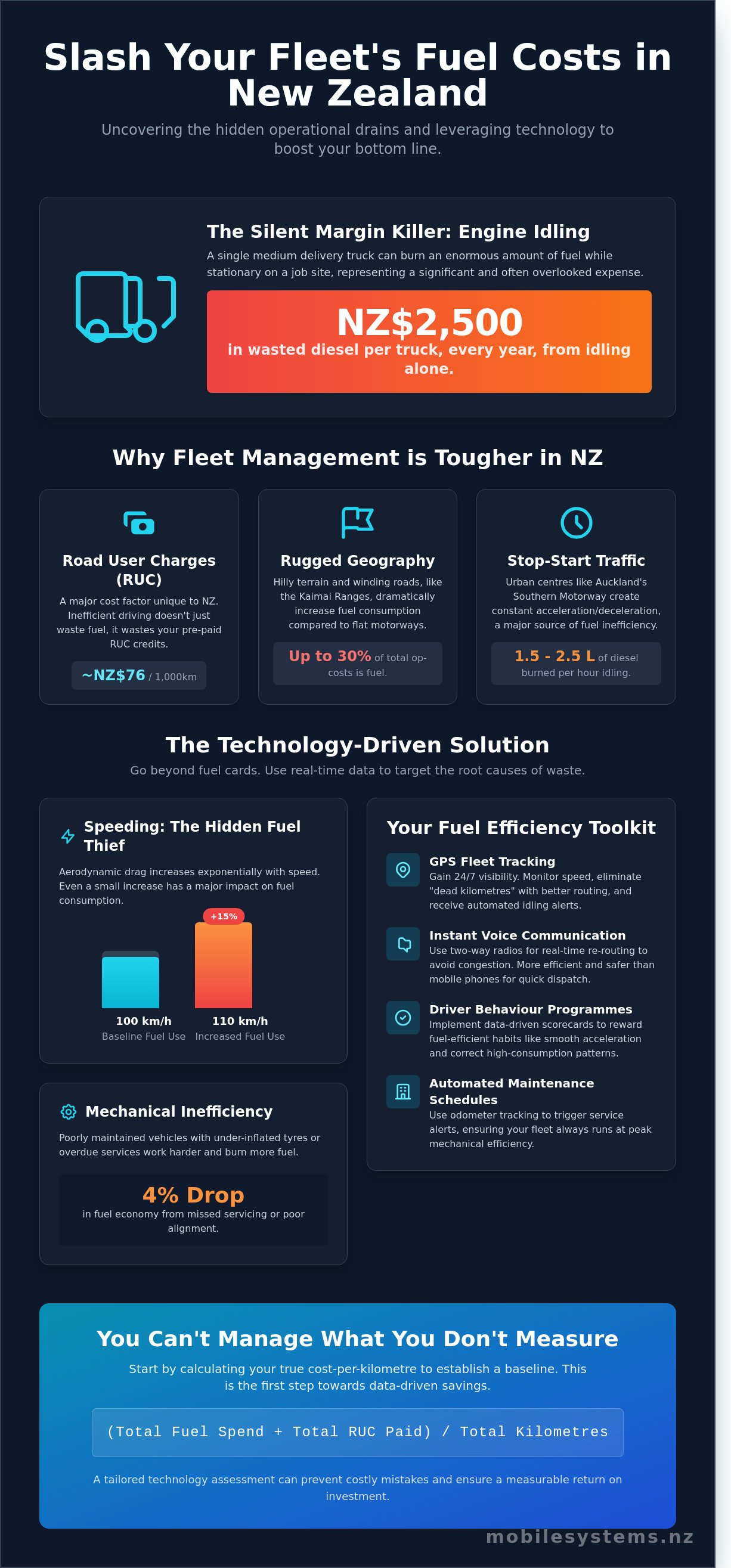
A single medium sized delivery truck can burn through NZ$2,500 of diesel every year just by idling on New Zealand job sites. If you're looking for ways to reduce fleet fuel costs nz, identifying these hidden inefficiencies is the most effective place to start.
It's frustrating to watch your margins shrink every time fuel prices spike or RUC rates increase. You likely feel that while fuel is a necessary expense, the lack of visibility into how every litre is used makes it impossible to control your overheads effectively.
This guide reveals practical, technology-driven strategies to lower your consumption and improve operational efficiency across the board. We'll move beyond simple fuel cards to address the specific root causes of waste in the local market.
You'll learn how to eliminate "dead kilometres" through better routing and how to foster driver accountability using real-time data. We'll provide a clear roadmap for turning your fleet into a leaner, more coordinated asset.
Key Takeaways
- Understand how New Zealand’s unique geography and Road User Charges (RUC) directly impact your diesel fleet’s bottom line and overall profitability.
- Leverage GPS tracking and telematics to reduce fleet fuel costs nz by eliminating excessive engine idling and managing vehicle speeds to reduce aerodynamic drag.
- Discover why instant voice communication via two-way radios is more efficient than mobile phones for real-time re-routing and avoiding fuel-wasting congestion.
- Implement a structured driver behaviour programme using data-driven scorecards to reward fuel-efficient habits and correct high-consumption driving patterns.
- Learn the value of a tailored technology integration and local on-site support to ensure your fleet management tools deliver a measurable return on investment.
Analysing the True Cost of Fleet Operations in New Zealand
Managing a fleet in New Zealand presents unique challenges. Our rugged topography and high excise duties mean that fuel represents up to 30% of total operating costs for most local businesses. To effectively reduce fleet fuel costs nz, managers must look beyond the pump price and understand the interplay between vehicle weight, driver behaviour, and regulatory compliance.
Fuel efficiency isn't just about choosing a modern engine. It's about how that engine handles the Kaimai Ranges or the stop-start traffic of Auckland's Southern Motorway. Operational inertia, which is the refusal to adopt monitoring technology, often costs businesses more in the long run than the initial investment in telematics and tracking hardware.
The NZ Fuel Landscape in 2026
By 2026, the transition toward a universal Road User Charge (RUC) system has changed how fleets budget. While the Auckland Regional Fuel Tax was abolished in June 2024, nationwide RUC rates for diesel and electric vehicles continue to rise to fund infrastructure. For a 3.5-tonne diesel van, RUC costs approximately NZ$76 per 1,000km, making fuel economy critical for maintaining profit margins.
- Diesel Volatility: Global supply chain shifts keep NZ diesel prices fluctuating significantly, often between NZ$2.10 and NZ$2.60 per litre.
- Weight Penalties: Heavier loads increase fuel consumption by roughly 2% for every 45kg of extra weight carried.
- Idling Costs: Modern NZ diesel engines consume 1.5 to 2.5 litres of fuel per hour while idling, a common drain in urban delivery sectors.
Calculating Your Current Fuel Baseline
You can't manage what you don't measure. To find your baseline, use the formula: (Total Fuel Spend + Total RUC Paid) / Total Kilometres Travelled. This gives you a true cost-per-kilometre that accounts for both consumption and taxes.
Service-based fleets often find that "litres per 100km" is a misleading metric. A technician's van might show poor efficiency because it idles for power at a job site, not because of bad driving. Identifying these nuances allows you to target the "low-hanging fruit" like unnecessary engine idling or inefficient route planning. Implementing a professional tracking solution can help reduce fleet fuel costs nz by providing the data needed to correct these habits.
Small changes yield significant results. A fleet of 10 vehicles reducing idling by just 15 minutes a day can save over NZ$3,000 annually in wasted fuel alone. Mobile Systems Limited provides the tools to uncover these hidden costs, ensuring your fleet remains profitable in a high-cost environment. A tailored assessment often prevents costly mistakes when choosing which technologies to deploy.
Leveraging GPS Fleet Tracking for Real-Time Fuel Savings
To effectively reduce fleet fuel costs nz, business owners must look beyond the price at the pump. Telematics provides the granular data needed to identify hidden wastage that occurs during daily operations. By installing GPS fleet tracking, managers gain 24/7 visibility into how vehicles are actually operated on New Zealand roads.
Speed management is one of the most immediate ways to lower overheads. Aerodynamic drag increases significantly once a vehicle exceeds 90 km/h. For a standard NZ delivery van, driving at 110 km/h instead of 100 km/h can increase fuel consumption by up to 15%. GPS systems allow for real-time speed monitoring and automated alerts, ensuring drivers stay within the most fuel-efficient range for their specific vehicle class.
Integrating tracking with maintenance schedules also prevents fuel loss caused by mechanical inefficiency. A vehicle that misses its service interval or runs on poorly aligned tyres can see a 4% drop in fuel economy. Automated odometer tracking ensures every ute or truck in the fleet receives its oil and filter changes exactly when required, maintaining peak engine performance.
Eliminating the "Idling Culture" on Work Sites
Many NZ contractors leave utes running to keep the cabin temperature comfortable or to power accessories. A typical 3.0L diesel engine consumes approximately 1.5 to 2.0 litres of fuel per hour when idling. At current NZ fuel prices, a 15-minute idle costs roughly NZ$0.80 per vehicle.
While this seems small, across a fleet of 20 vehicles idling four times a day, this totals over NZ$11,600 in annual waste. Automated alerts notify managers when an engine remains stationary for more than five minutes, allowing for immediate coaching. Setting a benchmark of zero non-essential idling is a standard practice for high-performing NZ civil construction and trade firms.
Route Optimisation and Reducing "Dead Kilometres"
The shortest route isn't always the most cost-effective path. Heavy congestion in metropolitan centres like Auckland or Tauranga often means a slightly longer motorway loop is more efficient than a direct route through stop-start city traffic. GPS software calculates the most efficient path based on live traffic data and the specific requirements of the vehicle.
Reducing "dead kilometres"—unproductive travel between jobs or back to the depot—by just 5% has a massive impact on the bottom line. For a fleet covering 500,000 km annually at an average consumption of 10L/100km, this 5% reduction saves 2,500 litres of fuel. This equates to over NZ$6,000 in direct savings, excluding the reduced wear and tear on tyres and brakes.
If you're unsure which tracking hardware suits your specific vehicle types, a tailored assessment often prevents costly mistakes.
Communication Systems: The Secret Weapon for Fuel Efficiency
Effective communication is often the missing link in strategies to reduce fleet fuel costs nz. While many managers focus on engine tuning or tyre pressure, the way a team coordinates movement has a direct impact on the pump. Instant voice communication allows for real-time adjustments that prevent unnecessary mileage and idling.
Mobile phones often fail as a primary fleet tool because they require one-to-one dialing and hands-free setup, which creates significant delays. In contrast, two-way radios provide instant, one-to-many broadcasts. This speed is vital when a site entrance is blocked or a delivery point changes. A 10-minute delay spent idling in a heavy truck can consume up to 2 litres of fuel; multiplying this across a fleet of 20 vehicles highlights the scale of potential waste.
Instant Re-routing via UHF/VHF Radio
Radio systems eliminate the "wrong turn" fuel waste common in complex New Zealand terrain. In industries like forestry and construction, a driver who misses a turn-off might travel several kilometres before they can safely turn a heavy trailer around. One-to-many communication ensures that if one driver identifies a hazard or a route change, every other driver in the vicinity hears it instantly. It's about collective awareness rather than individual instruction.
This coordination prevents "stop-start" movements at busy site gates. By using UHF or VHF systems to sequence arrivals, drivers can adjust their speed to arrive exactly when a slot is clear. This avoids the heavy fuel consumption required to bring a fully loaded vehicle from a complete stop back up to cruising speed. Maintaining momentum is one of the most effective ways to lower daily fuel burn.
Satellite Solutions for Rural NZ Fleets
New Zealand's geography presents unique challenges, with cellular "black spots" covering roughly 75% of the landmass. For fleets operating in the Southern Alps, the East Cape, or deep within North Island forests, losing contact means losing control over fuel efficiency. When a driver enters a dead zone, they're essentially operating in a vacuum without the benefit of real-time dispatch updates.
Deploying satellite phones and devices ensures that remote teams remain part of the coordinated network. If a vehicle breaks down or a road is washed out, immediate notification prevents other fleet members from heading into a dead-end. This technology also avoids the massive fuel and labour costs associated with sending "search" vehicles to locate a non-responsive driver in remote regions. Reliable communication is both a safety requirement and a proven method to protect the bottom line.
A tailored assessment often prevents costly mistakes when choosing between UHF, VHF, or satellite platforms. Mobile Systems Limited provides the technical expertise to ensure your communication hardware supports your fuel reduction goals effectively. For a professional evaluation of your fleet's communication needs, you can contact our team of experts.
Implementing a Driver Behaviour Programme That Works
Changing how people drive is the most immediate way to reduce fleet fuel costs nz. Research from the Energy Efficiency and Conservation Authority (EECA) suggests that fuel-efficient driving can reduce consumption by up to 15%. Technology provides the data, but your drivers provide the results.
Follow these five steps to build a programme that sticks:
- Step 1: Use telematics data to identify high-risk, high-consumption habits. Focus on excessive idling, high-RPM gear changes, and speeding.
- Step 2: Establish a transparent "Driver Scorecard". Metrics should be simple, such as Litres/100km or total idle time per shift.
- Step 3: Provide targeted training for harsh braking and rapid acceleration. These behaviours waste kinetic energy and force the engine to work harder to regain speed.
- Step 4: Reward top performers to foster a culture of efficiency. Use monthly prizes or public recognition to incentivise the team.
- Step 5: Regularly review and adjust goals based on fleet-wide progress. If the average fuel economy improves by 5%, set a new benchmark to keep the momentum.
The Physics of Fuel: Speed and Braking
In New Zealand, where state highways often involve hills and winding corners, the difference between 90km/h and 100km/h is substantial. At higher speeds, aerodynamic drag increases exponentially. For a typical heavy commercial vehicle, this 10km/h reduction can translate to a 10% saving in diesel.
Anticipatory driving is another core skill. Drivers should look 12 seconds ahead to anticipate traffic flow. By easing off the accelerator early instead of braking late, they preserve momentum. Real-time in-cab feedback systems can alert drivers to these events as they happen, allowing for instant correction. This reduces the need for expensive post-trip debriefs.
Maintenance as a Fuel Saving Strategy
Mechanical health is directly linked to how much you spend at the pump. Tyre pressure is a critical factor often overlooked. Industry data indicates that tyres under-inflated by just 10% can increase fuel consumption by 1%. For a fleet of 20 trucks, this adds up to thousands of dollars in avoidable NZ$ expenditure annually.
Regular engine tuning is essential, particularly for older NZ commercial fleets that may not have the latest efficiency technology. Carbon buildup and clogged filters force engines to burn more fuel to maintain power. Automating maintenance reminders via your fleet management software ensures no vehicle misses its service interval. This proactive approach is a proven way to reduce fleet fuel costs nz over the long term.
A tailored assessment from an expert often prevents costly mistakes in fleet management. Contact Mobile Systems Limited to discuss your fleet requirements.
Designing a Tailored Fleet Efficiency Solution with Mobile Systems
Generic, "one-size-fits-all" technology packages often result in wasted capital. A courier company navigating Auckland's CBD requires vastly different connectivity than a logging operation in the central North Island. When businesses buy off-the-shelf hardware without a strategy, they often pay for features they don't need while missing critical tools that actually drive down expenses.
A tailored assessment is the only way to ensure your hardware selection matches your operational reality. For example, up to 30% of fleet managers report that poor integration between different tracking and communication tools leads to data silos. By choosing a bespoke strategy, you align your radio, GPS, and cellular assets into a single ecosystem. This level of coordination is the most reliable way to reduce fleet fuel costs nz businesses encounter in fluctuating markets.
Custom solutions prevent the common mistake of over-investing in high-bandwidth cellular plans for rural areas where coverage is spotty. Instead, a hybrid approach using digital mobile radio (DMR) for voice and cellular for data ensures your team stays connected everywhere. This connectivity allows for real-time routing adjustments, which can cut unnecessary mileage by 10% or more across your entire fleet.
Expert Installation and Nationwide Support
Hardware is only as reliable as its installation. Vibration, dust, and temperature swings in New Zealand's varied climate can quickly degrade poorly fitted equipment. Professional on-site installation ensures that antennas are tuned correctly and power draws are managed safely. This prevents the intermittent data gaps that make fuel monitoring software inaccurate.
Local expertise is particularly vital for navigating New Zealand’s Radio Spectrum Management (RSM) regulations. Mobile Systems manages the complexities of radio frequency licensing so your business remains compliant with local laws. Our nationwide support network means your vehicles get serviced on-site, minimizing downtime and keeping your efficiency tools active.
Taking the Next Step Toward Lower Overheads
The return on investment for integrated fleet systems is often realized within the first 12 months. By monitoring idle times and optimizing routes, many NZ fleets see a reduction in fuel burn of 15% or higher. For a medium-sized fleet, this often equates to thousands of NZD saved every month.
The path to a more efficient fleet starts with a professional audit of your current communication and tracking capabilities. Moving away from fragmented systems toward a cohesive strategy reduces administrative burden and fuel waste simultaneously. A tailored assessment often prevents costly mistakes in hardware selection.
Contact the team at Mobile Systems for a tailored fleet assessment to begin your transition to a high-efficiency fleet model.
Optimising Your Fleet for Long-Term Fuel Savings
Managing a commercial fleet in New Zealand requires more than just watching the pump price. By integrating GPS tracking with robust UHF or satellite communication, managers eliminate the dead mileage that drains budgets. These tools provide the transparency needed to refine routes and reduce idle times across both the North and South Islands. Using real-time data ensures drivers aren't wasting litres on inefficient paths.
Implementing a structured driver behaviour programme often results in a 10% to 15% reduction in fuel consumption. When you combine these cultural shifts with technical precision, the ability to reduce fleet fuel costs nz wide becomes a measurable reality rather than a distant goal. It's about turning operational data into actionable savings that protect your bottom line every month.
Mobile Systems Limited provides the technical expertise to bridge these gaps. With NZ-based technical support and a fleet of mobile support vehicles for on-site assistance, our team specialises in complex UHF, VHF, and satellite integrations. We understand local terrain and connectivity challenges better than anyone else in the industry.
Request a tailored fleet efficiency assessment from Mobile Systems to identify specific savings for your operation. Taking the first step toward a smarter fleet ensures your business remains competitive and profitable in a fluctuating market.
Frequently Asked Questions
How much can GPS tracking realistically save on fuel costs?
GPS tracking typically reduces fleet fuel costs in NZ by 10% to 25% within the first year of implementation. These savings stem from a 30% reduction in vehicle idling and the elimination of unauthorized after-hours usage. By monitoring harsh acceleration and speeding, managers can curb the aggressive driving habits that waste significant amounts of diesel.
Do two-way radios really help with fuel efficiency?
Two-way radios improve efficiency by enabling instant, hands-free coordination that prevents "dead mileage." When a job changes or a road closure occurs, dispatchers can reroute drivers immediately without them needing to pull over to check a phone. This real-time communication can reduce daily kilometres travelled by 5% to 8% across a commercial fleet.
Is it legal to monitor driver behaviour in New Zealand?
It's entirely legal to monitor driver behaviour under the Privacy Act 2020, provided you're transparent about the data collection. You must have a clear fleet policy that explains what's being tracked and why it's necessary for safety or business efficiency. Most NZ transport operators find that involving staff in the process helps build trust and improves overall safety outcomes.
What is the most fuel-efficient speed for NZ commercial vehicles?
The most efficient speed for most NZ heavy vehicles is between 80km/h and 90km/h. Driving at 100km/h instead of 90km/h can increase fuel consumption by as much as 15% due to increased aerodynamic drag. Maintaining a steady pace within this optimal range is one of the fastest ways to reduce fleet fuel costs nz.
How does excessive idling impact my RUC and maintenance costs?
Excessive idling burns approximately 2.5 litres of fuel per hour while contributing to engine soot buildup. While it doesn't directly increase your Road User Charges (RUC) since the odometer isn't turning, it does accelerate maintenance intervals. Engines that idle for long periods often require oil changes 20% more frequently than those that don't.
Can fleet tracking help reduce insurance premiums in NZ?
Many NZ insurers offer premium discounts ranging from 5% to 12% for vehicles equipped with certified GPS tracking. These systems lower the risk profile of the fleet by encouraging safer driving and providing a high probability of vehicle recovery if stolen. You should consult with your broker to see if your specific hardware qualifies for these reductions.
What happens if my fleet operates in areas with no mobile coverage?
Modern fleet management systems use "store-and-forward" technology to handle NZ's varied terrain and black spots. The device records all GPS and engine data locally on internal memory and automatically uploads it once the vehicle re-enters a cellular or Wi-Fi zone. For remote forestry or rural operations, satellite-hybrid systems provide 100% geographic coverage.
How long does it take to see a return on investment for fleet management tech?
Most NZ businesses see a full return on investment (ROI) within 6 to 9 months of installation. This timeline is achieved through a combination of 15% lower fuel bills, reduced wear on tyres, and more accurate RUC management. A tailored assessment often prevents costly mistakes and ensures you select a system that matches your specific fleet size.
Related posts

- April 11, 2026
Transform Your Next Event with Strategic Communication Planning A well-structured event management communication plan reduces last-minute coordination issues by up...

- April 09, 2026
A standard mobile phone is often the most dangerous piece of equipment on a New Zealand job site. When your...

- April 09, 2026
Learn how to reset a modem for your NZ business. Step-by-step guide for fibre, satellite, and vehicle modems to restore...