
In-Vehicle Communication Systems: The Professional Guide for NZ Fleets (2026)
What if the most significant risk to your fleet's safety isn't the road conditions, but the silence between your drivers and dispatch? With roughly 25% of the New Zealand landmass still lacking reliable mobile coverage.
What if the most significant risk to your fleet's safety isn't the road conditions, but the silence between your drivers and dispatch? With roughly 25% of the New Zealand landmass still lacking reliable mobile coverage, relying on consumer-grade hardware for professional in-vehicle communication systems often leads to dropped calls. This gap creates unnecessary safety risks and potential non-compliance with the Health & Safety at Work Act 2015.
You likely recognize that maintaining constant contact with your team is non-negotiable for both operational efficiency and worker protection. This guide will show you how to master the complexities of vehicle-mounted radio, cellular, and satellite technologies to ensure 100% uptime across the country's most challenging terrain.
We'll examine the specific hardware configurations that provide a five year service life and explain how to eliminate communication gaps for good. This overview provides a clear strategy to lower long-term costs while keeping your drivers connected regardless of their location in the North or South Island.
Key Takeaways
- Understand the critical difference between consumer-grade devices and professional-grade in-vehicle communication systems to ensure reliable data and voice exchange.
- Evaluate the performance trade-offs between radio, cellular, and satellite technologies to maintain connectivity across New Zealand’s challenging topography.
- Implement industry-specific safety protocols for remote operations, such as "lone worker" features essential for the NZ forestry and logistics sectors.
- Navigate New Zealand regulatory requirements by ensuring all hardware meets Radio Spectrum Management (RSM) licensing and professional installation standards.
- Future-proof your fleet investment by exploring the shift toward LTE-LMR integration to maximize long-term return on investment.
Defining Modern In-Vehicle Communication Systems
Modern in-vehicle communication systems represent the sophisticated integration of hardware and software protocols designed for reliable voice and data exchange. These aren't simple consumer gadgets. They're purpose-built tools that link a mobile workforce to a central command, ensuring that every vehicle remains a visible, connected asset in the field.
Understanding the technical foundation of vehicular communication systems is essential for fleet managers who need to move beyond basic cellular connectivity. These systems prioritize uptime and clarity, providing a robust backbone for operations that cannot afford a signal drop during critical tasks.
To better understand the technical architecture of these networks, watch this helpful overview:
A professional system consists of three core components that must work in harmony:
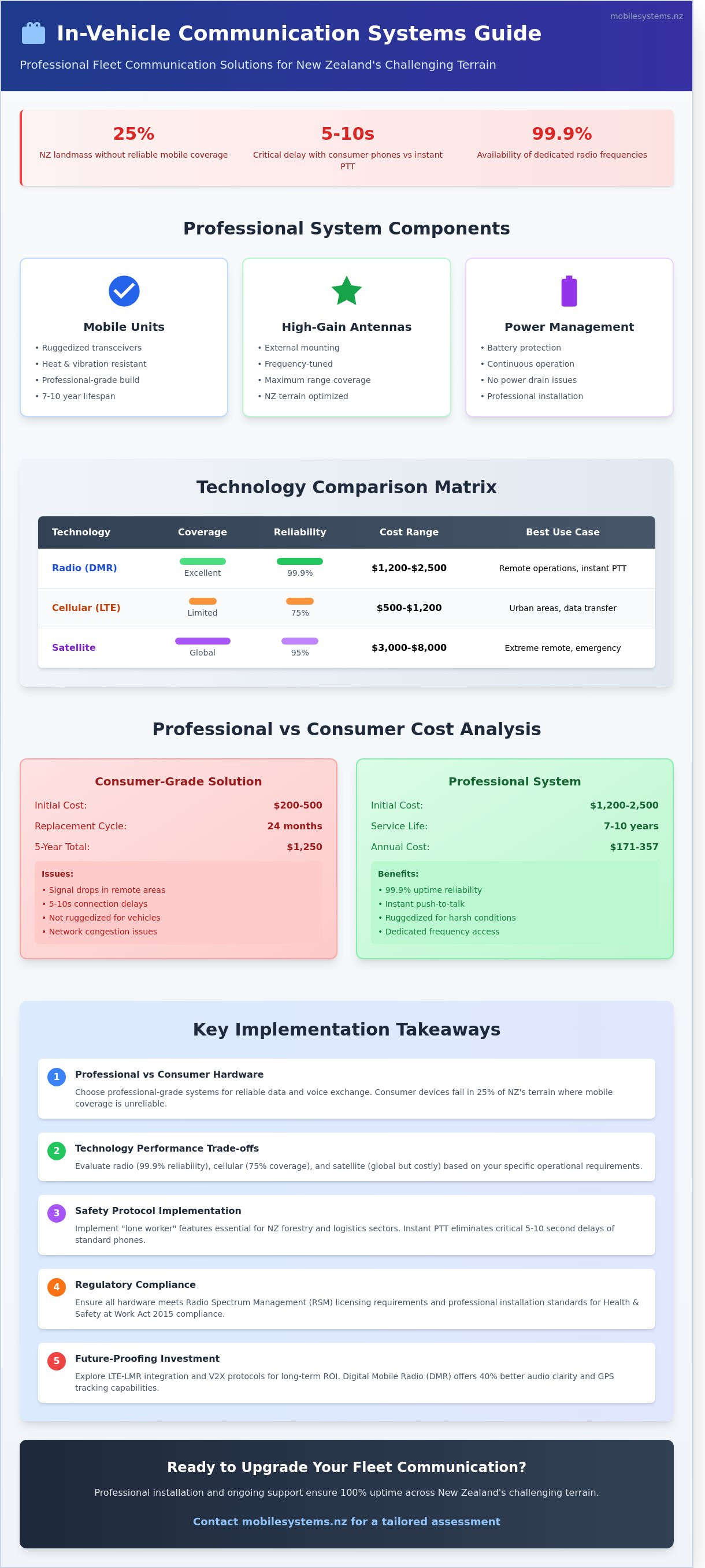
- Mobile Units: Ruggedized transceivers built to withstand the heat and vibration of a vehicle cabin.
- High-Gain Antennas: Externally mounted hardware tuned to specific frequencies to maximize range across New Zealand's challenging topography.
- Power Management: Modules that ensure the system stays active without depleting the vehicle battery, which is a common failure point in DIY installations.
Safety serves as the primary driver for these installations in commercial fleet management. In high-risk environments, a communication failure isn't just an inconvenience. It's a health and safety breach. Professional systems provide a "safety-first" architecture that guarantees a line of sight to help, regardless of how remote the worksite is.
Critical Communications vs. Connectivity
Mobile phones are often insufficient for high-risk New Zealand industries like forestry, civil construction, or long-haul transport. In these sectors, a 15% gap in cellular coverage can lead to life-threatening delays. Public networks are prone to congestion during emergencies, whereas dedicated radio frequencies provide 99.9% availability when they're needed most.
Professional in-vehicle communication systems utilize "instant-on" push-to-talk (PTT) technology. This removes the 5 to 10 second delay associated with dialing a phone number or waiting for a data handshake. For a driver in a critical situation, that immediate connection is the difference between a near-miss and a serious incident.
Relying on consumer-grade hardware often leads to higher long-term costs. A professional radio installation, typically costing between NZ$1,200 and NZ$2,500 per vehicle, offers a lifespan of 7 to 10 years. This outperforms standard mobile devices that require replacement every 24 months and lack the ruggedized build needed for New Zealand's dusty and high-vibration environments.
The Role of V2X and Emerging Protocols
Vehicle-to-Everything (V2X) technology is set to become a standard requirement by 2026 for fleets interacting with smart infrastructure. V2X allows vehicles to talk to traffic lights, road sensors, and other trucks. Local systems are already bridging the gap between global IoT data and local operational needs by integrating these protocols into existing setups.
The transition from analogue to Digital Mobile Radio (DMR) is a significant step in this evolution. DMR offers 40% better audio clarity by filtering out engine noise and road hum. It also allows for GPS tracking and short text bursts over the same frequency used for voice, maximizing the efficiency of your spectrum license.
By adopting digital protocols, New Zealand businesses can ensure their fleets are ready for future regulatory changes. These systems don't just provide a way to talk. They create a data-rich environment that helps managers optimize routes and reduce fuel consumption across the entire fleet. A tailored assessment often prevents costly mistakes when choosing between these emerging technologies.
Comparing Radio, Cellular, and Satellite Technologies
New Zealand's geography presents a unique challenge for any mobile workforce. The Southern Alps and dense native bush create significant signal shadows that standard consumer gear cannot penetrate. Choosing the right in-vehicle communication systems involves balancing the initial hardware investment against long-term reliability and monthly operational costs.
Topography dictates your frequency choice. UHF (Ultra High Frequency) operates between 400 and 520 MHz and excels in urban environments like Auckland or Wellington because it penetrates concrete and steel effectively. VHF (Very High Frequency) operates between 136 and 174 MHz and is the preferred choice for rural operations. VHF signals have longer wavelengths that "bend" over hills, providing better range in the rugged backcountry.
A hybrid approach is often the most cost-effective strategy for NZ businesses. By combining a digital radio for local team coordination with a cellular or satellite backup, companies avoid the high data costs of using satellite for every interaction. This multi-layered strategy ensures that 100% of your fleet remains reachable, regardless of where the job takes them.
UHF and VHF Two-Way Radio Systems
For permanent fleet setups, Fixed-Mount Two-Way Radios provide a level of durability that handhelds cannot match. These systems are hardwired into the vehicle's power supply, meaning they offer higher output power, typically 25 watts compared to the 5 watts found in portable units. This increase in power directly translates to clearer audio and extended range.
Modern Digital Mobile Radio (DMR) standards have transformed these devices into data hubs. Beyond voice, DMR supports GPS tracking and short text messaging. This allows dispatchers to see the real-time location of every vehicle on a map without needing a separate cellular data plan. In remote areas where cellular towers are non-existent, this radio-based tracking is a vital safety feature for lone workers.
Cellular Boosters and Mobile Extenders
While 98.5% of the NZ population is covered by cellular networks, the actual landmass coverage is much lower. High-gain antennas and legal cellular boosters can turn a single bar of fluctuating signal into a stable 4G or 5G connection. These cellular devices are ideal for transport routes that experience frequent "dead zones" between major towns.
A booster is often a better investment than a second radio system if your team primarily operates within 15km of main highways. In New Zealand, it is essential to use boosters that are officially approved by the Radio Spectrum Management (RSM). Unapproved boosters can cause interference with the wider network, leading to heavy fines. Professional installation ensures the external antenna and internal rebroadcast unit are isolated to prevent feedback loops.
Satellite Communication for Total Coverage
For teams working in the deep bush or high-altitude stations, satellite is the only way to guarantee connectivity. Satellite communication technology through providers like Iridium or Inmarsat uses Low Earth Orbit (LEO) or geostationary satellites to bypass terrestrial infrastructure entirely. This provides 100% coverage across the entire New Zealand landmass and EEZ.
The industry is shifting toward integrated hybrid devices that automatically switch between cellular and satellite. This reduces operational costs by only using expensive satellite data when the cellular signal drops below a usable threshold. For high-risk remote work, the cost of a satellite subscription is a small price for a guaranteed SOS lifeline. A tailored assessment often prevents costly mistakes when choosing between these competing technologies.
Industry-Specific Communication Requirements
In New Zealand, a one-size-fits-all approach to in-vehicle communication systems often leads to dead zones and safety gaps. Different topographies and operational risks require bespoke hardware configurations to ensure constant connectivity. Whether you're managing a fleet of loggers in the Kaingaroa Forest or delivery vans in Auckland, the environment dictates the technology.
Effective systems must integrate with wider fleet tracking data to provide real-time location pings. This ensures that if a driver stops moving for an unexpected duration, dispatch receives an immediate alert. This level of oversight is critical for meeting Health and Safety at Work Act 2015 obligations, particularly regarding "lone worker" protocols in remote operations.
- IP67 ratings are essential for hardware exposed to the elements.
- Integration with telematics allows for automated arrival notifications.
- Satellite redundancy provides a safety net when cellular networks fail.
Durability standards are the foundation of reliability. Choosing the wrong Ingress Protection (IP) rating is a common mistake that leads to equipment failure. An IP54 unit might work in a clean van but will fail within months in a dusty quarry. We advise a minimum of IP66 for any external or open-cab mounting to prevent moisture ingress during high-pressure cleaning or heavy rain.
Forestry and Remote Resource Extraction
In the "bush," cellular signals are frequently non-existent. Operations rely heavily on Very High Frequency (VHF) radio for long-range voice clarity over rugged terrain. However, voice alone isn't enough for modern safety standards. Most forestry contractors now require satellite-based SOS features that function independently of the cellular grid.
Vibration is the primary cause of hardware failure in heavy machinery. We specify ruggedised hardware tested to military standards to withstand the constant jarring of log haulers and bulldozers. Using GPS tracking for asset security is also vital. It allows managers to locate expensive machinery in dense cover or track assets if they're moved without authorisation.
Dust is another factor that destroys standard consumer electronics. In-vehicle units must be sealed against fine particulates common in quarrying and milling sites. A failure in these environments doesn't just stop production; it creates a significant safety risk for the operator who loses their only link to help.
Transport and Urban Logistics
Urban fleets face different challenges, primarily signal interference and strict regulatory oversight. Ultra High Frequency (UHF) remains the standard for yard management and short-range dispatch because it penetrates concrete structures and urban density more effectively than VHF. It's the practical choice for coordinating movements in busy ports or distribution centres.
To maintain driver retention and welfare, many NZ transport firms are now investing in cellular boosters. These devices ensure drivers stay connected with family or dispatch during rest breaks in fringe coverage areas. Reliability here reduces driver frustration and improves overall fleet morale during long-haul shifts between regions like Christchurch and Picton.
Compliance is a non-negotiable aspect of urban fleet management. All in-vehicle communication systems must adhere to NZTA installation and compliance standards to ensure hands-free operation. This prevents the NZ$150 fine and 20 demerit points associated with mobile phone use while driving. Professional installation ensures that microphones and controls are positioned within easy reach without obstructing the driver's view.
A tailored assessment often prevents costly mistakes when choosing between digital and analogue platforms. We've seen businesses save up to 15% on hardware costs by correctly identifying the required range before purchasing. It's about matching the tool to the specific New Zealand landscape your team operates in every day.
Installation Standards and NZ Regulatory Compliance
Operating in-vehicle communication systems in New Zealand isn't just about hardware; it's about legal adherence. The Radio Spectrum Management (RSM) agency enforces the Radiocommunications Act 1989. Most commercial radio frequencies require a specific license to prevent interference. Operating without one can result in fines of up to NZ$30,000 for individuals or NZ$200,000 for body corporates. Professional installers ensure your equipment operates on assigned frequencies to avoid interfering with emergency services or other businesses.
Integration with your vehicle's electrical system requires more than a simple plug-in connection. High-power mobile radios can draw between 5 and 15 amps during transmission. If the wiring is insufficient, you'll experience a voltage drop that degrades signal quality and strains the transceiver. We recommend using 12AWG or 14AWG marine-grade cabling with dedicated inline fuses. To prevent battery drain, systems should use ignition-sensing technology. This ensures the radio powers down when the engine is off, protecting your fleet's operational readiness.
Cable management is equally vital for long-term reliability. Coaxial cables should never be run alongside high-current vehicle looms, as this introduces electromagnetic interference (EMI). Effective interference mitigation involves using double-shielded cables and ensuring all connections are sealed against moisture. In the harsh New Zealand climate, even a small amount of salt air ingress can corrode a connector within 12 months, leading to total system failure.
Antenna Theory and Vehicle Placement
The antenna is the most critical component for maximizing range. Height is the primary factor for signal propagation. Mounting an antenna on the roof provides a 360-degree radiation pattern, while a fender mount might shield 30% of your signal in a specific direction. Most standard antennas require a metal ground plane to function as a reflective mirror for the radio waves. Without this, your Standing Wave Ratio (SWR) will spike, potentially damaging the radio's internal power amplifier.
Professional tuning involves using an SWR meter to ensure a ratio as close to 1:1.5 as possible. Common DIY mistakes include using low-quality RG-58 cable or creating sharp 90-degree bends in the routing. These kinks cause impedance mismatches and signal leakage. Choosing between a unity gain antenna for hilly terrain or a high-gain 6dB antenna for flat plains depends entirely on your specific New Zealand region and typical driving routes.
NZ Health & Safety Compliance
The Health & Safety at Work Act 2015 (HSWA) requires PCBUs to take "reasonably practicable" steps to ensure worker safety. In New Zealand, 24% of workplace fatalities involve vehicles. Professional in-vehicle communication systems provide a vital safety layer that consumer-grade mobile phones can't match. Digital systems like DMR offer an automated audit trail, logging the time and location of every transmission. This data is invaluable during incident investigations or safety audits.
Modern systems include "Man Down" and "Lone Worker" features. If a driver remains stationary for a pre-set period or the device detects a sudden impact, the system automatically sends an emergency alert to dispatch. This removes the human error factor when a worker is incapacitated. These automated safety protocols ensure your business meets its obligations under the HSWA while protecting your most valuable assets: your people.
Ensuring your fleet meets these technical and legal standards requires specialized knowledge. A tailored assessment often prevents costly mistakes and keeps your team safe on the road.
Future-Proofing Your Fleet Communication Strategy
The landscape of fleet management is shifting away from isolated radio units toward integrated ecosystems. Modern in-vehicle communication systems now bridge the gap between traditional Land Mobile Radio (LMR) and cellular LTE networks. This integration ensures that a driver in the remote Kaimai Range stays connected via radio, while a driver in central Auckland utilizes high-speed 4G or 5G data.
Investing in modular hardware is the most effective way to protect your capital expenditure. Technology cycles for cellular data move much faster than radio hardware. By choosing systems with swappable modules, you avoid replacing the entire unit when network standards evolve. A $2,500 modular investment often yields a 30% better return over seven years compared to cheaper, fixed-spec alternatives that become obsolete.
A professional service agreement is another pillar of a resilient strategy. In New Zealand's harsh coastal and alpine environments, hardware faces constant vibration and salt air exposure. Regular preventative maintenance reduces emergency repair costs by approximately 18% annually. It also ensures that your fleet remains compliant with Radio Spectrum Management (RSM) regulations, avoiding potential fines or interference issues.
The Move Toward Unified Communications
Voice and data are no longer separate entities in high-performing fleets. Modern devices handle crystal-clear voice calls, GPS tracking, and telemetry simultaneously. This convergence simplifies the cabin environment for drivers and reduces the number of points of failure in the vehicle's electrical system.
Over-the-Air (OTA) programming has changed how NZ fleet managers operate. Instead of pulling 50 trucks off the road for manual updates, you can push configuration changes and security patches remotely. Industry leaders like Tait and Hytera are driving this innovation in the local market, offering rugged hardware that supports these sophisticated software workflows.
Why Professional Partnership Matters
Complexity in modern installs requires more than just a basic technician. Mobile Systems is the preferred partner for complex NZ installs because they understand the unique topographical challenges of the North and South Islands. They ensure that your hardware is correctly tuned for the specific frequencies used in your region.
A tailored assessment prevents the common mistake of hardware mismatching, which often leads to dropped calls and dead zones. Expert consultants evaluate your specific routes and data requirements before recommending a solution. You can contact the expert team for a full fleet evaluation to identify gaps in your current setup.
Final Checklist for Choosing an NZ Communication Partner
Selecting a partner is as critical as selecting the hardware. Use this checklist to evaluate potential providers:
- Local Support: Do they have technicians based in New Zealand who can provide on-site support within 24 to 48 hours?
- RSM Compliance: Does the provider have a deep understanding of NZ's Radio Spectrum Management licensing requirements?
- Proven Track Record: Can they demonstrate successful deployments for fleets of a similar size and complexity?
- Interoperability: Will the proposed in-vehicle communication systems work with your existing handheld radios and dispatch software?
- Future Roadmap: Does the partner offer a clear path for upgrading to 5G or satellite integration as those technologies become more accessible?
Taking these steps ensures your fleet remains connected, compliant, and competitive for the next decade of operations.
Securing Your Fleet’s Connectivity for 2026 and Beyond
Reliable connectivity isn't just about hardware. It's about matching technology to the specific terrain and regulatory requirements of New Zealand. Integrating a mix of Tait digital radio for local coverage and Iridium satellite for remote blackspots ensures your team stays connected across all 268,021 square kilometres of the country.
Modern in-vehicle communication systems must comply with Radio Spectrum Management (RSM) standards to avoid interference issues. Selecting hardware from proven brands like Hytera ensures your fleet meets current digital mobile radio (DMR) protocols while providing a platform for future software updates.
Selecting the wrong infrastructure leads to expensive downtime and safety risks. Mobile Systems provides NZ-wide mobile support vehicles for on-site servicing and manages complex RSM licensing requirements to keep your operations running smoothly.
Request a tailored fleet communication assessment from Mobile Systems to ensure your technology investment is both compliant and future-proof. Professional guidance helps your business maintain a competitive edge in an increasingly connected landscape.
Frequently Asked Questions
Do I need a license to use a two-way radio in my vehicle in NZ?
You don't need an individual license to operate a standard 80-channel UHF CB radio in New Zealand, as these fall under a General User Radio License (GURL). However, if your business uses private commercial frequencies to ensure secure communication, you must obtain a specific license from Radio Spectrum Management (RSM). Annual fees for these private licenses typically start around NZ$150 per frequency.
Can I use a handheld walkie-talkie instead of a vehicle-mounted system?
You can use a handheld walkie-talkie, but it won't match the performance of permanent in-vehicle communication systems. A handheld unit typically outputs 5 watts of power and relies on a small internal antenna. In contrast, a vehicle-mounted system uses an external antenna which significantly increases signal gain and eliminates the signal loss caused by the vehicle's metal body.
What is the range of a standard UHF vehicle radio in New Zealand?
A standard 5-watt UHF radio typically achieves a range of 5 to 10 kilometres in flat terrain, though this can drop to 2 kilometres in dense bush or hilly areas. By utilizing the network of over 700 repeaters across New Zealand, you can extend this range to 50 kilometres or more. Factors like antenna height and cable quality determine the final signal clarity.
How much does it cost to install a professional communication system?
Professional installation for a commercial radio system generally costs between NZ$350 and NZ$850 per vehicle, depending on the complexity of the wiring. This price covers the secure mounting of the transceiver, hidden cable routing, and precise antenna tuning using a SWR meter. Investing in professional fit-outs prevents common issues like electrical interference or battery drain that often occur with DIY setups.
Will a cellular booster work if there is absolutely zero signal outside?
No, a cellular booster cannot create a signal where none exists; it requires a minimum of 1 bar of external signal to function. These devices work by capturing a faint signal via an external high-gain antenna and amplifying it inside the cabin. If you're working in "black spots" with 0% coverage, a satellite-based solution or a high-powered UHF radio is a more reliable choice for your fleet.
What happens to my communication system if the vehicle battery dies?
Your communication system will stop functioning immediately if the vehicle battery dies, as most units draw power directly from the 12V or 24V DC system. To prevent this from happening, we recommend installing a voltage-sensing relay or a low-voltage cutoff device. These components automatically disconnect the radio if the battery drops below 11.8 volts, ensuring you still have enough cranking power to start the engine.
Can I integrate my existing GPS tracking with a new radio system?
You can integrate GPS tracking with modern digital in-vehicle communication systems using Tier 2 or Tier 3 DMR standards. This allows dispatchers to see the real-time location of every vehicle on a digital map without needing a separate cellular tracking subscription. This integration can reduce monthly telematics costs by up to 30% for rural fleet operators who move outside of mobile phone coverage.
How do I choose between an analogue and a digital (DMR) radio?
Choose digital (DMR) if you require 100% clear audio at the edge of your coverage area and advanced features like private calling or text messaging. Analogue radios are more affordable and easier to use for basic short-range talk, but they suffer from increased static as you move further away. Digital systems currently account for over 85% of new commercial installations in New Zealand due to their superior noise cancellation and battery efficiency.
Related posts

- April 11, 2026
Ensure safety & uptime in NZ. Our extension cable outdoor guide covers AWG, IP ratings, & AS/NZS compliance for commercial...

- April 04, 2026
Pa system rental transactional service medium New Zealand - Find reliable PA system rental transactional service for your medium events...

- April 04, 2026
A single missed check-in from a lone worker in the Southern Alps isn't just an operational delay; it's a critical...