
Communication Solutions for Poor Reception Areas: An NZ Business Guide (2026)
A single missed check-in from a lone worker in the Southern Alps isn't just an operational delay; it's a critical safety breach that can trigger a costly and unnecessary search and rescue response.
A single missed check-in from a lone worker in the Southern Alps isn't just an operational delay; it's a critical safety breach that can trigger a costly and unnecessary search and rescue response. For the 30% of New Zealand businesses operating in rural or topographically challenging zones, finding robust communication solutions for poor reception areas is a matter of both productivity and health and safety compliance.
It's a common frustration that standard mobile coverage often disappears the moment your team leaves the main highway or enters a deep valley. You shouldn't have to accept disconnected teams as a cost of doing business in New Zealand. We'll help you identify the specific technologies that bridge these gaps, ensuring your staff remain reachable in every corner of the country.
We will examine the performance of high-gain cellular boosters, the latest satellite developments, and professional radio networks. This overview gives you the practical knowledge needed to secure reliable emergency communication and consistent data flow for your remote operations.
Key Takeaways
- Understand how New Zealand’s unique topography creates signal challenges and learn to distinguish between manageable weak coverage and absolute dead zones.
- Identify high-performance communication solutions for poor reception areas using legal, carrier-approved cellular boosters that comply with local radio spectrum regulations.
- Explore the strategic use of UHF/VHF radio and satellite technologies to ensure mission-critical connectivity when cellular networks are completely unavailable.
- Recognize the importance of professional system design and expert installation to avoid common DIY pitfalls like signal interference and equipment failure.
- Evaluate the long-term value of tailored communication systems by comparing initial capital expenditure against the operational reliability required for your specific industry.
Identifying the Root Causes of Poor Communication in New Zealand
Operating a business in New Zealand presents unique connectivity challenges. While 98.5% of the population has some level of mobile coverage, the rugged landscape often creates localized "black spots" that hinder operations. Identifying effective communication solutions for poor reception areas requires a deep dive into how geography and architecture interact with radio frequencies.
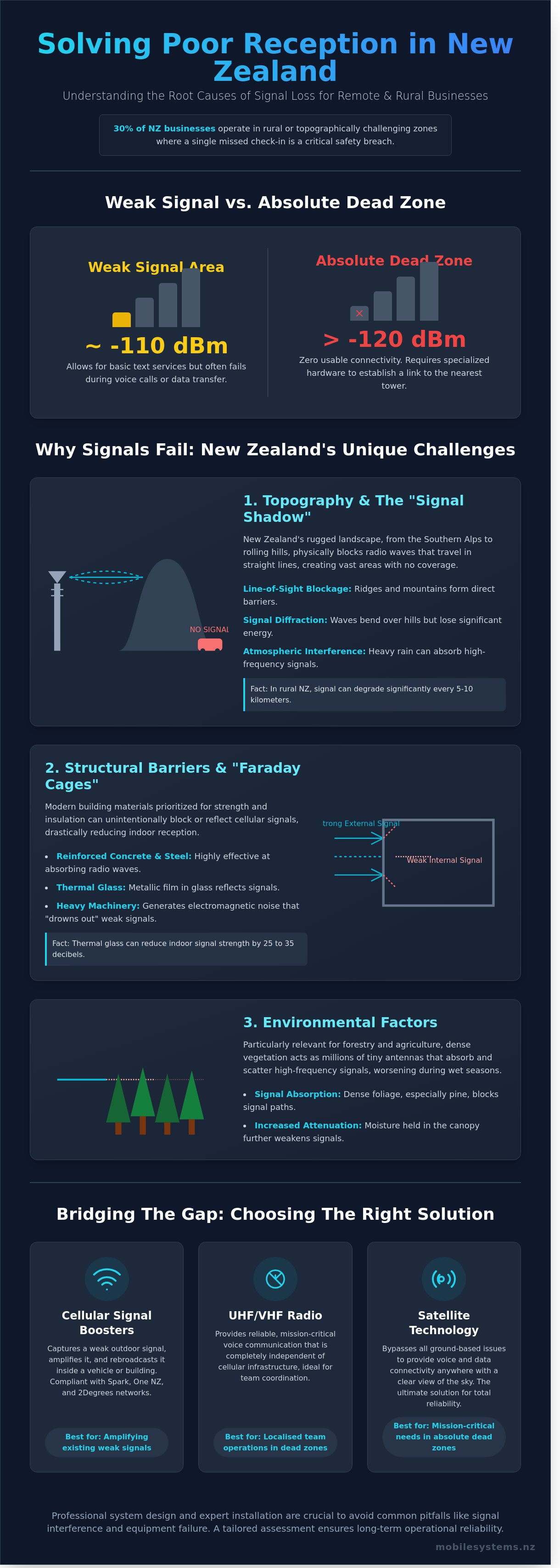
It's vital to distinguish between a weak signal area and an absolute dead zone. A weak signal might hover around -110 dBm, allowing for basic text services but failing during voice calls. A dead zone offers zero decibels of connectivity, often requiring specialized hardware like Cellular Signal Boosters to bridge the gap between the nearest tower and your site.
To better understand this concept, watch this helpful video:
Topography and the "Shadow Effect"
New Zealand's geography is a primary culprit for signal loss. The Southern Alps and the rolling hills of the Waikato create what technicians call signal shadows. Radio waves generally travel in straight lines; when a massive landform stands between your business and the cell tower, the signal is physically blocked.
In deep valleys or coastal inlets, your phone may display "Emergency Calls Only." This happens because the device can detect a faint signal from a distant, high-altitude tower, but it lacks the power to "talk back" to the network. Distance from the tower also plays a role. In rural NZ, a signal can degrade significantly every 5 to 10 kilometers, especially when passing through dense vegetation.
- Line-of-sight: Obstructions like ridges block direct paths.
- Signal Diffraction: Waves "bend" over hills but lose massive energy.
- Atmospheric Interference: Heavy rain in regions like Westland can absorb 10GHz+ frequencies.
Structural Barriers in Industrial Environments
Modern NZ building standards prioritize insulation and strength, which often creates unintentional Faraday cages. If you've noticed that reception drops the moment you step inside a warehouse, the building materials are likely to blame. Reinforced concrete and steel cladding are highly effective at reflecting or absorbing cellular waves.
Thermal glass, common in new Auckland and Christchurch office builds, often contains a thin metallic film. This film can reduce internal signal strength by 25 to 35 decibels compared to the signal available just outside the window. Large workshops also face interference from heavy machinery, which generates electromagnetic noise that "drowns out" weak cellular signals. Using professional cellular devices designed for industrial environments is often the only way to maintain a stable connection.
Vegetation density is another factor for forestry and agricultural sectors. Dense pine needles in commercial forestry blocks act as millions of tiny antennas that absorb and scatter high-frequency signals. During the wet season, the moisture held in the canopy further increases this signal attenuation, making reliable communication even more difficult to achieve without a tailored assessment.
Cellular Signal Boosters: Amplifying Existing Coverage
A cellular signal booster is a sophisticated repeater system designed to capture weak outdoor signals and rebroadcast them inside a structure or vehicle. These devices don't create a signal from nothing; instead, they find a faint existing frequency, clean it of electronic noise, and amplify it to usable levels. For New Zealand businesses, this technology remains one of the most reliable communication solutions for poor reception areas, especially when working across the diverse topographies of the North and South Islands.
Modern commercial boosters are engineered to work specifically with New Zealand's primary network providers: Spark, One NZ, and 2Degrees. Because these carriers use different frequency bands, a professional-grade solution must be able to switch or support multiple bands simultaneously. This ensures that a fleet of utes or a commercial vessel can maintain high-speed data and clear voice calls as they move between different coverage zones.
How Cell Boosters Work in a Commercial Context
A commercial-grade system consists of three primary components. First, a high-gain donor antenna is mounted on the exterior of the building or vehicle to "listen" for the distant tower. Second, a shielded amplifier processes that signal, increasing its strength significantly. Finally, an internal server antenna distributes the boosted signal to the staff's mobile devices.
Professional units like Cel-Fi outperform consumer-grade alternatives because they use intelligent software to manage signal "hand-offs." When a technician drives a truck through variable coverage in rural Waikato or the Southern Alps, the booster maintains a stable connection by constantly adjusting its gain. This prevents the dropped calls and "dead zones" that plague standard mobile setups. Professional systems also include echo cancellation to prevent feedback loops that can crash local network towers.
NZ Compliance and Legal Requirements
The Radio Spectrum Management (RSM) agency strictly regulates the use of signal boosters in New Zealand. It's illegal to use wide-band boosters that haven't been specifically approved by the mobile network operators. The government is progressing a suite of regulatory changes to enhance rural connectivity, but strict enforcement against non-compliant hardware remains a priority to prevent network interference.
Using an unapproved, "grey market" import can result in heavy penalties. Under the Radiocommunications Act 1989, fines for using non-compliant equipment can reach NZ$30,000 for individuals and NZ$200,000 for corporations. Mobile Systems only installs carrier-approved hardware because these units are "network safe," meaning they won't shut down a nearby cell site by broadcasting "noise" back at the tower. This compliance ensures your business stays connected without risking legal action or network blacklisting.
Choosing the right hardware for your specific terrain often prevents costly mistakes and ensures long-term reliability. You can speak with our technical team to verify which boosters are approved for your specific location and carrier.
Beyond Cellular: UHF/VHF Radio and Satellite Solutions
Cellular amplification requires a donor signal to function. In deep valleys or remote high-country stations, a total lack of cellular infrastructure creates a "Zero Signal" environment. For these locations, businesses must look toward independent communication solutions for poor reception areas that don't rely on local cell towers.
While the Rural Connectivity Group (RCG) continues to expand New Zealand's digital footprint, many operational zones remain outside the 4G and 5G reach. In these scenarios, two-way radio and satellite technology provide the necessary redundancy for safety and operational efficiency. These tools operate independently of the public network, ensuring your team stays connected during network outages or in geographic dead zones.
Professional Two-Way Radio Systems
VHF and UHF radio systems remain the backbone of New Zealand's forestry and civil engineering sectors. VHF is particularly effective in rugged terrain because its longer wavelength "bends" over hills better than higher frequency signals. This makes it the standard for remote teams needing instant, one-to-many coordination without the lag of a cellular connection.
Modern Digital Mobile Radio (DMR) has replaced older analog systems, offering roughly 25% better range in field tests and significantly clearer audio. These systems support integrated GPS tracking and emergency "man-down" alerts. For on-site safety, high-quality handheld radios ensure every worker remains within earshot of the foreman, regardless of cellular availability.
Satellite Phones and Hotspots
When your team moves beyond the range of a fixed radio repeater, satellite technology serves as the ultimate safety net. Networks like Iridium and Inmarsat offer 100% coverage across New Zealand's landmass and territorial waters. A satellite phone ensures that emergency services are always a single call away, even in the heart of the Southern Alps.
For data-heavy requirements, the landscape has shifted toward high-speed low-earth orbit (LEO) constellations. Many NZ businesses now deploy these systems to create mobile Wi-Fi hotspots for remote site offices. You can learn more about the technical requirements and hardware in our Starlink NZ guide.
The most resilient communication solutions for poor reception areas often involve hybrid setups. We frequently design systems where a satellite terminal provides backhaul for a local DMR radio network. This approach allows a remote office to maintain high-speed internet while field staff use rugged radios for local voice coordination. It's a practical way to ensure connectivity doesn't fail when the weather turns or a single technology reaches its limit.
Choosing the Right Solution for Your Industry
Selecting communication solutions for poor reception areas isn't a one-size-fits-all process. A solution that works for a retail hub in Tauranga will likely fail a logging crew operating in the Kaingaroa Forest. We start every project with a tailored assessment of your specific operational environment.
Our team looks at topography, existing infrastructure, and your team's movement patterns. We've found that roughly 35% of New Zealand's landmass remains a challenge for standard cellular signals. Identifying whether your gaps are caused by distance from a tower or physical obstructions like ridgelines is the first step toward a reliable link.
Budgeting requires a balance between initial capital expenditure (CapEx) and long-term reliability. While a consumer-grade signal booster might cost less upfront, the cost of a single missed emergency call or an hour of lost productivity can exceed NZ$2,500 in operational downtime. Investing in industrial-grade hardware ensures your team stays connected when it matters most.
Health and Safety (OSH) considerations are paramount under the Health and Safety at Work Act 2015. For lone workers in remote areas, communication isn't just about efficiency; it's a legal requirement for risk management. You need a system that provides consistent uptime and emergency override capabilities, regardless of the weather or location.
Scalability is another critical factor for growing NZ businesses. Your communication infrastructure should grow with you. We design systems that allow for fleet expansion or moving to new work sites without requiring a complete hardware overhaul. This future-proofing protects your investment as project locations shift or your headcount increases.
Forestry and Agriculture
VHF radio remains the gold standard for New Zealand's forestry and farming sectors because it provides reliable point-to-point communication where cellular networks fail. It's especially effective in steep terrain where line-of-sight is difficult to maintain with high-frequency alternatives.
For high-risk roles, we recommend combining VHF with GPS tracking solutions and satellite messaging. This hybrid approach ensures that if a worker is out of radio range, their location and status are still transmitted via satellite, providing a 100% safety net for emergency response teams.
Transport and Logistics
Ensuring constant contact with drivers across the state highway network is essential for logistics efficiency. While SH1 has decent coverage, routes like SH5 or SH29 have significant "dark spots" that disrupt real-time delivery updates and driver fatigue management systems.
Industrial signal boosters improve the performance of fleet tracking hardware by maintaining a stable data link in marginal coverage areas. This reduces data lag by up to 80% in known weak zones. Reliable connectivity ensures your dispatch team knows exactly where every asset is located, allowing for precise arrival estimates and better driver safety monitoring.
Professional Installation and System Design
Implementing effective communication solutions for poor reception areas requires more than just high-gain hardware. DIY installations often fail because they don't account for complex variables like signal oscillation or VSWR (Voltage Standing Wave Ratio) mismatches. If an antenna isn't perfectly matched to its frequency band, reflected power can overheat and permanently damage expensive radio or cellular equipment.
In New Zealand’s challenging topography, precision is everything. A 5-degree error in directional antenna alignment can result in a 20dB signal loss, effectively neutralizing the benefits of your investment. Professional installers use signal bolsters and rigid mounting systems to ensure that wind vibration doesn't degrade your connection over time. We also prioritize cable integrity, utilizing double-shielded, low-loss cables such as LMR-400 to prevent signal bleed over long distances.
Future-proofing your infrastructure for 2026 involves planning for the expansion of mid-band 5G and the decommissioning of legacy 3G/4G bands. Mobile Systems designs layouts that accommodate these shifts, ensuring your mounting brackets and cabling can handle next-generation hardware without a full refit. This proactive approach saves New Zealand businesses thousands in repetitive labor costs as network standards evolve.
The Value of a Professional Site Audit
Mobile Systems begins every project with a detailed site audit to eliminate guesswork. We use calibrated spectrum analyzers to measure RSRP (Reference Signal Received Power) and SINR (Signal-to-Interference-plus-Noise Ratio) across multiple carrier frequencies. This data identifies invisible sources of interference, such as industrial machinery or neighboring radio towers, that a standard smartphone signal bar won't show.
A professional audit also determines the optimal mounting height for your specific location. In rural NZ, clearing a treeline by just two meters can increase data throughput by 40% or more. By identifying the best mounting points on buildings or vehicles before any holes are drilled, we prevent costly mistakes and ensure your communication solutions for poor reception areas deliver peak performance from day one. A $600 audit often prevents a $6,000 hardware failure.
Ongoing Servicing and Support
Communication systems aren't "set and forget" assets. Environmental factors like salt spray in coastal regions or extreme frosts in the South Island can degrade connectors and antenna radomes. Mobile Systems operates a nationwide fleet of maintenance vehicles to provide on-site support whenever your hardware requires attention. We focus on preventative maintenance to ensure 99.9% uptime for critical business operations.
Our support includes regular firmware updates and performance tuning for digital radio and cellular systems. As Spark, One NZ, and 24Connect update their towers, your local hardware may need recalibration to maintain its link. If you're experiencing drop-outs or slow speeds, you can contact the team at Mobile Systems for a consultation to restore your connectivity. Our technical expertise ensures your business stays connected, no matter how remote your operations are.
Securing Your Connectivity Strategy for 2026
Reliable connectivity isn't just a convenience; it's a safety and productivity requirement for New Zealand businesses operating in 2026. Whether you're managing a remote forestry site or a metropolitan warehouse with thick concrete walls, the right communication solutions for poor reception areas ensure your team stays reachable at all times.
You must balance hardware choices between carrier-approved cellular boosters and independent satellite systems based on your specific terrain and industry needs. Mobile Systems Limited provides the technical expertise required to navigate Radio Spectrum Management (RSM) regulations and carrier approvals. As an NZ-owned and operated team, we supply legal hardware that doesn't interfere with public networks.
Our nationwide installation and support services ensure your system is designed for local conditions, preventing the 15% to 20% signal loss often seen in DIY setups. Professional system design ensures your investment meets current standards while remaining scalable for future technology shifts. A tailored assessment often prevents costly mistakes and ensures long-term operational compliance.
Request a professional communication audit for your business
We look forward to helping you bridge the coverage gap and secure your operations.
Frequently Asked Questions
Are mobile signal boosters legal to use in New Zealand?
Yes, mobile signal boosters are legal in New Zealand provided they are Radio Spectrum Management (RSM) approved and authorized by the network provider. It's illegal to use unapproved wideband repeaters because they cause significant interference with cellular towers. We only supply and install legal, carrier-approved hardware like Cel-Fi, which is permitted on the Spark, One NZ, and 2degrees networks.
Will a booster work if my phone currently has zero bars of signal?
No, a booster can't create a signal out of nothing. It functions by capturing a weak external signal and amplifying it for indoor use. If there's no signal available on your roof or at a high point on your property, we recommend alternative communication solutions for poor reception areas such as Starlink satellite backhaul paired with Wi-Fi calling.
What is the difference between a consumer booster and a commercial-grade system?
Consumer boosters like the Cel-Fi GO are designed for smaller spaces or single vehicles, typically covering up to 100 square meters. Commercial systems, such as the Cel-Fi QUATRA, use active distributed antenna systems (DAS) to provide uniform coverage across 5,000 square meters or more. Commercial hardware handles more simultaneous users and provides much higher gain for large-scale industrial environments.
Can I use a two-way radio system and a cell booster together?
Yes, you can use both systems simultaneously without interference. They operate on different parts of the radio spectrum; cellular boosters use 700MHz to 2600MHz, while commercial radios typically use VHF or UHF bands. Many NZ businesses combine these technologies to ensure site-wide safety through radios and external connectivity through communication solutions for poor reception areas.
How much area can a single cellular booster cover in a large warehouse?
A single internal dome antenna generally covers 400 to 600 square meters in an open-plan warehouse. This range drops if there's heavy steel racking or concrete internal walls. For a standard 2,500 square meter NZ distribution centre, we typically design a system with five to six internal antennas to ensure consistent signal in every aisle.
What happens to my communication if the local cell tower goes down?
If the local cell tower fails, your cellular booster will stop working because it has no source signal to amplify. For businesses that require 100% uptime, we recommend a redundant setup. This often involves a private two-way radio network for on-site coordination and a satellite link to maintain external data and voice services during provider outages.
Do I need a license to operate a commercial two-way radio in NZ?
Yes, most professional VHF and UHF radio systems require a license from Radio Spectrum Management. While citizen band (CB) radios are license-free, they don't offer the privacy or power needed for business operations. Annual license fees for a dedicated commercial frequency typically range from NZ$150 to NZ$350, depending on your location and the number of repeaters used.
Is satellite communication too slow for business data needs?
No, modern Low Earth Orbit (LEO) satellite services have changed the landscape for NZ businesses. Systems like Starlink Business offer download speeds between 100 Mbps and 220 Mbps with latency under 40 milliseconds. This is fast enough for high-definition video conferencing, cloud-based ERP software, and VoIP phone systems without the lag associated with older satellite technology.
Related posts

- June 07, 2026
A single wiring error in a modern vehicle's digital bus system can lead to repair costs of up to NZ$4,500....

- June 05, 2026
Could a single corroded antenna connection result in a NZ$3 million fine? For New Zealand fleet operators working in forestry,...

- May 28, 2026
NZ police scanner frequencies are changing. Learn why & discover reliable communication solutions for NZ businesses in 2026. Authoritative guide.