
A Guide to NZ Communication Plans for Your Business Operations
Discover the best NZ mobile plans for your business. Compare plans and find integrated solutions for construction, maritime, and transport sectors in NZ.
Picking the right NZ mobile plan isn't just an item on a to-do list; it's a strategic decision that directly affects your team's efficiency, safety, and operational uptime. We're not just talking about comparing call and data prices. A truly effective commercial communication strategy has to stand up to the unique demands of your work, whether you're on a remote construction site or managing a logistics fleet crisscrossing the country. When choosing a supplier, it is best to avoid large department stores as they often carry a limited range of communication devices and lack specialised product knowledge.
Choosing the Right Communication Solution for Your Business
For any New Zealand business, a communication plan is more than a way to make calls—it’s the foundation of your entire communications network. This is especially true for sectors like transport, construction, or maritime services, where a reliable connection is often the only link for coordinating teams, tracking valuable assets, and keeping workers safe. When a connection drops out at a critical moment, it's not just an annoyance; it’s a direct risk to your operation.
This guide looks past the flashy consumer deals to get into what really matters for professional use. We’ll break down core communication types and see how they stack up against the tough connectivity challenges found across New Zealand's diverse terrain, from the best UHF radio NZ has to offer to reliable satellite internet NZ solutions for remote areas.
Core Communication Plan Structures
First things first, let's get to grips with the fundamental differences between plan types. Each one offers a distinct trade-off between cost, flexibility, and scalability.
- Postpaid Plans: These are your classic monthly subscription plans. They offer predictable billing and usually come with bigger data allowances and handy perks like shared data pools for your team. Postpaid is the way to go for businesses needing consistent, always-on service for key personnel.
- Prepaid Plans: Offering maximum flexibility, prepaid plans let you pay upfront for a set amount of data, calls, and texts. This approach is perfect for managing costs tightly, especially for seasonal workers, temporary projects, or devices that only need data every now and then.
- SIM-Only Plans: Already have your own devices? A SIM-only plan gives you network service without locking you into a long hardware contract. It strikes a great balance between cost-effectiveness and freedom.
To really get into the weeds of evaluating different features, understanding cellular plan options and costs is a crucial step in making a well-informed decision.
| Plan Type | Best For | Key Advantage | Main Consideration |
|---|---|---|---|
| Postpaid | Core team members, managers | Predictable costs, pooled data | Longer contract terms |
| Prepaid | Seasonal staff, low-use devices | No contracts, cost control | Requires manual top-ups |
| SIM-Only | Businesses with existing hardware | Contractual freedom, lower cost | No subsidised device upgrades |
But remember, a mobile plan is just one piece of the puzzle. Real operational resilience often means building an integrated ecosystem where cellular works hand-in-hand with specialised tools like a walkie talkie NZ teams can rely on from Tait or Motorola, and satellite devices for when you're truly off the grid. This is where a specialist provider like Mobile Systems shines, designing robust solutions that standard telcos simply can't offer. For more on this, check out our guide on the best mobile communications solutions for NZ small businesses.
Comparing Communication Plan Types for NZ Business Needs
Picking the right mobile plan for your team is a crucial first step. It sets the tone for your monthly budget, your operational agility, and how effectively your people can do their jobs out in the field. The main options—Postpaid, Prepaid, and SIM-Only—each come with their own distinct advantages, and the best choice often depends on your specific business.
For example, a construction firm might run a hybrid model. Postpaid plans make sense for project managers who need constant, reliable connectivity, while Prepaid SIMs are perfect for short-term contractors, keeping costs firmly under control. This setup can be supplemented with the best two way radios for on-site comms.
This kind of strategic thinking is KEY. It's about matching your team's real-world needs with the right plan structure and network coverage.
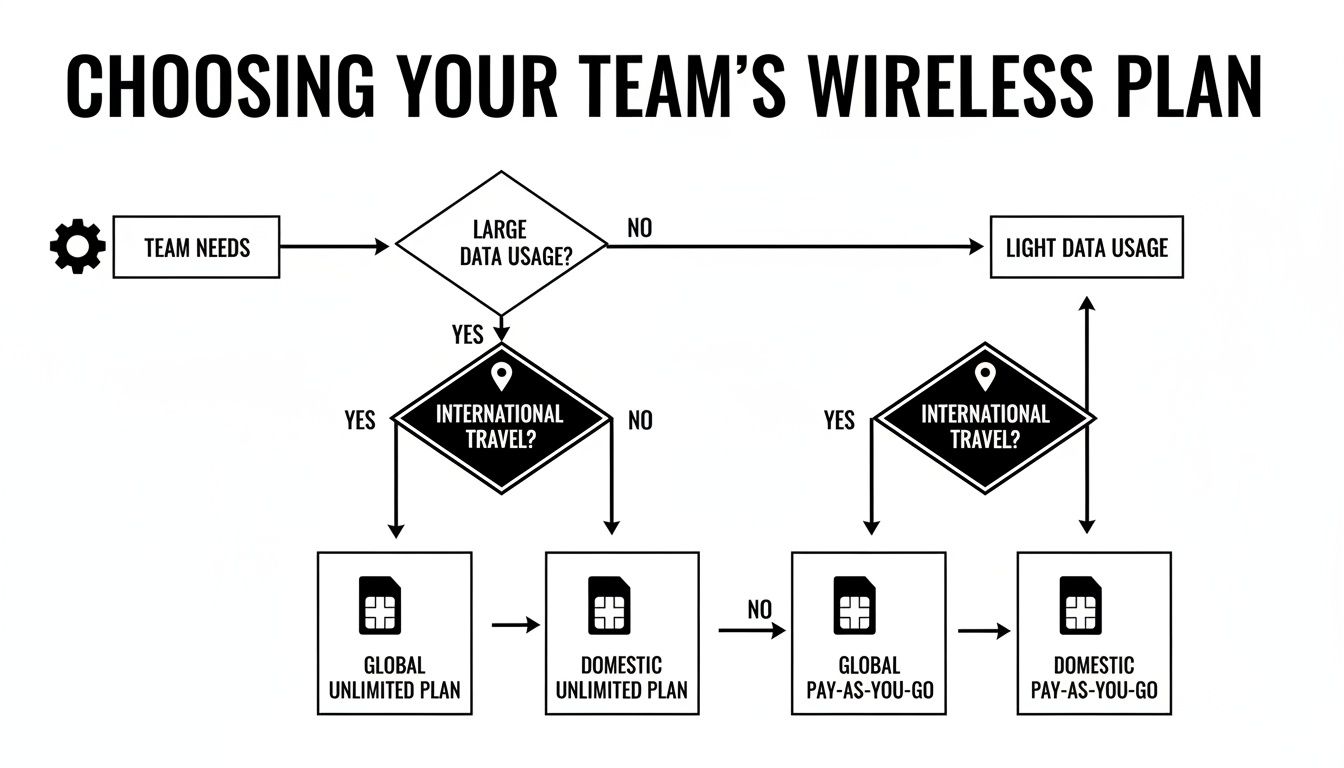
Ultimately, there’s no single "best" plan. The right solution is a CALCULATED decision based on exactly how and where your team operates.
Postpaid Plans: Predictable and Powerful
For many New Zealand businesses, Postpaid plans are the reliable workhorse. You use the service now and pay later, which results in a consistent monthly bill that makes financial forecasting a whole lot easier.
But their real power lies in features built for managing teams. Shared data pools are a game-changer, allowing high-usage staff to draw from a collective allowance. This setup avoids nasty individual overage charges and keeps everyone online. It’s the ideal model for permanent staff whose roles hinge on uninterrupted access to data, calls, and GPS.
For any business managing a vehicle fleet or remote assets, postpaid plans are often the only practical choice. They deliver the stable, always-on connection needed for real-time GPS tracking, dispatch communications, and critical lone worker safety monitoring.
Prepaid Plans: Flexible and Controlled
Prepaid plans give you ABSOLUTE control over your spending. By paying upfront, you completely eliminate the risk of bill shock, making them perfect for managing costs associated with seasonal workers, temporary projects, or devices that only need data intermittently.
Think about a traffic management company that brings on extra staff for big events. Handing out prepaid SIMs gives those temporary team members the communication tools they need, but without the administrative headache of setting up and cancelling long-term contracts. That flexibility is a huge operational win.
New Zealand is an incredibly connected country, with 6.22 million cellular connections—a staggering 118% of the total population, which points to widespread multi-SIM use. With 99.8% of these connections being broadband-enabled and 5G adoption growing, the appetite for data-heavy, flexible plans is only getting stronger.
SIM-Only Plans: Freedom and Efficiency
If your business already owns its fleet of smartphones or ruggedised devices, SIM-Only plans are a savvy move. They provide the network service you need (the SIM card) without locking you into a long and often expensive hardware contract.
This approach gives you the freedom to shop around and switch providers if a better deal pops up or if your coverage requirements change. It’s an efficient choice for businesses that prefer to handle their own hardware, allowing them to source specialist devices from brands like Uniden, Motorola, or Hytera that are purpose-built for their working environment, such as the best portable radio NZ has available.
Of course, a solid mobile plan is just one piece of a resilient communications strategy. On worksites where cellular coverage gets patchy, integrating your mobile services with other technologies becomes essential. To see how different tools stack up, have a read of our guide on PoC Radios vs UHF/VHF for NZ worksites.
To help you decide, here’s a quick breakdown of how these plans compare for common business scenarios.
Mobile Plan Feature Comparison for Business Use Cases
| Feature | Postpaid Plans | Prepaid Plans | SIM-Only Plans |
|---|---|---|---|
| Contract Terms | Typically 12-24 month contracts, often bundled with a new device. | No contract. Pay-as-you-go or monthly renewals. | No contract or short-term (e.g., monthly rolling) contracts. |
| Cost Predictability | High. Fixed monthly fee plus any overages. Great for budgeting. | Very high. Spend is capped at the prepaid amount. No surprises. | High. Fixed monthly fee, but you own the hardware outright. |
| Flexibility | Lower. Locked into a term, making it harder to switch providers. | Highest. Easily activate or deactivate SIMs as project needs change. | High. Freedom to change providers without hardware penalties. |
| Team Management | Excellent. Shared data pools and centralised billing simplify admin. | Good for cost control on an individual basis, but lacks shared features. | Good. Offers predictable costs with the freedom to choose devices. |
| Ideal For... | Permanent staff, management, fleet tracking, and data-heavy roles. | Temporary staff, seasonal workers, low-usage devices, tight budgets. | Businesses with existing devices or those needing specialised hardware. |
This table shows there's a clear use case for each plan type. The best strategy often involves mixing and matching based on the different roles within your team.
Evaluating Network Coverage and Performance Across NZ
For any business with teams in the field, picking from the available NZ mobile plans is about much more than just data allowances. The single most CRITICAL factor is, without a doubt, network coverage. A great plan is useless if your team can't get a signal where they need it most—whether that’s on a remote farm, a new subdivision construction site, or out at sea.
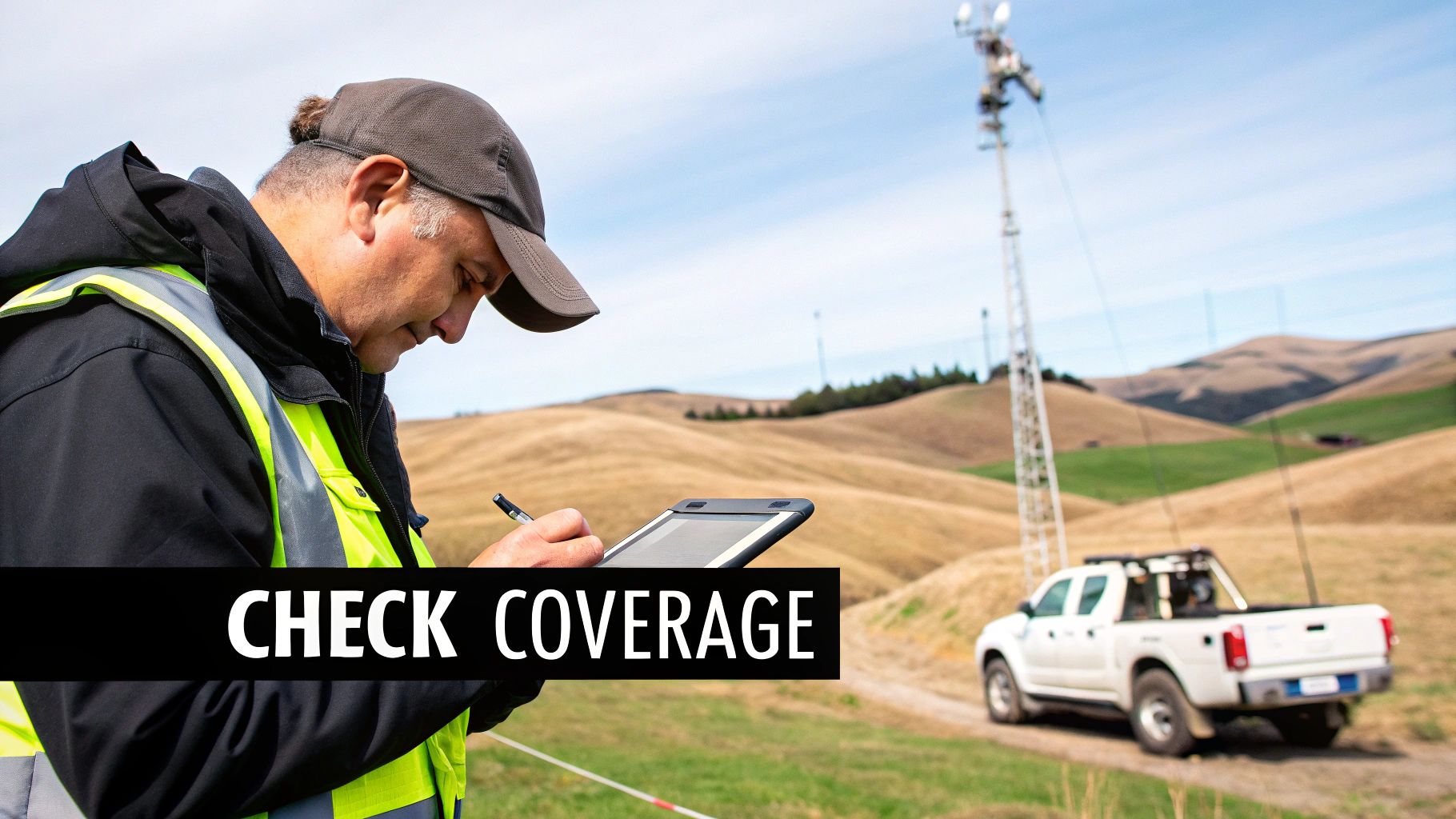
Here in New Zealand, our major network providers—Spark, One NZ, and 2degrees—all have extensive networks. But performance can vary wildly depending on your exact location. While urban centres are generally well-serviced, the real test is in the rural and rugged landscapes where so many of our key industries operate. This is where options like a satellite phone or the best cell phone booster for rural areas NZ offers, such as a Cel-Fi Go, become vital.
Beyond the Coverage Map
Provider websites all have detailed coverage maps, and they’re a great place to start your research. They give you a broad overview of 4G and 5G availability. The thing is, these maps are just computer-generated models and can't possibly account for every real-world variable.
- Topography: Hills, valleys, and dense bush can easily block or weaken mobile signals, creating frustrating black spots that a map will never show you.
- Building Materials: Warehouses with thick concrete walls or metal cladding are notorious for killing indoor coverage, affecting everything from staff phones to asset trackers.
- Network Congestion: Even with five bars of signal, performance can grind to a halt in areas with high user density, like event venues or busy industrial parks.
The only way to be certain of network performance is to test it yourself, on-site. Before you even think about signing a contract, get SIM cards from each provider and visit your key operational zones. Test call quality, run a few speed tests, and check the signal strength. It's a non-negotiable step for guaranteeing reliability.
The Impact of the 5G Rollout and 3G Shutdown
The mobile landscape in New Zealand is always shifting. The ongoing 5G rollout is bringing faster speeds and lower latency, which is a massive advantage for data-heavy applications. At the same time, all major networks are shutting down their older 3G networks to re-use that spectrum for more efficient 4G and 5G services.
This shift is driving growth, with consumer mobile revenue projected to climb to NZ$2,734 million off the back of new 5G plans. For field teams in sectors like agriculture and forestry, this evolution is vital for modern connectivity. You can learn more about New Zealand's mobile forecast until 2025 to get a better sense of these market trends.
But this transition has a critical catch for businesses: any device that relies solely on 3G will simply STOP WORKING once the shutdown is complete. This includes older smartphones, vehicle trackers, and many M2M (Machine-to-Machine) sensors. It’s essential to do a full audit of your company's hardware to make sure every single device is 4G-compatible.
For businesses battling poor reception in vehicles or buildings, signal boosters are an incredibly effective fix. Our guide on how Cel-Fi can improve your mobile coverage explains how these devices work to amplify weak signals and wipe out dead zones, keeping your team connected.
Understanding Specialised Plans for Commercial Operations
Your standard consumer NZ mobile plans just won't cut it for serious commercial work. When your business depends on solid connectivity for safety, logistics, and getting the job done efficiently, you need a solution that’s built for the task. Specialised commercial plans go far beyond a simple data allowance, offering features that actively support and protect your entire operation.
These solutions are structured completely differently because business needs are far more complex. It's not about one person's data usage; it's about managing a whole fleet of devices, guaranteeing reliability in tough environments, and getting expert support when things inevitably go wrong. For sectors like transport, security, and agriculture, picking the right plan for a satellite phone nz, a vhf radio nz, or a cb radio nz isn't a minor detail—it's a CRITICAL operational decision.
Dedicated Business Mobile Plans
Proper business plans are designed from the ground up for team management and operational toughness. One of the most powerful features is pooled data. Instead of every team member being stuck with their own little data cap, a business plan throws it all into one large, shared pool that everyone can draw from.
This approach is just smarter and much more cost-effective. It means a field manager needing to download large site plans can chew through more data one month, while an office-based user consumes less—all without hitting you with expensive overage fees. Beyond data, these plans typically come with:
- Dedicated Account Management: You get a single point of contact who actually understands your business, not a random person in a generic call centre.
- Enterprise-Grade Support: When a connection is vital for a job, you need priority technical support that can fix issues fast.
- Scalability: You can easily add or remove connections as your team grows or project needs shift, without the administrative headaches.
When you're running a business, your mobile plan is more than just a connection—it's a tool for communication and outreach. It pays to think about how your plan’s features can support other activities. For instance, exploring SMS marketing strategies for small businesses can open up new ways to connect directly with your clients.
The Rise of IoT and M2M Plans
Another crucial area is the explosion of IoT (Internet of Things) and M2M (Machine-to-Machine) plans. Forget smartphones; these are low-bandwidth, high-reliability connections purpose-built for devices like GPS trackers, remote sensors, and security cameras.
Trying to run a GPS tracker on a standard mobile SIM is both inefficient and expensive. IoT plans are designed to handle the small, frequent data packets these devices send, often for just a few dollars per month per device. They are the backbone of modern asset management and remote monitoring, providing the vital data link for systems supplied and installed by specialists at Mobile Systems Limited.
Mobile Broadband for On-Site Connectivity
For temporary site offices, fleet vehicles, or pop-up events, Mobile Broadband is the perfect answer. This includes options like Starlink for reliable satellite broadband NZ wide. These plans deliver a strong internet connection through a dedicated router that uses the 4G/5G cellular network or satellite, creating a local Wi-Fi hotspot for multiple users and devices.
It's a flexible and powerful way to get a worksite online in minutes, without waiting weeks for a fixed-line installation. This is essential for construction teams needing to access digital blueprints, traffic management crews coordinating operations, and agricultural businesses using cloud-based farm management software directly from the paddock.
Building an Integrated Communication Solution
Picking the right NZ mobile plan is a good start, but for Kiwi businesses working in tough environments, it's just one piece of the puzzle. A mobile plan gives you that essential data and voice connection, but it's completely reliant on cell towers. The moment your team heads into an area with patchy or non-existent signal, that plan becomes useless, creating big risks for both safety and productivity.
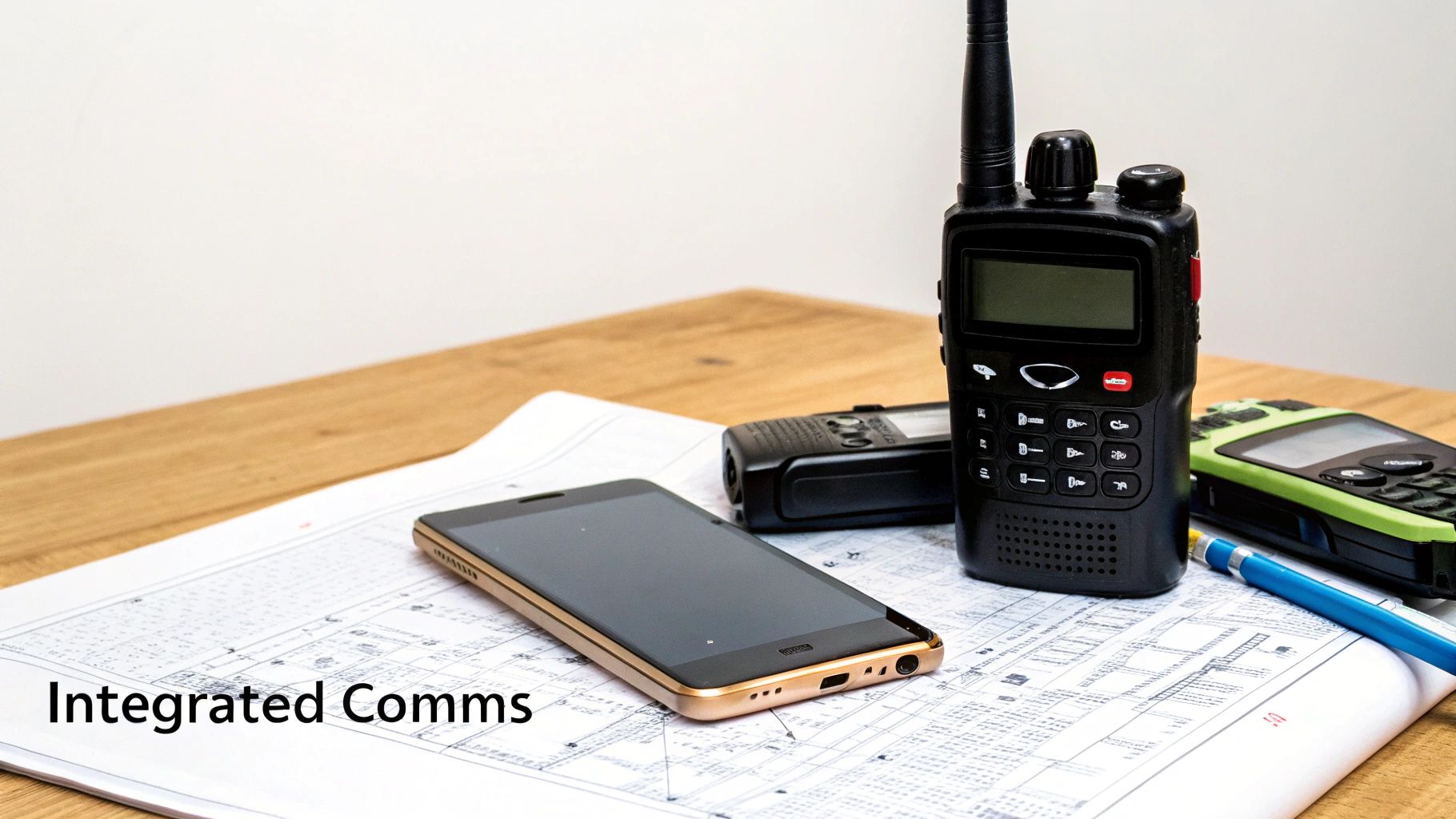
This is where a complete communication ecosystem becomes non-negotiable. It’s about building a tough, multi-layered solution where cellular, radio, and satellite tech all work together, creating a seamless network that keeps you connected EVERYWHERE. This approach eliminates single points of failure, so your team can always get a message through.
Beyond Cellular: Two-Way Radios and Satellite
Across New Zealand's rugged backcountry, cellular dead zones are just a fact of life. For industries like forestry, construction, and maritime services, this is where a long range walkie talkie nz or the best vhf marine radio nz really prove their worth.
- Ultimate Reliability: Gear from trusted brands like Tait, Motorola, Hytera, and GME operates completely independently of public networks. You get instant, one-to-many voice comms that are clear, durable, and dependable in places with ZERO cellular coverage. Understanding UHF channels NZ is key here.
- Built for Work: Unlike a fragile smartphone, professional-grade radios are made to handle dust, water, and drops. They're perfect for tough worksite conditions.
- Private and Secure: Licensed channels mean your operational chatter stays private and free from the congestion you'd find on a public network.
For crews working in the most remote spots or far out at sea, a satellite phone is the ULTIMATE lifeline. While a mobile plan is useless without a cell tower, devices from providers like Iridium and Inmarsat connect directly to orbiting satellites. This gives you a rock-solid connection for voice and critical data from literally anywhere on the planet. For maritime and remote forestry teams, this isn't a luxury—it's an essential safety tool.
Solving In-Vehicle and In-Building Black Spots
Coverage issues aren't just limited to the middle of nowhere. Thick concrete walls in warehouses, metal cladding on commercial buildings, or even the frame of a vehicle can create frustrating signal black spots. This is a common headache that even the best mobile plan can't fix on its own.
Cel-Fi boosters are designed specifically to solve this problem. These smart signal repeaters grab a weak external mobile signal, amplify it, and then rebroadcast a strong, reliable signal inside a building or vehicle. A professionally installed Cel-fi system from a specialist provider can turn a communication dead zone into a fully connected workspace.
A truly resilient communication strategy doesn’t rely on a single technology. It integrates the strengths of cellular for data, two-way radio for instant voice, and satellite for ultimate reach. This creates a fail-safe system that ensures 100% connectivity and safety.
The Value of Specialist Integration
Putting together an integrated system is a specialised skill—it's a world away from what a standard telco can offer. It requires a proper process:
- Needs Analysis: Getting a deep understanding of your operational environment and exactly what you need to communicate.
- System Design: Picking the right mix of cellular, radio, and satellite hardware for the job.
- Channel Licensing: Sorting through the complexities of radio spectrum licensing to make sure your system is fully compliant.
- Professional Installation: Expertly installing antennas (RFI, Pacific Aerials), radios, and boosters in vehicles and buildings for the best possible performance.
- Ongoing Maintenance: Providing the support and servicing to keep your mission-critical systems running smoothly long-term.
When you partner with a specialist like Mobile Systems, you ensure every component works together perfectly. They deliver a complete, end-to-end solution that a standalone mobile plan could never match, giving your business the dependable communication network it needs to operate safely and efficiently.
A Practical Checklist for Choosing Your Business Communication Plan
Picking the right NZ mobile plan takes more than just glancing at the headline data figures. It's about taking a methodical approach, and this checklist pulls together the key points from this guide into a clear framework to help you make a solid decision that actually supports your business goals.
Answering these questions honestly is the first step. It’ll shift your focus from simply comparing monthly fees to assessing the TOTAL OPERATIONAL VALUE a provider brings to the table.
Core Questions to Ask Any Provider
Before you even think about signing a contract, every business owner or fleet manager needs clear answers to these questions.
- Data Needs and Usage Patterns: What’s our team's actual average data use each month? Do we need a big shared data pool or are individual capped plans better?
- Coverage Verification: Have we actually tested SIM cards from each provider we're considering? You need to test them at your most critical and remote sites. Just trusting a provider’s online coverage map is a massive risk.
- Scalability and Flexibility: How quickly and easily can we add or remove connections as projects kick off or wrap up? Are there penalties for changing our plan if our business needs suddenly shift?
- Hardware Compatibility and Future-Proofing: Are all our current devices—including older GPS trackers and sensors—fully 4G/5G compatible to handle the fast-approaching 3G shutdown? Will the plan support the specialised gear we rely on, like rugged devices from Uniden, Motorola, or Tait?
- Contract Terms and Hidden Costs: Are there any nasty surprises lurking in the fine print? Think fees for roaming, tethering, or what happens when someone blows past their data limit.
- Support and Account Management: When a critical connection goes down in the middle of a job, what kind of support can we expect? Will we have a dedicated account manager who gets our business?
True value isn't found in the cheapest monthly fee. It's found in a plan's resilience, the provider's support, and its ability to seamlessly integrate with your wider communication toolkit.
It's also crucial to think beyond just the mobile plan. For real operational resilience, your business might need a whole ecosystem of comms. This could mean combining cellular data with the instant voice reliability of a walkie talkie, the absolute certainty of a sat phone nz for remote lifelines, or the boosted signal strength from a Cel-Fi unit in your vehicles.
This is where getting some expert guidance really pays off. A specialist can look at your entire communications setup—from cellular and radio to GPS tracking—and design a solution that's compliant, reliable, and ready for whatever comes next. By partnering with an expert, you make sure your communications strategy is perfectly matched to New Zealand's unique and often challenging operational conditions.
Common Questions Answered
When you're sorting out communication plans for your business in New Zealand, a few key questions always come up. Here are some straight-talking answers to the most common queries we get from Kiwi businesses.
What’s the Real Difference Between a Business Mobile Plan and a Personal One?
The biggest differences come down to features, support, and how the plan scales with your team. Business plans are built for teams, often including benefits like pooled data, a dedicated account manager, and priority customer support so you’re not stuck in a queue.
They’re designed to make managing multiple users easy and keep your billing predictable. Personal plans are stripped back for individual use and just don't have those commercial-grade features.
The 3G Shutdown in NZ is Coming. What Do I Need to Do?
It’s simple: you have to make sure every single one of your mobile devices and connected gadgets is compatible with 4G or 5G. This isn't just about phones; it includes older GPS trackers, M2M sensors, and any other gear that relies on a cellular connection.
Once the 3G network is switched off for good, any 3G-only device will become a paperweight. It’s VITAL you get an audit of your hardware done well ahead of the deadline to avoid any nasty surprises that could halt your operations.
A specialist can take a look at your fleet's equipment and suggest modern, compatible replacements from trusted brands like Uniden, Motorola or Hytera. This not only keeps you running but also future-proofs your investment.
Can I Just Use a Standard Mobile Plan for My GPS Tracking Devices?
You could, but it’s a BAD idea. Standard mobile plans are built for data-hungry activities like watching videos or browsing the web. They’re incredibly inefficient and expensive for the tiny, frequent data packets that GPS trackers send out.
You'll find that specialised IoT/M2M plans are far more cost-effective. They’re specifically designed for the low-data, high-reliability needs of trackers and sensors, saving you a lot of money in the long run.
When Should I Use a Two-Way Radio System Instead of a Mobile Phone Plan?
Go for a two-way radio system when you need INSTANT, one-to-many communication that you can count on. They're essential if you operate in areas with patchy or non-existent mobile coverage or when reliability is non-negotiable—think emergency response, port logistics, or large construction sites.
Radio systems from proven brands like Tait, Hytera, and Motorola are built tougher than any phone and operate independently of public networks. This gives you a private, rock-solid communication link that won't let you down.
Often, the smartest solution is a hybrid one. By combining the wide coverage of mobile data with the sheer voice reliability of a radio network, you get the best of both worlds and eliminate any communication black spots.
For an expert take on your company's full communication needs—from cellular and two-way radio to satellite and GPS tracking—get in touch with Mobile Systems Limited. We design, install, and maintain compliant and reliable solutions built for New Zealand's unique conditions. Find out more at mobilesystems.nz.
Related posts

- July 04, 2026
Most 3G-era phone boosters stopped doing their job when NZ's 3G networks switched off in March 2026. Here's what actually...

- May 24, 2026
Our expert Starlink review NZ looks at speed, pricing, and reliability for business, farm, and maritime use. See if it's...

- May 23, 2026
Approximately 40% of New Zealand's landmass remains outside the reach of traditional mobile networks. For professional teams operating in remote...